


Does every cavity need a new filling? Often not, and that single distinction between decay that has to be removed and an old restoration that's wearing out shapes everything that follows: which material goes in, how many visits it takes, what you'll pay and whether you're looking at a repair or a replacement. Plenty of people arrive at the chair having already decided on a tooth-coloured filling because that's what a search results page implied. The decision that matters comes first, and it's clinical rather than cosmetic.
Get the diagnosis right and the rest falls into a predictable order. Get it wrong and you pay twice, once for a filling you didn't need and again when the tooth is smaller than it had to be.
Filling Types and How Long Each Lasts
Three materials cover nearly every direct restoration a general practice places, and each one wins in a different situation.
| Material | Best for | Longevity evidence | Appearance | Main trade-off |
|---|---|---|---|---|
| Composite resin | Small to mid-size cavities in front and back teeth | 7-year survival 67.4%; median about 11 years in adult posterior teeth | Tooth-coloured | Higher risk of secondary decay and fracture over time |
| Amalgam (silver) | Large back-tooth cavities where strength and cost matter | 7-year survival 94.5%; median over 16 years in adult posterior teeth | Silver-grey | Visible colour; a sound filling isn't replaced for looks alone |
| Porcelain (ceramic) | Inlays, onlays and large restorations needing strength and a natural look | No survival figure from the composite and amalgam trials cited here, since it's lab-made and often placed across more than one visit | Tooth-coloured and stain resistant | Usually lab-made and often needs more than one visit |
The survival figures in that table come from the ADA's amalgam evidence summary and a systematic review of restoration survival, and both sets of authors are careful to say the numbers shift with clinical circumstances and study design.
Start with the composite row, because composite is what people usually mean when they search Filling Near Me. It bonds to enamel, it takes a shade match, and it lets a dentist preserve more healthy structure than an amalgam preparation of the same size. It's the right answer for a small or mid-size cavity in a front tooth and a reasonable one in a back tooth. It isn't automatically the strongest option for a large molar.
Matching the material to the cavity, not the photo
The American Dental Association's review of direct restorative materials sets out what should decide the choice: cavity size, moisture control, caries risk, occlusal loading and remaining tooth structure. Appearance isn't on that list. The same review cites a 2020 systematic review putting the annual failure rate of large posterior composite restorations at about 2.19%, a 10-year composite success rate of roughly 90% in one study, and a randomized trial of 1,748 restorations that found a 3.5-fold higher risk of secondary caries with composite than with amalgam. Secondary caries and fracture are the two ways composite restorations most often fail.
Three cases show how the criteria sort themselves out.
- A chipped edge on a front tooth: composite, always. Access is simple, moisture control is easy and the shade match carries real value.
- A large cavity in a second molar: here the calculus changes. A big bonded composite asked to survive years of heavy chewing is a harder bet than amalgam or a porcelain onlay that covers and protects the cusps.
- Active decay or night-time grinding: material matters less than the review schedule. Six-month checks, fluoride and a night guard do more for survival than the choice between two resins.
None of this is an expiry date on your tooth. A small, well-sealed filling in a low-risk mouth outlasts the median comfortably, while a wide restoration under grinding load can fail years earlier. The drivers are consistent: material, tooth location, cavity size, bite forces, hygiene, diet and whether decay returns at the margin.
Protecting the filling you've got
- Fluoride toothpaste twice daily, and don't rinse immediately after brushing.
- Clean between the teeth once a day, since margins near the contact point are where recurrent decay starts.
- Fewer sugary snacks, because frequency of sugar exposure matters more than total quantity.
- A night guard if you wake with a tight jaw or flattened wear facets.
- Routine examinations with radiographs when indicated, so leakage is caught while it's still a repair.
Porcelain inlays and onlays are lab-made and typically need a second visit. They earn their keep when a cavity is too large for a direct filling but not large enough to justify a crown. I won't quote a longevity figure for ceramic because the trials summarised above compare composite with amalgam, not porcelain. Our Midtown practice places both porcelain and composite fillings, and the recommendation is made after the exam rather than before it. Patients who want to understand the long-lived options also ask about dental gold fillings, which have a durability story worth knowing even if you never choose one.
Whoever places your next restoration benefits from knowing exactly what's already in the tooth, which is the practical case for dental documentation with PatientNotes: material, surfaces, shade and date recorded once, readable years later by a dentist who wasn't there.
The shortlist rule: leave the consultation with two materials that suit that tooth and the price of each. Then ask whether the cavity is large enough to need cusp protection.
Telling a New Filling Apart From a Replacement
A filling often gets replaced for the wrong reasons: it's old, dark at the margin, or the wrong colour. Age isn't a diagnosis. The FDA's guidance on dental amalgam fillings doesn't recommend removing an intact amalgam restoration unless it's medically necessary, and it asks certain groups to discuss non-amalgam options with their dentist instead: young children, people with kidney dysfunction or neurological impairment, people with relevant sensitivities, and pregnant or nursing patients.
Every replacement removes enamel and dentin that never grows back, and drilling out amalgam briefly raises mercury vapour exposure. That trade only makes sense when the filling is genuinely failing.
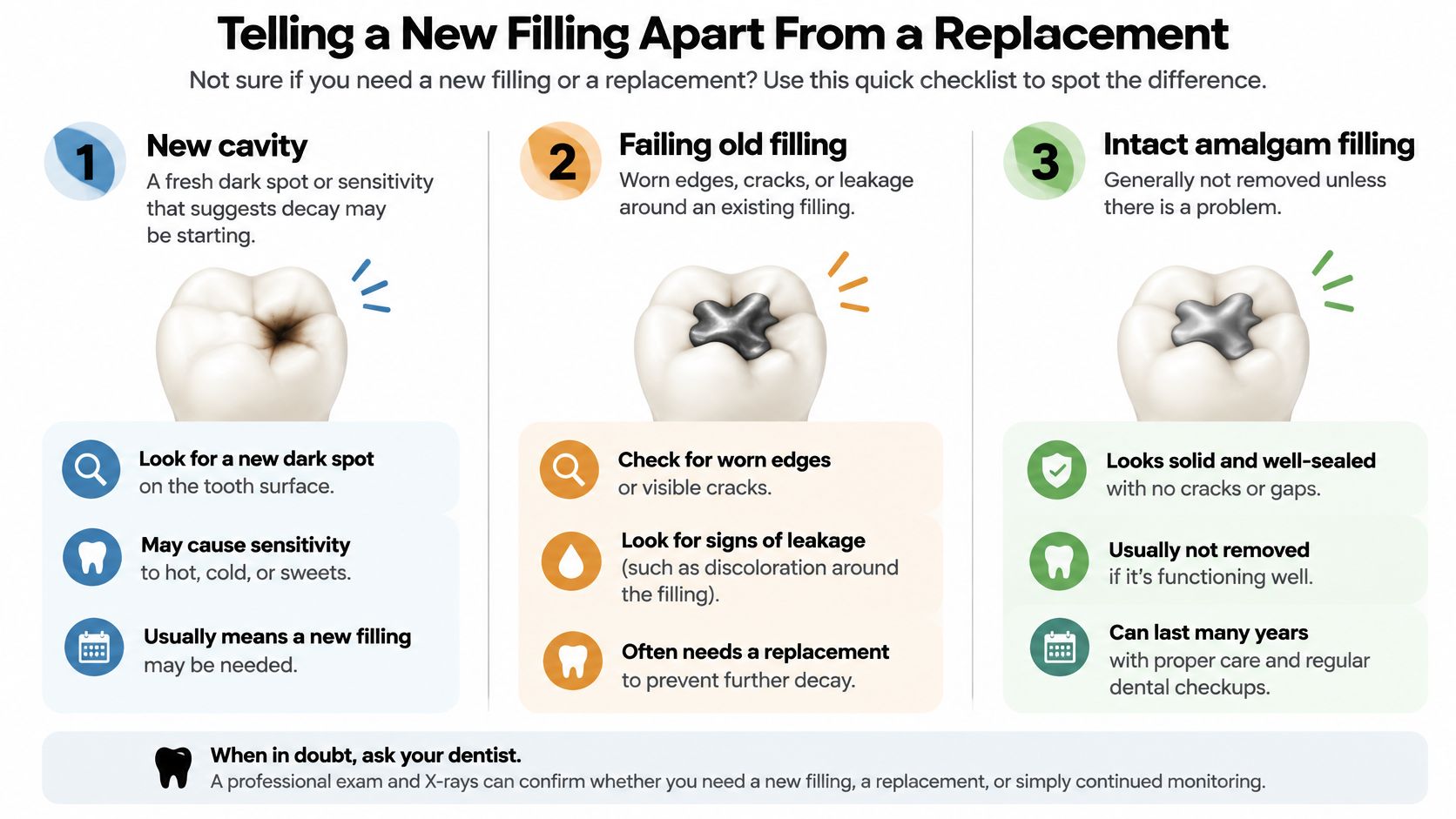
These are the signs that justify a visit rather than a wait.
- Lingering sensitivity to cold or sweets, especially if it lasts more than a few seconds after the stimulus is gone.
- A visible gap or dark line at the margin, which suggests the seal has broken and bacteria have a route underneath.
- A chip or a rough edge you can feel with your tongue.
- Pain on biting, or a filling that feels proud of the bite.
- Food trapping at one spot, which usually means an open contact or a broken marginal ridge.
A broken filling and a recurrent cavity are different problems. A fracture is visible and often repairable in one visit. Decay under a margin that still looks intact needs imaging to establish how far it has travelled, because the surface can look sealed while the dentin beneath it is soft.
A filling is replaced when it's failing, not when it's old.
Three questions are worth asking before anyone starts. Is the tooth decayed, or is only the restoration failing? Does the defect still fit a direct filling, or does it need cusp coverage? And what happens if treatment waits six months? That last one is the honest way to weigh urgency, and the answer depends on depth, symptoms and your decay rate. For the ranges by material, this explainer on how long tooth fillings last sets out what the evidence supports. My threshold is simple: new pain that lasts more than a few days gets examined.
When a Filling Problem Is an Emergency
Four steps get merged in most late-night searches, and pulling them apart is what turns a bad evening into a plan.
- Emergency triage. The first question isn't which filling you need, it's whether the problem can wait for a routine exam. Sharp pain from a lost filling with no swelling can usually be stabilised within a day or two. Facial swelling, fever or difficulty swallowing cannot wait.
- Diagnostic imaging. An X-ray establishes how deep the decay runs under or beside the existing restoration, and whether the nerve is involved. Without it, every plan is a guess.
- Temporary stabilisation. A sedative dressing or temporary restoration protects the tooth and settles symptoms until the definitive filling can be placed, which may be on a later visit once the tooth is calm.
- Permanent filling placement. The final step, once the tooth is stable, the decay is fully removed and the bite has been checked.
Severe spontaneous throbbing, swelling, fever, or pain that lingers long after heat is removed points to the pulp, and those cases may need root canal treatment rather than a simple filling. A filling alone won't solve an infected nerve.
When you call for a short-notice appointment, bring specifics: which tooth, what the pain does and when it started, whether a filling has broken or dropped out, and any recent X-rays from another office. Ask directly whether a same-day assessment or stabilisation is possible, and whether follow-up can be coordinated if the decay turns out deeper than expected. If the restoration has come out entirely, this guide to what to do when a tooth filling falls out covers the interim steps.
Pain that is severe, spreading or paired with swelling should be reported the same day. New pain lasting more than a few days should be examined, even if it's mild.
What Happens During a Filling Visit and How It Feels
A straightforward filling is a quiet, predictable appointment. Knowing the sequence removes most of the anxiety, because nothing in it is a surprise once you've seen it laid out.
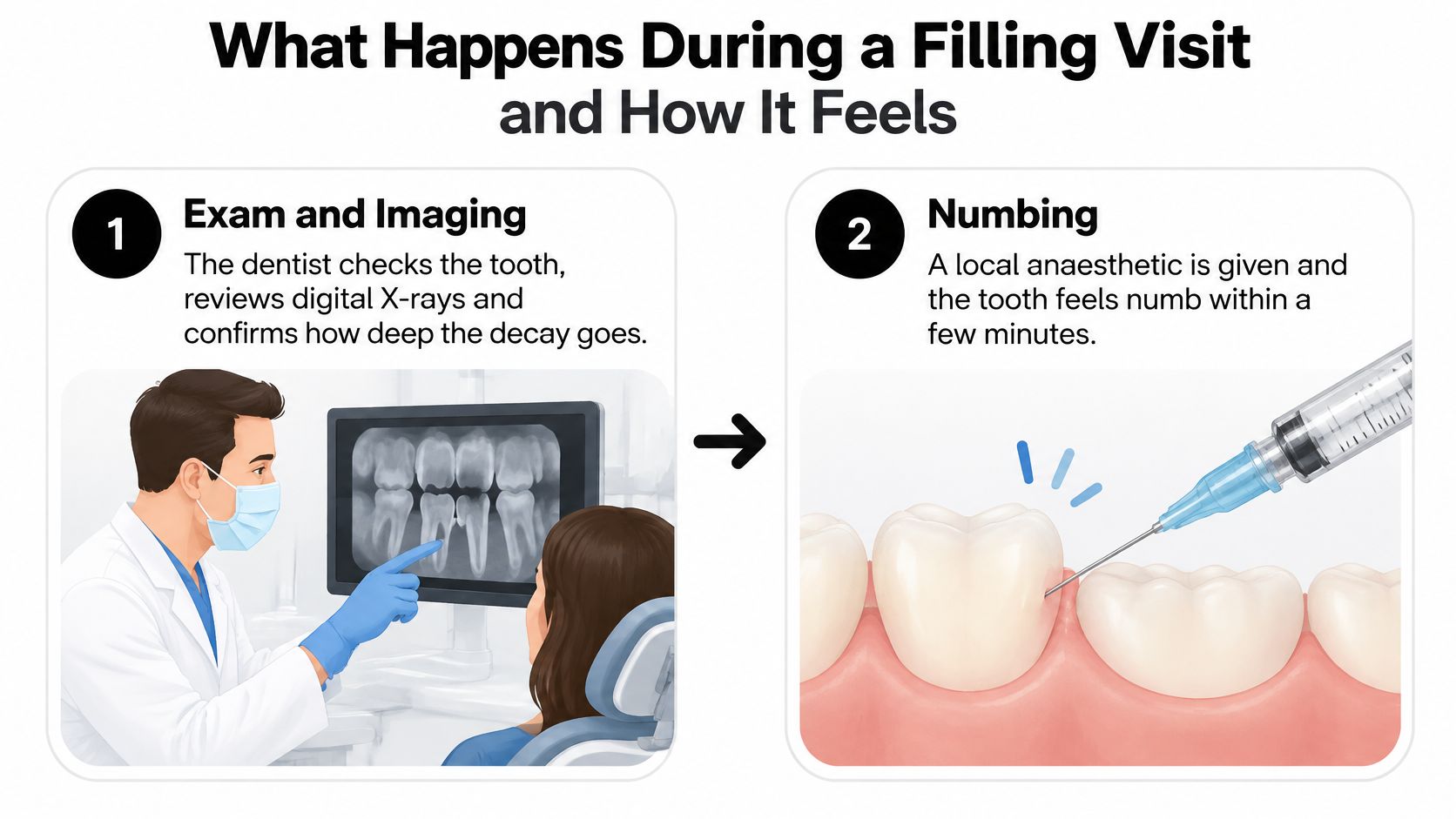
- Exam and imaging. The dentist checks the tooth visually, probes the surface and reviews digital X-rays to confirm how deep the decay goes. Bitewings show decay between teeth and under an existing margin; a periapical view shows the root. If the tooth is tender to bite or the film is ambiguous, expect a little more investigation before anything is drilled.
- Numbing. A topical gel goes on first, then local anaesthetic. The tooth typically feels numb within a few minutes, and what you feel after that is pressure, vibration and cold water rather than sharp pain. An inflamed tooth can be slow to numb, and the correct response is more anaesthetic, not endurance.
- Isolation. A rubber dam or cotton rolls keep saliva away from the tooth. This matters most for bonded composite, because moisture contaminates the bond and a contaminated bond fails early. It's the least dramatic step and the one that most affects how long the filling lasts.
- Removal of decay. Diseased dentin comes out and healthy structure stays, which is the whole point of a conservative restoration. Sometimes the extent of decay is only clear once the soft tissue is gone, and that's the moment a small filling becomes a medium one.
- Placement. Composite goes in thin increments, each cured under a blue light, because building in layers reduces the shrinkage stress that pulls a bond away from the cavity wall. Amalgam is packed, condensed and carved instead. Both approaches demand a dry field.
- Shaping and polishing. Contours get refined so the tooth meets its neighbour cleanly and the surface feels smooth to your tongue and floss.
- Bite check. You'll be asked to tap and slide before you leave. A filling sitting a fraction high produces days of jaw ache and a tooth that feels bruised, and it takes about a minute of articulating paper to fix properly.
A single-surface filling often takes under an hour. Multi-surface or replacement restorations run longer and can be staged across visits when the tooth needs to settle first. For a closer walk through the clinical sequence, this explanation of how dentists fill cavities follows the same order.
Here's the sequence in motion, from the exam through the injection.
What numbness and the first few days feel like
Numbness usually clears within one to three hours, and the lip and tongue often stay numb longer than the tooth itself. Mild sensitivity to cold for a few days to a few weeks is normal, as is slight tenderness when you bite down hard. Both settle as the pulp calms and the ligament around the root recovers.
Practical rule: don't chew until the numbness has gone. Most bitten lips and cheeks happen in the hour after the appointment, not during it.
Anxious patients get more control than they expect. Ask for topical gel before the injection, ask for more anaesthetic if the tooth is slow to go numb, ask for short breaks, and agree on a hand signal that means stop. One patient's note on our reviews page puts it plainly: "During the actual procedure, both of them made sure I felt no pain."
When to call rather than wait
Severe pain, pain that wakes you at night, facial swelling, or a filling that still feels high after a day or two all warrant a call. The first three can indicate pulpal or periapical involvement rather than a problem with the filling itself. The last is usually a quick adjustment.
For the first evening, an over-the-counter pain reliever if your dentist recommends one, no very hot or cold food while the tooth is sensitive, and nothing hard on that side until the numbness wears off. If tenderness on biting persists past a week, get the bite rechecked rather than waiting for the next recall. Broken fillings are a common reason people call us, and one recent patient described being seen within days, with the new filling done in 35 minutes and the insurance explained before treatment started.
Filling Costs and How Insurance Applies
A filling doesn't have one price. It has a range that moves with the material, the number of surfaces involved and what your plan does with the claim, which is why a written estimate is the only number worth planning around.
| Cost factor | How it changes the price | What to ask the office |
|---|---|---|
| Filling material | Porcelain involves lab work and is usually priced above composite or amalgam | What is the price for each material I could choose? |
| Size and number of surfaces | Larger or multi-surface fillings take longer and use more material | How many surfaces does my cavity involve? |
| Tooth location | Back teeth under heavy load may need a stronger or more involved restoration | Does my tooth location change the recommended material? |
| Exam and X-rays | Diagnostic visits are often billed separately from the filling | Are the exam and X-rays included in the estimate? |
| Insurance plan | Coverage percentage, deductible and annual maximum change what the patient pays | Will you verify benefits and give a written pre-treatment estimate? |
Insurance usually covers a percentage of basic restorative work after a deductible, capped by an annual maximum. The frequent surprise is classification: a plan may treat a porcelain restoration as a major service and a composite as a basic one, so the percentage covered differs and the gap falls to you. Ask whether benefits are verified before treatment, whether claims are submitted by the office, and whether the pre-treatment estimate comes in writing. A verbal "should be covered" is not an estimate.
Self-pay patients have their own questions worth asking out loud: whether paying in full earns a discount, whether a payment plan exists, and what the follow-up costs if the decay turns out deeper than the X-ray suggested. That last one is the most under-asked question in dentistry.
"He truly has his patients' best interest at heart and has never tried to upsell me on anything like other dentists have." That's the standard to hold any practice to.
The principle worth keeping: the cheapest filling isn't the one that lasts. Choose the material that fits the tooth first, then compare price. If you're working out what your plan will pay, this explanation of what a dental insurance deductible is covers the part patients find most confusing.
Book Your Filling in Midtown Manhattan

Paul L. Gregory, DDS is at 57 W 57th Street, Manhattan, NY 10019, near Central Park South and Columbus Circle, which puts it within walking distance of Midtown offices and close to several subway lines. This is why "near me" needs a real geography behind it. In 2025, 46% of consumers said they always or often added "near me" to local search queries, according to BrightLocal's consumer search behavior research, and the answer they get often stops at a pin on a map.
Manhattan's neighbourhoods sit inside 59 community districts, which gives a firmer answer than "we serve the area" (NYC Department of City Planning community districts). Community District 7 covers the Upper West Side and Lincoln Square, and Community District 8 covers the Upper East Side, Lenox Hill, Yorkville and Roosevelt Island.
Community District 4 runs from 14th Street to 59th Street and takes in Chelsea, Clinton and Hell's Kitchen, Midtown West, the Theatre District and Hudson Yards (Manhattan Community Board 4 district map). Turtle Bay and Gramercy Park are a short transit ride away rather than a walk, and that distinction is worth knowing before you book a lunchtime slot.
For downtown patients, Community District 2 takes in Greenwich Village, SoHo, NoHo, Little Italy and Chinatown, with the West Village and East Village listed separately, so confirm which address you mean when you call (Manhattan Community Board 2 district description). Community District 1 covers Tribeca, the Financial District, the Seaport and Battery Park City, which is where most Wall Street searches land (Manhattan Community Board 1 district profile).
Timing deserves honesty. ADA 2025 data reported average new-patient appointment waits of just over 12 days in Q3, rising to 13.4 days in Q4 (ADA Health Policy Institute state of the dental economy report), so a routine filling is rarely a same-hour event. Our practice keeps short-notice visits for urgent problems and makes every effort to schedule dental emergencies as quickly as possible. We also treat patients from Long Island City, Astoria, Brooklyn, Hoboken, Jersey City, Weehawken, Queens, The Bronx, Staten Island and Fort Lee.
Practices that keep their hours, services and accepted insurance current make this far easier for patients, which is the practical argument for how you optimize your medical practice's Google profile.
When you book, bring the tooth, the symptoms, the date the pain started and any recent X-rays. Confirm the material and the written estimate before the appointment ends, so the only decision left on the day is the filling itself.
A cavity that's caught while it's still small is a simple, single-visit repair, and Paul L. Gregory, DDS offers porcelain and composite fillings at 57 W 57th Street, chosen after an exam rather than before one. If you're weighing a new filling against replacing an old one, book an exam and bring the symptoms, the timing and any recent X-rays with you. Visit Paul L. Gregory, DDS to schedule a visit and get a written estimate before treatment starts.