

A 2025 U.S. market estimate puts one dental implant unit, covering placement, the abutment, and the crown, at $8,500 to $12,000 (Dataintelo). That sticker is where most dental bridge vs implant cost write-ups stop. It is the wrong stopping point. The first fee leaves out imaging, extraction, grafting, temporary teeth, yearly insurance caps, repairs, and the replacement that arrives years later. Two people with the same missing molar can finish thousands of dollars apart once those lines are on the page. Every figure below still depends on the individual mouth.
Bridge and Implant Costs at a Glance
A conventional three-unit bridge replaces one missing tooth with two crowns on the neighboring teeth and a pontic suspended between them. FAIR Health-based estimates place the typical U.S. price at approximately $2,500 to $6,000. The final amount moves with the material, such as porcelain-fused-to-metal versus all-ceramic, and with the local market. That initial price is commonly lower than a complete single-tooth implant, even though the bridge still prepares the teeth beside the gap and may need replacement later.
| Factor | Dental bridge | Dental implant |
|---|---|---|
| Typical U.S. price | $2,500 to $6,000 for a three-unit bridge | $8,500 to $12,000 per single implant unit (implant, abutment and crown) |
| Initial price ranking | Lower | Higher, though more expensive overall |
| Adjacent teeth | Two neighboring teeth reduced for crowns | No neighboring teeth prepared |
| Surgery | Usually none | Implant placement, with grafting if bone is missing |
| Typical timeline | Often finished across a short series of visits, without a surgical healing wait | Staged around healing before the final crown, and longer if grafting comes first |
How each row changes the bill
Price and ranking. The bridge wins the first invoice. The implant column is higher, and that gap is already real before anyone prices a second crown or a failed abutment tooth. If you want the clinical tradeoffs in plain language beside the fees, it helps to compare dental implants and bridges before you sit with two written plans.
Adjacent teeth. A bridge works only because the teeth beside the gap are reduced for crowns. That reduction is permanent. An implant leaves those teeth alone, which is the biological cost the cheaper line does not show.
Surgery and time. A bridge usually skips surgery, so the calendar stays short. An implant is a surgical placement, and grafting is added when bone is missing. The bridge is the faster fixed option. The implant is staged, so a packed week feels the difference before the wallet does.
The quoted fee is only the opening number. Imaging, extraction, grafting, temporary teeth, and later maintenance change the total. Our notes on what a dental implant costs separate the restoration from those add-ons so the first number is not the only number.
Practical rule: Use the table as the first page of a written estimate, not a final quote for your own mouth.
What Changes the Price of Each Option
National bands hide the four levers that move a quote. A systematic review comparing single-implant crowns with tooth-supported fixed dental prostheses found that initial costs were generally similar and that long-term financial outcomes were also comparable. Complexity came largely from the condition of the adjacent teeth and the available alveolar ridge. Headline ranges and that review are answering different questions. The ranges describe a typical U.S. bill. The review says the bill tightens or splits once your neighbors and your jaw are examined.
Materials, then how many teeth
A bridge crown is not one product. Porcelain fused to metal and all-ceramic restorations carry different lab fees, and the implant crown is a separate choice on top of the post and abutment. Material is a line item, not a style preference.
Unit count works differently on each path. A three-unit bridge replaces one tooth with two crowns and a suspended pontic, so you are buying three connected pieces even though one tooth is missing. A longer gap can move to several implants, or to an All-on-4 full-arch plan when many teeth are failing together. We place dental implants, All-on-4 dental implants, bone grafting, and dentures in the same office, so a multi-tooth case does not have to be priced as a stack of unrelated single teeth. Spreading support across fewer implants can change the per-tooth math, but only after the bite and the bone are mapped.
Bone, neighbors, and the extras on the estimate
Grafting and site preservation show up when the jaw lacks volume. They add a surgery, a healing interval, and a later placement date. They are not optional cosmetics. Without enough bone, the implant is not a candidate yet.
Neighboring teeth often decide the route before the fee sheet does. Intact enamel makes an implant the cleaner path, because nothing healthy has to be cut. Decayed, cracked, or already-crowned neighbors often tip the same gap toward a bridge, since those teeth need crowns anyway. A Midtown patient missing a molar over a thin ridge pays grafting and the crown on the implant total. A patient whose two neighbors already carry large crowns sees the bridge fee change very little, because the preparation was coming either way.
Lab charges, provisional teeth, and sedation sit on many estimates as add-ons. Geography moves the same chart too. Compare written plans from practices in one market, such as Paul L. Gregory, DDS, rather than a national average against a Manhattan fee. The useful question is simple. Which of these four factors applies to my mouth?
If you are still sorting out what a bridge is before you price one, what a dental bridge involves is the clinical sequence, separate from the fee.
Total Cost Over 10 to 20 Years
The fee on the treatment plan is one line. Over 10 to 20 years the ledger is original treatment, replacements, repairs, and whatever the annual maximum pays in each calendar year.
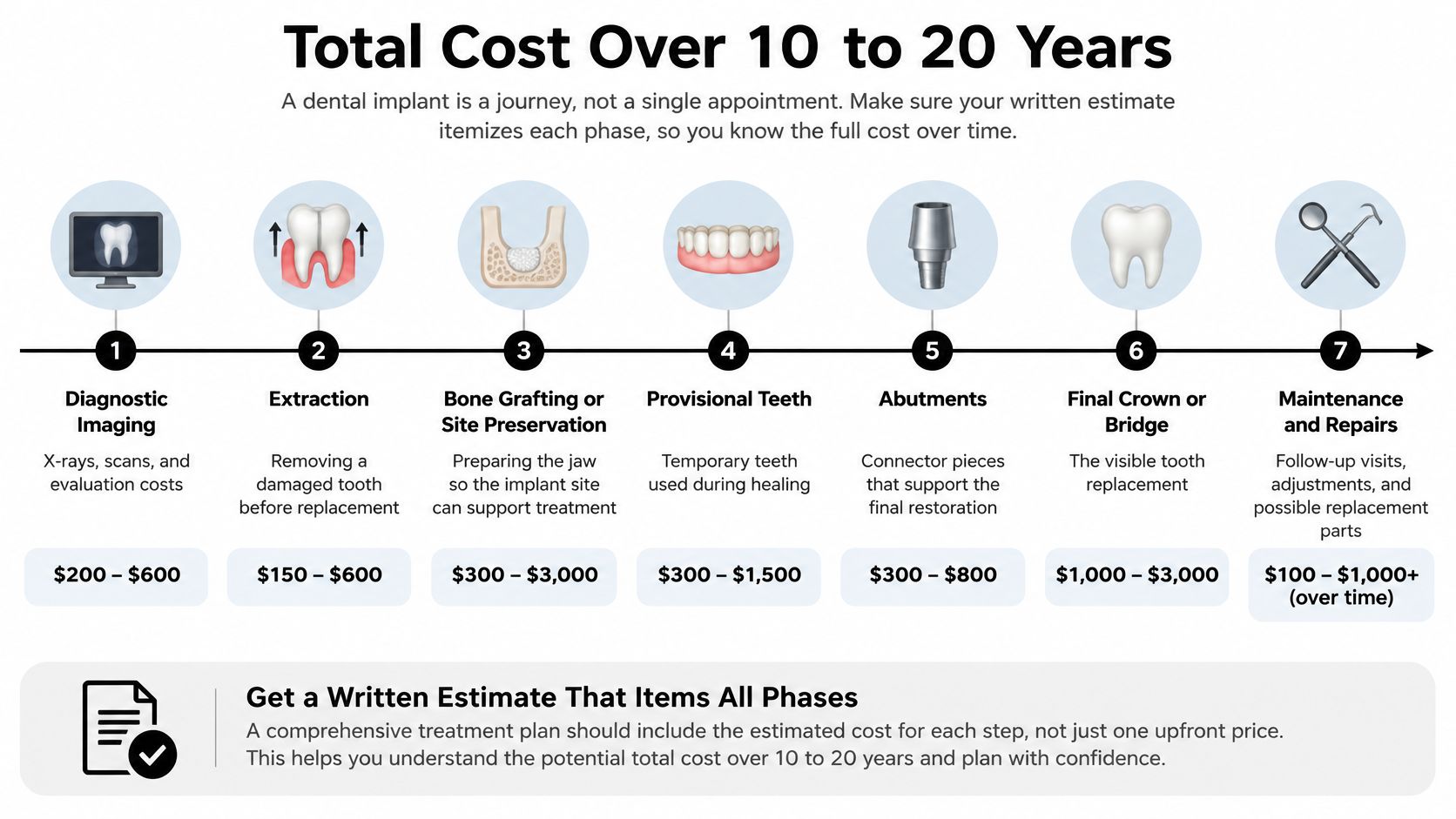
A lifetime-cost model has to include diagnostic imaging, extraction, bone grafting or site preservation, provisional teeth, abutments, the final crown or bridge, follow-up visits, hygiene maintenance, repairs, and eventual replacement (PMC evidence synthesis). Tissue around an implant still needs monitoring and care. How often problems show up depends on the diagnostic criteria and the length of follow-up, so the maintenance line belongs on the estimate from the start.
Cleveland Clinic, citing the American Dental Association, notes that bridges may require replacement after approximately 5 to 7 years, while the implant post can last a lifetime in suitable conditions and the crown commonly lasts about 15 years. Treat those spans as planning assumptions, not guarantees. A crown billed after the annual maximum is already used costs more out of pocket than the same crown in the next plan year, even when the office fee does not change.
The phases below are a checklist, not a single upfront price.
Three scenarios on one ledger
Add the same four buckets in each case: original fee, replacement, maintenance visits, and repairs. Do not invent a citywide dollar total. Your exam sets the fees. What changes the 10- and 20-year total is which failures you are underwriting, and which of those bills land inside one benefit year.
Uncomplicated implant. Assume one post, one abutment, and one crown, with no graft. Over 10 to 20 years you add the original surgical and restorative fee, hygiene and films, any screw or cement repair, and one replacement crown near year 15. The post is the piece you are trying not to buy twice. If surgery uses most of year one's maximum, shifting the crown into year two can cut what you pay without cutting the fee.
Implant that needs grafting first. Start with the same buckets, then insert graft surgery, site healing, and a later placement date before the crown exists. The original fee is larger, the timeline is longer, and temporary teeth cover the gap. Crown replacement still sits near that later year. You are not replacing the graft on a schedule, but a failed graft sends you back to surgery. Two surgical bills in one plan year can exhaust the maximum before the crown is submitted.
Three-unit bridge. The original fee is lower and there is usually no graft. Plan on a possible full replacement after about 5 to 7 years, so a 10-year window can hold the first bridge plus one remake, and a 20-year window can hold more than one. Also add the chance that a supporting tooth later needs a new crown, root canal treatment, or extraction. That last item can erase the upfront savings, because the bridge and the tooth under it fail together. A remake early in a new plan year leaves more of the maximum available than the same remake in a month when the cap is already gone.
A fair 10-year estimate itemizes each phase, states those assumptions, and shows what your annual maximum does to each year. Only an exam can say you are eligible, or what the fees are.
Longevity and Maintenance Over Time
At 10 years, the cited evidence reports 89.2% survival for tooth-supported bridges and 93.1% for implant-supported fixed prostheses. These figures come from different evidence sets, so they are not a direct head-to-head comparison. Patient selection, implant location, bone quality, smoking, oral hygiene, and maintenance can all affect outcomes.
| Measure | Dental bridge | Dental implant |
|---|---|---|
| 5-year survival | 93.8% (tooth-supported bridges, systematic review) | 95.6% (implant-supported fixed prostheses) |
| 10-year survival | 89.2% (tooth-supported bridges) | 93.1% (implant-supported fixed prostheses) |
| Per-year prosthesis survival, three-unit | 96.4% | 97.4% |
| Complication-free at 5 years | No pooled rate in that meta-analysis; track abutment decay and crown replacement | 66.4% (implant-supported fixed prostheses) |
Survival is not a clean record
A meta-analysis of 66 studies found no statistically significant difference in annual survival for three-unit tooth-supported and implant-supported fixed dental prostheses: about 96.4% versus 97.4%. Supporting-abutment survival was also similar, at about 99.0% per year for teeth and 98.7% per year for implants. Separate evidence for implant-supported fixed prostheses reported 95.6% survival at five years and 93.1% at 10 years. At five years, 66.4% of patients were complication-free. Reported problems included veneer fractures, peri-implant or soft-tissue complications, screw or abutment loosening, and loss of cement retention.
The restoration's survival does not mean every component stays trouble-free. Decay or periodontal disease in a supporting tooth can compromise a bridge, while an implant crown may need replacement even if the implant remains in place. Bridge maintenance focuses on the supporting teeth, including decay, root-canal problems, and crown replacement. Implant maintenance includes cleaning around the implant, radiographic review, and repairs if a screw loosens or cement fails.
For a long-term cost estimate, include both the chance of replacement and the cost of managing complications. A bridge may need attention to its supporting teeth; an implant can require maintenance or crown repair. The evidence on dental implant lifespan helps frame that ownership question, but an individual estimate depends on the condition of the mouth and the treatment plan.
Maintenance checklist:
- Keep cleanings on a set interval: Plaque at a bridge margin and plaque around an implant create different risks. Both become harder to manage when routine visits slip.
- Have periodic X-rays: Films can reveal decay beneath a bridge crown or bone changes around an implant before the restoration feels loose.
- Report changes promptly: Gum bleeding, a bad taste, or a restoration that rocks warrants a call rather than waiting for the next routine visit.
Which Option Fits Your Situation in Manhattan
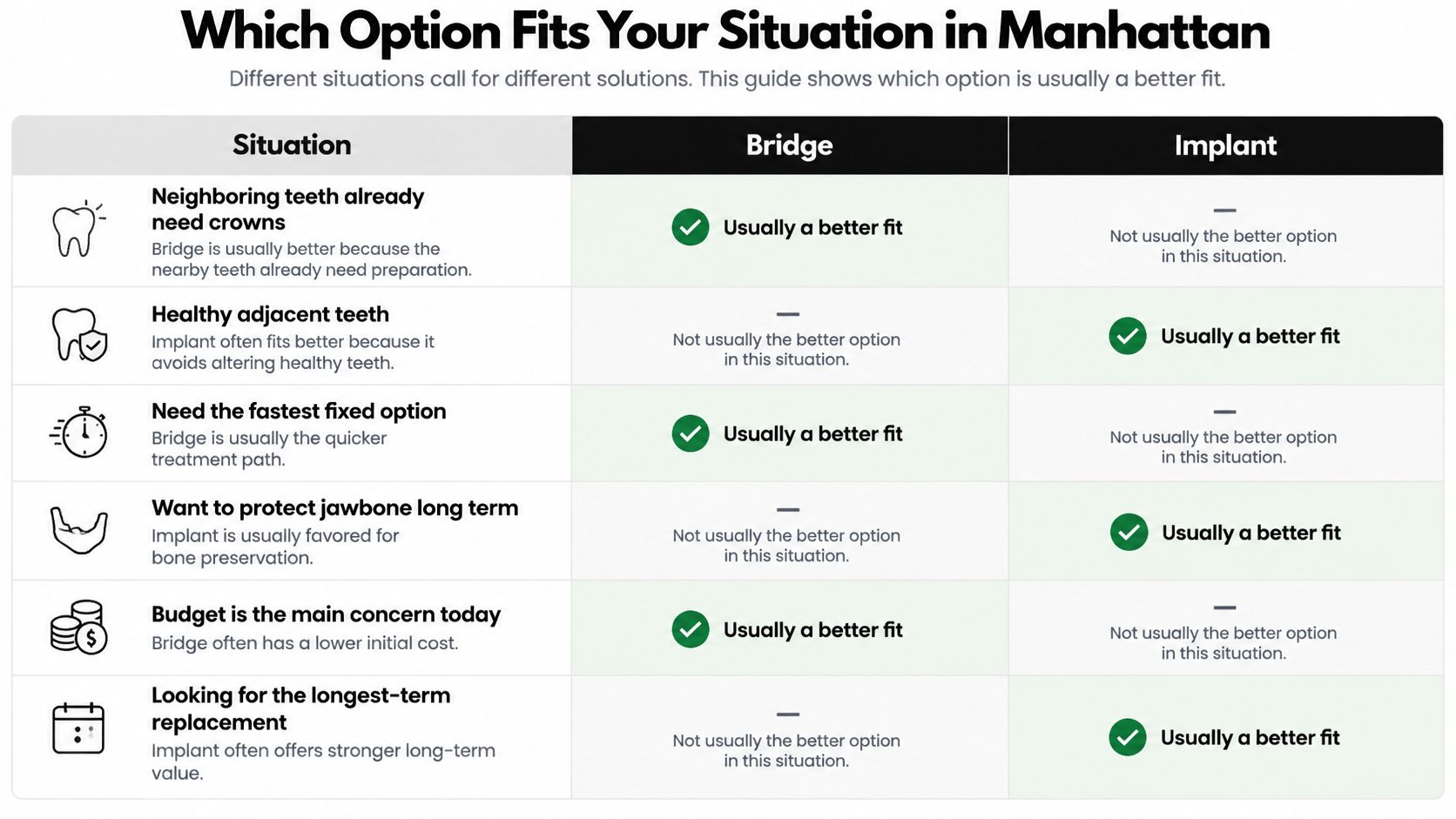
| Situation | Usually the better fit | Why |
|---|---|---|
| Neighboring teeth already need crowns | Bridge | The adjacent teeth are already being prepared |
| Neighboring teeth intact, enough bone | Implant | No healthy teeth need reducing |
| Need a fast result, no surgery wanted | Bridge | Avoids surgery and healing time |
| Bone missing, grafting required | Implant after individualized review | Grafting adds time and cost |
| Long-term preservation is the priority | Implant | Avoids future work on neighboring teeth |
| Smoking or poor hygiene | Decide after examination | Affects both options, with different maintenance demands |
Neighborhood names are not fee zones
Patients reach a Midtown office from Midtown, Chelsea, the Upper West Side, the Upper East Side, Lennox Hill, Turtle Bay, Hell's Kitchen, the Theatre District, Gramercy Park, the West Village, Greenwich Village, NoHo, the East Village, SoHo, TriBeCa, Hudson Yards, Chinatown, and Wall Street. NYC planning materials identify many of these as community-district or neighborhood-tabulation areas, and Community Board 2 specifically includes Greenwich Village, SoHo, NoHo, Little Italy, Chinatown, Hudson Square, and Gansevoort Market. Neighborhood boundaries are not formal price zones. The ranges in this article are market estimates, not a separate fee for each block.
Two mouths, two usual answers
Say the teeth beside the gap already carry large crowns, deep fillings, or cracks. A bridge usually fits, because the preparation is happening whether or not you fill the space. You solve the missing tooth and the tired neighbors in one restoration, and you skip a surgical wait.
Say those neighbors are intact and the ridge can hold a post. An implant is usually the better fit, because no healthy tooth is reduced to hold a pontic. Grafting, if the scan shows thin bone, adds time and cost, so the implant is chosen after that review, not by default. Smoking and uneven hygiene do not pick a winner on a chart. They change maintenance for both, and they belong in the exam, not in a slogan. Candidacy details sit on our page about who is a good candidate for dental implants.
One patient put the clinical priority in personal terms after three decades in the chair: "I've been a patient of Dr. Paul Gregory for 30 years, and I wouldn't trust my teeth to anyone else. He does everything he can to preserve your natural teeth and has helped me with crowns, root canals, fillings, implants, and even closing a gap between my front teeth."
The better question is not which option is cheaper, but which one leaves the least damage to teeth you still have.
Insurance, Estimates and Questions to Ask
Your insurance benefit can change which option costs less over time. Smile Costs explains that plans may cover part of a bridge under major restorative benefits, while implant coverage may be limited or may apply only to the crown, not the surgery and implant post. Annual maximums, missing-tooth exclusions, waiting periods, and alternate-benefit clauses can reduce payment further. An alternate-benefit clause may limit the allowance to what the plan would pay for a bridge or denture. Get a written pre-treatment estimate before comparing your out-of-pocket costs.
A hypothetical plan year
Consider a plan with a $1,500 annual maximum and 50% coverage for major restorative care. If you start a bridge and an implant in the same year, the plan pays no more than $1,500 across both treatments, even if half of their fees would add up to more. Splitting treatment across plan years may change the amount paid, while a missing-tooth exclusion or alternate-benefit clause may reduce it further.
Paul L. Gregory, DDS can review dental plan options with patients comparing coverage and fees. Heather said, "I was impressed by Dr. Greg's proficiency in my dental treatment and his advice on maximizing my insurance benefit." The practice offers dental bridges, crowns, dentures, implants, cleanings and exams, and dental X-rays. For more on dental insurance and payment plans, consider how coverage and payment arrangements may affect a staged treatment plan.
What to ask before you commit
- Request two written pre-treatment estimates. Have the bridge and implant priced as separate plans.
- Ask which implant components are covered. Crown-only coverage differs from coverage for the post, surgery, and abutment.
- Check for an alternate-benefit clause. If the plan allows only a bridge benefit toward an implant, ask what you would owe.
- Compare financing with the remaining annual maximum. A payment plan spreads the bill, but does not increase the plan's cap.
- Confirm what each estimate includes. Ask about imaging, extraction, grafting, temporary teeth, abutment, final crown, and sedation.
- Ask for a 10-year total. Include maintenance and potential replacement, and request the assumptions behind the estimate.
- For a bridge, identify the teeth to be prepared. Ask what could happen if a supporting tooth later needs root canal treatment.
A medical coder may work with billing codes, but your insurer determines how your specific plan applies its benefits. Compare estimates using the same time horizon and included services. A lower initial fee does not necessarily mean a lower long-term cost.
Paul L. Gregory, DDS offers dental bridges, implants, bone grafting, and crowns. A dental exam can help assess the neighboring teeth and the ridge before you compare written estimates. Paul L. Gregory, DDS provides care in Midtown Manhattan.