

Patients treated with clear aligners were 1.6 times more likely to have an unacceptable treatment result than those treated with fixed appliances in a systematic review of comparative orthodontic studies, with a confidence interval of 1.2 to 2.0, according to the review of aligner and fixed-appliance outcomes. That finding doesn't mean aligners are a poor treatment. It means the question is not whether trays can straighten teeth, but whether they can reliably deliver the particular movements your bite needs.
For a busy Manhattan adult, the right choice also has to survive ordinary life: coffee between meetings, client dinners, travel, and late nights. A discreet appliance isn't automatically the least disruptive one if its daily requirements don't match your habits.
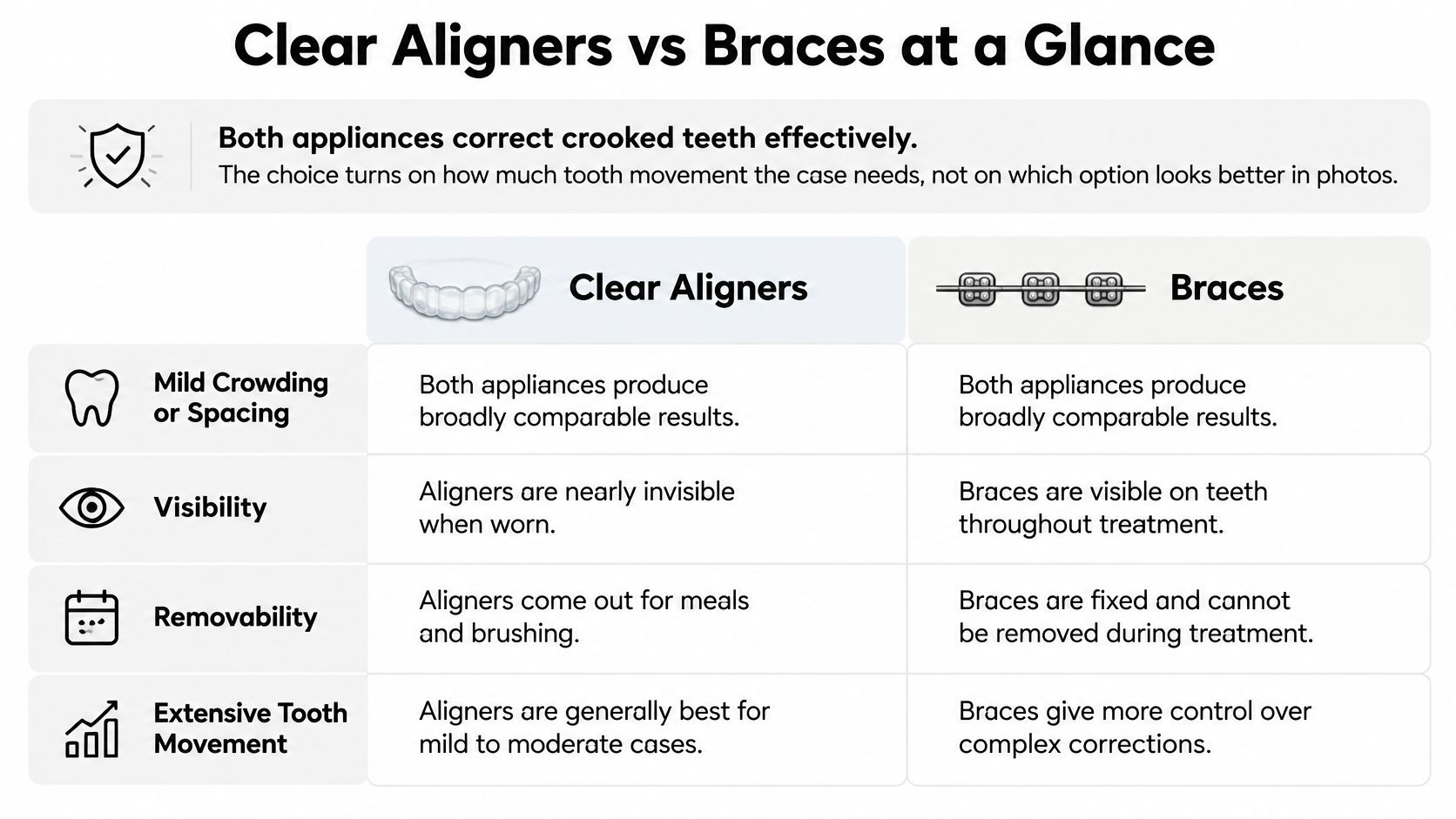
Clear Aligners vs Braces at a Glance
Both appliances correct crooked teeth effectively. The choice turns on the movements your case requires and the routine you can sustain, not which option looks better in photos.
Clear aligners and braces side by side
| Factor | Clear aligners | Traditional braces |
|---|---|---|
| Visibility | Clear, nearly invisible trays | Brackets and wire; ceramic or clear options available |
| Removable | Yes, out for eating, drinking and brushing | No; removed only by the orthodontist |
| Change cadence | New tray every 1-2 weeks | Wire adjustments roughly every 4-8 weeks |
| Typical fit | Mild-to-moderate, non-extraction cases | Broad range, including complex and extraction cases |
| Typical duration | Similar for mild cases; potentially longer in extraction cases | Similar for mild cases; comparison baseline for extraction cases |
The cadence row describes a typical schedule, not a promise about appointment frequency or completion. Your clinician should set both according to your response to treatment.
This visual comparison highlights the main differences before the more important movement-specific decisions.
Read the table as trade-offs, not a scorecard
Removability can be a benefit or a burden. You can take trays out for lunch, but you also become responsible for getting them back in promptly. Fixed brackets remove that particular decision without removing your responsibility for cleaning and appointments.
Similarly, visible straightness doesn't establish that a case is simple. The position of the roots and the way the upper and lower teeth meet matter alongside the appearance of the front teeth.
For another patient-facing overview, Prosth & Co.'s comparison of braces versus removable clear aligners is a useful companion when preparing consultation questions.
Start with the typical fit row rather than visibility. Once you understand your malocclusion, meaning the way your teeth are misaligned or your bite fits together, the lifestyle rows become meaningful. Choosing an appliance before identifying the movements reverses the clinical decision.
Which Bite Problems Suit Each Appliance
Two smiles can look equally crooked in the mirror and need completely different appliances. What separates them is the movement list: whether teeth must rotate, roots must torque, or the bite itself must shift. A 2025 expert-consensus review supports clear aligners as a credible option for non-extraction Class I cases involving mild-to-moderate crowding. Beyond that envelope, the mechanics decide.
Brackets and wires apply continuous force through a fixed attachment. Trays apply force in stages, and each stage only works if the plastic grips the tooth and the tooth responds as planned.
Bite problems and predictable appliance fit
| Problem or movement | Clear aligners | Braces | Clinical reasoning |
|---|---|---|---|
| Mild crowding, non-extraction | Strong candidate | Strong candidate | The consensus review supports aligners as a credible option in this group |
| Substantial rotations | Limited; often needs attachments | More predictable continuous control | Rounded teeth give tray plastic little surface to grip |
| Root torque on incisors | Weaker control | Stronger control | A tray pushes on the crown; a wire can couple forces along the root |
| Transverse (width) expansion | Less effective | More effective | Trays tend to tip crowns outward rather than widen the arch itself |
| Occlusal contacts and finishing | Can be less predictable | Generally stronger finishing control | A wire accepts small late adjustments; a tray needs a new stage |
| Extraction cases | Less predictable space closure and root control | More predictable root control | Planned and achieved movements can differ under load |
| Severe bite correction | May need attachments, elastics, or conversion | Often the preferred option | Fixed auxiliaries deliver forces trays cannot sustain alone |
Why the movement matters more than visible crowding
Root torque means controlling the root's inclination, not just tipping the visible crown. Occlusal contacts describe how the opposing teeth meet when you bite. A smile can photograph straighter while both still need substantial work.
In extraction treatment, closing a gap is only half the job: the clinician must control the roots and stop neighboring teeth from drifting into the space. An extraction-focused systematic review reported approximately 1.93 mm of under-retraction and 6.08 degrees of excess mesial tipping of upper first molars with aligners, alongside weaker root control and occlusal-contact outcomes.
Numbers like those explain why attachments, elastics, refinement trays, or a mid-course switch to braces show up in honest aligner plans. None of them automatically signals failure. Each should be named before you sign.
An examination connects the proposed digital movements with your actual bite.
Questions that reveal the real treatment plan
Complex conditions aren't automatically off-limits for aligners. The deciding factor is what the plan adds to make those conditions feasible. Bring these to the consultation:
- Which movements are necessary? Ask whether treatment involves rotation, root torque, width development, or substantial bite correction.
- Are extractions needed? If so, ask how the clinician will control anchorage and close the spaces.
- Which attachments or auxiliaries are expected? Establish whether elastics or other components are part of the initial plan, and what would trigger a conversion to braces.
If your main concern is an overbite, the discussion of whether Invisalign can fix an adult overbite can help frame a more specific consultation.
Retention belongs in that discussion too. Trays come out permanently the day treatment ends, and the result then depends entirely on the retainer schedule. Ask what that schedule includes and how long it runs. A remote smile simulation can't replace the in-person examination needed to judge any of this.
Treatment Time and Mid-Course Changes
Research doesn't support a universal claim that clear aligners finish faster. A 2024 systematic review of treatment duration included 10 studies, six of them randomized trials, and found low-certainty evidence of similar duration for mild-to-moderate crowding; it also discussed earlier pooled findings of 6.31 months shorter treatment with aligners in predominantly non-extraction cases and an extraction study in which aligner treatment was 44% longer.
These results aren't interchangeable estimates for your mouth. They describe different case mixes and evidence of varying certainty. Comparing a straightforward tray case with a demanding extraction case tells you little about which appliance would finish your own treatment sooner.
A tray count isn't a completion guarantee
As a deliberately simplified calculation, a 12-tray plan, changed every two weeks, represents 24 weeks on paper. That's an illustration of scheduling arithmetic, not a treatment estimate or a research finding.
The calculation assumes each stage is completed as planned. A remade tray, a tooth that doesn't track, or an additional refinement series changes the calendar.
For aligners, common sources of disruption include:
- Missed wear. Removing trays for longer than prescribed interrupts the intended treatment routine.
- Tracking problems. A tooth may not achieve the position needed for the next stage.
- Additional mechanics. Attachments or elastics may need to be introduced or revised.
- Refinement trays. The clinician may need another series to improve alignment or the bite.
Braces also require monitoring and adjustment. Their fixed design doesn't make treatment immune to missed appointments, broken components, or a revised plan.
Ask for the contingency, not just the estimate
The discussion of how long Invisalign treatment takes is most useful when paired with a case-specific estimate. Ask for the planned stages, how progress will be checked, and what happens if the teeth don't follow the simulation.
Planning principle: Compare the likely full course, including possible refinements, rather than the shortest advertised timeline.
For someone whose calendar is already crowded, the better question is which approach minimizes total disruption and mid-course changes. A slightly less convenient appliance at the start may be easier overall if it offers more predictable control for the necessary movements.
What a Full Course Costs With Each Option
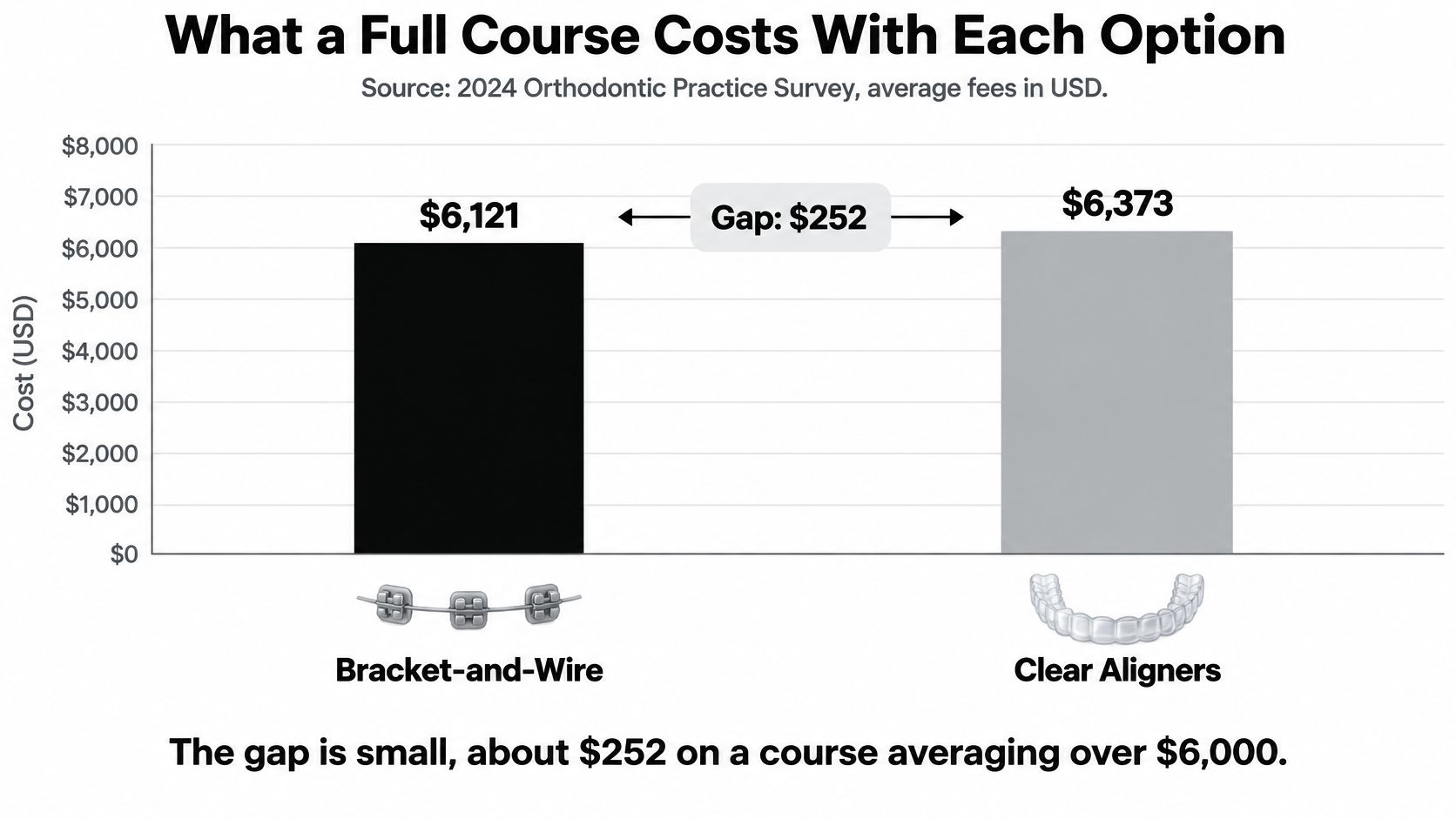
A 2025 report on the 2024 Orthodontic Practice Survey reported average fees of $6,121 for bracket-and-wire treatment and $6,373 for clear aligners, a calculated difference of $252. These are practice-survey averages, not Manhattan price quotes or a prediction of your bill.
The chart provides a useful starting comparison, but the written treatment agreement matters more than the average.
Orthodontic fees and cost drivers compared
| Cost item | Clear aligners | Traditional braces | Note |
|---|---|---|---|
| Average practice fee | Higher survey average noted above | Lower survey average noted above | Survey averages aren't individual quotes |
| Fee difference | Modest premium in the survey | Comparison baseline | Case requirements may matter more |
| Refinement trays or extra visits | Confirm inclusion | Confirm extra-adjustment terms | Request written details |
| Attachments for complex movement | Ask whether included | Ask about auxiliary components | Varies by case and practice |
| Retainers after treatment | Usually required | Usually required | Include in the total quote |
| Insurance orthodontic maximum | Plan-specific | Plan-specific | Check the actual benefit terms |
Compare complete treatment, not the opening payment
Case complexity, extractions, additional mechanics, refinement policies, and retainers can change what you're paying for. A fee that appears lower may cover a narrower course, while another may include more follow-up care.
Ask whether the quote includes treatment planning, monitoring, finishing, and retention. If an aligner case needs conversion to braces, establish whether the original agreement covers that change or whether a new fee applies.
The video below provides additional context for discussing the appliance decision with your clinician.
Get the financial contingencies in writing
Request these items before starting:
- The full planned-course fee. Identify what is included and what is billed separately.
- The refinement and extra-visit policy. Don't assume additional trays or adjustments are automatically covered.
- The plan-change terms. Clarify the financial consequences of conversion, interruption, or extended treatment.
Insurance benefits may cap orthodontic coverage, and the net cost depends on your policy's eligibility rules and terms. The practice's explanation of dental insurance and payment plans can help you prepare the right financial questions.
A sensible budget covers the route to an acceptable result and its maintenance, not merely the appliance placed at the first treatment visit.
Comfort, Looks and Patient Satisfaction
In a 2024 questionnaire study of 303 patients, overall satisfaction didn't differ significantly between fixed braces and clear aligners (p=0.989). That result challenges the assumption that a less visible appliance automatically produces a better experience.
Preference is a different question. In a separate 2024 survey of orthodontic preferences, 325 of 423 respondents, or 76.83%, preferred clear aligners, while 69.03% considered them expensive.
Preference before treatment isn't satisfaction afterward
An aesthetic preference tells you what someone would rather wear. Satisfaction reflects the entire course: whether expectations were realistic, the daily routine was manageable, and the finished result addressed the original concern.
The visible result is not the same as the treatment experience.
Comfort also includes more than soreness. Discuss possible pressure after tray changes or wire adjustments, irritation, and speech adaptation rather than expecting either appliance to feel absent.
Aligners may be appealing for meetings and photographs, but removability introduces its own logistics. A case belongs in your work bag, and every meal requires a plan for removal, storage, cleaning, and reinsertion.
Small routines matter as much as the appliance's appearance.

Test the choice against ordinary situations
A client dinner may make removable trays attractive, but a long evening can make prompt reinsertion difficult. Braces stay in place, although eating and cleaning around them require different accommodations.
Consider your own pressure points:
- Client-facing work. Decide how much visibility matters after accounting for possible attachments and other treatment components.
- Travel. Think about storage, cleaning access, and following instructions away from home.
- Gym sessions and social plans. Ask whether you'll reliably manage trays when your usual routine changes.
If visibility is the main obstacle to fixed treatment, clear braces for adults deserve consideration rather than treating metal brackets and removable trays as the only choices.
The useful test isn't which appliance you'd prefer for a photograph. It's which one you can live with during a demanding week without repeatedly compromising the plan.
Daily Maintenance and Hygiene Habits Compared
Aligners work only when worn. The FDA's clear-aligner guidance advises at least 20 hours daily, unless your treating clinician instructs otherwise, while the American Association of Orthodontists' appliance guidance describes at least 22 hours for aligners; follow your own prescribed schedule.
Braces remain attached and don't depend on remembering to put them back in. That doesn't make them compliance-free: cleaning, food choices, appointments, and any prescribed elastics still matter.
Daily upkeep for aligners and braces
| Daily routine | Clear aligners | Traditional braces |
|---|---|---|
| Wear requirement | Follow the prescribed daily wear target above | Continuous fixed wear |
| Eating and drinking | Remove before anything except water | Follow food guidance; avoid sticky and hard foods |
| Cleaning | Clean teeth and rinse trays before reinsertion | Brush around brackets; floss with a threader |
| Biofilm and white spots | Less biofilm reported; white spots remain a concern | Bracket areas need particular cleaning attention |
| Saliva and dry mouth | Reduced flow remains an open research question | Discuss dry mouth individually; no assumed advantage |
| Lost or broken parts | A lost tray can interrupt staging | A broken bracket may require a repair visit |
Removable doesn't mean self-cleaning
A review addressing aligner-related oral-health and material concerns describes possible biofilm-control benefits that may be clinically insignificant, with gingival recession and white-spot lesions remaining concerns. It also identifies reported irritation, localized inflammation, and unresolved questions about chemical leaching and saliva flow, while indicating that most materials appear generally safe.
That isn't a reason to assume trays are unsafe. It's a reason not to market them as automatically healthier just because they're removable.
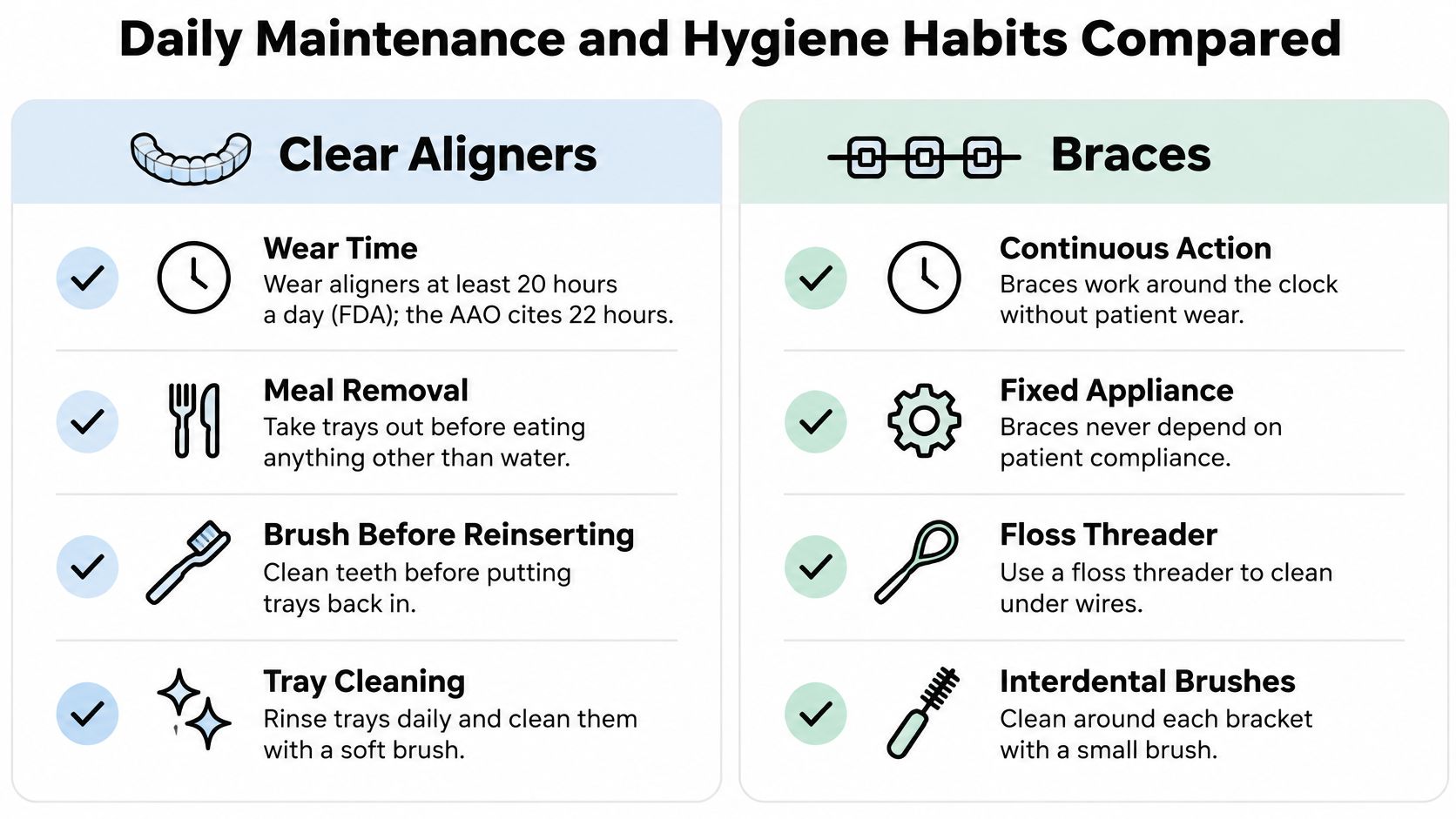
This checklist summarizes the practical routines.
Build the routine before treatment starts
For aligners, remove trays before food or drinks other than water, clean your teeth before reinserting them, and rinse and clean the trays as instructed. Store them in a case rather than a napkin.
For braces, brush carefully around every bracket and use a floss threader to clean beneath the wires. An interdental brush can help reach awkward areas.
Frequent snacks and coffee breaks create repeated aligner-management decisions. If you have dry mouth, discuss symptoms and prevention before starting rather than assuming either appliance solves that problem.
Choose the Right Appliance for Your Midtown Schedule
Choose clear aligners when the clinical fit is appropriate and you're confident about the removable-appliance routine. Choose braces when the required movements favor fixed control or when repeatedly managing trays would be unrealistic.
Visibility is the easiest variable to compare and the least predictive one. The movements your bite needs and the habits you can sustain through months of treatment decide which appliance performs.
Neither decision is a judgment about motivation. A conscientious patient can still hold a job that makes regular tray removal, cleaning, and reinsertion awkward. A workable treatment plan accommodates real behavior rather than an idealized version of it.
Match the appointment plan to your actual commute
Braces require periodic adjustment visits plus unplanned repairs when a bracket debonds or a wire shifts. Aligner checks tend to run less often, though a lost tray or poor tracking can still trigger an extra appointment. Either appliance generates more trips than the first consultation suggests, so each trip's cost in time matters.
I tell patients to test the route before they sign anything. Someone working in Hudson Yards or Hell's Kitchen who picks a Midtown practice can reach a same-week repair visit without losing an afternoon. A patient commuting from outside Manhattan should ask whether the office groups monitoring visits, handles minor aligner issues remotely, or holds same-day slots for broken brackets.
Don't choose an office only because the first consultation fits your calendar. Ask how the practice handles concerns between scheduled visits, missed appointments, and changes to the original plan.
For another perspective on scheduling, Winn Smiles' overview of clear aligner and braces treatment times can help you prepare questions. Treat any general timeline as background, not a substitute for a clinical estimate.
Choose an examination over an attractive simulation
A digital preview shows a proposed result without proving the movements behind it are achievable. When the recommendation stays unclear, get an in-person assessment rather than picking the more appealing animation.
Use these decision criteria:
- Clinical suitability first. Ask what would make the clinician recommend the other appliance instead.
- Habit compatibility next. Describe your coffee, meal, travel, and cleaning routines candidly.
- A workable fallback. Establish how the clinician will recognize and manage a plan that is not progressing as intended.
If fixed treatment looks more appropriate, review the options for braces in Midtown Manhattan before ruling it out on appearance alone. Clear braces can address part of the aesthetic concern without changing the need for attached appliances.
Book a thorough in-person examination at 57 W 57th St, near Central Park South and Columbus Circle. Bring your questions about the required tooth movements, whether extractions are needed, and how the digital staging will be verified clinically before and during treatment.
The most useful answer to clear aligners vs braces is a defensible plan for your bite, your habits, and your schedule. You should leave the consultation knowing which appliance you will wear and why it is the right tool for your case.
Paul L. Gregory, DDS offers Invisalign clear aligners and clear braces for teens and adults, with dental diagnostics and broader restorative care available in the Midtown practice. Each examination covers the tooth movements your bite needs, your daily routine, and a written treatment and fee plan before any commitment.