

You're at a Midtown lunch, smiling comfortably for a photo, then cutting your food into smaller pieces. Or you're having dinner after a show and worrying that your lower denture will move when you bite. The question isn't just how your teeth look. It's whether you can eat, speak, and get through the day without planning around them.
When Missing Teeth Start Limiting Meals
A missing tooth or an unstable denture can change small decisions long before you book an appointment. You might chew on one side, skip crusty bread, or order something soft rather than explain why you're struggling. Meanwhile, surgery can sound like a commitment your calendar can't accommodate.
That's why dental implants vs dentures is usually a practical question disguised as a choice between products. You want to know what will help with your particular problem, what treatment involves, and what you'll need to do afterward.
Start with what needs replacing
First, separate partial replacement from full-arch replacement. A person missing a single tooth isn't making the same decision as someone whose entire lower denture moves during meals. Then separate the question of how replacement teeth are supported from whether you remove them yourself.
The treatment spectrum includes a conventional complete or partial denture, a removable implant overdenture, and a fixed implant restoration. Fixed treatment might mean a single crown, a multi-unit bridge, or a full arch. An implant doesn't automatically mean a complete set of fixed teeth.
Practical starting point: Describe what you can't comfortably do now before deciding which treatment you want.
Bring your everyday priorities
Before a consultation, write down:
- Foods you avoid: Identify whether the difficulty involves biting, chewing, soreness, or fear of movement.
- Removal preferences: Say whether taking an appliance out at night would bother you.
- Surgical concerns: Explain whether your hesitation involves recovery, medical issues, anxiety, or additional visits.
- Calendar limits: Be realistic about weekday appointments and transportation.
- Future help: Consider who could assist with cleaning if your dexterity changes.
The right plan has to work beyond the delivery appointment. Bone availability, general health, budget, and the ability to maintain the result all belong in the conversation. A promise of permanence doesn't answer those questions, and no treatment should be presented as maintenance-free.
How Implants and Dentures Actually Differ
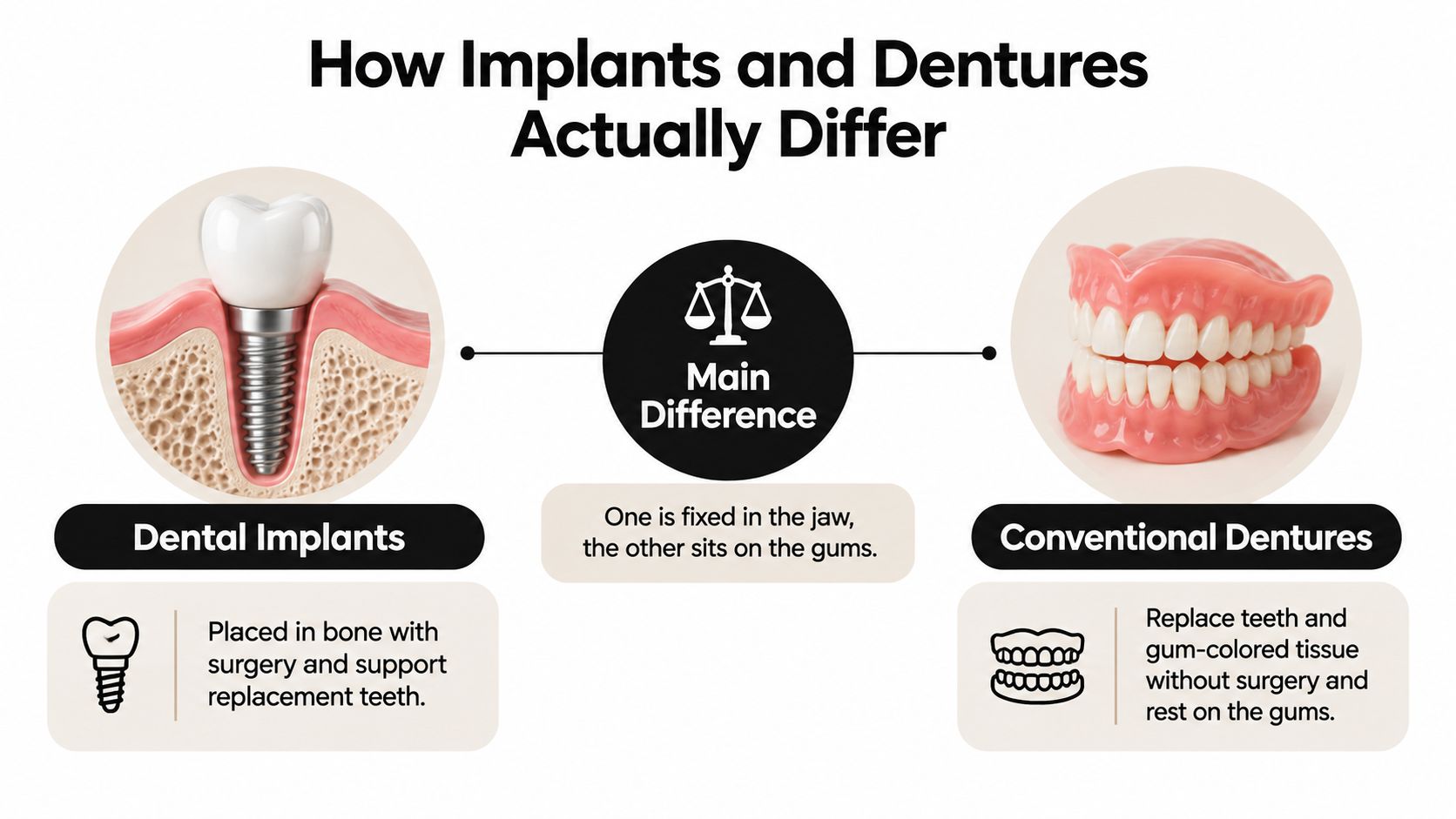
The easiest way to understand the choices is to ask what supports the replacement teeth. The visible teeth may look similar in a photograph, but the supporting structures and cleaning access can be very different.
Conventional dentures use the existing mouth for support
A conventional complete denture replaces missing teeth and gum-colored tissue without implant surgery. It rests on the gums over the underlying jaw ridge. A partial denture replaces some missing teeth while using the remaining teeth as part of its support.
This established approach remains relevant when surgery isn't appropriate or a person doesn't want implant treatment. Limited bone doesn't automatically prevent someone from receiving a conventional denture, although the available supporting tissues influence fit and comfort. The practice's guide to complete and partial dentures distinguishes these replacement patterns.
Implants provide a foundation for separate replacement teeth
An implant fixture is placed surgically in bone. The crown, bridge, or denture attached to it is a separate component. That distinction matters whenever someone uses the word “implant” to describe the entire treatment.
- Implant overdenture: Implants improve retention, but you still remove the denture for cleaning.
- Fixed implant crown or bridge: The replacement stays in place during daily use and requires cleaning around its supporting components.
- Fixed full-arch restoration: A connected set of replacement teeth stays attached to implants rather than being removed by the patient.
A Canadian health-technology review comparing implant treatment reported implant survival above 95% after one year for implants supporting upper dentures. That early survival finding doesn't mean the denture or its attachments will never need repair.
Think of the implant as the foundation and the visible replacement as the structure it supports. Both need assessment, but they don't necessarily wear out together. An implant can support either removable or fixed teeth. Asking whether a proposed restoration comes out is more useful than assuming all implant treatment works the same way.
Comparing Chewing Stability and Longevity
Dentures, Overdentures, and Fixed Implants at a Glance
| Criterion | Conventional Denture | Implant Overdenture | Fixed Implant Restoration |
|---|---|---|---|
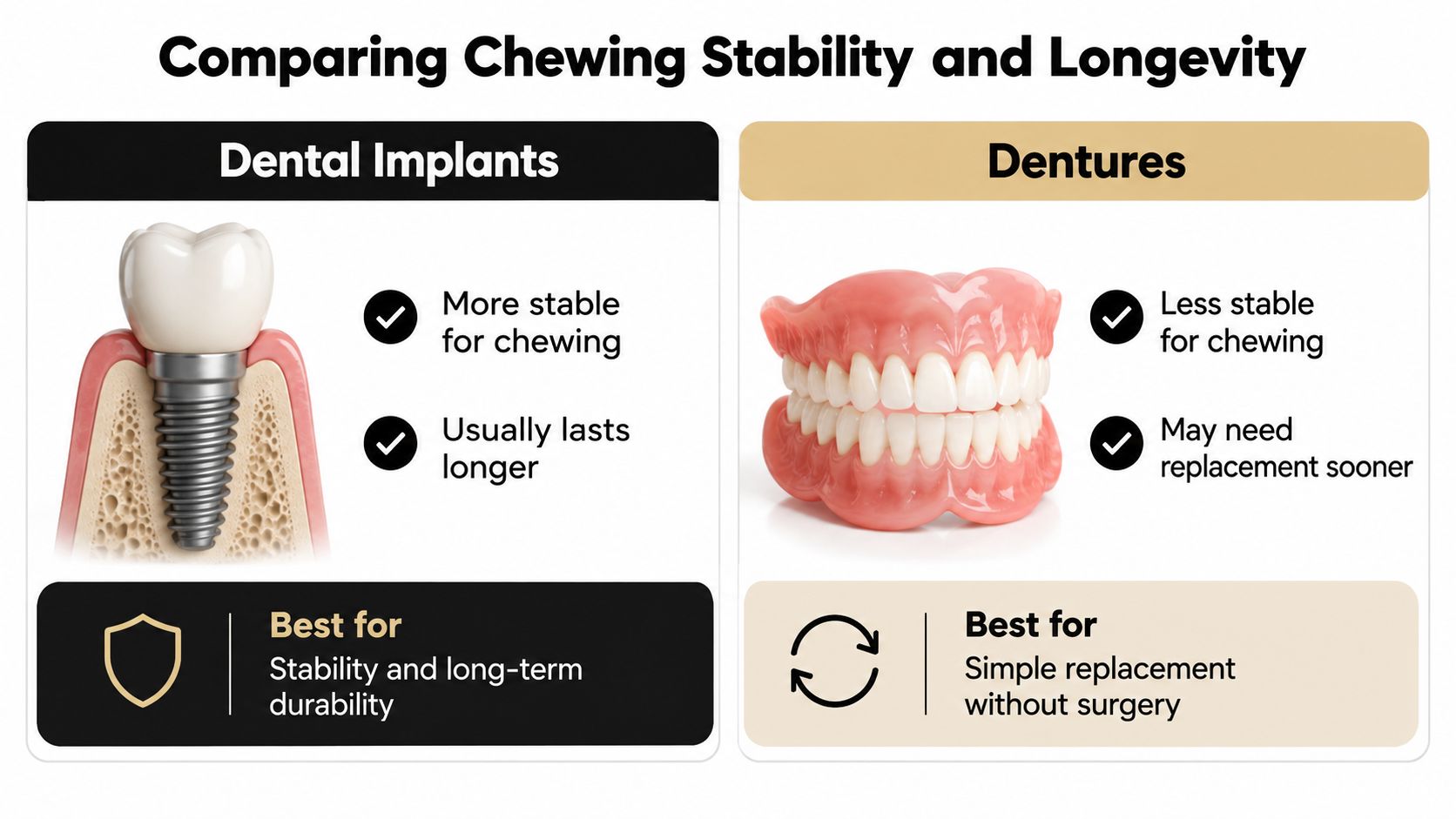
| Chewing stability | Depends on fit and supporting tissues | Added retention can reduce movement | Implant-supported stability |
| Speech and comfort | Movement may be a concern | Evidence favors improvements over conventional dentures | Depends on restoration design and adaptation |
| Longevity | Fit and appliance condition require review | Implant survival and attachment wear are separate issues | Implant survival and restoration survival are separate outcomes |
| Complications | Soreness and retention problems may require attention | Attachments and denture components may need repair | Biological and technical complications remain possible |
The table separates treatment designs rather than treating every implant-supported replacement as equivalent. In particular, evidence about a lower overdenture shouldn't be presented as proof of identical results for every upper-jaw or fixed treatment.
Chewing and speech
For people with a completely toothless lower jaw, a systematic review of mandibular implant overdentures found better stability, comfort, speech, chewing efficiency, and oral-health-related quality of life than conventional dentures; one included comparison found more than twice the mean bite force, while findings after approximately four years favored bite force and satisfaction even when overall quality-of-life scores were similar.
That's a meaningful reason to discuss implant retention when the main complaint is movement during meals. It isn't a guarantee that every food will become effortless or that every measure of well-being will improve equally.
Survival isn't the same as freedom from repairs
A systematic review of implant and restoration survival reported these pooled estimates:
- Single-crown implants: Estimated implant survival was 97.2% after five years and 95.2% after ten years, according to the review.
- Implants supporting fixed partial dentures: Earlier evidence summarized in the same review estimated survival at 95.4% after five years and 92.8% after ten years.
- The fixed prostheses themselves: The same review reported survival of 95.0% after five years and 86.7% after ten years.
- Complication-free treatment: In that review, only 61.3% of patients remained free of any complication after five years, while peri-implantitis and soft-tissue complications affected approximately 8.6% of prostheses.
Those figures describe different outcomes. An implant can remain in place even when the bridge it supports needs treatment. They're also pooled research estimates, not a personal forecast.
The useful comparison is expected function, surgical demand, and the probability of complications over time, not simply permanent versus removable.
When discussing dental implant lifespan, ask which component the estimate describes. A durable foundation is valuable, but it doesn't remove the need to budget time and attention for the replacement teeth.
Matching Each Option to Daily Life
Match the treatment to the complaint, not to an age stereotype. Someone who wants to avoid surgery has a different starting point from someone whose main frustration is a lower denture that lifts during chewing.

When each path deserves discussion
A conventional denture deserves consideration when avoiding surgery or grafting is the priority. It may also suit someone who wants a less invasive replacement plan and accepts its functional limitations. That choice isn't a failure to choose more advanced care.
A two-implant lower overdenture deserves discussion when the current appliance moves, firmer foods feel difficult, or retention dominates every meal. The person must also accept removing the appliance and cleaning around its attachments.
A fixed restoration fits a different preference: replacement teeth that stay in place during daily life. Planning still depends on suitable bone, willingness to consider grafting when indicated, and the ability to clean around a fixed bridge.
A useful distinction: Wanting more secure chewing doesn't necessarily mean wanting fixed teeth.
Age, appearance, and the commute
Appearance alone shouldn't drive the overdenture decision. The functional evidence discussed earlier points more directly toward retention, comfort, and confidence than toward assuming a dramatic cosmetic advantage.
Age alone shouldn't settle the decision either. A review addressing implant care in older adults describes patients aged 75 and older as potential candidates when benefits outweigh treatment burden, cost, and risk, with individualized medical assessment and assured maintenance. Questions about dental implants for seniors should therefore include future assistance, not just present health.
Travel is another practical consideration. Patients may come from Midtown, Chelsea, the Upper West Side, the Upper East Side, Lenox Hill, Turtle Bay, Hell's Kitchen, the Theatre District, Gramercy Park, the West Village, Greenwich Village, NoHo, the East Village, Soho, Tribeca, Hudson Yards, Chinatown, or Wall Street. The relevant question is whether the proposed schedule works from home and work, including unplanned follow-up.
Paul L. Gregory, DDS, at 57 W 57th St near Central Park South and Columbus Circle, offers cleanings, complete and partial dentures, single implants, multi-unit fixed restorations, All-on-4 full-arch care, and grafting in one office. For someone comparing local practices and referral-based care, ask which appointments can be coordinated at the same location and which might require another provider.
Weighing the First Fee Against Later Repairs
A fair dental implants vs dentures cost conversation separates the initial treatment from the care that follows. A lower starting fee doesn't necessarily mean lower lifetime spending, and a higher starting fee doesn't guarantee fewer future problems.
Conventional dentures generally cost less initially and avoid implant surgery. However, supporting tissues and the jaw ridge can change, so an appliance may lose its fit before its materials are worn out. Cleveland Clinic's denture guidance gives a typical lifespan of seven to ten years with appropriate care, while noting that fit can deteriorate as the mouth changes.
Different components have different replacement timelines
Cleveland Clinic's implant guidance states that implants can often last a lifetime with brushing, flossing, and regular dental visits, while implant crowns and bridges commonly last about 15 years and traditional dentures last at least seven years. These are general expectations, not warranties.
Design choices can also shift later repair needs. A review of implant-overdenture outcomes and maintenance reports better satisfaction, comfort, speech, and stability with overdentures, without consistently significant esthetic advantages and with potentially worse hygiene outcomes; evidence summarized there also found no significant five-year implant-survival difference between one- and two-implant lower overdentures, but more fractures, remakes, and metal-housing reattachments with the single-implant design.
The lesson isn't that more treatment is always better. It's that reducing surgical complexity may change the prosthetic repair burden. Ask why the proposed design suits your bone, bite, hygiene ability, and priorities.
Request a total-care explanation
Bring these questions to a dental implant cost discussion:
- Included treatment: Does the estimate distinguish surgery, grafting if needed, temporary teeth, and the final restoration?
- Likely upkeep: Which parts may require relining, replacement, or repair?
- Coverage: What does insurance contribute, and what remains your responsibility?
- Disruption: How will planned visits or urgent repairs affect work and transportation?
- Future assistance: Could a family member realistically manage the proposed cleaning routine?
The Midtown office assists with most insurance plans and claim submissions and explains coverage and fees before treatment. Still, your comparison should include more than the invoice: time away from work, transit, insurance limitations, and access to repair appointments all matter. Ask for a plan you can understand before committing, rather than relying on a headline price.
From the First Visit Through Daily Cleaning
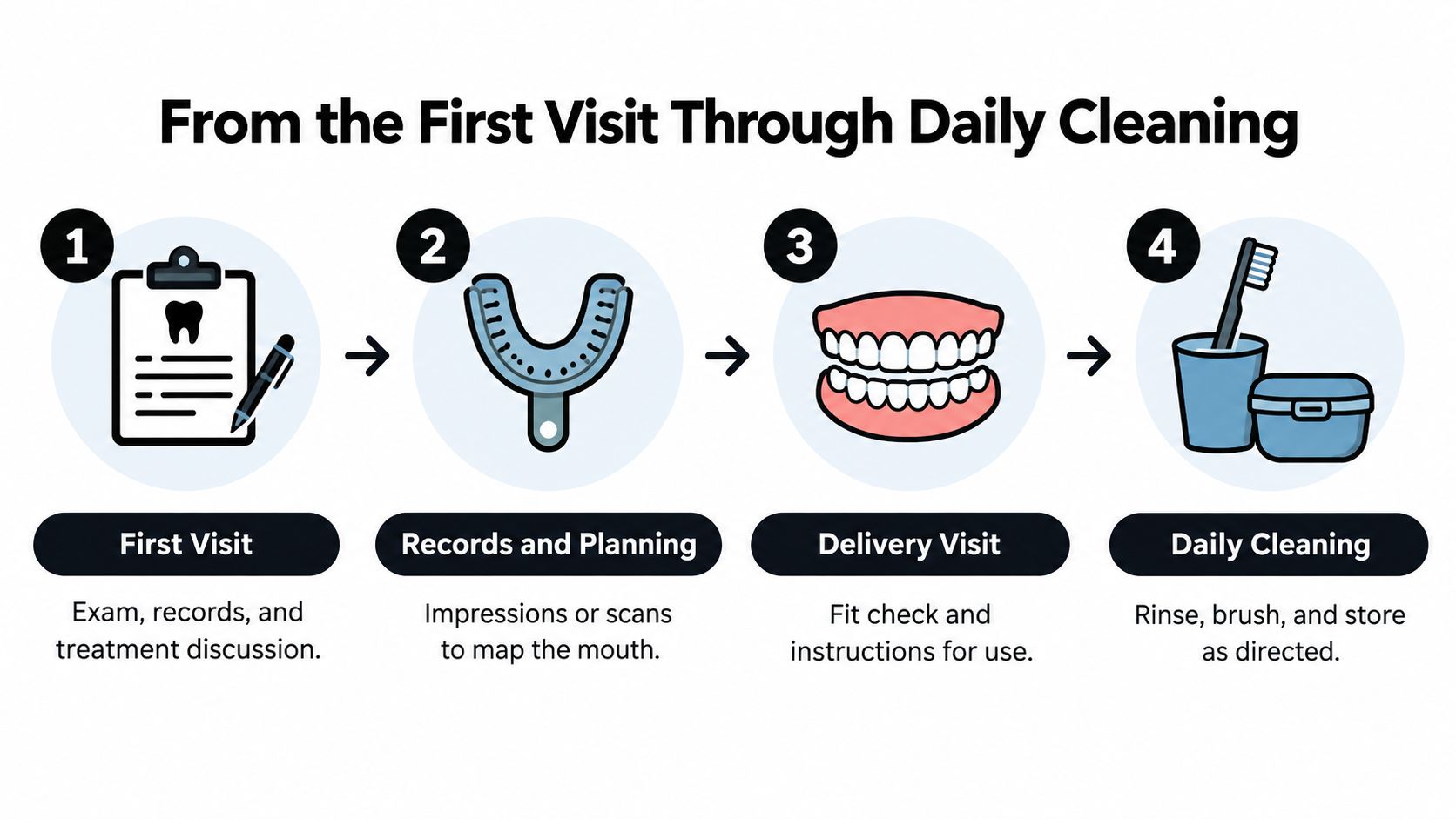
Treatment begins with records and an examination, not with choosing replacement teeth from a photograph. The sequence varies because the condition of the remaining teeth, gums, and bone affects what can safely happen next.
Separate planning, surgery, and making the teeth
Records may include an examination, low-radiation digital X-rays, intraoral photographs, and a digital scan instead of a traditional impression. These tools help the dentist explain the current situation and plan the replacement.
A conventional denture typically proceeds through impressions or scans, try-ins, delivery, and adjustments. A sore spot after delivery needs attention rather than an assumption that discomfort must be tolerated.
Implant treatment adds surgical planning, placement, healing, and reassessment before completing the replacement teeth. Some mouths need grafting or site preservation, which changes the sequence. A guide to the dental implant procedure can help you prepare questions, but your dentist should provide your own appointment map.
- Surgical visits: Address placement, healing, and any bone-related treatment.
- Restorative visits: Address the fit, bite, appearance, and delivery of the replacement teeth.
- Maintenance visits: Monitor tissues, hygiene, and the condition of prosthetic components.
An overdenture remains removable after treatment. It isn't the same design as a fixed All-on-4-style restoration, even though both involve implants.
What happens at the bathroom sink
The American Dental Association's denture-care guidance explains that plaque, stains, calculus, food debris, bacteria, and fungi can accumulate on dentures, and inadequate cleaning can contribute to denture stomatitis. It also presents the American College of Prosthodontists' recommendation for daily soaking and brushing with an effective, nonabrasive denture cleanser.
Implant overdentures require appliance cleaning plus cleaning around the attachments. Fixed implant teeth need brushing, flossing or other appropriate aids, and professional care. Ask the clinician to demonstrate the technique on your actual restoration, then have you practice it.
A recent review of long-term implant maintenance reports that maintenance compliance was associated with 86% fewer peri-implantitis conditions and suggests at least two implant-maintenance visits annually; it also cites a cohort in which 48.6% of implant-supported prostheses had prosthetic complications, most commonly veneer chipping. Those findings describe associations and a particular cohort, not a guaranteed preventive effect or your individual repair risk.
Choosing a Next Step in Midtown
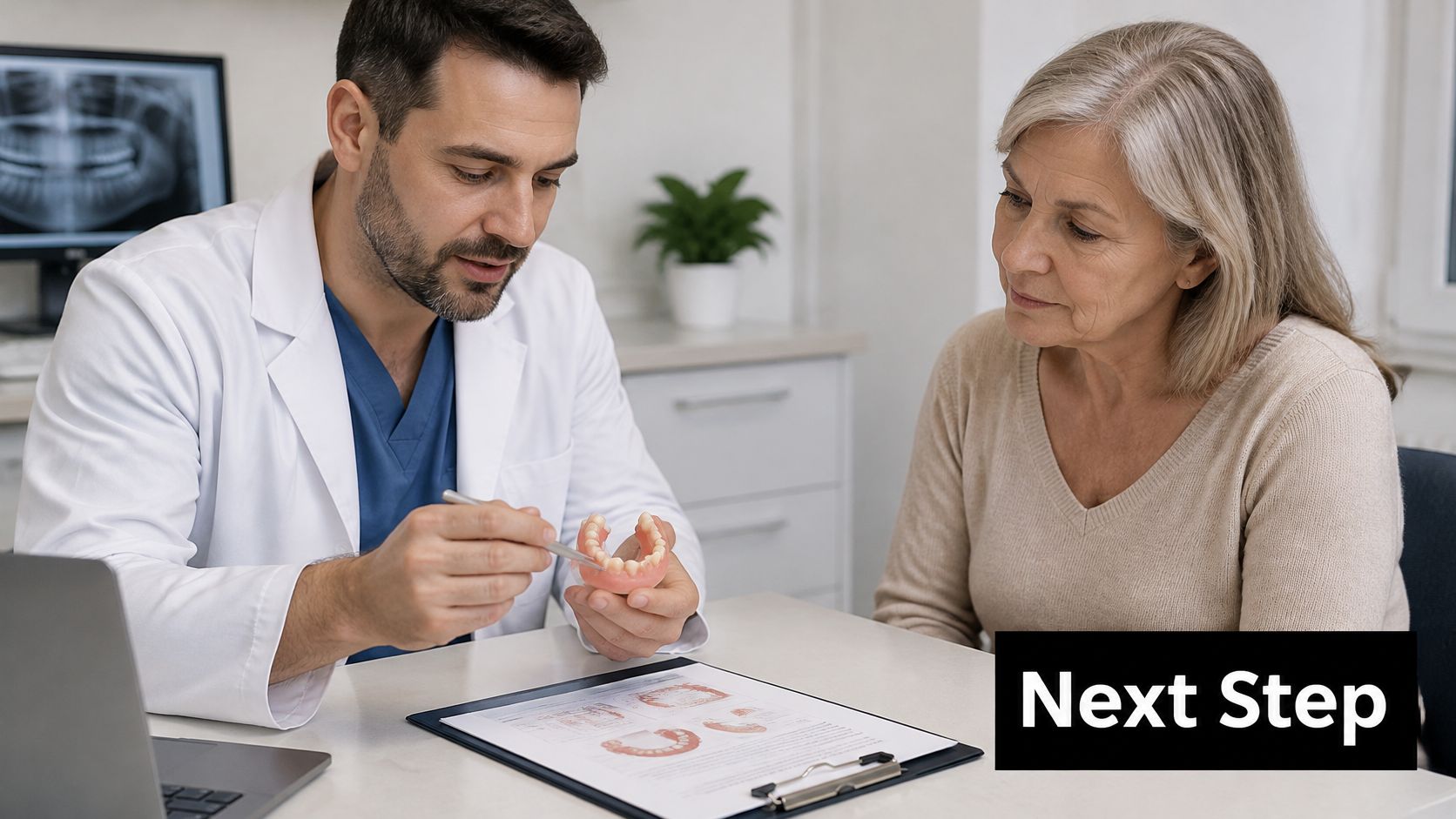
Choose the next conversation before choosing the final appliance. Bring the problem you want solved, whether that's a loose denture, a missing single tooth, a worn bridge, or an entire arch that needs replacement.
The practice website offers a starting point for reviewing available care.
Make the decision around your priorities
The plain decision rule is straightforward: discuss conventional replacement when avoiding surgery matters most, an overdenture when removable retention addresses the main complaint, and fixed treatment when staying in place justifies the surgical and cleaning demands. Smoking, systemic health, bone volume, and future cleaning support can change which preferences are medically workable.
For help preparing that conversation, The Patients Guide offers a resource on choosing treatments that reflect your values. Use that approach to explain what matters most to you, then ask the dentist to describe the compromises rather than naming a preferred procedure.
Leave with a workable appointment plan
At the Midtown family and restorative office, consultation can include digital imaging and scanning, discussion of whether grafting may be needed, and an outline of the maintenance each suitable option requires. Bring your insurance card and describe your calendar constraints before treatment is scheduled.
Ask about teledentistry when an initial conversation could save a trip, and flexible Wednesday and Friday appointments if leaving work midday is difficult. Pain, a fracture, or a broken restoration calls for short-notice assessment rather than waiting for a routine replacement consultation.
The practice video provides another way to become familiar with the office before visiting.
Leave with clarity: You should know what is proposed, why it fits your mouth, what appointments it requires, and how you'll maintain it.
The practice offers conventional dentures, implant-based replacement, digital diagnostics, and ongoing restorative care so you can compare suitable options in the same setting. Visit Paul L. Gregory, DDS to arrange a consultation, bringing your main chewing or denture concern and your insurance information so the discussion can address both your mouth and your schedule.