

You're on the subway, a molar is throbbing, and you type Mendota Dental Associates into your phone because someone mentioned the name or a directory surfaced it first. The listing looks legitimate. The services sound familiar. What isn't obvious is whether that office is anywhere near you, whether it takes your plan, or whether it can see you before this gets worse. That confusion is exactly what you need to clear up before you book anything.
What a Midtown Manhattan Patient Is Actually Searching For
Most Manhattan readers who land on Mendota Dental Associates aren't planning a trip to Minnesota for a cleaning. You're trying to answer a local question with a search result that isn't local, and that mismatch wastes time when you're already in pain or overdue for care. Don't treat a familiar service list as proof of fit.
You're really asking five things. Can this office handle what you need, from prevention to implants? Can you get in quickly, including for an emergency? Will your insurance work there, and what will you owe? Is it reachable from your neighborhood or office? Can your kids stay with the same practice as they grow?
Why emergency access changes the search
A cracked crown on a Tuesday in Midtown doesn't wait for a leisurely comparison. Practices that generate urgent inquiries understand that timing, clear phone pathways, and short-notice slots matter as much as clinical skill, which is why resources on how to get emergency service calls focus on how patients find help under pressure. For you, the practical test is simple. Does the office answer, triage, and offer a realistic appointment?
Routine care raises a different test. If you're comparing options for regular dental cleanings and exams in Manhattan, you're weighing travel time, recall systems, and whether preventive visits connect smoothly to restorative treatment when something turns up. A distant office fails that test quickly, no matter how polished its website sounds.
Don't ask whether a practice looks good online. Ask whether you can reach it, afford it, and return to it without friction.
Geography matters in Manhattan because your day is already fragmented. Someone in Hell's Kitchen, Chelsea, or Hudson Yards makes a different calculation than someone commuting from Wall Street or living near Gramercy Park. Distance isn't a minor detail for multi-visit treatment like implants, root canal therapy, or aligners. It's the difference between finishing treatment and dropping out.
My recommendation is to judge every listing, including Mendota Dental Associates, against those five criteria before you look at branding or star ratings. If an office can't demonstrate local access, insurance clarity, emergency capacity, and family continuity, it's not a serious Manhattan option. That's the standard I'll apply throughout this guide.
What the Public Record Actually Shows About Mendota Dental Associates
Start with what's verifiable, not what's marketed. Mendota Dental Associates is a privately held, family-owned practice in Mendota Heights, Minnesota, with a practice profile reporting a 2015 founding date, a 1 to 10 person workforce, and a location at 720 Main Street, Mendota Heights, Minnesota 55118. That's a small-practice model, not a large dental service organization.
Ownership history adds context. Dr. Stephen Sawyer reportedly practiced in Blaine, Burnsville, and Mendota Heights for more than 20 years and, with his wife as practice manager, owned the office for 10 years, according to that same public profile. Independent directories also associate clinicians including Dr. Janice O. Frederick, DDS, and Dr. Stephen M. Sawyer with the practice, although directories don't always count active providers the same way.
Hours and scope of care
The published schedule is Monday through Thursday from 7:00 a.m. to 5:00 p.m., plus selected Fridays from 8:00 a.m. to noon. That's up to 40 regularly listed weekday hours across Monday through Thursday, with an additional 4-hour Friday session when offered. For a Minnesota patient, early starts may be convenient. For a Manhattan patient, those hours are irrelevant if you can't get there.
- General and preventive care: Exams, cleanings, and fillings form the core offering.
- Restorative care: Crowns, bridges, and partial dentures are listed among its services.
- Implants and cosmetics: Dental implants and teeth whitening extend the scope beyond basic maintenance.
That breadth is real, but it isn't unusual. Many general practices list a similar mix, so service breadth alone doesn't justify choosing an out-of-state office. You still need evidence on outcomes, responsiveness, and patient experience.
Why the review record is thin
Public review coverage won't give you that evidence. A WebMD practice listing reported zero reviews for Mendota Dental Associates at the time of listing, and another directory likewise showed no ratings. Yelp coverage is also very limited.
An absence of reviews isn't proof of poor care. It's proof that you don't have a reliable satisfaction signal.
That's my clear-eyed assessment. The strongest public profile for this practice rests on its Minnesota location, published hours, service list, and clinician listings, not on a large review dataset. If you're in the Twin Cities, you could reasonably call and verify the rest yourself. If you're in Manhattan, the public record already tells you the central fact. This is not a local practice, and no amount of service copy changes that.
The Midtown Benchmark That Any Comparison Has to Beat
A useful comparison needs a fixed yardstick. For a Manhattan patient, that yardstick is a full-service Midtown family practice that handles prevention, restoration, surgery, orthodontics, pediatrics, and emergencies under one roof. Anything less means referrals, repeated histories, and more travel between offices.
Location sets the first part of the benchmark. An office at 57 W 57th St sits near Central Park South and Columbus Circle, at the seam of Midtown, Hell's Kitchen, and the Upper West Side. A commonly used geographic description places Hell's Kitchen between approximately 34th and 59th Streets, Eighth Avenue, and the Hudson River, which explains why patients use overlapping labels for the same trip.
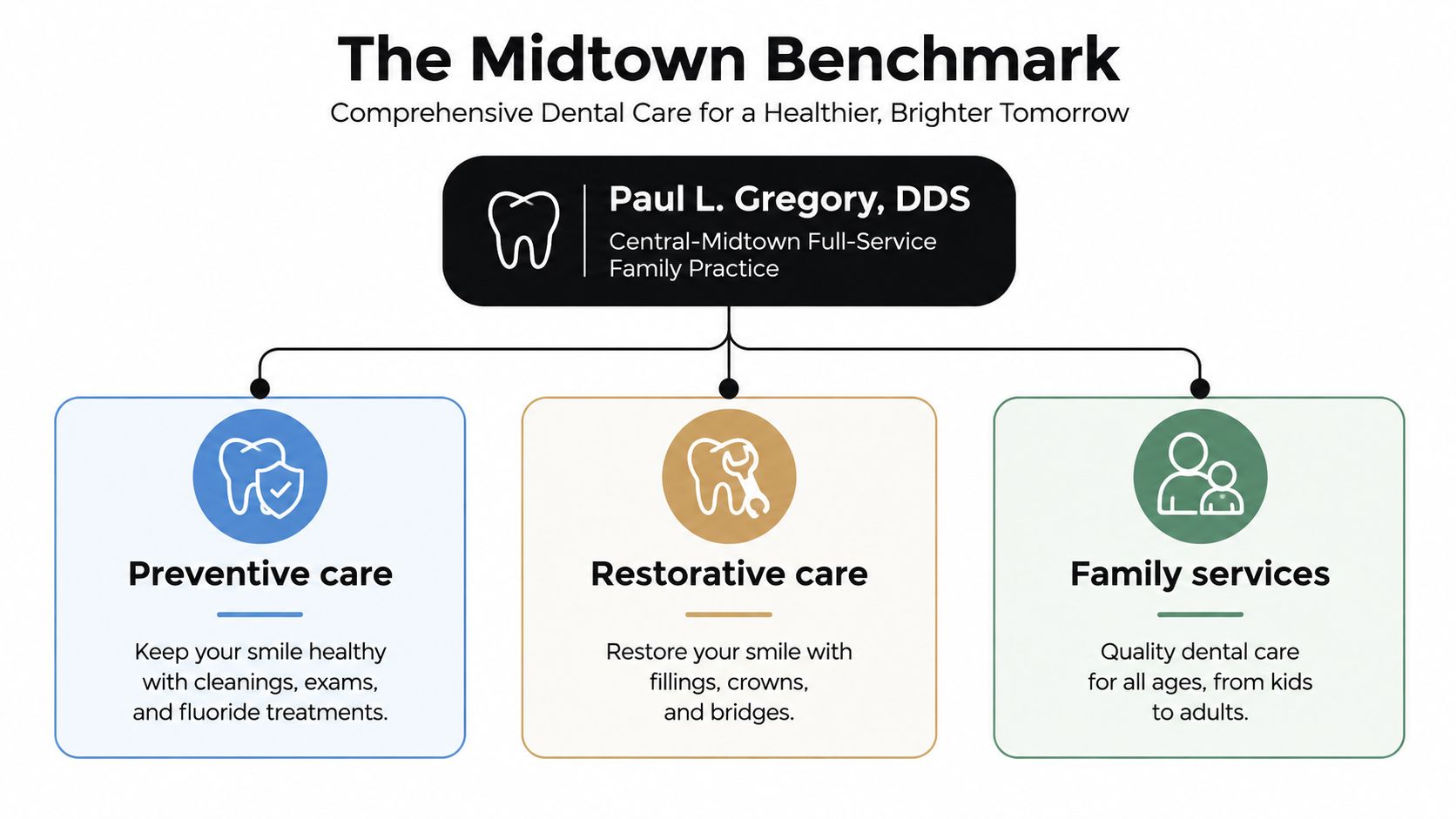
That position is practical, not decorative. It's reachable for office workers in the Theatre District, residents heading down from Lenox Hill and the Upper East Side, and patients crossing from Turtle Bay. If you're evaluating what makes a strong dentist in Midtown Manhattan worth choosing, start with that combination of central access and clinical breadth.
What comprehensive actually includes
- Preventive and diagnostic care: Cleanings, exams, digital X-rays, and oral cancer screenings.
- Restorative and surgical care: Fillings, crowns, bridges, dentures, extractions, and implants, including full-arch solutions.
- Specialty-adjacent care: Root canal treatment, periodontal therapy, porcelain veneers, whitening, and Invisalign.
- Family and urgent care: Pediatric dentistry, night guards, sleep apnea appliances, teledentistry, and short-notice emergency assessment.
Technology is the second part of the benchmark, but don't accept buzzwords. Low-radiation digital imaging should follow the ALARA principle, keeping exposure as low as reasonably achievable while still getting a diagnostic image. Impression-free digital scanning should improve comfort and data transfer, with verification steps for complex implant cases rather than blind confidence in the scanner.
Continuity is the third part. Children, parents, and grandparents shouldn't need three separate offices for routine needs. A Midtown benchmark practice keeps records, habits, and treatment history together over years. That's the standard Mendota Dental Associates, or any out-of-area listing, has to beat for a Manhattan household. On geography alone, it can't.
Side by Side Criteria for a Manhattan Patient
Features don't decide this comparison. Consequences do. The table below puts the Minnesota practice next to the Midtown benchmark on the criteria that affect your time, money, and ability to finish treatment.
Comparison Criteria for a Midtown Manhattan Patient
| Criterion | Mendota Dental Associates (MN) | Midtown Manhattan full-service practice |
|---|---|---|
| Services and technology | General, restorative, cosmetic, and implant care including crowns, bridges, partial dentures, fillings, and whitening | Preventive, restorative, endodontic, periodontal, implant, surgical, cosmetic, Invisalign, pediatric, sleep apnea, and emergency care with digital imaging and scanning |
| Hours and emergency access | Monday to Thursday daytime schedule, selected Friday mornings, no Manhattan access | Central location with short-notice emergency capacity and flexible special appointments |
| Insurance handling | Public listings give little detail on plans, estimates, or partial coverage | Help with most plans and claim submissions, verified case by case before treatment |
| Pediatric continuity | Family-oriented general practice, but unreachable for routine Manhattan recalls | Pediatric and adult care under one roof for long-term continuity |
Services and clinical technology
Both models cover everyday dentistry, so don't stop at the service list. The Midtown benchmark adds root canal treatment, periodontal therapy, oral surgery, clear aligners, and dedicated pediatric care without sending you elsewhere. That matters when a routine exam uncovers gum disease or a failing tooth that needs coordinated implant planning.
Technology needs the same scrutiny. ADA guidance reports digital dental imaging can reduce radiation dose by approximately 40–60% compared with film-based imaging, with actual patient dose depending on indication, sensor, collimation, and retake rate. Owning a digital sensor isn't enough. Ask about indication-based imaging, calibrated settings, positioning, and how the office avoids retakes, especially for children and patients who need serial monitoring.
Hours and emergency availability
A Monday to Thursday schedule in Minnesota can't help a Manhattan patient with swelling on a Friday. Local short-notice availability, including special Wednesday and Friday appointments at benchmark practices, changes whether you get stabilized quickly or spend a weekend managing pain. For implants, crowns, and aligners, repeated local visits also beat any theoretical advantage of a distant office.
Practical rule: If you can't reach the office on your worst dental day, don't choose it for your routine care either.
Insurance and payment handling
Vague websites hurt patients most. Public coverage for Mendota Dental Associates gives little practical detail about accepted plans, claim handling, or what happens when treatment is only partly covered. Before you commit anywhere, work through the difference between in-network and out-of-network dental care and ask for a pre-treatment estimate in writing.
Pediatric and family continuity
A family in Chelsea or the West Village shouldn't split care across boroughs, let alone states. Pediatric sealants, fluoride, growth monitoring, adult restorative work, and senior prosthetics belong in one record whenever possible. The Midtown benchmark wins this criterion because continuity is built into its model. The Minnesota option only works if your family resides near Mendota Heights.
Which Manhattan Patients Should Consider Which Option
Your situation, not a generic ranking, should drive the decision. These six Manhattan scenarios show how the criteria above play out in real life, and in each one my advice is direct. Stay local unless you have a specific, verifiable reason not to.
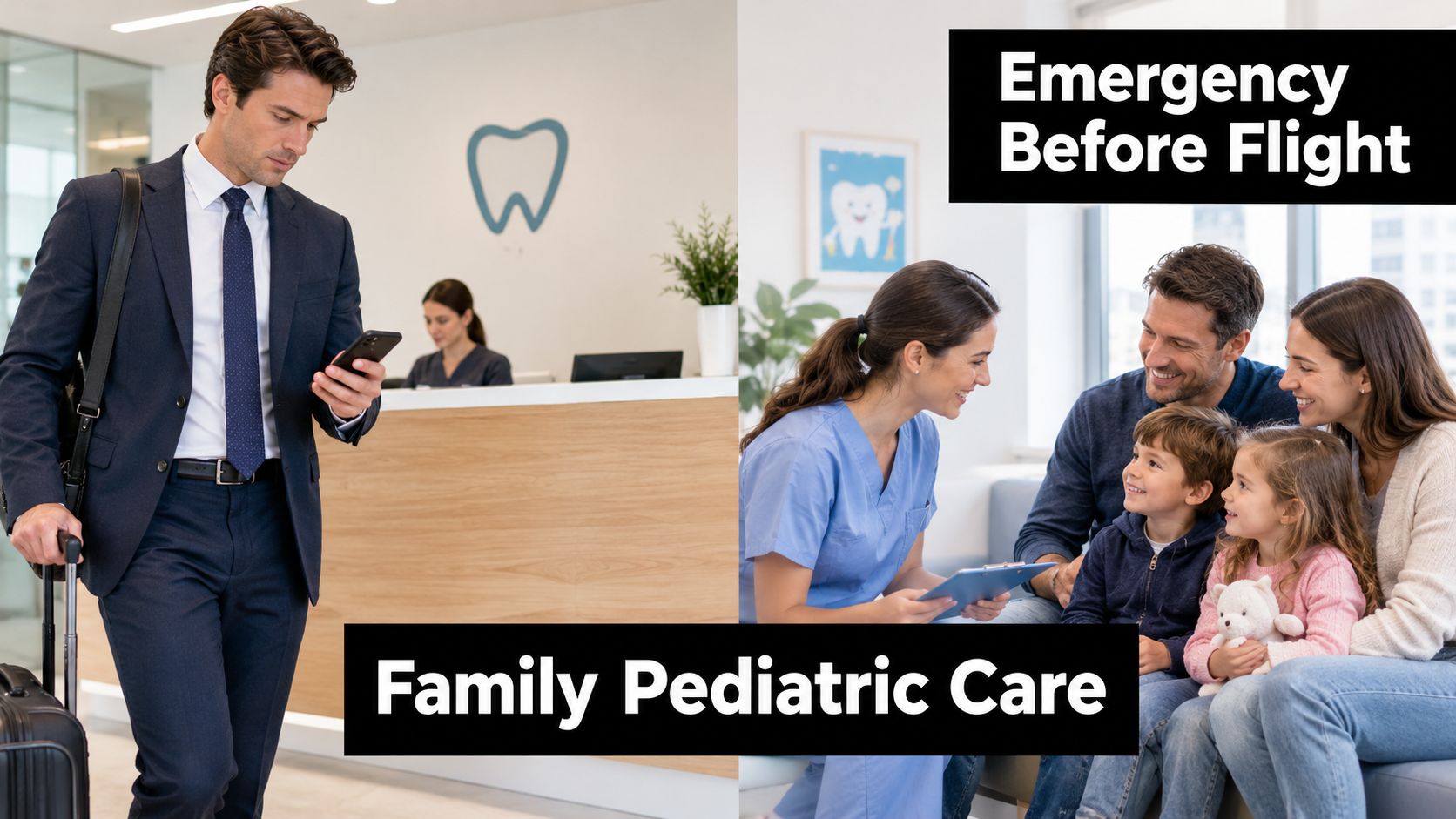
Emergency before a flight. A Hell's Kitchen professional cracks a tooth hours before leaving for the airport. You need assessment, stabilization, and a clear plan today, not a directory listing in another state. Choose the Midtown office with short-notice capacity and ask what can safely wait until you return.
Family care under one roof. An Upper East Side family wants pediatric visits, parental crowns, and grandparent denture care coordinated together. A local full-service practice keeps recall schedules and records aligned. If gum problems appear along the way, you can address treatment options with a dentist for gum disease without starting over elsewhere.
Implant and full-arch decisions
A SoHo resident weighing a single-tooth implant needs imaging, surgery, healing checks, and a final crown over multiple visits. Travel friction compounds at every stage, and small fit or bite issues need prompt chairside review. A Manhattan practice you can revisit easily is the safer choice.
A Wall Street patient rebuilding a full arch faces an even longer sequence, including possible grafting, provisional restorations, and adjustments. Don't underestimate the follow-up burden. Full-arch work rewards proximity because comfort, speech, and bite are refined over time, not settled in one appointment.
Cosmetic, orthodontic, and language needs
A Hudson Yards professional combining Invisalign with whitening needs periodic aligner checks and honest sequencing, since whitening and movement have to be timed sensibly. A central office near work makes those brief visits realistic between meetings. Missed check-ins are how aligner treatment drifts off schedule.
A Chinatown family looking for a bilingual-friendly, English-language practice should prioritize clear explanations, written estimates, and unhurried consent conversations. Ask directly how the team handles questions from family members who help with decisions. Communication quality is a clinical safety issue, not a courtesy extra.
- Choose Midtown: You live or work in Manhattan and need ongoing, emergency, pediatric, implant, or orthodontic care.
- Consider Mendota Heights: You're relocating, visiting family, or already have a treatment history there.
- Verify first either way: Insurance participation, emergency protocol, and who provides follow-up if something hurts after treatment.
The Manhattan-Specific Recommendation
Here's my call. If you live or work in Manhattan, choose a Midtown full-service practice with documented digital workflows, short-notice emergency capacity, and pediatric continuity. Mendota Dental Associates is a reasonable option only if you're in Mendota Heights for family, relocation, prior treatment, or a planned Twin Cities stay.
Neighborhood labels help you judge reach, but don't treat them as legal borders. New York City's Department of City Planning explains that Neighborhood Tabulation Areas are aggregations of census tracts and that their boundaries and names may not definitively represent neighborhoods. Use the names as practical wayfinding, then check your actual trip.
How this breaks down by area
- Midtown West and Theatre District: A West 57th Street office is an easy default for lunch-hour prevention and urgent problems.
- Upper West Side and Upper East Side: You gain one dental home for children and adults, including patients coming from Lenox Hill and Turtle Bay.
- Chelsea and Hudson Yards: Central access supports multi-visit restorative and aligner care without cross-town detours piling up.
- Lower Manhattan: Residents from Tribeca, SoHo, NoHo, Greenwich Village, West Village, East Village, Chinatown, and Wall Street should still choose a Manhattan office they can reach repeatedly, even if another neighborhood practice ends up closer than Midtown.
City geography supports that neighborhood-based thinking. Official City Council district listings group areas such as Tribeca, SoHo, Chinatown, Chelsea, Hudson Yards, Hell's Kitchen, Turtle Bay, and the Upper East and Upper West Sides within Manhattan's civic geography. These are recognized places with real travel patterns, not marketing inventions.
What could change my answer? An established relationship with a Minnesota clinician, a documented specialization you can't find locally, or verified insurance alignment tied to a move. Absent one of those, don't let a search result override geography. Dentistry is a relationship built over repeat visits, and repeat visits only happen when the office fits your life.
The Questions Patients Skip and the Access Gap That Still Matters
Convenience doesn't eliminate access barriers, and reputation doesn't pay your balance. Patients routinely book first and ask about coverage later, then delay treatment when the estimate surprises them. That's avoidable if you ask better questions before anyone picks up a drill.
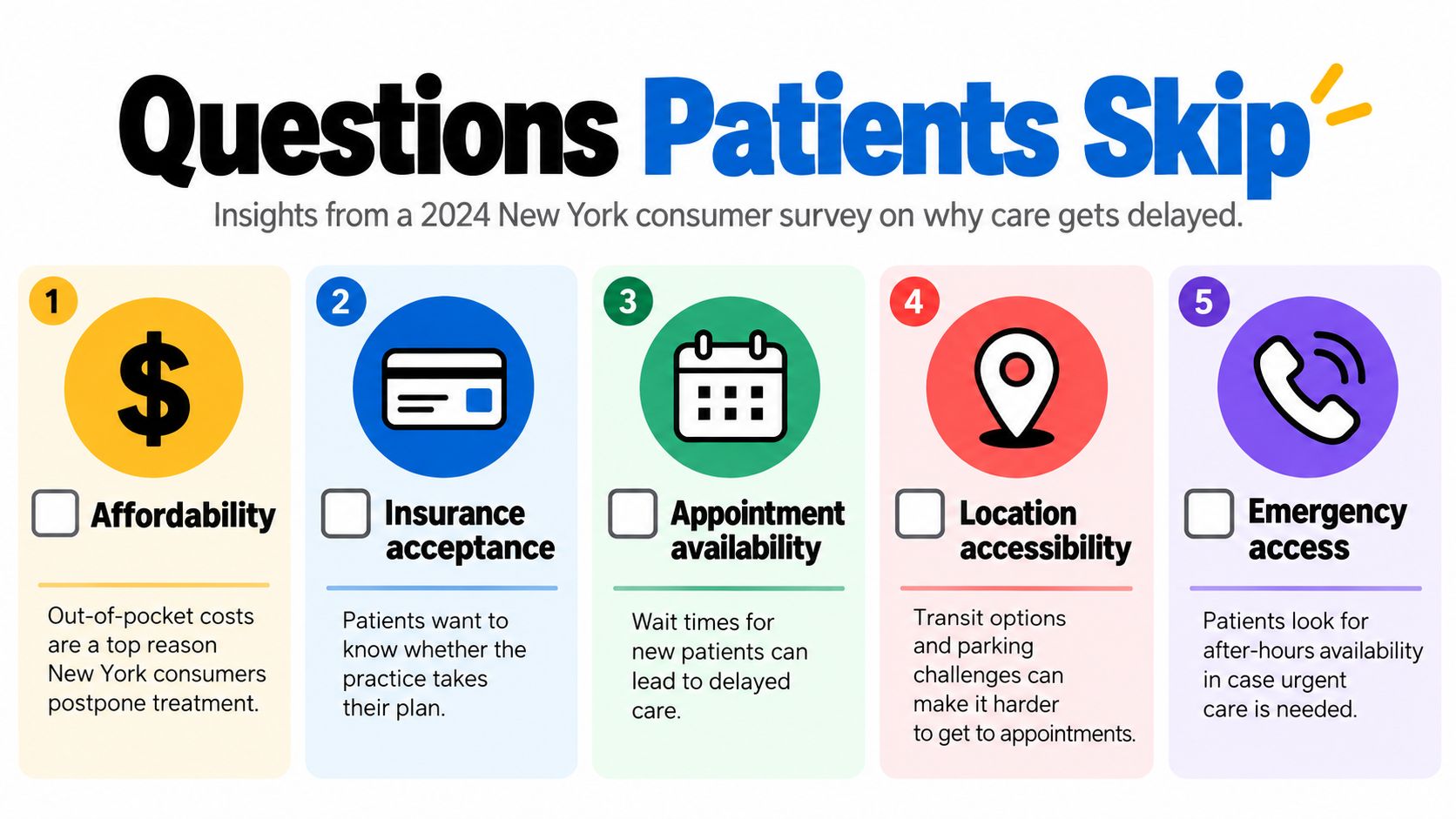
The stakes are documented. A 2024 New York consumer survey found 43.4% of respondents experienced a major barrier to dental care, led by unaffordable visits at 11.5%, lacking dental insurance at 9.8%, difficulty finding a dentist who accepted their plan at 9.8%, and discovering needed services were excluded at 8.4%. Administrative uncertainty is itself a reason people postpone care.
Technology claims deserve the same skepticism. For implant impressions, a systematic review and meta-analysis found a mean three-dimensional deviation difference of 8.20 µm between digital and conventional impressions in completely edentulous models, with no statistically significant difference at p = 0.72, while partially edentulous cases showed a 52.31 µm difference favoring conventional impressions at p = 0.03. Digital scanning is valuable and often more comfortable, but it isn't automatically superior in every case. Ask about scan-body checks, bite validation, and try-in steps.
Your pre-booking checklist
- Confirm benefits directly: Give the office your plan details and review how dental insurance and payment plans typically work before treatment begins.
- Get the estimate in writing: Separate diagnostic, preventive, restorative, cosmetic, and emergency charges so exclusions are visible.
- Test emergency access: Ask who responds after hours and how quickly urgent patients are usually seen.
- Check pediatric continuity: Confirm age ranges, sealants, fluoride, and referral policy if your child needs specialist care.
- Map the follow-up: For implants or aligners, count the visits and make sure you'll realistically attend them.
Ask those five questions of Mendota Dental Associates, a Midtown benchmark practice, or any office you find online. The practice that answers clearly, in writing, before treatment is the practice that respects your time and money. Don't settle for less because a listing ranked first.
If you're weighing a confusing out-of-state listing against care you can reach, choose the office that can verify your benefits, see you promptly, and keep your family's treatment under one roof in Midtown. Paul L. Gregory, DDS offers preventive, restorative, cosmetic, implant, pediatric, and emergency dentistry at 57 W 57th St, with digital imaging and scanning built into everyday care. Visit the practice online to request an appointment and confirm how your insurance and treatment needs will be handled before you commit.