

The most popular advice about dental implants for seniors is also the least useful: “You're never too old.” Age alone usually isn't the deciding factor, but reassurance without a medical and practical assessment can be just as misleading as age-based refusal. Implants may improve stability and chewing, yet they won't automatically correct swallowing problems, medication-related dry mouth, limited food access, or broader nutritional decline.
In my Manhattan practice, the better question is whether an older adult has enough healthy bone, controlled medical conditions, manageable hygiene needs, and reliable access to follow-up care. A thoughtful plan may involve one implant, an implant-supported overdenture, a fixed bridge, or conventional dentures. The right choice depends on the person, not the sales pitch.
Age Is Not a Barrier to Implant Success
Age alone does not rule out implant treatment. A systematic review and meta-analysis of older adults reported pooled implant survival of 97.7% after one year, 96.3% after three years, 96.2% after five years, and 91.2% after ten years, based on studies with different follow-up periods (Clinical Oral Implants Research review). The review described implant therapy for older patients as a potentially predictable long-term option, while acknowledging bone changes and complications.
Those figures describe groups, not a promise for one patient. Results depend on anatomy, periodontal health, smoking, diabetes control, medications, manual dexterity, and attendance at maintenance visits. An older adult who can clean around a restoration and return for monitoring may have a more favorable outlook than a younger patient with uncontrolled disease or unreliable follow-up.
What the evidence actually changes
A pooled comparison found no statistically significant difference in implant loss between adults aged 60 or more and those aged 54 or less. The estimated risk ratio was 0.92, with a 95% confidence interval from 0.43 to 1.96 and a P value of 0.83. Clinically, that supports assessing medical stability, oral hygiene, and maintenance capacity instead of using a birthday as a treatment cutoff.
Implant stability depends on biology and mechanics, not age labels. In the 1950s, Per-Ingvar Brånemark observed that a commercially pure titanium cylinder placed in a rabbit femur became firmly integrated with bone. In 1965, he placed the first commercially pure titanium dental implant in a human volunteer. This process, called osseointegration, remains central to treatment because the implant must form a direct structural and functional connection with living bone (ITI consensus statement on advanced age and systemic conditions).
The practical question is whether treatment can deliver a stable, cleanable restoration that fits the patient's health, function, and daily routine. In Manhattan, that assessment also includes transportation, caregiver support, and the ability to reach the office for staged treatment and recalls.
Practical rule: A birth date starts the conversation. It doesn't finish the diagnosis.
Families can review this guide to who is a good candidate for dental implants before assuming age settles the decision. The consultation should identify risks that can be improved, risks requiring medical coordination, and cases where another restoration is safer or more practical.
Navigating Bone Loss and Systemic Health
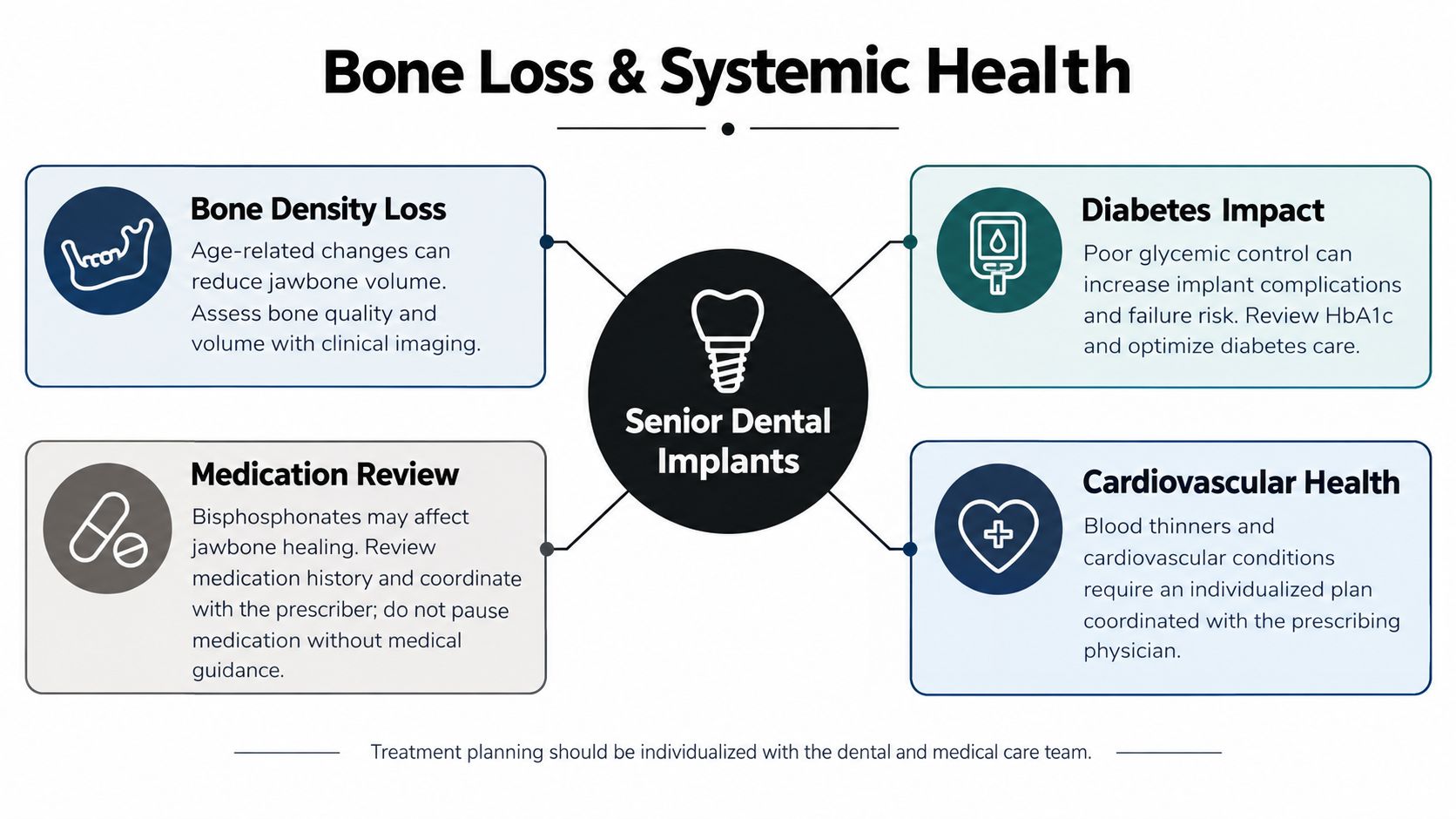
Challenges often sit beside aging rather than inside the number of years a patient has lived. Reduced bone volume can limit implant placement, while osteoporosis, diabetes, periodontal disease, dry mouth, and multiple medications can affect surgical planning, healing, comfort, or daily cleaning.
Why bone and healing matter
Osseointegration requires close, stable contact between the implant surface and healthy bone. If bone is too thin or too soft in the planned location, the implant may need a different position, a staged approach, or additional support. Bone grafting and site preservation can rebuild or protect anatomy, but they add planning, healing, and maintenance considerations rather than removing them.
A senior's medical history should include every prescription, over-the-counter medication, supplement, and previous surgery. Blood-thinning medication may require coordination with the prescribing physician. Medications that contribute to dry mouth can raise the risk of decay and inflammation around remaining teeth and restorations. Diabetes requires attention to disease control and healing, not an automatic rejection of treatment.
The medical review is part of the treatment
I look for practical details that can determine whether a technically sound implant remains maintainable. Can the patient brush effectively despite arthritis or tremor? Is there a caregiver who can help? Does the patient have a history of periodontal disease? Can the patient return if a temporary restoration needs adjustment?
Nutrition can support general health, but dietary changes don't replace medical coordination. Families may find it useful to review guidance on managing chronic conditions with diet alongside advice from the patient's physician and dietitian. The dental team should also ask about swallowing difficulty, hydration, appetite, and food texture tolerance.
A thorough evaluation can include periodontal treatment before surgery, medication coordination, management of dry mouth, and a discussion of whether grafting is appropriate. For patients with substantial structural loss, a detailed explanation of what bone grafting for dental implants involves helps set realistic expectations. The goal isn't to force an implant into unsuitable anatomy. It's to determine whether the anatomy can be improved safely and whether the final restoration will be cleanable and functional.
Choosing the Right Implant Configuration
Replacing one missing tooth is a different clinical problem from stabilizing a loose lower denture or rebuilding an entire arch. Seniors don't automatically need a full-mouth reconstruction, and placing an individual implant for every missing tooth may create more surgery, more surfaces to clean, and more prosthetic maintenance than the patient needs.
A single-tooth implant can preserve the adjacent teeth when those teeth are healthy and the missing site has suitable bone. A multi-unit fixed bridge can replace several teeth while distributing forces across planned support points. An implant-supported overdenture uses implants to improve retention while remaining removable for cleaning. A fixed full-arch restoration offers a different experience, but it requires careful assessment of bone, hygiene, bite forces, speech, expectations, and repair access.
Biomechanics should guide the design
For overdenture patients older than 65, splinting implants was associated with 5.6-fold higher survival than non-splinted configurations, according to the evidence summarized in the senior implant literature (systematic review of implant outcomes in older adults). The practical lesson isn't that every overdenture needs a bar. It's that retention and load distribution deserve deliberate planning, especially when a patient has limited dexterity or significant chewing forces.
A newer review of patients with a mean age of 65 or older included 27 studies and 3,892 implants. It reported five-year survival of 92.1% among patients aged 65 to 75 and 96.8% among patients older than 75, while finding no significant difference in implant success between the age groups (review of implant outcomes in older patients). These results reinforce the need to match the prosthetic design to anatomy and maintenance ability.
Senior tooth replacement options compared
| Option | Stability | Maintenance Demand | Best For |
|---|---|---|---|
| Conventional denture | Removable, with stability varying by ridge anatomy and fit | Remove and clean regularly, with periodic relining or repair as needed | Patients seeking a non-surgical option or those unable to undergo implant treatment |
| Implant-supported overdenture | Improved retention and controlled movement compared with a conventional denture | Clean the denture and attachment areas, with professional monitoring | Patients who want removable care with greater stability |
| Implant-supported bridge | Fixed replacement with support distributed across planned implants | Brush, use interdental tools, and attend restorative maintenance visits | Patients missing several teeth with suitable support and cleaning capacity |
| Full-arch fixed prosthetic | Fixed restoration with broad functional replacement | Detailed daily hygiene beneath the prosthesis and ongoing professional review | Patients seeking a fixed full-arch solution who can manage long-term care |
Patients comparing full-arch designs should review the clinical and maintenance differences in All-on-4 versus All-on-6 treatment with their dentist. The most extensive option isn't automatically the most appropriate one.
The Digital Planning and Diagnostic Phase
Good implant surgery begins before surgery. The diagnostic phase should connect the patient's medical condition, bone anatomy, bite, hygiene ability, and desired restoration into one plan rather than treating the implant as an isolated screw.
What the planning visit should answer
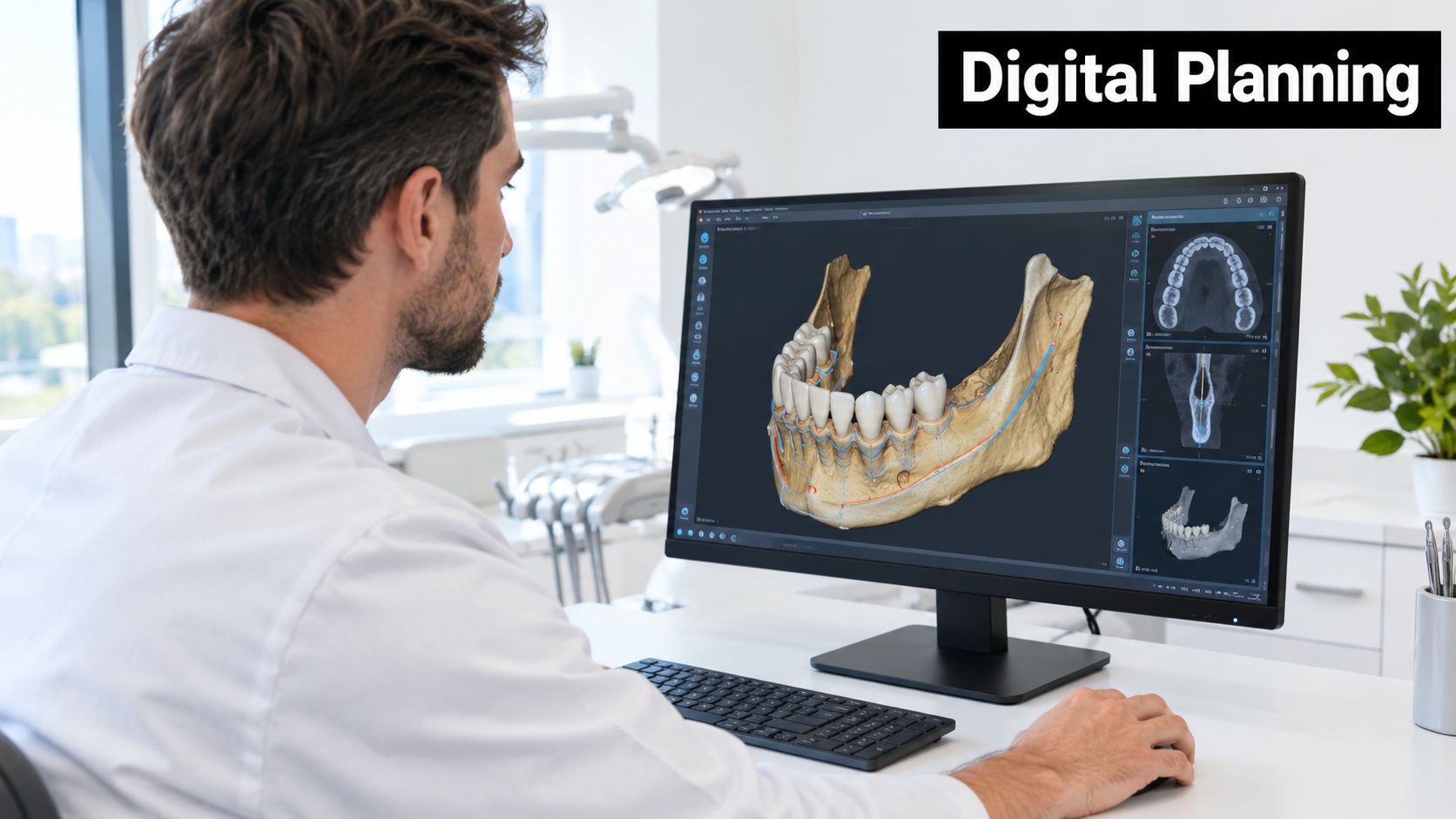
Low-radiation digital X-rays can help assess teeth, roots, and surrounding structures. Three-dimensional imaging can show bone width, available height, sinus anatomy, and the location of important nerves. An intraoral camera helps identify cracks, gum inflammation, decay, and areas that a patient may not see at home.
Impression-free digital scanning creates a three-dimensional model of the mouth without conventional impression material. The dentist can use the scan to evaluate the bite, design a temporary restoration, and coordinate the surgical position with the final crown, bridge, overdenture, or full-arch prosthesis.
The medical interview matters just as much as the technology. Bring an updated medication list, information about diabetes or cardiovascular conditions, details about previous periodontal treatment, and a realistic account of who can help with transportation and home care. Digital planning improves precision, but it can't compensate for an uncontrolled medical condition or a restoration the patient cannot clean.
After the clinical and imaging review, the dentist should explain alternatives, likely stages, healing considerations, maintenance demands, and what happens if the plan needs to change. A visual plan is useful only when the patient understands the decisions behind it.
Realistic Expectations for Function and Nutrition
Implants can improve chewing efficiency, bite force, and a patient's sense of dietary satisfaction, but they aren't a nutritional cure. A recent evidence synthesis covering 18 studies found generally improved chewing and self-reported dietary outcomes, while objective nutritional markers and body measurements remained inconsistent (evidence synthesis on implants, nutrition, and function). Better chewing doesn't automatically prevent weight loss or correct malnutrition.
That distinction is important in consultations. A stable prosthesis may make it easier to manage foods that were previously frustrating or embarrassing, but swallowing difficulty, dry mouth, medication effects, facial changes, reduced appetite, and food access can continue to limit a diet. If a patient is losing weight, coughing during meals, or avoiding broad categories of food, the dental restoration should be one part of a wider medical and nutritional evaluation.
Match the restoration to the daily problem
Ask what the patient wants to change. Someone may need a denture that stays in place during conversation. Another person may need one missing molar restored so chewing feels balanced. A third may need an entire arch rebuilt, but may be better served by a removable implant-supported option that a caregiver can remove and clean.
Conventional dentures avoid implant surgery but can move, require adaptation, and may need relining as the supporting ridge changes. Implant-supported restorations can improve stability, but they demand more precise hygiene and professional monitoring. Fixed restorations can feel more natural to some patients, yet cleaning beneath them may be difficult when dexterity declines.
Better chewing is a meaningful outcome. It's not the same as guaranteed nutritional recovery.
During healing or after extensive treatment, soft foods may be practical. Families looking for meal ideas can use a Prime Journal guide to soft meals, while keeping the patient's medical needs and swallowing safety in view. The restoration should support eating, not create pressure to rush into textures the patient cannot manage safely.
Long-Term Maintenance and Peri-Implant Care
The surgery is only the beginning. An implant can integrate successfully and still develop problems around the gum, screw, crown, or bridge if daily cleaning and professional review lapse.
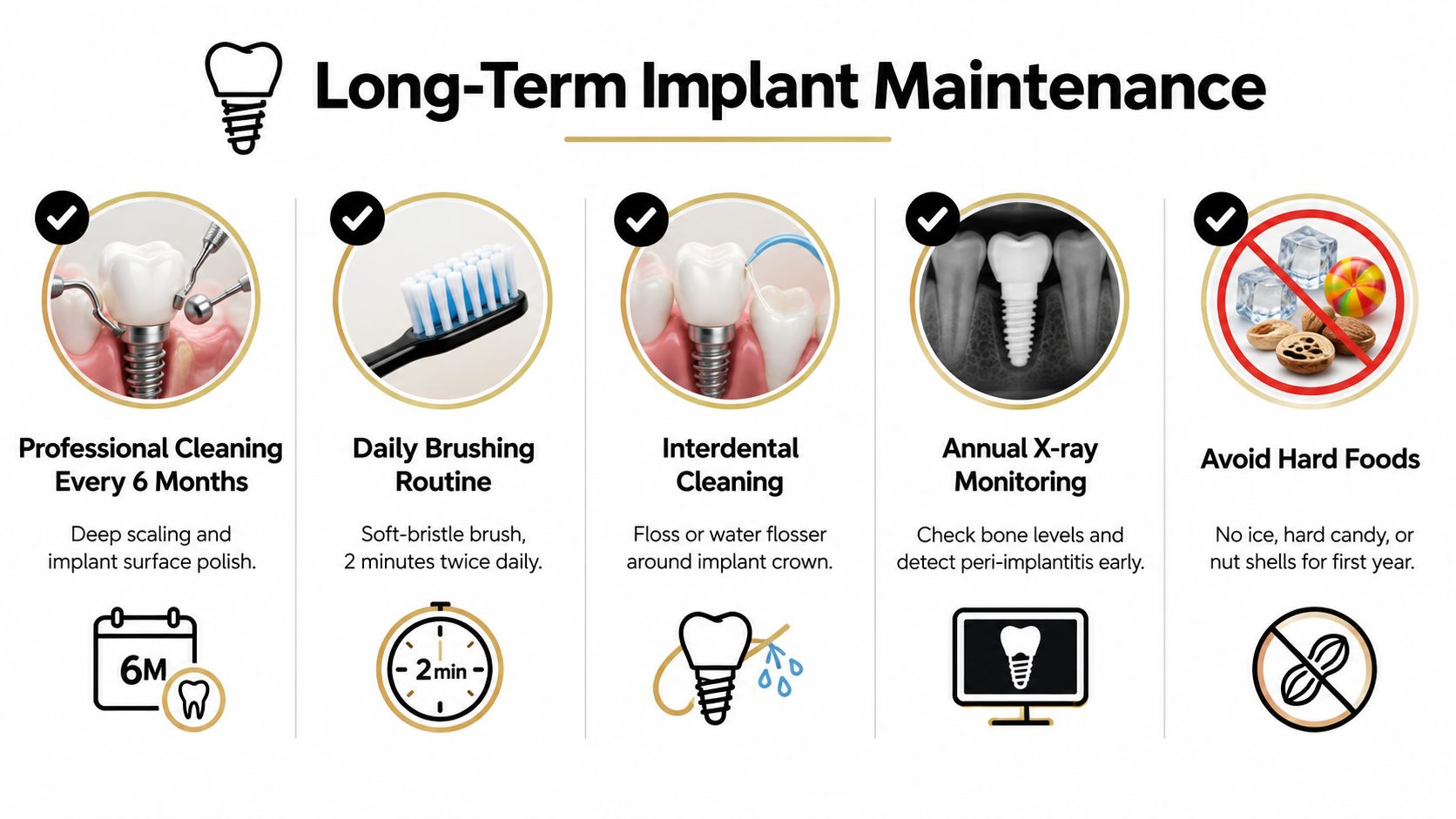
A typical maintenance conversation includes brushing around the restoration, cleaning beneath bridges or full-arch prostheses, checking for bleeding, and reporting looseness or changes in comfort early. Reduced dexterity can make a technically excellent restoration difficult to maintain. An electric toothbrush, enlarged handle, floss threader, interdental brush, or water flosser may make the difference between a manageable routine and an ineffective one.
Problems that require attention
Peri-implant inflammation, screw loosening, prosthesis fracture, ceramic chipping, and retention problems remain possible even when overall implant survival is high. A patient who notices bleeding, bad taste, swelling, mobility, or a change in the bite shouldn't wait for the next routine visit.
A useful maintenance plan should account for the patient's hands, eyesight, memory, caregiver support, and transportation. Some patients can manage a detailed routine independently. Others need a simpler restoration and scheduled assistance. The best long-term design is one the patient can clean.
Maintenance should be planned before placement
Professional visits allow the team to inspect soft tissue, remove deposits, evaluate the prosthesis, and monitor bone levels when indicated. The recall interval should reflect the patient's periodontal history, hygiene performance, restoration design, and medical risk rather than a universal schedule.
Home care instructions need to be specific. A patient with an overdenture should know how to clean the attachments and when to remove the prosthesis. Someone with a fixed bridge needs tools that reach beneath the bridge. The detailed guide on how to clean dental implants can help patients and caregivers establish a routine.
The most durable result is usually the one supported by realistic habits. If attending maintenance visits is difficult, that logistical problem belongs in the treatment decision from the start.
Accessing Complex Implant Care Across Manhattan
Complex implant treatment may involve examination, imaging, periodontal preparation, surgery, temporary restoration, final prosthetic work, and maintenance. For an older adult, the burden isn't only clinical. It includes transportation, stairs, weather, caregiver schedules, medication timing, and coordinating records between offices.
A centralized Midtown location can reduce that friction when preventive, restorative, periodontal, and implant services are coordinated within one practice. Paul L. Gregory, DDS is located at 57 W 57th Street, near Central Park South and Columbus Circle, placing care within reach of patients traveling from Midtown and surrounding Manhattan neighborhoods.
That includes Chelsea, the Upper West Side, the Upper East Side, Lenox Hill, Turtle Bay, Hell's Kitchen, the Theatre District, Gramercy Park, the West Village, Greenwich Village, NoHo, the East Village, SoHo, Tribeca, Hudson Yards, Chinatown, and Wall Street. Manhattan is not one uniform service area, and travel time can shape whether a patient consistently attends the visits that protect an implant.
Continuity helps families manage care
Keeping diagnostic images, surgical notes, restorative plans, and maintenance findings connected can simplify communication with family members and medical providers. It can also reduce the risk that one clinician misses information held by another office. Adult children coordinating appointments may find practical scheduling ideas in this guide for adult children caregivers.
Patients should still ask whether the practice can manage the specific complexity of their case, how urgent adjustments are handled, and what happens if specialist coordination becomes necessary. A centralized office is useful when it supports continuity, not merely because it has a convenient address. For an overview of implant treatment options and evaluation, review dental implants in Manhattan.
Paul L. Gregory, DDS provides implant evaluation, bone grafting, implant-supported dentures, single-tooth replacement, and full-arch rehabilitation with digital diagnostics in Midtown Manhattan. If you're considering dental implants for yourself or an older family member, visit Paul L. Gregory, DDS to arrange a consultation focused on health, function, maintenance, and realistic treatment options.