

You feel a sharp jolt in a back tooth while biting into lunch near Midtown, then notice the same tooth reacting to coffee. Your calendar is already crowded, so the idea of several dental visits, a temporary crown, insurance questions, and a permanent restoration feels difficult to fit in. Yet a cracked or heavily weakened tooth can't be judged by appearance alone. Dental crown services are a decision about protection, biology, bite forces, material, and maintenance, not merely a cosmetic upgrade.
A crown may preserve a tooth that has lost too much structure for an ordinary filling, but it also requires careful preparation of the remaining tooth. The right choice can differ between a molar in a patient who grinds at night and a front tooth for a public-facing professional. This guide follows that decision from the first conversation through long-term care, with practical context for patients across Manhattan, including Midtown, Chelsea, the Upper West Side, Upper East Side, Lennox Hill, Turtle Bay, Hell's Kitchen, the Theatre District, Gramercy Park, West Village, Greenwich Village, NoHo, East Village, SoHo, Tribeca, Hudson Yards, Chinatown, and Wall Street.
Meeting the Patient in the Chair
At 8:10 in the morning, a Midtown consultant checks her phone outside the operatory and presses a hand against her cheek. The molar began hurting after she bit down on something firm. It doesn't ache constantly, but cold water causes a quick, deep sensitivity, and chewing on that side feels unreliable.

She wants a crown because a colleague mentioned one, but a responsible consultation starts earlier. The dentist asks when the pain began, whether it lasts after the cold stimulus, whether the tooth has had a large filling or root canal, and whether she clenches during stressful workdays. A visual examination, bite assessment, intraoral images, and digital X-rays help determine whether the tooth has a surface crack, decay around an old restoration, an inflamed nerve, or damage that still may be treated more conservatively.
Is a crown actually necessary
A filling replaces a limited area of lost tooth structure. A crown covers the prepared tooth more broadly, so it becomes useful when the remaining walls are too weak to tolerate normal chewing or when a root-treated tooth needs additional protection. But full coverage isn't automatically the right answer. If the nerve is severely inflamed or infected, endodontic treatment may be needed before the crown, and if too little healthy structure remains, the dentist must discuss whether the tooth can be predictably saved.
The patient also raises the common initial questions: How many appointments will this take? Will she need a temporary? What material will look natural? What will insurance cover? Those questions matter, but the first priority is identifying the condition of the tooth and its supporting tissues.
Practical rule: A crown protects a tooth only when the tooth beneath it, the gum around it, and the patient's bite can support the restoration.
For a busy practice, access and communication affect the experience too. Patients comparing offices may find it useful to understand how Heyline AI phone staff for dentists can help dental teams manage calls and appointment communication, especially when a patient has sudden pain or a restoration breaks during a workday.
What a Crown Actually Does for a Tooth
A dental crown is an indirect restoration, meaning the restoration is designed and fabricated outside the mouth before the dentist bonds or cements it over a prepared tooth. Think of it as a custom-made garment rather than a patch. A filling repairs one damaged area, while a crown reshapes and covers the visible portion of a tooth so chewing forces can distribute more safely across the restored structure.
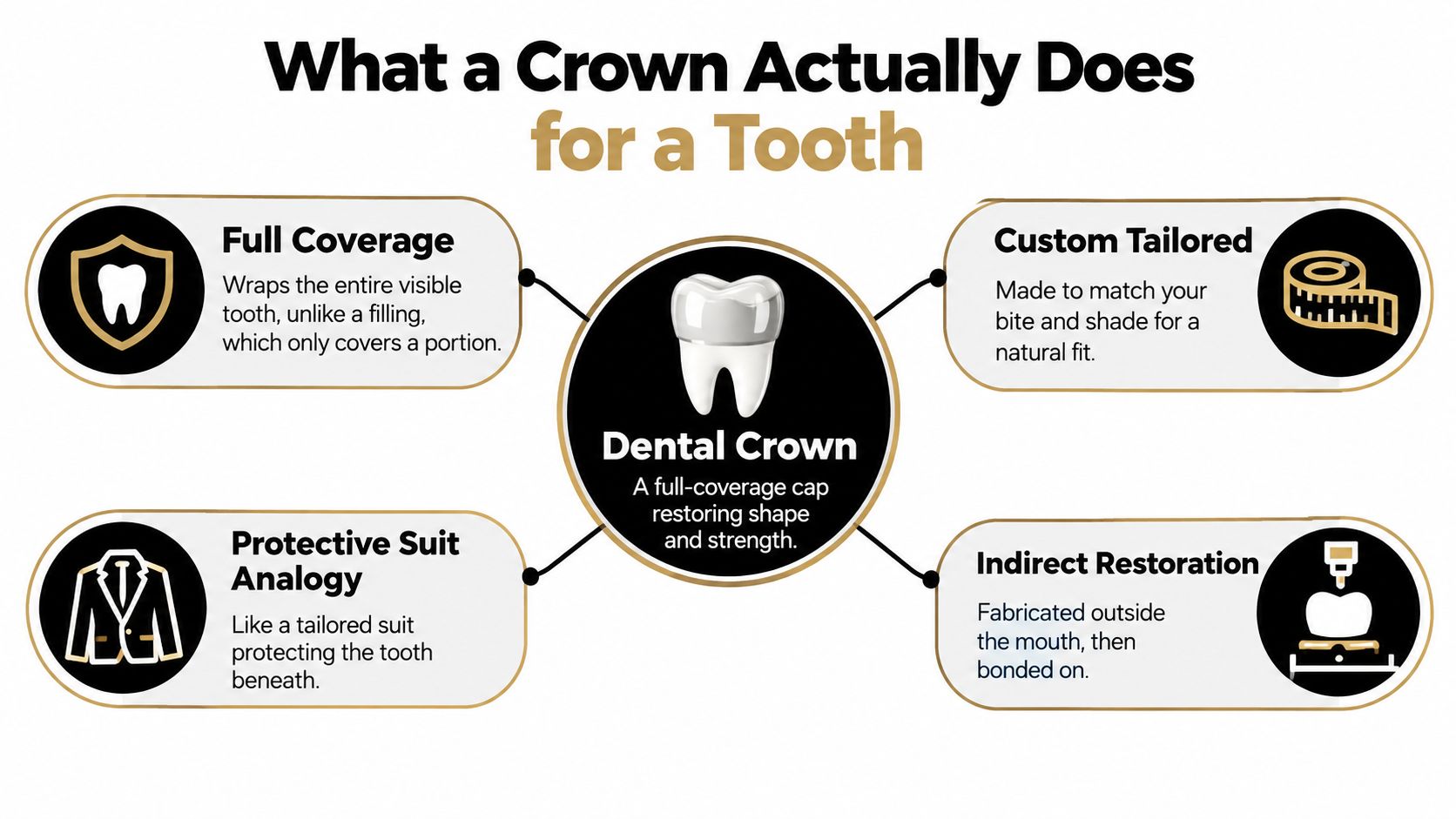
The National Institute of Dental and Craniofacial Research explains dental materials and restorations, including metals and metal alloys, ceramics, and composite resins. Tooth-colored ceramics and composites can be matched to neighboring teeth, while crowns may also be used when a tooth is badly broken down or needs more coverage than a direct filling can provide.
How the dentist decides between a filling and a crown
The decision usually follows a clinical sequence:
- Assess remaining structure. The dentist looks for sound walls, cracks, undermined cusps, decay, and the strength of any existing filling.
- Check the nerve and root. Deep decay, lingering sensitivity, or a history of root canal treatment can change the treatment order.
- Evaluate function. The opposing tooth, chewing pattern, clenching, and grinding all affect how much force the restoration must tolerate.
- Plan the restoration. The dentist selects a material, shade, contour, and bonding approach that fit the tooth and the patient's priorities.
Preparation removes some natural tooth structure to create space for the crown and provide a stable shape for retention. That tradeoff deserves honest discussion because repeated replacement can remove additional structure and increase the long-term risk of losing the tooth. A crown is protective, but it isn't a permanent layer that makes the underlying tooth immune to decay, cracks, nerve problems, or gum disease.
Digital scanners and CAD/CAM systems can capture the prepared tooth without a traditional impression tray. The scan helps create a digital model, design contacts and chewing anatomy, and send information to a laboratory or milling system. Technology improves the workflow, but it doesn't replace clinical judgment. Moisture control, margin finishing, reduction, occlusion, and the health of the tooth still determine whether the final crown performs well.
Crown Materials Compared Side by Side
No material wins every category. A crown for a visible upper front tooth has a different job from a crown on a molar that receives heavy chewing forces, and the opposing dentition can influence the choice as much as the crowned tooth itself.
| Material | Best Used For | Esthetics | Key Trade-Off |
|---|---|---|---|
| Porcelain-fused-to-metal | Posterior teeth and cases needing a proven balance of support and appearance | Tooth-colored porcelain over a metal substructure | Strong track record, but the ceramic layer can chip and the metal may affect translucency |
| Zirconia | Posterior teeth, high functional loading, and selected bruxism cases | Modern shades can look natural, though translucency varies by design | High load resistance, but the dentist must manage contour, contacts, and opposing-tooth effects |
| Lithium disilicate | Anterior teeth and cases where translucency and adhesive bonding matter | Excellent optical integration for visible teeth | Requires careful thickness and occlusal design |
| Full gold | Posterior restorations where durability and conservative preparation are priorities | Metallic appearance | Outstanding functional durability, but many patients don't want the color |
| Composite | Selected temporary, repair, or limited restorative situations | Can be shade matched | Generally less suitable than laboratory-fabricated full-coverage materials for demanding long-term loads |
Evidence summarized in a Canadian health-technology review reported five-year survival ranges of 95.7% to 97.6% for porcelain-fused-to-metal crowns and 90.7% to 96.6% for all-ceramic crowns (Canadian review of crown longevity). The same review reported a five-year survival estimate of 94.7% for metal-ceramic single crowns, with an annual failure rate of 0.88% over an average follow-up of 7.3 years, and an overall survival probability of 96.1% for lithium-disilicate crowns for up to nine years. Anterior lithium-disilicate crowns reached 100% in that review compared with 94.5% for posterior crowns.
Strength is only one part of the equation
A systematic review of CAD/CAM single crowns found zirconia and lithium-disilicate crowns had similar periodontal and endodontic complication rates to metal-ceramic crowns, while reported chipping was approximately 1.4% for zirconia versus 5% for lithium disilicate (CAD/CAM crown evidence). Laboratory testing in that evidence base found zirconia tolerated simulated loads up to about 900 N, while lithium disilicate was more reliable around 300 N.
That doesn't mean every molar should receive zirconia or every front tooth should receive lithium disilicate. A porcelain-fused-to-metal molar may suit a patient with substantial grinding forces, while a lithium-disilicate crown may be appropriate for a front tooth where shade integration and translucency carry greater weight. Full gold can be mechanically sensible in a back tooth, but its appearance may conflict with a patient's priorities.
For a more focused comparison of posterior restorations, review zirconia crowns versus porcelain-fused-to-metal crowns with your dentist. The useful question isn't “Which crown is most expensive?” It's “Which material gives this tooth the right balance of load resistance, appearance, preparation, bonding, repairability, and maintenance?”
The Crown Treatment Timeline From Prep to Placement
A crown appointment follows a sequence, even when the practice uses digital scanning and laboratory coordination. Patients who work in Midtown, commute from Hudson Yards, or travel in from Wall Street often plan treatment around that sequence rather than trying to compress every decision into one rushed visit.
Preparation and digital scanning
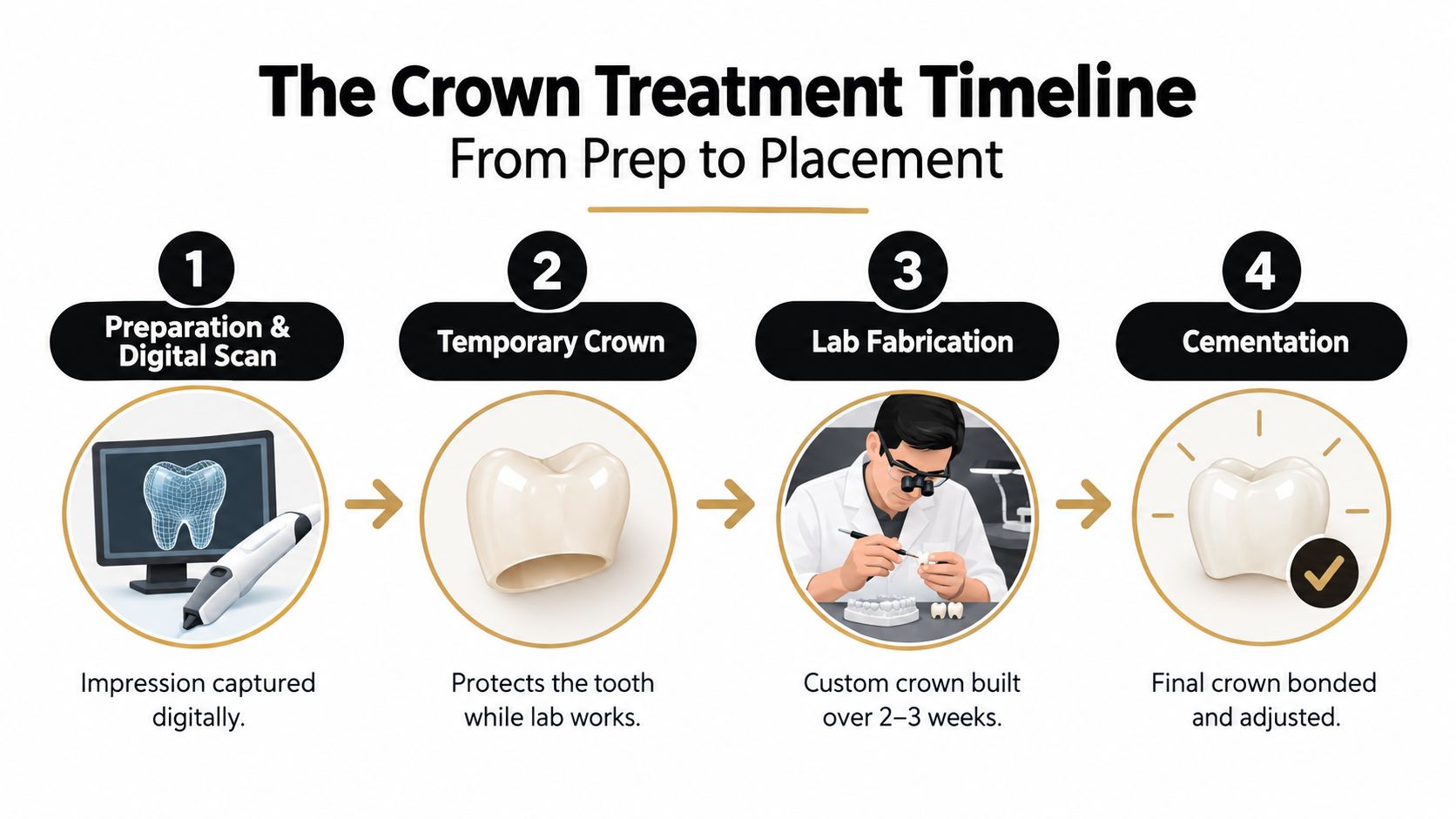
The first visit begins with diagnosis and treatment planning. After local anesthetic, the dentist removes decay or defective restorative material, reshapes the tooth to create clearance, and rounds internal angles so the crown can seat without stress points. An intraoral scanner then records the prepared tooth, neighboring teeth, opposing arch, bite relationship, and shade information.
Digital scanning can avoid the discomfort of a traditional impression tray and gives the team a visual model to inspect. The dentist still checks the preparation clinically. A scan can't rescue inadequate reduction, bleeding at the margin, or an unstable tooth.
The temporary crown
A temporary crown protects the prepared tooth while the final restoration is fabricated. It helps maintain position, shields exposed dentin, and lets the dentist assess the general contour and bite. It isn't designed to withstand every behavior a permanent crown should tolerate, so avoid chewing ice, using the teeth as tools, or pulling sticky foods directly against it.
If a temporary crown feels loose, the bite feels high, or sensitivity worsens, contact the office instead of waiting for the permanent appointment. Guidance on what to do if a tooth crown falls off can help, but an individual examination remains important.
Laboratory fabrication and final cementation
The laboratory or in-office CAD/CAM workflow creates the crown from the digital design. The dentist evaluates the restoration when it arrives, checking shade, margins, proximal contacts, contour, and occlusion before placing it. At cementation, the tooth is cleaned and isolated, the selected bonding or luting protocol is followed, and the dentist adjusts static and chewing contacts.
A same-day CAD/CAM crown may be realistic when the case has a suitable preparation, an appropriate material, and a workflow that supports in-office fabrication. A laboratory crown may be preferable when the case requires complex characterization, layered esthetics, specialized design, or additional laboratory control.
For a visual introduction to the process, this treatment overview can help you understand what happens between preparation and placement:
Bring four questions to the consultation: Can the tooth be restored with a filling? Is the nerve healthy? Which material suits the bite and location? What will happen if the crown needs adjustment or repair? Clear answers make the timeline easier to manage.
What Dental Crown Services Cost in a Manhattan Practice
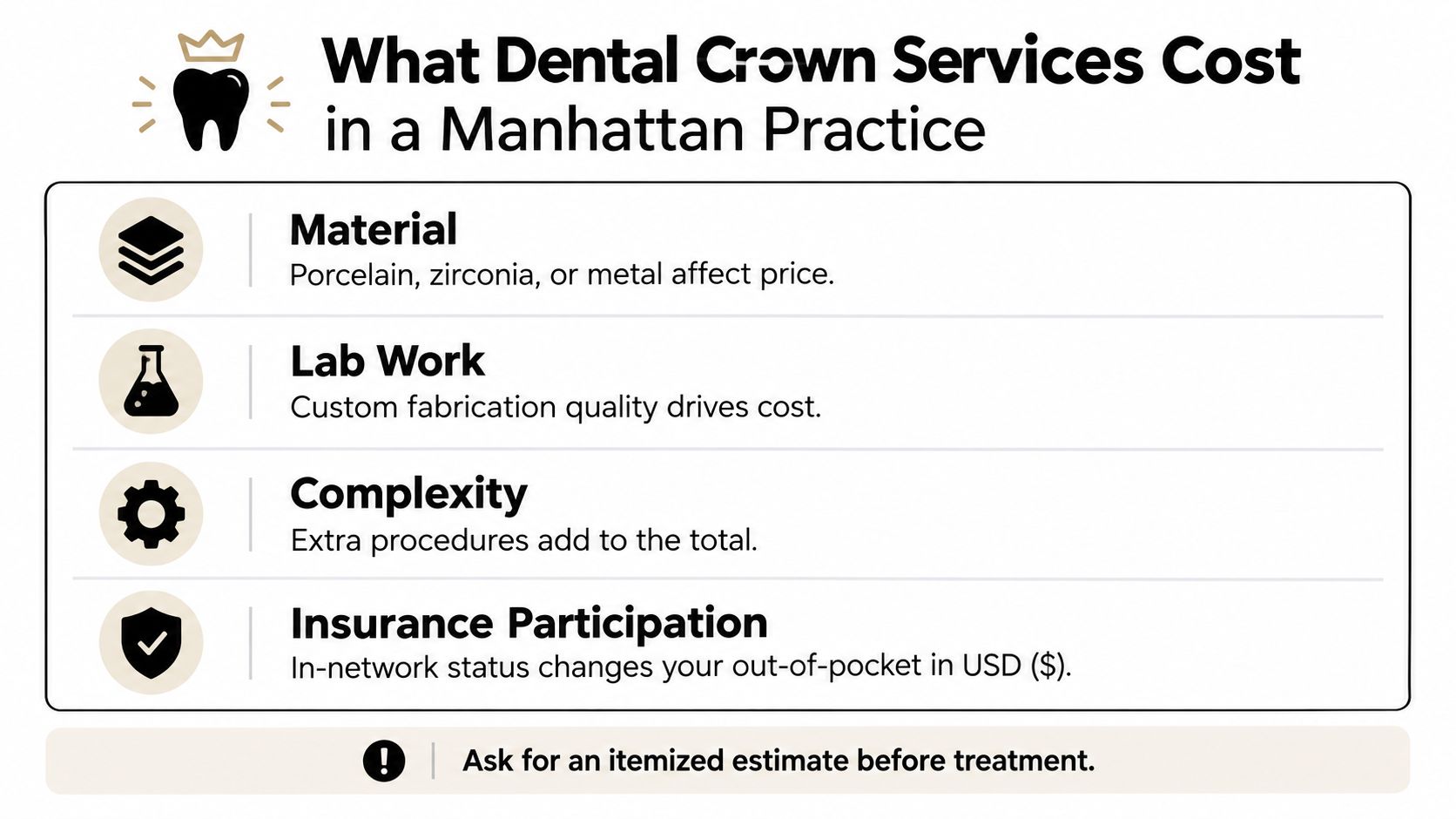
A crown estimate reflects more than the visible material. The dentist and financial coordinator may need to account for diagnosis, decay removal, a build-up, root canal treatment, post placement, temporary protection, laboratory fabrication, cementation, and follow-up adjustments.
Why two apparently similar crowns can cost differently
Two patients may both select zirconia and still receive different estimates. One tooth may need only preparation and a crown, while another may need decay removal, a core build-up, treatment for an inflamed nerve, or a post to support the remaining structure. A front tooth may also require more shade characterization and laboratory communication than a straightforward posterior restoration.
Material affects the laboratory and fabrication component, but complexity often matters more than patients expect. The dentist should explain whether the proposed fee includes the examination, imaging, temporary crown, final crown, cementation, and post-placement review.
Insurance adds another layer. Coverage depends on the plan's rules, deductible, annual maximum, exclusions, waiting provisions, frequency limitations, and whether the practice participates in the plan. Even when a plan contributes, it may not cover every associated procedure. Ask the coordinator to distinguish the insurance estimate from the patient's actual responsibility, because an estimate isn't a guarantee of payment.
A useful financial conversation includes:
- Itemized treatment: Request each procedure and its fee separately.
- Coverage assumptions: Ask what the office has verified and what remains subject to the insurer's final adjudication.
- Phased care: If several teeth need treatment, discuss which tooth is urgent and which can safely wait.
- Payment timing: Confirm what is due before preparation, at cementation, and after insurance processing.
You can also review practical questions about the cost of a dental crown before your consultation. The goal isn't to choose based on a sticker price alone. A lower initial fee may not represent the same diagnostic work, laboratory process, material, or aftercare.
Caring for a Crown Once It Is in Place
A crown doesn't decay, but the natural tooth at its margin can. Plaque can collect where the crown meets enamel or root structure, and gum inflammation can make that area harder to clean. Your home routine protects the foundation, not only the visible cap.
The daily rhythm
Brush twice daily with a soft-bristled brush and fluoride toothpaste, then clean between the teeth each day. Slide floss through the contact and guide it out sideways rather than snapping it upward, particularly when the restoration is new. Interdental brushes or water flossers may be useful when the contact, gum shape, or orthodontic history makes conventional floss difficult.
Avoid using the crown or neighboring teeth to open packages, bite fingernails, crack hard objects, or hold items. Ice, hard candies, sticky foods, and popcorn kernels can create forces that exceed the restoration's intended design.
Manage force before it creates damage
Clenching and bruxism can overload a crown during sleep or concentrated work. Ask about a custom night guard if you wake with jaw soreness, notice worn tooth surfaces, or have already fractured restorations. A guard doesn't eliminate every risk, but it can provide a controlled protective surface when the dentist determines it fits your situation.
At hygiene and examination visits, the clinical team checks the crown margin, contact, gum response, bite, and adjacent teeth. A recent meta-analysis estimated five-year survival of 98.5% for monolithic lithium disilicate, 97.3% for veneered densely sintered zirconia, 97.1% for metal-ceramic crowns, and 96.8% for monolithic densely sintered zirconia (contemporary all-ceramic crown evidence). Those survival figures don't mean complication-free service. Chipping, secondary caries, periodontal problems, debonding, and occlusal overload still require monitoring.
Call for a same-week assessment if the crown moves, a piece chips, the bite suddenly feels uneven, sensitivity persists or increases, the gum swells, or you develop spontaneous pain. The sooner the dentist identifies the problem, the more likely repair or bite adjustment may remain possible. A practical aftercare checklist is available in this guide to tooth crown aftercare.
Choosing the Right Crown for Your Tooth and Lifestyle
Use five questions to organize the decision:
- Where is the tooth? A molar usually handles greater chewing force than a front tooth.
- How much healthy structure remains? A crown can't compensate for an unstable foundation.
- What does the bite do? Grinding, clenching, and a heavy opposing contact may favor a more load-resistant design.
- How important is optical integration? A visible front tooth may require a material with strong translucency and shade behavior.
- What maintenance can you support? Home care, guard use, hygiene visits, and prompt evaluation all influence prognosis.
A molar for a nighttime grinder may need a design that prioritizes fracture resistance and occlusal protection. A front tooth for a television presenter or sales professional may place greater emphasis on translucency, symmetry, and conservative bonding. A child's stainless-steel crown serves a different purpose from an adult's permanent esthetic restoration, especially when the tooth is a baby tooth and its expected role is limited.
Long-term evidence supports caution about universal promises. A longitudinal analysis of crowns placed in England and Wales found 77% remained in place at five years, 63% at ten years, and 53% at fifteen years (longitudinal crown survival analysis). These figures describe survival without a further major intervention or extraction, and patient age and treatment need affected outcomes. A crown's prognosis therefore belongs to the tooth and patient, not just the material label.
When a crown fails, ask whether the issue is limited to a chip, contact, cement, or bite, or whether decay, fracture, or infection has compromised the tooth. Repair may preserve structure in selected cases. Replacement may be necessary in others, but each replacement should be planned carefully because preparation removes additional natural tooth structure. For patients comparing porcelain veneers and crowns, the central distinction is coverage and purpose, not which option looks more polished.
Common Questions Manhattan Patients Ask About Crowns
How long does the procedure take?
A traditional crown commonly involves a preparation visit, a temporary crown, laboratory fabrication, and a placement visit. Same-day CAD/CAM treatment may be possible for selected cases, but the dentist must decide whether the tooth, material, design, and workflow are appropriate.
Can a crowned tooth still need a root canal?
Yes. A crown covers the outside of the tooth, but the nerve remains inside unless endodontic treatment has already removed it. New spontaneous pain, lingering temperature sensitivity, swelling, or biting pain requires evaluation.
What should I do if the temporary falls out?
Keep the temporary if you can, avoid chewing on that side, and contact the office promptly. Don't use household glue, and don't assume the permanent crown will fit correctly if the prepared tooth has shifted.
Will whitening change the crown's color?
Whitening changes natural enamel, not the shade of an existing crown. Discuss whitening before final shade selection if you expect to brighten your natural teeth.
Patients also increasingly ask how dental offices answer questions online and maintain clear educational information. Resources about dental practice AI visibility address that digital communication side, while your dentist remains the right source for an individualized diagnosis.
Paul L. Gregory, DDS offers crown evaluation, digital imaging, material selection, tooth preparation, temporary protection, and restorative treatment in Midtown Manhattan. Visit Paul L. Gregory, DDS to arrange a consultation and discuss the safest crown plan for your tooth, bite, schedule, and long-term maintenance needs.