

Have you been told you need a denture, only to hear “complete” and “partial” presented as if they were interchangeable products? In a Manhattan practice, that question usually comes from someone balancing work, appearance, eating, speech, and a calendar that leaves little room for repeated adjustments. The more important question is whether your remaining teeth can safely support a restoration, and whether you can maintain them over time.
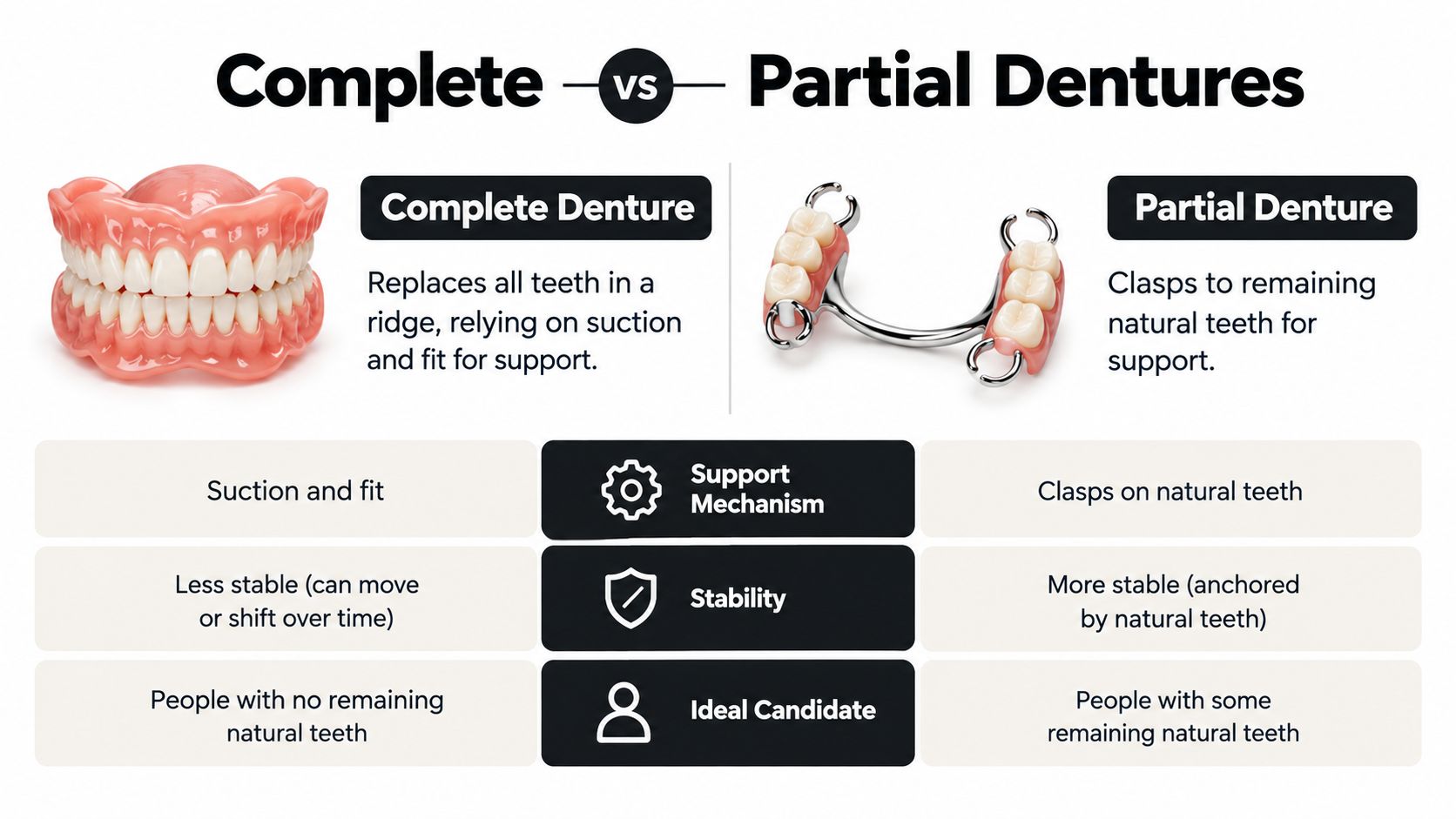
Complete and partial dentures solve different clinical problems. A complete denture replaces an entire arch when no natural teeth remain in that arch. A partial denture replaces selected missing teeth while using the remaining dentition for support, stability, and retention. The choice affects comfort, cleaning, speech, chewing, design, future treatment, and the health of the teeth that stay.
| Clinical consideration | Complete denture | Partial denture |
|---|---|---|
| Teeth replaced | An entire upper or lower arch | Some missing teeth |
| Main support | Mucosa, border seal, ridge anatomy, and neuromuscular control | Remaining teeth plus soft-tissue support |
| Main risk | Movement from ridge anatomy, poor fit, or inadequate adaptation | Overloading, decay, or periodontal problems around abutment teeth |
| Daily responsibility | Clean the prosthesis and protect oral tissues | Clean the prosthesis and maintain every supporting tooth |
| Best starting question | Is the entire arch edentulous? | Are the remaining teeth healthy and strategically useful? |
Understanding Complete and Partial Dentures
A Midtown West professional may first notice the problem over lunch, when chewing becomes awkward, or while speaking during a meeting. A longtime resident might reach the same decision after years of cracked restorations, loose teeth, or an extraction that changes the balance of an arch. The immediate question is often, “Do I need a full denture or a partial?” Clinically, the answer begins with a simpler question: Which natural teeth remain, and can they be trusted?
A complete denture replaces all missing natural teeth in one arch. It rests on the oral tissues and depends on the residual ridge, the border seal, neuromuscular control, and the accuracy of the fit. A partial denture replaces some missing teeth while preserving and incorporating the remaining teeth. Those teeth may receive rests, clasps, or other retentive elements, but they also become part of the restoration's long-term maintenance burden.

The distinction matters beyond appearance. A partial denture can feel more stable when the remaining teeth provide sound support, but those teeth must be evaluated for cavities, periodontal support, mobility, position, and strategic value. A complete denture avoids loading natural abutments, yet it has no teeth to help resist movement. Neither option automatically produces comfortable chewing or natural speech. Fit, bite design, ridge anatomy, saliva, muscle control, and patient adaptation all influence the result.
The practical rule: A partial denture is only as dependable as the teeth supporting it. If those teeth are compromised, preserving them without a realistic maintenance plan can create more problems than it solves.
Patients comparing treatment approaches can also review this dentures resource from Delaware Center for Advanced Dentistry for a broader overview of removable options. For appearance expectations, it helps to discuss before-and-after dentures photos during a consultation, while remembering that another patient's result won't predict your own anatomy or function.
The choice isn't strictly between a smaller and larger appliance. It's a decision about whether the remaining dentition can participate safely in rehabilitation. When an entire arch is edentulous, a complete denture may be the appropriate removable solution. When useful teeth remain, a partial denture may preserve function and appearance, provided those teeth are treated as active components of the treatment rather than passive anchors.
Why These Options Remain Clinically Essential
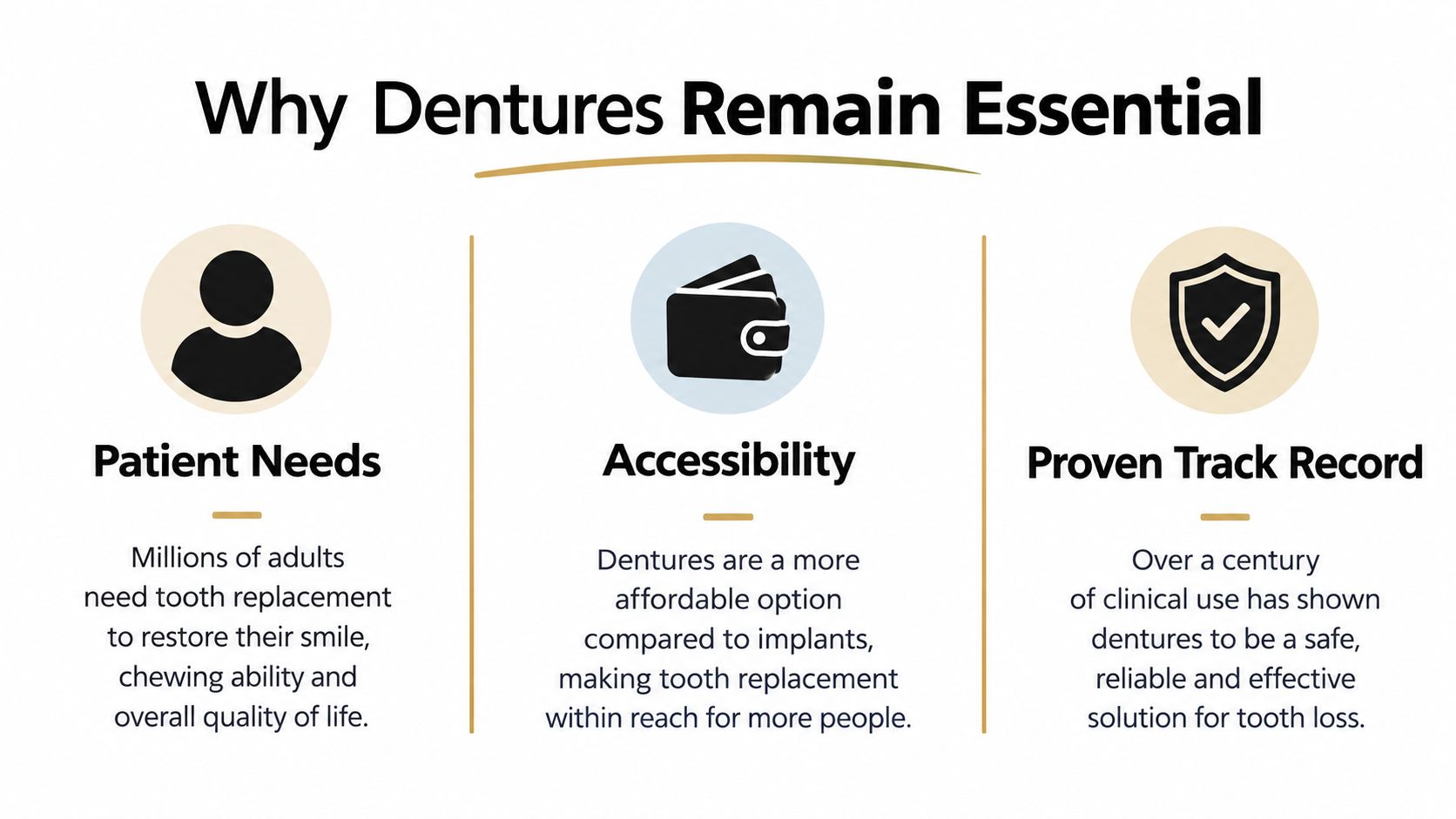
Modern preventive dentistry has helped more adults retain natural teeth, but tooth replacement remains a substantial clinical need. The World Health Organization's oral health fact sheet defines edentulism as the loss of all natural permanent teeth and reports that complete tooth loss affects almost 7% of people aged 20 years and older, rising to approximately 23% among people aged 60 years and older. U.S. surveillance shows the same age gradient, with edentulism reported among 1.2% of adults aged 35 to 49, 5.9% of those aged 50 to 64, 11.4% of those aged 65 to 74, and 19.7% of adults aged 75 or older, as summarized by the WHO.
These figures don't mean every person without natural teeth wears a denture. They do show why complete dentures remain a foundational restorative option, particularly when surgery, implant treatment, anatomy, medical status, finances, or patient preference make a removable solution more appropriate.
Better retention does not eliminate tooth loss
U.S. data reviewed in CDC-linked research on tooth retention and functional dentition shows meaningful improvement among adults aged 50 and older. Complete tooth retention increased from 14% in 1999–2004 to 21% in 2009–2014, while edentulism declined from 17% to 11%. Even during the later period, approximately 6.2 million adults in that age group had lost all natural teeth.
Functional dentition, defined in that analysis as having at least 21 natural teeth, increased from 55% to 67%, yet about 18.6 million adults still lacked a functional dentition. The figures support two clinical conclusions. Preserving remaining teeth can help a patient avoid complete edentulism, but extensive tooth loss may still require a removable prosthesis to restore oral function and appearance.
A rational option, not a treatment failure
Dentures can be the sound choice when a patient needs broad tooth replacement without extraction of every remaining tooth, implant surgery, or extensive fixed reconstruction. The plan still requires examination of bone and soft tissues, periodontal condition, caries risk, chewing goals, speech, esthetic expectations, and the patient's ability to clean and attend recalls. For broader restorative planning, patients may find this overview of restorative and cosmetic dentistry useful before discussing specific designs.
Design, Support, and Clinical Performance
A complete denture and a partial denture don't fail for the same reasons. The complete appliance must create a stable relationship with the mucosa and residual ridge. The partial appliance must coordinate the denture base, framework, rests, connectors, clasps, bite, and remaining teeth without creating damaging forces.
Where support comes from
A complete denture relies primarily on tissue support, border extension, the peripheral seal, ridge anatomy, and neuromuscular control. Upper dentures often benefit from a broader supporting area and palatal coverage, while lower dentures face the constant influence of the tongue, cheeks, floor of the mouth, and a smaller supporting foundation. A close fit helps, but suction alone isn't a guarantee of stability.
A partial denture gains additional support and retention from natural teeth. That advantage can make eating and speaking feel more secure, but it introduces a different responsibility. The framework must distribute forces appropriately, and the abutment teeth must tolerate those forces.
Complete denture reality: A carefully balanced bite cannot compensate for an inaccurate border, an unstable ridge, or a denture base that moves under function.
Research summarized in a systematic review of complete denture performance found no consistently superior occlusal scheme among anatomic alternatives. Reported clinical trials found that bilateral balanced occlusion didn't necessarily improve masticatory efficiency compared with canine-guidance arrangements. Ridge anatomy and food-specific dislodgement may matter more for a particular patient. Some patients preferred canine guidance for foods such as carrots and meat, while balanced or lingualized arrangements reduced food avoidance or perceived disability in selected cases.
Why partial framework design matters
In a distal-extension partial denture, the appliance is supported by teeth at one end and compressible mucosa at the other. That difference can cause rotation and movement. Finite-element and literature-based analysis identifies stress-concentration areas near the clasp shoulder, gingival-approach region, and major connector adjacent to terminal abutments. The design must therefore manage mechanical advantage instead of merely filling visible spaces.
A review of designing removable partial dentures can help patients understand why surveying and framework planning matter. Clinically, I look at the position and periodontal condition of each proposed abutment, the location of rests, the need for indirect retention, and whether clasp flexibility matches the tooth's condition. A flexible clasp may reduce transferred stress, while a rigid major connector can limit framework flexure and unwanted movement.
For patients weighing removable treatment against surgical alternatives, a discussion of dental implant technologies can clarify how additional support changes the design problem. Implants may improve retention, but they don't remove the need for hygiene, careful bite planning, or recall care.
Materials, Digital Workflows, and Long-Term Care
Digital dentures can improve record keeping and streamline selected laboratory steps, but “digital” doesn't mean automatically faster, stronger, or more comfortable. A 2025 systematic review of digitally fabricated complete dentures reported clinical performance similar to, or sometimes better than, conventional dentures. It also found that different digital manufacturing methods didn't consistently change patient-reported outcomes.
The distinction between laboratory performance and daily clinical performance matters. Milled digital denture bases showed greater laboratory flexural strength than 3D-printed and conventional bases in a 2025 review, but the authors emphasized that this mechanical advantage still requires validation through high-quality clinical trials. Positive patient acceptance has been reported, while evidence about long-term effects on phonetics and chewing efficiency remains insufficient.
What technology changes
A digital workflow may use an intraoral scan, a digital record of the bite, computer-aided tooth arrangement, and a milled or printed base. Digital files may support a replacement if the denture is lost or damaged, but only when the records remain accurate and the replacement case doesn't require major changes. Scanning also doesn't eliminate the need to evaluate movable tissue, saliva, ridge resorption, muscle attachments, or the patient's existing prosthesis.
Conventional impressions remain useful when tissue capture, border molding, or the clinical situation makes a physical impression more predictable. A scan can record anatomy accurately, yet the final denture may still need pressure relief, occlusal adjustment, polished-surface refinement, or a reline.
The remaining teeth are part of the appliance
Partial denture maintenance is more demanding around clasps, rests, and connectors. Food and plaque can accumulate in those areas, and periodontal inflammation or new decay can reduce the very support the appliance depends on. Patients should clean the appliance separately from their natural teeth and use tools and techniques suited to the abutment surfaces.
A partial denture that becomes suddenly loose, causes repeated sore spots, develops odor, or is associated with bleeding or mobility needs examination. Repeated repairs may hide a framework, abutment, or bite problem. A redesign, reline, periodontal treatment, or restorative treatment may be more appropriate than another temporary repair. Daily oral hygiene matters for removable dentures just as it does for implant restorations, and this guide to how to clean dental implants reinforces the broader principle that prosthetic surfaces and supporting tissues both require attention.
Implants and Fixed Prostheses as Alternatives
Some patients want a fixed result, while others prioritize avoiding surgery, controlling cost, or completing treatment with a simpler removable appliance. Neither preference is automatically correct. The clinical question is whether the expected benefit justifies the additional procedures, healing, maintenance, and financial commitment.
For an edentulous arch, implant-supported treatment can provide retention that a conventional complete denture can't match. Full-arch solutions such as All-on-4 use implants to support a fixed restoration, while implant-retained overdentures can preserve removability with improved resistance to movement. Single-tooth implants and implant-supported bridges offer fixed alternatives when selected teeth are missing and the neighboring teeth don't need to be prepared.
When fixed treatment makes sense
Implants may become more compelling when denture movement is unacceptable, when ridge anatomy makes conventional retention difficult, or when a patient wants to avoid covering certain tissues. They still require sufficient bone or a plan for grafting, surgical evaluation, hygiene, and long-term maintenance. Treatment may involve multiple appointments and a recovery period, which matters to someone managing a demanding Manhattan work schedule.
A fixed bridge may be appropriate when adjacent teeth already need crowns or when implant surgery isn't suitable. It isn't automatically conservative, because preparing supporting teeth can remove healthy structure. The right choice depends on the condition of those teeth, the span being restored, bite forces, cleansability, and the expected service demands.
Clinical trade-off: Fixed stability can be valuable, but it doesn't turn maintenance into an optional task. Implants and bridges still need professional evaluation and daily cleaning.
A removable complete or partial denture remains rational when the patient wants a non-surgical approach, needs broad replacement, has medical or anatomical limitations, or prefers a lower-complexity treatment path. The comparison between dental implants and bridges is useful before making a decision, but a general comparison can't determine whether a specific tooth should be preserved as an abutment.
Budget and scheduling also deserve direct discussion. A lower initial burden doesn't make a removable prosthesis “cheap” in the clinical sense, and a higher investment doesn't guarantee satisfaction. The best plan is the one a patient can complete, clean, maintain, and accept functionally.
Treatment Timeline and What to Expect
A denture appointment should answer two questions early: what must be done before fabrication, and how many visits are likely to be needed after delivery? The exact sequence changes with extractions, tissue healing, existing dentures, implant planning, and the complexity of the partial framework.
The clinical sequence
The process usually includes:
Examination and diagnosis. The dentist evaluates remaining teeth, periodontal tissues, caries, ridges, bite, facial support, and any painful or mobile areas. Radiographs and digital imaging may identify problems that aren't visible during a simple visual check.
Records. The office captures an impression or digital scan, records the relationship between the arches, and discusses tooth shade, shape, display, speech, and facial support. For a partial denture, the clinician also surveys the proposed path of insertion and evaluates abutment teeth.
Try-in and laboratory fabrication. Tooth arrangement and the bite may be reviewed before the final base and framework are completed. A partial denture may require careful verification that clasps engage appropriately without damaging or overloading the supporting teeth.
Delivery and adjustment. Pressure areas, speech changes, bite contacts, border extension, and retention are checked. Patients commonly need follow-up because tissues and muscles respond to a new appliance through use.
A complete denture may need two or more clinical appointments to refine fit and occlusion. A partial denture can require additional design and adjustment time because the appliance must work with the existing dentition rather than rest on the ridge.
Urgent and ongoing care
Same-day or emergency denture services may help after sudden tooth loss, a broken appliance, or acute discomfort, but an immediate or repaired denture is often a provisional solution. It may need adjustment as extraction sites heal or as the oral tissues change. A Manhattan office with short-notice scheduling can help patients stabilize an urgent problem without treating the emergency appliance as the final long-term plan.
After delivery, don't wait through persistent pain, repeated ulcers, a suddenly loose prosthesis, or changes in speech that don't settle. Recall visits allow the dentist to assess tissue health, abutment teeth, occlusion, and the need for a reline or redesign.
Making the Right Choice for Your Situation
The strongest decision framework starts with the remaining teeth, not with the appliance name. A partial denture may be preferable when the teeth are healthy, strategically positioned, periodontally stable, and maintainable. A complete denture may be more predictable when the remaining teeth are extensively decayed, mobile, poorly distributed, or unable to support a framework without repeated treatment.
Ask these questions at the consultation:
- Can each remaining tooth be maintained? Ask about cavities, periodontal support, mobility, restorability, and the expected role of each abutment.
- What will the appliance rely on? Clarify whether support comes from teeth, mucosa, implants, or a combination, and what movement is realistic during chewing.
- What maintenance is required? Discuss cleaning around clasps, recall visits, relines, repairs, and signs that the design needs to change.
- What matters most day to day? Explain whether your priority is removability, speech, appearance, chewing particular foods, appointment efficiency, or avoiding surgery.
- What is the complete financial plan? Include necessary periodontal treatment, extractions, temporary appliances, adjustments, and future maintenance rather than comparing only the delivery fee.
Keeping natural teeth doesn't guarantee better satisfaction. Chewing, speech, comfort, and appearance depend on tooth distribution, tissue support, bite design, fit, and hygiene. In some cases, a less extensive partial denture works well because the remaining teeth are strong and well distributed. In others, preserving compromised teeth creates instability and repeated repairs.
Patients also encounter dental information through online education and practice websites, including services such as dentist marketing services. Marketing can help you find a provider, but it can't replace an examination. Bring your current denture, a list of medications, details about sore spots or looseness, and a clear description of the foods, conversations, or situations that currently cause difficulty.
A consultation with an experienced restorative dentist should result in more than a product recommendation. You should leave knowing which teeth can be preserved, what the proposed appliance will use for support, what alternatives exist, how many visits are likely, and what maintenance will protect the result.
Paul L. Gregory, DDS provides complete and partial dentures, immediate and implant-supported denture options, and same-day denture repairs for patients who need practical restorative care in Midtown Manhattan. Visit Paul L. Gregory, DDS to request an evaluation and discuss the option that fits your teeth, schedule, expectations, and long-term maintenance needs.