


A sharp toothache rarely arrives at a convenient time. You may be sitting at your desk in Midtown, trying to finish a workday, when a sip of coffee triggers a jolt that continues long after the cup is gone. By evening, you're searching “root canal specialist near me,” wondering whether you need antibiotics, an emergency appointment, or an extraction.
The right decision starts with diagnosis, not distance. A nearby practice may be appropriate, but the clinician should determine which tooth is involved, whether the pulp is inflamed or infected, whether the tooth can be restored, and whether specialist care is justified. This guide follows that decision path, from first symptoms and urgent triage to endodontic treatment, restoration, insurance questions, and a practical Midtown plan.
When a Thursday-Night Toothache Becomes a Decision
It's Thursday evening. You're chewing something soft, perhaps pasta or scrambled eggs, when a lower molar sends a sharp pain through your jaw. You stop eating, wait a moment, and try again. The pain returns, then lingers instead of fading.
Your first reactions are understandable. You might hold an ice pack against your cheek, rinse with warm salt water, take an over-the-counter pain reliever, and start searching for a root canal specialist near me. Some of those steps can make the next few hours more manageable. None can tell you whether the tooth has reversible irritation, irreversible pulp inflammation, a crack, or an infection around the root.
Pain intensity alone doesn't answer that question. A milder ache can still involve a tooth that needs prompt attention, while a dramatic but brief sensitivity may have a different cause. Pay attention to how long the pain lasts, whether heat or cold triggers it, whether biting causes pain, and whether swelling or facial tenderness appears.
Practical rule: Temporary comfort is useful, but it shouldn't replace an examination when symptoms persist or escalate.
A same-week dental evaluation is especially important when decay may have reached the pulp. The CDC reports that 91% of U.S. adults aged 20 to 64 had experienced dental caries in permanent teeth, and 27% had untreated tooth decay in nationally representative examination data from 2011–2012. These figures don't mean every cavity requires a root canal. Many cavities are treated with fillings, but decay that reaches the pulp can require endodontic treatment. The CDC's dental caries data explains why prompt evaluation matters.
Don't let a prescription become a substitute for finding the source. Antibiotics aren't needed for most pulpal or localized periapical pain in otherwise healthy adults when definitive dental care is available, according to ADA antibiotic stewardship guidance. The decision path is straightforward: identify urgency, test the tooth, choose the appropriate level of expertise, preserve the tooth when its prognosis is reasonable, and plan the final restoration.
For immediate guidance about what qualifies as urgent care, review this emergency dental care guide before deciding whether to wait for a routine appointment.
What a Root Canal Specialist Actually Does
Think of a tooth as a living root system rather than a hard white object. Enamel is the visible outer trunk. Dentin is the supporting wood beneath it. Deep inside, the pulp chamber and root canals form a buried network containing nerves, blood vessels, and connective tissue.
When decay, trauma, or a crack allows bacteria to reach that network, the problem becomes more complicated than a surface cavity. An endodontist diagnoses conditions affecting the pulp and tissues around the roots, then treats the narrow internal spaces where ordinary instruments and limited visibility can make the work difficult.
Endodontics is a formally recognized dental specialty. According to the Commission on Dental Accreditation's program information, most accredited endodontic programs provide two or three years of advanced postgraduate training leading to a certificate or a Master of Science degree in Endodontics.
That focused training can matter when a tooth has:
- Curved or accessory canals: Molars may contain anatomy that's difficult to locate, clean, and seal through a small access opening.
- Calcified canals: Age, previous dental work, or injury can narrow the canal space and make location more demanding.
- A previous root canal: Retreatment requires identifying why the earlier treatment didn't heal and deciding whether the tooth remains restorable.
- Traumatic damage: Endodontists also manage certain dental injuries, including displaced or injured teeth.
- Persistent or confusing pain: A specialist can help distinguish pulpal pain from periodontal, bite-related, or referred pain.
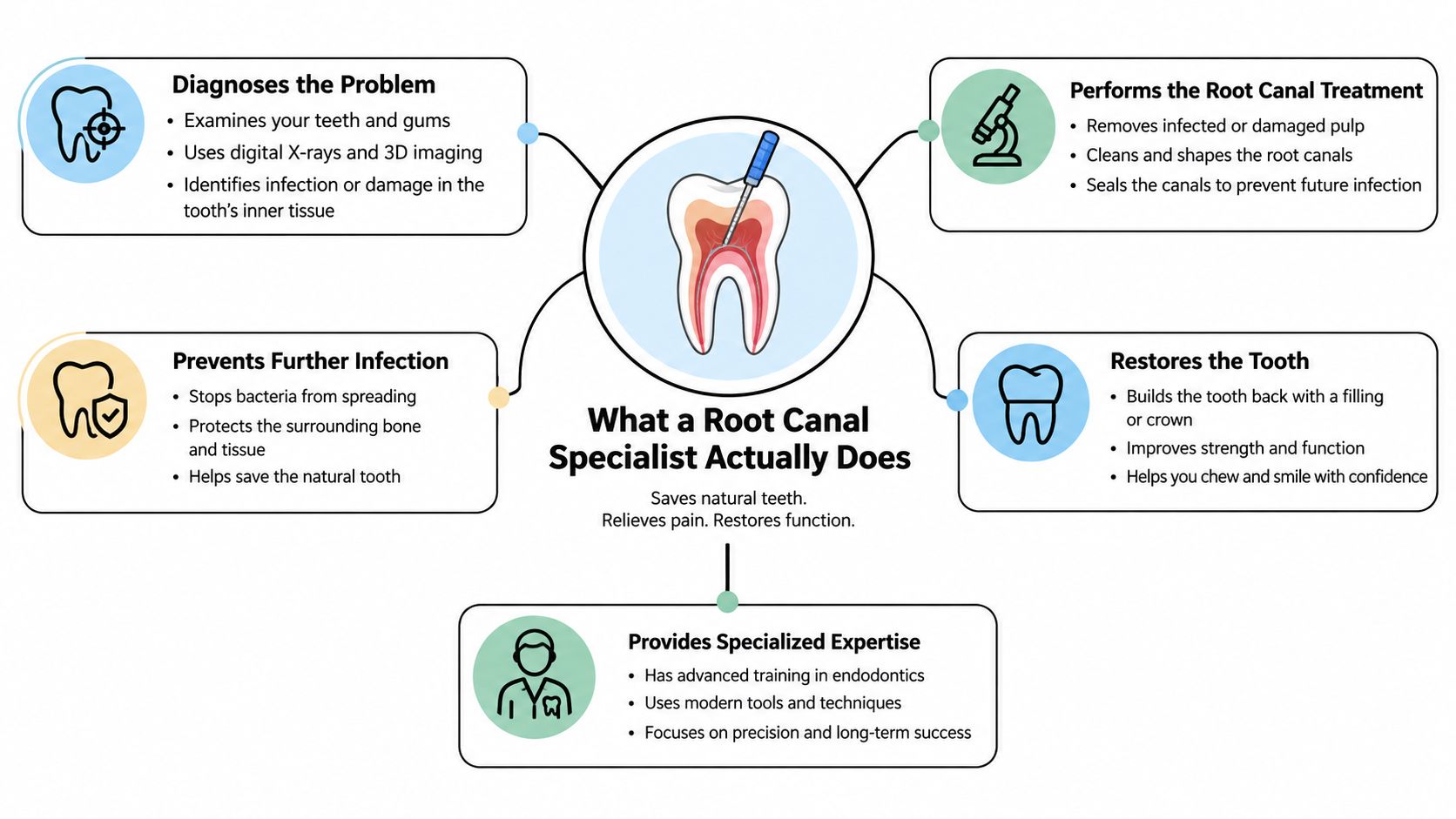
A general dentist may diagnose and perform many root canals. General practices also offer an important advantage when the tooth needs a filling, crown, bite adjustment, or broader treatment plan. Specialty training becomes more valuable when anatomy, retreatment, trauma, or uncertain prognosis raises the technical difficulty.
The useful question isn't “Which provider is always better?” Ask instead, “How complex is this tooth, and who can diagnose and treat it with an appropriate prognosis?” A coordinated Midtown plan may involve a general dentist for the initial or final restorative work and an endodontist for the canal treatment itself.
Symptoms That Mean You Should Be Evaluated Soon
“My tooth hurts” doesn't provide enough information for a clinician to triage the problem. Try to describe the trigger, duration, location, and associated signs. A tooth that hurts briefly with cold is different from one that throbs without stimulation or produces swelling along the gum.
The following table is a starting point, not a diagnosis.
| Symptom | Likely Meaning | Time Window | Action |
|---|---|---|---|
| Cold or hot pain that lingers | Pulp inflammation that may no longer be reversible | Same-week evaluation | Call a dentist or endodontist and describe the duration |
| Spontaneous throbbing, especially at night | Significant pulpal irritation or inflammation | Prompt assessment | Request an examination rather than waiting for medication to solve it |
| Pain when biting that fades after pressure is released | Possible pulpal, crack-related, or supporting-tissue problem | Soon, particularly if it repeats | Avoid chewing on that side and arrange testing |
| Gum tenderness or facial sensitivity | Inflammation around the tooth or another dental source | Same-week evaluation | Report the exact location and any change in swelling |
| A pimple-like bump that appears and disappears | Possible drainage pathway from a chronic dental infection | Prompt dental visit | Don't puncture it or assume the infection has resolved |
| A single tooth that darkens | Possible trauma or pulpal breakdown | Arrange evaluation | Tell the clinician when the color change began |
| Facial swelling, fever, or worsening malaise | Possible spreading infection or systemic involvement | Urgent care | Contact a clinician promptly, and seek medical emergency care for airway or swallowing symptoms |
The distinction between reversible inflammation, irreversible pulpitis, and infection around the root requires clinical testing. The American Association of Endodontists' diagnostic guidance supports pulpal and periapical testing before treatment, along with a restorability and prognosis assessment.
Go to a hospital or emergency department rather than waiting for a dental chair if you have difficulty swallowing, trouble breathing, rapidly spreading facial swelling, difficulty opening your jaw, fever with chills, or a compromised immune system combined with signs of infection. Those symptoms can indicate a problem that needs medical evaluation beyond local dental treatment.
Before calling, take a photograph of visible swelling and write down when the pain began. Note whether hot or cold triggers it, whether biting changes the pain, and whether you've already taken medication. If you're unsure how a swelling or abscess should be handled, use this guide to dental abscess symptoms and treatment to prepare for the conversation with the office.
General Dentist vs Endodontist for Root Canals
Choosing between a general dentist and an endodontist isn't a contest between two opposing professions. It's a question of training, complexity, diagnostic tools, and continuity of care.
A general dentist manages a broad range of oral health needs, including prevention, fillings, crowns, gum care, and many routine root canals. A straightforward front tooth with accessible anatomy may fall comfortably within that scope. The general dentist may also be the clinician best positioned to plan and place the final crown or other restoration.
An endodontist devotes advanced training to diagnosing tooth pain and treating the pulp and root canal system. That focused experience is particularly relevant for molars, calcified canals, retreatment, traumatic injuries, and cases where the tooth's prognosis is uncertain.
| Consideration | General Dentist | Endodontist |
|---|---|---|
| Typical role | Broad dental care and routine endodontic treatment | Focused diagnosis and treatment of pulpal and root-related disease |
| Best fit | Straightforward cases within the dentist's experience | Complex anatomy, retreatment, difficult diagnosis, or challenging prognosis |
| Diagnostic approach | Clinical testing and available dental imaging | Specialized endodontic assessment, with advanced imaging when indicated |
| Restoration planning | Often coordinates or completes the crown phase | May complete the canal treatment and communicate with the restorative dentist |
| Referral value | Can identify when a case exceeds the office's experience | Can evaluate technical complexity and treatment alternatives |
Magnification, operating microscopes, and three-dimensional imaging can help in selected cases, but equipment names shouldn't make the decision by themselves. A microscope doesn't compensate for an uncertain diagnosis, and a scan isn't useful unless it answers a specific clinical question.
The handoff between offices deserves attention. A Midtown general dentist may identify the problem, provide an emergency restoration, and plan the crown, while an endodontist treats the root canal. Ask whether the offices will share radiographs, test results, treatment notes, and the restorability assessment.
For a broader explanation of the general dentist's role, read whether general dentists can perform root canals. The practical answer is case-dependent: choose the provider whose training and experience match the tooth in front of you.
What Happens During the Visit Step by Step
A Thursday-night toothache can make treatment feel urgent, but the first appointment should still begin with questions, testing, and a plan. Pain may be referred, so the tooth you point to is not always the tooth causing it. The clinician should confirm the source before creating an access opening.
The examination identifies the source
The clinician may ask you to compare sensations between teeth, then use percussion, palpation, thermal testing, periodontal probing, and targeted radiographs. A periapical radiograph shows the roots and surrounding bone. Three-dimensional imaging may help when the anatomy or diagnosis remains uncertain.
Treatment should follow at least a tentative diagnosis, your consent, and an assessment of whether the tooth can be restored, as described in the American Association of Endodontists' competency guidance. Ask what the tests showed, which alternatives were considered, and whether the tooth is restorable.
Access reaches the internal system
After the tooth is confirmed and the area is thoroughly numb, the clinician makes a small opening through the biting surface. This opening leads to the pulp chamber and canal entrances. Fine instruments then shape the canals and remove inflamed or infected tissue.
Irrigation cleans areas instruments cannot touch directly. The clinician also determines canal length, controls the working field, and prepares the internal spaces for filling. The technique depends on the tooth's anatomy, diagnosis, and the provider's clinical judgment. You should be able to ask what the clinician found during treatment and whether the plan changed.
Sealing protects the cleaned canals
Once cleaning and shaping are complete, the canals are dried and filled with sealing material. The access opening receives a temporary or restorative seal, depending on the treatment plan. This seal limits contamination while the final restoration is arranged. The tooth may look unfinished, but the internal space has been closed to protect the work.
The crown protects function
Root canal treatment removes diseased internal tissue, but it does not rebuild tooth structure lost to decay, cracks, or earlier restorations. A weakened tooth may need a crown or another definitive restoration from the restorative dentist. That restoration helps protect the remaining tooth during chewing.
Before treatment, ask who will complete the final restoration, when it should occur, and which foods to avoid meanwhile. Relief from pain is encouraging, but outcome assessment also considers function, clinical signs, symptoms, and radiographic healing. A systematic review of root-canal outcomes identifies preoperative disease, canal complexity, technical quality, and the coronal restoration as factors in prognosis.
Antibiotics, Pain Relief, and When to Skip the Pharmacy
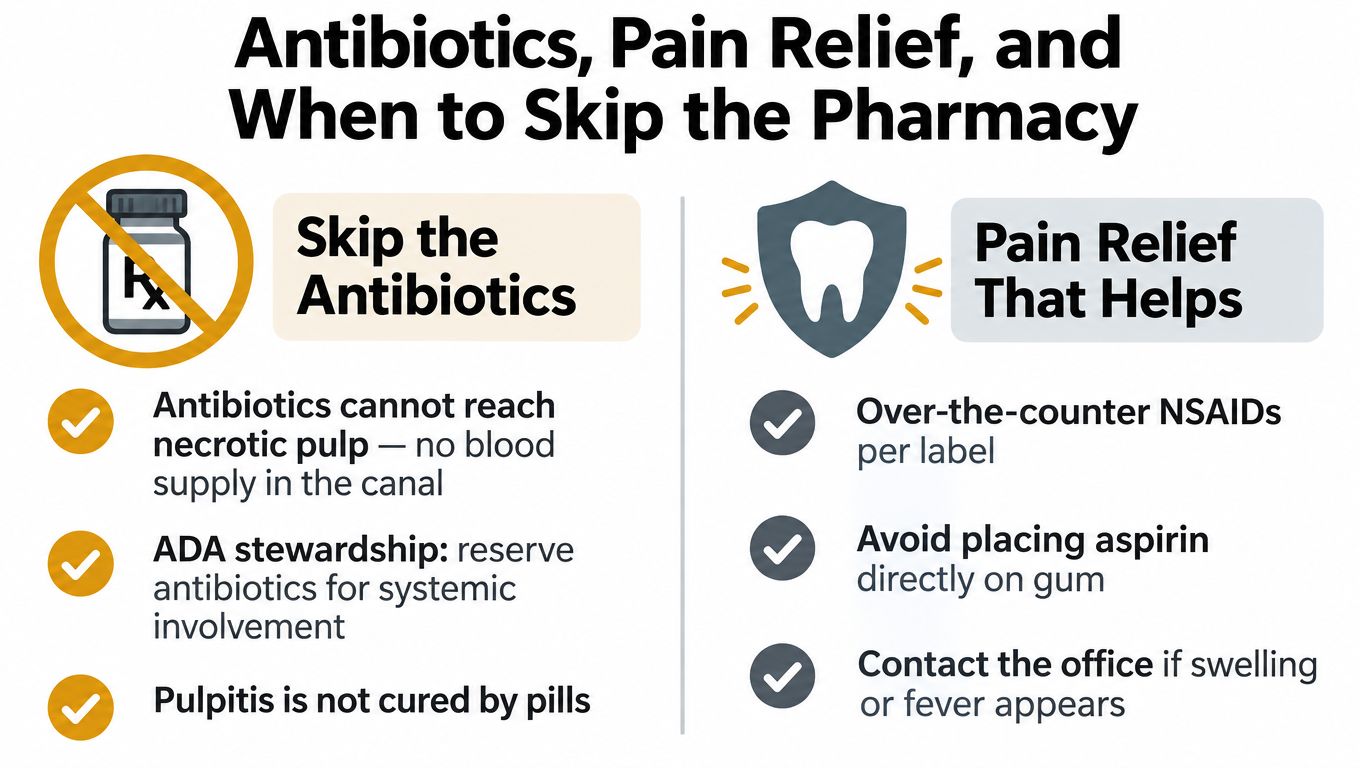
A toothache flares late at night, and a prescription may seem like the quickest solution. Antibiotics do not remove inflamed pulp, disinfect the canal system, or seal a leaking tooth. For most pulpal and localized periapical pain in otherwise healthy adults who can receive definitive dental treatment, ADA guidance on antibiotic stewardship supports dental treatment rather than routine antibiotics.
The first question for a Midtown provider is, “What did the examination show?” Definitive care may involve removing inflamed pulp, completing nonsurgical root-canal treatment, draining a collection when appropriate, or extracting a tooth that cannot be restored. Antibiotics may be appropriate when systemic involvement is present or a patient's medical condition changes the risk calculation. That decision requires an examination, not a medication request alone.
If a clinician offers antibiotics without examining the tooth, ask what the examination showed and whether the source has been identified.
For short-term comfort, follow the label directions for an appropriate over-the-counter analgesic. Check possible contraindications with a pharmacist or physician, especially if you take other medicines or have a medical condition. Never place aspirin directly on the gum, because it can irritate or injure soft tissue. A cold compress against the cheek may reduce swelling, but it does not treat the source.
People who prefer fewer medications can review practical drug-free pain management advice. These measures support comfort while you arrange dental care. They do not replace treatment that addresses the tooth.
Seek emergency medical care for trouble breathing or swallowing, rapidly spreading swelling, difficulty opening the jaw, fever with chills, or swelling approaching the eye. For expected symptoms after treatment and signs that require follow-up, read this root canal recovery guide.
Insurance and Coverage Questions Worth Asking
Insurance conversations become easier when you separate the treatment into phases. The endodontic visit may address diagnosis and root-canal treatment. A later appointment may involve a crown or another definitive restoration. Each phase can involve different billing codes, providers, deductibles, and benefit limits.
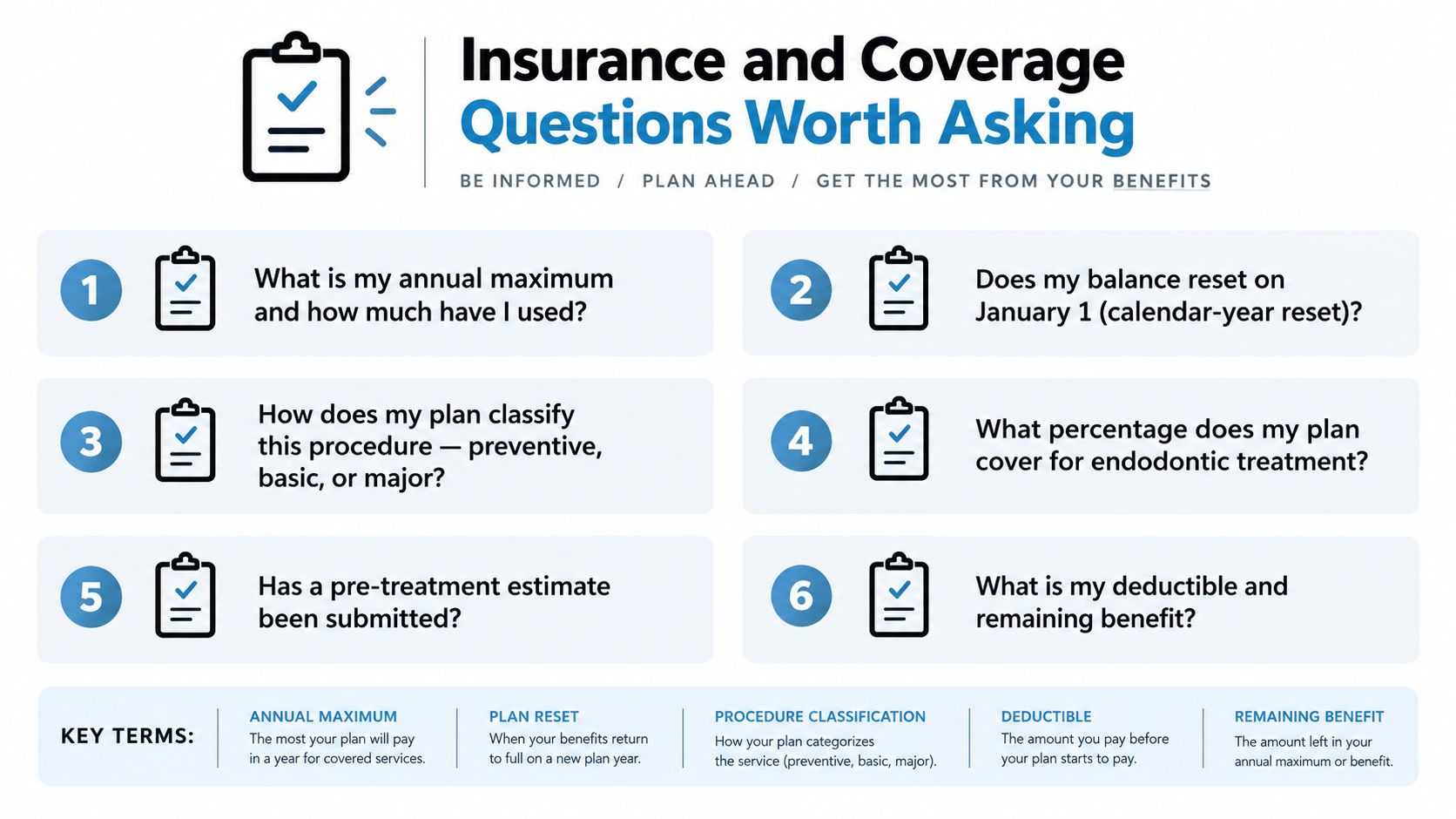
An annual maximum is the amount a dental plan may pay toward covered care during its benefit period. A calendar-year reset means the available benefit may change when the plan year renews. The reset date isn't universal, so ask whether unused benefits expire and when the available amount returns.
Plans also divide care into categories such as preventive, basic, and major services. The exact classification and reimbursement depend on the policy. A root canal and crown may not be treated the same way, and a specialist claim may be processed differently from a general dentist's claim.
A predetermination or pre-treatment estimate can make the expected balance clearer. The office submits the proposed treatment and supporting information, the insurer responds with an estimate of its portion, and you remain responsible for amounts the policy doesn't cover. The estimate isn't a guarantee of payment.
Ask for the estimate in writing, then compare it with the explanation of benefits after treatment.
Before scheduling, ask the front desk:
- Network status: Is the practice in-network, and does the endodontist bill as a specialist?
- Referral relationship: Will the referring dentist remain in-network for the crown or final restoration?
- Treatment split: How does the plan divide benefits between the root canal and the restoration?
- Patient balance: What is the estimated out-of-pocket amount for the proposed tooth and treatment sequence?
- Pre-treatment estimate: Has the office submitted a predetermination, and when should you expect the response?
- Payment options: What choices are available for any uninsured balance?
Plans may also limit replacement crowns, apply waiting periods, or pay according to a lower-cost alternative than the restoration selected. Assignment of benefits may send payment directly to the practice, while other policies send reimbursement to the patient. Those administrative details matter when you're coordinating two offices.
If you're comparing policies before treatment, a general resource to compare best dental plans online can help you understand plan terminology. It shouldn't replace a direct benefits verification. Use the practice's dental insurance and payment-plan information as a starting point, then confirm the details with your insurer because your plan documents control.
Your Same-Day Action Plan in Midtown
You don't need to solve every dental question before making the first call. You need to collect the information that determines urgency, provider type, tooth restorability, and the next appointment.
Start with the symptom pattern
Write down whether the pain lingers after cold or heat, starts without warning, occurs during biting, or follows a crack or broken cusp. Photograph visible swelling and note whether it has spread. Tell the office if you have fever, facial tenderness, difficulty opening your mouth, or a medical condition that affects immunity.
Call for an in-person examination rather than requesting antibiotics without a diagnosis. The clinician should test the suspected tooth and nearby teeth, use appropriate radiographs, and decide whether additional imaging is needed. Severe or confusing pain may justify referral to an endodontist, but the decision should follow the clinical findings.
Match the provider to the case
A general dentist may be an efficient choice when the tooth is straightforward and the office can complete both the endodontic and restorative phases. An endodontist may be more appropriate for a molar with complex anatomy, a previous root canal that hasn't healed, a calcified canal, trauma, or uncertain restorability.
Ask who will perform each part of treatment. If the endodontist completes the root canal and the referring dentist places the crown, request that records and images move between offices so the restorative plan doesn't become an afterthought.
Set up the financial and restorative steps
Use one call to ask about network status, specialist billing, pre-treatment estimates, the expected balance, and payment arrangements. Before leaving the endodontic appointment, arrange or reserve the follow-up restorative visit when appropriate. Until the tooth receives its definitive restoration, avoid chewing hard foods on that side and follow the clinician's instructions.
Cold compresses can support comfort when swelling is present. Use pain medication only as directed and only if it's medically appropriate for you. Don't start leftover antibiotics, and don't delay evaluation because a prescription temporarily changes the pain.
A same-day appointment guide such as this resource from 10 Rx Home may help you think through urgent scheduling logistics, but a suspected root-canal problem still requires an in-person dental examination.
By the end of the process, you should have four concrete items: a working diagnosis, a scheduled treatment visit, a plan for the final restoration, and a written estimate of your expected cost. If swelling approaches the eye, swallowing becomes difficult, breathing changes, or fever and systemic symptoms develop, bypass the routine plan and seek emergency medical care.
Paul L. Gregory, DDS provides diagnostic, restorative, emergency, and root canal care at its Midtown Manhattan office, with treatment planning that can connect urgent evaluation to the final crown or other restoration. To discuss a painful or damaged tooth and determine the appropriate next step, visit Paul L. Gregory, DDS.