

A patient walks into a Midtown Manhattan dental office with a treatment estimate for an implant. The quoted fee is $4,800, but the insurance estimate shows only $1,500 toward the procedure. The patient has a demanding work schedule, bills due between paychecks, and one practical question: how can the remaining balance be paid without delaying necessary care?
That question explains why dental insurance payment plans are often misunderstood. Insurance and financing solve different problems. Insurance reduces the price of covered care according to the patient's plan, while a payment plan spreads the patient's remaining responsibility over time. The right arrangement depends on the treatment, the insurer's rules, claim timing, and the patient's cash flow.
Why Dental Insurance Payment Plans Matter in Real Life
The implant patient isn't asking whether insurance exists. The patient wants to know what will leave the bank account, when the insurance payment will arrive, and whether treatment can fit around work. An estimate that says insurance covers part of the procedure can still leave a substantial balance after the insurer applies its allowed fee, deductible, coinsurance, annual maximum, and exclusions.
That gap is common because dental insurance usually isn't designed to pay the entire cost of major treatment. The American Dental Association's review of the U.S. dental benefits market found that preferred provider organizations represented 86% of the total dental benefit market, while DHMOs represented 4% and indemnity plans 2% in 2022. By the end of 2024, the National Association of Dental Plans reported that dental benefits covered 290 million Americans, about 87% of the U.S. population, and DPPO products represented 89% of commercial dental enrollment. These figures are summarized in the ADA's overview of dental benefits.
The gap between coverage and payment
A PPO plan may negotiate the dentist's fee, pay a percentage of covered treatment, and leave the patient responsible for the rest. The plan may also stop contributing when the annual maximum is reached. Even a patient with good coverage can face a deductible, a coinsurance amount, a noncovered service, or a balance created by treatment that exceeds the plan's benefit limit.
Payment flexibility has become part of how many patients manage that balance. A 2026 industry report citing Gallup data stated that 41.2% of U.S. dental patients used payment plans in 2023, compared with 28.9% in 2020. The same report also cited coverage data showing that about 72 million adults lacked dental insurance, while approximately 284 million Americans had dental benefits at the end of 2024. See the dental payment plan statistics report for the reported figures and source discussion.
Practical rule: Insurance answers, “What part of this treatment does my plan pay?” A payment plan answers, “How can I manage what remains?”
For a Midtown professional, the difference can affect more than convenience. A patient may be able to attend an early appointment or a lunch-hour consultation, but still postpone the procedure because the balance is due immediately. That delay can allow pain, infection, fracture, or tooth movement to complicate the original problem. A clear payment arrangement gives the patient a way to coordinate treatment with real income timing rather than treating the insurance estimate as the final bill.
Patients who want a plain-language explanation of deductibles, network status, and benefit estimates can also review this guide to dental insurance at a Manhattan office.
How Dental Insurance and Payment Plans Work Together
Start by separating the two agreements.
Dental insurance is a contract between the patient and an insurance carrier. It defines which procedures are covered, how the carrier calculates its payment, what the patient must pay, and when benefits expire or reset. The plan may use an annual deductible, a fixed copay, coinsurance, an annual maximum, waiting periods, and network-specific fees.
A payment plan is a way to spread the patient's remaining balance over time. It may be offered by the dental office, a third-party lender, or a patient's own credit, HSA, or FSA resources. It doesn't increase the insurance benefit and it doesn't turn an excluded procedure into a covered procedure.
The usual sequence
- The office evaluates the treatment. The dentist identifies the procedure and provides the practice fee or the applicable network fee.
- The office checks benefits. Staff review eligibility, network status, deductibles, remaining annual maximum, and the plan's estimated coverage.
- The claim is filed. The insurer reviews the procedure under the patient's specific policy.
- The insurer assigns its payment. The carrier applies the allowed amount and plan rules, then issues an Explanation of Benefits.
- The patient pays the balance. The remaining amount can be paid at the visit or placed into an available financing arrangement.
Consider a simple sequence. A patient has a preventive visit billed at $200. The plan may cover that service according to its preventive-care rules, but the exact result depends on eligibility, network status, frequency limits, and the plan document. Later, the patient needs a $1,400 crown. The insurer reviews the crown claim, applies the allowed amount, deductible, coinsurance, and remaining annual maximum, and then assigns its portion.
Suppose the insurer's processing leaves a $650 patient balance. The patient may pay that amount at the appointment, or the office may place the eligible balance into a financing arrangement. The financing applies to the $650 residual balance, not to the full $1,400 fee before insurance is processed.
Why the estimate can change
An estimate isn't always a promise. The insurer may process the claim differently if another claim has used part of the annual maximum, if the treatment falls during a waiting period, or if the carrier applies a different allowed fee. A predetermination before treatment can make the expected patient portion clearer, but it still doesn't replace the final adjudication.
The front desk should explain which amount is due now, which amount is an estimate, and what happens if the carrier pays less than expected. Patients should ask whether the office submits the claim, whether the insurer pays the practice or the patient, and whether the payment plan can be adjusted after the claim is completed.
Comparing In-Office Plans, CareCredit, and Other Options
Not every financing route serves the same patient. An in-office membership arrangement can make sense for someone without insurance who expects routine care and wants a predictable package. A third-party lender may suit a patient facing a large restorative or implant balance. A credit card can be convenient, but its interest rate and repayment terms require close attention.
An in-office membership plan generally involves an annual fee in exchange for specified preventive services and a discount on additional treatment. It isn't insurance, and it may not be useful for a patient whose PPO already covers the same preventive services. Its value is usually clearer for an uninsured patient who wants routine care and a defined discount structure.
CareCredit and similar third-party lenders evaluate the patient's application and, if approved, finance eligible treatment under the selected account terms. Promotional periods may offer no interest if the balance is paid under the promotion's conditions. Patients should read the agreement carefully because deferred-interest terms, minimum payments, and post-promotion rates vary by offer.
HSA and FSA funds can help pay eligible dental expenses with tax-advantaged dollars, subject to the account's rules. They aren't loans, so they don't create a monthly financing balance, but the patient still needs enough available funds and should retain receipts and benefit documentation.
Financing options at a glance
| Option | How It Works | Best For | Interest / Fees |
|---|---|---|---|
| In-office membership plan | Annual fee covers defined preventive services and may provide a treatment discount | Uninsured patients who want routine-care budgeting | Membership fee and stated office terms apply |
| CareCredit or another third-party lender | Approved charges are placed on a financing account and repaid under selected terms | Larger restorative, implant, or staged treatment balances | Interest depends on the offer; promotional conditions apply |
| Credit card | Patient pays the office with an existing card and repays the card issuer | Short-term convenience or a patient's established credit strategy | Card interest and fees depend on the account |
| HSA or FSA funds | Available account dollars pay eligible dental expenses | Patients with funds already set aside for care | No loan interest, but account rules and available balances apply |
A patient with a PPO should first confirm whether the proposed membership plan duplicates benefits already included in the policy. Someone facing a major balance should compare the total repayment cost, not only the monthly figure. A lower monthly payment can last longer and cost more if interest accumulates.
The practice can help patients compare these paths at the front desk before treatment begins. Reviewing dental financing information early gives the patient time to understand eligibility, claim handling, and payment timing before committing to a procedure.
Estimating Your Out-of-Pocket Cost Before Treatment
The most useful estimate is built from the insurance contract, not from the phrase “insurance pays 50%.” Begin with the dentist's fee schedule. Then ask what the insurer considers the allowed amount for that procedure. If the practice is in network, the negotiated fee may control the calculation. If it's out of network, the carrier may base its contribution on a plan allowance that differs from the office fee.
Next, apply the patient's deductible and coinsurance. Preventive, basic, and major services may have different categories and percentages under the policy. Don't assume that a percentage applies to the full office fee. It may apply to the allowed amount, after the deductible, and only while the patient still has annual benefits available.
A practical estimate
The table below uses the requested example of a $1,200 crown, a $50 deductible, and 50% coinsurance. It illustrates the arithmetic, but the insurer's actual allowed amount and plan rules control the final result.
| Step | Item | Amount |
|---|---|---|
| 1 | Crown fee used for the example | $1,200 |
| 2 | Deductible applied first | $50 |
| 3 | Remaining amount for the coinsurance example | $1,150 |
| 4 | Patient share at 50% coinsurance | $575 |
| 5 | Deductible plus coinsurance | Roughly $625 |
| 6 | Possible additional amount from fee differences or plan rules | About $25 |
| 7 | Illustrative estimated patient responsibility | Roughly $650 |
A $1,500 annual maximum would usually be enough for the insurer's estimated contribution in this simplified example, assuming the patient hadn't already used much of the benefit. Annual maximums commonly fall in the $1,000 to $2,000 range, and many plans exclude routine preventive and diagnostic care from that cap, as explained by Delta Dental of New Jersey's dental benefits guide. Once the cap is reached, the patient may owe much more for later covered treatment during that benefit year.
Two timing traps
Waiting periods can change the estimate. Basic-service waiting periods commonly run 3 to 12 months, while major-service waiting periods commonly run 6 to 12 months, according to this overview of dental insurance waiting periods. A crown performed before eligibility begins may receive a very different benefit from the same crown performed afterward.
The benefit-year reset creates another planning issue. If the patient has used most of the annual maximum, treatment scheduled after the reset may be processed under a fresh benefit year. That doesn't guarantee coverage, and care shouldn't be delayed when the dentist identifies an urgent problem, but timing can matter for planned, multi-stage treatment.
Ask the office for a predetermination before committing to a crown, implant, orthodontic plan, or other multi-stage care. The request gives the insurer a chance to review the proposed procedure and return an estimate, while the patient gets a clearer basis for choosing between immediate payment and dental insurance payment plans. Patients considering endodontic care can also review this explanation of root canal treatment cost without insurance.
Understanding Claim Timing and Insurance Paperwork
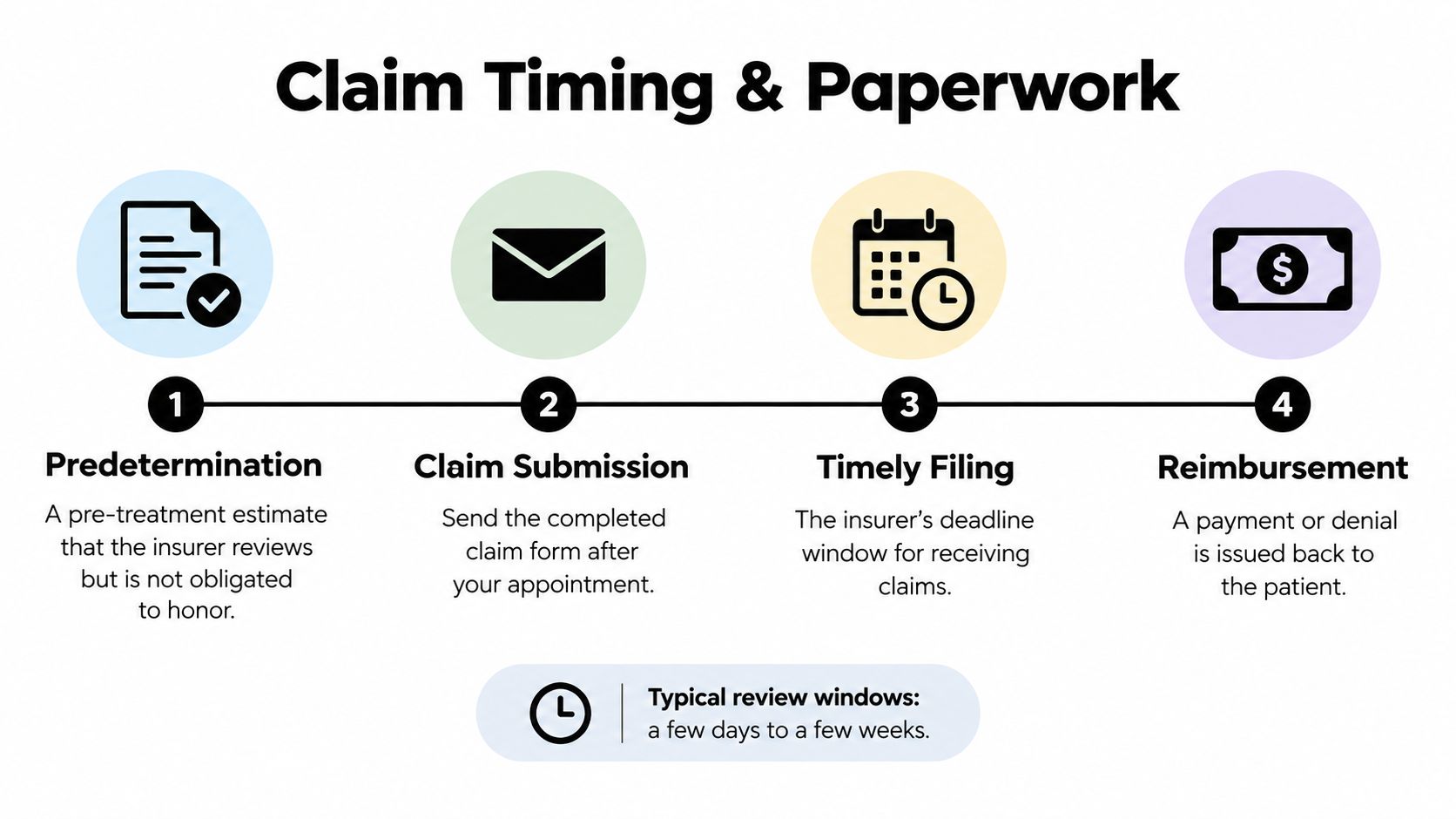
Insurance paperwork has its own clock. A predetermination, sometimes called a pre-treatment estimate or pre-authorization, is sent before care so the insurer can review the proposed procedure. It helps estimate the carrier's contribution, but the insurer's response generally isn't a guarantee of final payment.
After the appointment, the practice or patient submits the claim. The insurer checks eligibility, coding, documentation, network status, annual benefits, and policy exclusions. The carrier then sends an Explanation of Benefits, or EOB. The EOB explains what was submitted, what the insurer allowed, what it paid, and what it assigned to the patient. It isn't the same thing as the dental office bill.
Two ways the money can move
In one workflow, the patient pays the office upfront and submits the claim independently. The insurer then sends any reimbursement to the patient, assuming the plan permits that process and the claim is approved. This can be straightforward, but the patient carries the cash-flow burden while waiting.
In another workflow, the practice submits the electronic claim and the insurer pays the practice directly under an assignment-of-benefits arrangement. The office collects the expected patient portion and bills or refunds the balance after the carrier processes the claim. This approach can reduce the amount the patient must advance, but the patient still needs to review the EOB and reconcile it with the office statement.
Ask before treatment: Who submits the claim, who receives the insurance payment, and what happens if the carrier changes the estimated benefit?
Timely filing rules also matter. Each plan sets a deadline for receiving claims, and the window can range from 90 days to a year, depending on the policy and carrier. The office should confirm the applicable deadline rather than relying on a general assumption.
Predetermination is especially useful for crowns, implants, and orthodontics because these procedures can involve multiple appointments, separate codes, staged laboratory work, or benefits that vary by phase. A favorable response reduces uncertainty, but it doesn't override the policy. Patients should keep the predetermination, EOBs, receipts, and payment-plan documents together, particularly when reconciling HSA or FSA expenses or preparing tax records. For a related explanation of crown coverage, see whether insurance covers dental crowns.
How a Midtown Practice Supports Busy Patients
A Midtown appointment often has to fit between a train arrival, a conference call, school pickup, or a meeting across town. The office workflow should account for those constraints before the patient sits in the chair. That includes benefit verification, treatment sequencing, and a payment conversation that doesn't begin after the procedure has already been completed.

At a Midtown practice, the coordinator can verify benefits before the visit, check whether the dentist is participating with the patient's specific network, and request a predetermination when the proposed care warrants one. Early-morning and lunch-hour appointments help working patients handle consultations without losing an entire day, while Wednesday and Friday blocks can accommodate longer procedures that need more uninterrupted chair time.
Same-day emergency slots matter when a crown breaks, a tooth fractures, or pain appears during a workday. A quick teledentistry triage can help the team determine whether the patient needs an in-person examination immediately, what records to bring, and whether the visit is likely to involve a diagnostic or treatment charge.
Fewer visits through digital dentistry
Digital impressions and intraoral scanning can replace traditional impression materials for appropriate cases and support more efficient crown planning. When the clinical and laboratory workflow allows it, the team may be able to avoid a separate impression visit. That convenience is particularly useful when a patient is traveling between Midtown, Columbus Circle, and an office elsewhere in Manhattan.
The front desk also coordinates the financial side. Claims can be submitted electronically after the appointment, and secure payment links can let patients settle a balance without returning to the office. Multilingual coordinators and direct phone access help patients who are moving between meetings or need an explanation while they're in transit.
This short video provides another way to understand the patient-facing workflow:
Flexible financing through CareCredit or an in-house arrangement can be reviewed before treatment begins. The practical objective isn't to push a particular product. It's to make sure the patient understands the expected insurance contribution, the likely balance, the claim process, and the payment schedule before choosing a treatment date.
Choosing the Right Plan for Your Treatment Type
The right payment method depends on the type of care and the way the insurance plan classifies it. A patient shouldn't use a long repayment arrangement for a small preventive balance, and an uninsured patient shouldn't assume a membership plan is valuable if it duplicates benefits already included in a PPO.
Preventive care, such as examinations, cleanings, diagnostic images, and fluoride when covered, is often subject to strong plan benefits. Verify the network, frequency limits, and included services before paying for a membership plan that may repeat coverage you already have.
Restorative procedures require a closer calculation. Fillings, root canals, and crowns may be subject to a deductible and coinsurance, with the final patient share affected by the allowed amount and remaining annual maximum. For a manageable balance, a short-term financing promotion may be appropriate if the patient can satisfy its terms. An in-office discount may also help an uninsured patient who prefers not to open a credit account.
Major care often needs staged planning. Implants, bridges, orthodontics, and full-mouth rehabilitation may involve several procedures, separate claims, and an annual maximum that limits the carrier's contribution. The dentist and insurance coordinator can discuss whether medically appropriate phases should be scheduled across benefit years, while avoiding delays that could worsen the condition.
Financing options by treatment type
| Treatment Type | Typical Insurance Coverage | Best-Fit Financing Option | Why It Works |
|---|---|---|---|
| Preventive care | Often covered strongly, subject to plan limits and network rules | Insurance first, or an in-office membership plan for uninsured patients | Avoids paying twice for benefits already included |
| Restorative care | Often partially covered after deductible and subject to plan category | Short-term third-party financing, office discount, or available HSA/FSA funds | Matches a moderate balance with a defined repayment period |
| Major restorative care | Coverage can be limited by annual maximums, exclusions, timing, and staged claims | Assignment of benefits plus carefully reviewed third-party financing | Reduces the amount advanced while claims are processed |
| Orthodontics | Varies by plan, age rules, lifetime limits, and eligibility | Structured third-party financing or an office arrangement | Spreads a multi-visit balance over the treatment schedule |
| Implant treatment | Often involves separate surgical and restorative stages with different benefit rules | Predetermination, staged claims, and a financing plan for the residual balance | Gives the patient a clearer view of each phase before treatment |
Review the clinical plan and the financial plan together. For patients considering implants, this guide to dental implant costs can help frame the questions to ask about surgical stages, restoration, insurance processing, and payment timing.
Paul L. Gregory, DDS provides preventive, restorative, implant, orthodontic, emergency, and family dental care in Midtown Manhattan, with support for benefit verification, claim submission, predetermination, and payment planning. Bring your insurance information and treatment questions to Paul L. Gregory, DDS so the team can review your expected coverage and discuss a payment approach before care begins.