

An All-on-4 treatment commonly starts around $11,640 to $27,500 per arch, with a national average of $15,176, while a Midtown Manhattan patient should expect a substantially higher final bill once surgery, prosthetics, and add-on procedures are included. In practice, that means a complete full-mouth case can reach $60,000 to $95,000 in Midtown.
You're probably looking at a treatment estimate with one attractive number in large type and several unanswered questions underneath it. Does the quote include removing the teeth that are still present? What happens if your bone needs attention? Is sedation included? Are the temporary teeth and final bridge made from the same material? Will follow-up adjustments cost extra?
Those questions matter more than the advertised starting price. A published cost analysis found a mean adjusted total of $42,422 ± $3,860 for All-on-4 treatment, compared with $57,944 ± $20,198 for a conventional full-arch historical group, a difference of about $15,522 in that analysis, as summarized in this All-on-4 cost reference. But your out-of-pocket bill depends on the scope of treatment, the material selected, the condition of your jaw, and the way the practice bundles its fees.
What All on 4 Dental Implants Cost in Midtown Manhattan
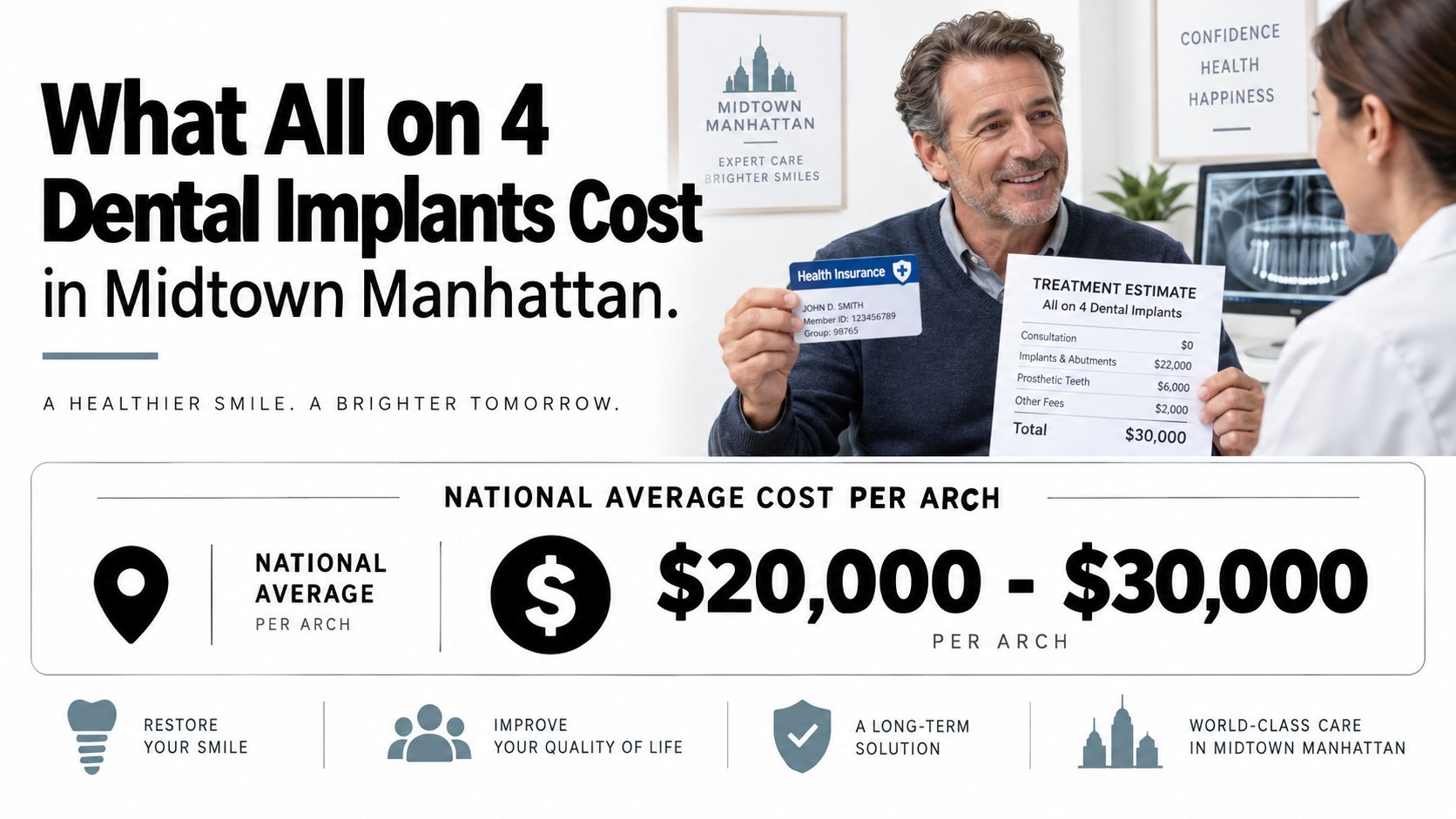
A patient sits in a Midtown consultation room with an insurance card in one hand and a treatment estimate in the other. The page says “starting at” a per-arch price. The patient's real question isn't whether four implants can support a fixed bridge. It's whether the number on the final financial agreement will still resemble the number on the advertisement.
For planning purposes, national pricing guides commonly place acrylic All-on-4 treatment around $20,000 to $35,000 per arch and zirconia around $28,000 to $45,000 per arch in higher-cost settings. In Midtown Manhattan, a single arch can reach approximately $30,000 to $55,000, while restoring both arches can bring the total to roughly $60,000 to $95,000. These local planning ranges reflect the premium associated with a high-cost urban practice, complex coordination, and premium laboratory work. They aren't a promise of what any particular office will charge.
The number that matters
The teaser quote may cover only implant placement and a basic provisional. The signed estimate should identify the surgery, extractions, temporary prosthesis, final bridge, imaging, sedation, laboratory work, and follow-up care. If those items aren't listed, you don't yet have a usable price.
A national pricing guide based on CareCredit data reports an average of $15,176, with a range from $11,640 to $27,500, and averages around $19,260 in California and $19,271 in Washington, D.C., compared with about $13,014 in Alabama. That source illustrates how location alone can shift the price substantially, as shown in this 2026 All-on-4 pricing guide.
If you're comparing Midtown offices, review the clinical scope before comparing the totals. A lower quote can exclude the final prosthesis, sedation, or the procedures needed to make the case predictable. For a local overview of provider considerations, see this Midtown Manhattan dentist resource.
How the All on 4 Treatment Concept Works
Think of a full arch as a bridge and the implants as its supporting columns. Instead of placing an implant under every missing tooth, the All-on-4 concept uses four strategically positioned implants to anchor one fixed prosthesis.
Two implants sit more vertically toward the front of the jaw. The two posterior implants are tilted to use available bone farther back without extending into areas where bone may be limited. The prosthesis then distributes biting forces across the four supports, much like a well-engineered bridge transfers load through its columns.
The treatment sequence
Consultation and imaging: The dentist evaluates your teeth, gums, bite, medical history, and available bone. Three-dimensional imaging helps the surgical and restorative teams plan implant positions and the provisional bridge.
Surgical appointment: The team removes teeth that can't be saved, places the implants, and secures a temporary fixed prosthesis when immediate loading is appropriate. The temporary teeth may be attached within 24 hours, depending on stability and the treatment plan.
Healing and integration: The implants heal while the temporary restoration protects the treatment area and restores basic function. The healing phase commonly lasts three to six months, after which the team evaluates the implants and prepares the final bridge.
Final prosthesis: The laboratory fabricates the permanent arch based on the approved design, bite, speech, and appearance. The dentist then delivers and adjusts the final restoration.
Tilting the back implants can help many patients avoid extensive grafting, but it doesn't guarantee that grafting will be unnecessary. Existing infection, severe bone loss, extraction sites, or sinus-related concerns can change the plan. That clinical uncertainty is one reason a responsible quote follows examination and imaging rather than a phone call.
The mechanics and appointments make more sense when you review the broader dental implant procedure guide. The important financial point is simple: you're paying for a coordinated full-arch reconstruction, not four isolated implant posts.
What Drives the All on 4 Dental Implants Cost
An All-on-4 estimate is best understood as an invoice made of several clinical and laboratory layers. The four implants are only one part of the treatment. The prosthesis, surgical planning, temporary bridge, sedation, and restorative appointments can carry as much financial importance as the implant hardware.
A typical ledger may include:
| Component | Typical Cost Range | Required? |
|---|---|---|
| Four implant fixtures | $2,000 to $5,000 each | Usually |
| Custom abutments | Varies by system and design | Usually |
| Acrylic or PMMA prosthesis | $15,000 to $25,000 per arch | One material option |
| Zirconia full-arch prosthesis | $25,000 to $38,000 per arch | One material option |
| CBCT imaging and surgical planning | Varies by practice | Usually |
| Temporary healing prosthesis | Varies by design | Usually |
| Extractions | Varies by number and complexity | If teeth remain |
| Bone grafting or site preservation | Varies by need | Only when indicated |
| Sedation or anesthesia | Varies by method and duration | Optional or clinically indicated |
| Follow-up and adjustments | Varies by contract | Confirm in writing |
The full-arch dental implant cost guide explains why pricing is usually organized by arch rather than by tooth. A single prosthesis spans the entire arch and requires coordinated surgery, design, and laboratory fabrication. The key cost inflection points are the restoration design, provisional workflow, material choice, and whether treatment can proceed immediately or must be staged.
Why a starting quote expands
Suppose an office advertises a $24,000 starting quote. Once the practice adds extractions, sedation, imaging, temporary upgrades, or a more advanced final material, the total may increase by $6,000 to $12,000. Those figures are planning ranges from the brief, not a universal fee schedule, so your written estimate must show exactly which services are included.
Ask these questions before accepting the quote:
- Implant system: Which manufacturer and implant model will the surgeon use?
- Restorative design: Is the quoted bridge acrylic, PMMA, titanium-acrylic, zirconia, or another material?
- Temporary teeth: Are they fixed on the day of surgery, and are adjustments included?
- Laboratory work: Does the fee include the final scan, try-in, design, milling, finishing, and delivery?
- Complications: Who pays if an implant needs management or the provisional requires repair?
For a broader discussion of surgical and restorative pricing, review this dental implant cost resource. A practice that can't separate these charges isn't giving you a transparent estimate.
Acrylic vs Zirconia Full Arch Materials
Material choice can change the value equation more than the implant count. A titanium-acrylic or PMMA hybrid usually offers a lower entry price and easier repair. Zirconia costs more because the laboratory workflow is more demanding and the finished restoration is positioned as a premium option for strength and appearance.
Current U.S. guides commonly place acrylic or PMMA hybrid arches at $15,000 to $25,000 per arch and zirconia arches at $25,000 to $38,000 per arch, as reported in this All-on-4 material and cost guide. In a Manhattan practice, the laboratory difference may add roughly $4,000 to $8,000 for zirconia, depending on the design and the laboratory.
| Factor | Acrylic Hybrid | Zirconia |
|---|---|---|
| Typical material cost | Lower | Higher |
| Structure | Titanium bar with acrylic teeth and gingival material | Monolithic or layered ceramic |
| Repairability | Easier and generally less expensive to repair | Repair can be more complex |
| Appearance | Good when properly designed | Strong aesthetics, translucency, and stain resistance |
| Weight | Can feel lighter depending on design | Can feel denser depending on design |
| Maintenance concern | Acrylic teeth and gum material may wear or fracture | Ceramic fracture is possible, especially with heavy forces |
| Best fit | Budget-sensitive patients and cases needing practical serviceability | Patients prioritizing premium appearance and long-term material performance |
Choosing the restoration
Acrylic makes sense when budget control, repairability, or future modification matters most. It can also be a practical choice for patients who grind, because the dentist can often repair or replace worn acrylic components more directly than a damaged ceramic structure. That doesn't make acrylic disposable. It means the restoration has a different maintenance philosophy.
Zirconia makes sense when you place greater weight on stain resistance, refined aesthetics, and a more durable ceramic surface. The final decision should account for bite forces, bruxism, hygiene access, lip support, speech, and the dentist's ability to service the restoration later. Ask to see the proposed design and learn whether the laboratory will produce a monolithic restoration, layered zirconia, or a titanium-supported ceramic design.
A dental implant technology overview can help you prepare questions about digital planning, scanning, and laboratory fabrication. Don't select zirconia because it sounds more advanced. Select it when its advantages solve a problem you have.
How Location Affects Your Final Price
Location changes more than the rent on the office. It affects staffing, laboratory access, specialist coordination, equipment investment, insurance, and the time required to manage a complex case.
The 2026 CareCredit-based guide cited earlier reports averages around $19,260 in California, $19,271 in Washington, D.C., and $13,014 in Alabama, with a national average of $15,176. The range runs from $11,640 to $27,500, depending on material, implant count, and surgeon experience, as detailed in this national All-on-4 pricing analysis. Midtown Manhattan pricing can sit above those national figures because the practice carries higher operating costs and often coordinates multiple specialists and premium laboratories.
What the Midtown premium can buy
A Midtown office may offer a digitally integrated workflow with CBCT imaging, intraoral scanning, guided surgery, and close access to prosthodontic and surgical expertise. That infrastructure doesn't automatically produce a better result, but it can make planning and communication more coordinated. You're paying for the people, systems, facility, and accountability behind the restoration.
Lower-cost U.S. markets may quote less because overhead and staffing costs differ. Dental tourism can reduce the headline price further, but surgery abroad creates practical questions about emergency care, warranty enforcement, follow-up visits, and who adjusts or replaces the prosthesis after you return home.
Practical rule: Compare the cost of the complete treatment pathway, not the airfare-adjusted surgical price. A cheaper operation becomes less attractive when a local dentist must manage an unresolved complication without access to the original laboratory or surgeon.
Staying local can cost more upfront, but local care offers easier access to examinations, adjustments, hygiene appointments, and communication among the clinicians involved. For a fixed full-arch restoration, that ongoing access deserves a place in your financial comparison.
Insurance, Financing, and Payment Plans
Dental insurance rarely pays for an All-on-4 case as if it were a routine crown. Plans often classify the treatment as a major procedure, apply exclusions to implant surgery, and impose annual limits that leave a large balance. Coverage varies by employer, plan design, missing-tooth clauses, waiting periods, and whether the restoration or implant portion receives benefits.
Ask the office to submit a predetermination before surgery. The estimate should identify the planned dental procedure codes, which can include D6010 for implant placement, D6056 for abutments, D6075 for implant crowns, D7240 for extractions, D7953 for bone grafting, and D9243 for IV sedation. Code selection depends on the actual treatment, so treat the predetermination as a coverage estimate, not a guarantee of payment.
Build the payment plan around phases
The treatment usually has a surgical phase and a restorative phase. A practice may require payment before surgery, before delivery of the final prosthesis, or in installments tied to those milestones. Get the schedule in writing, including what happens if healing takes longer or the temporary restoration needs repair.
For financing, review the total repayment amount, promotional terms, and interest rate rather than focusing only on the monthly payment. CareCredit is one option patients may encounter, and the implant financing information page can help you organize questions for the office. HSA and FSA funds may also help eligible patients use tax-advantaged dollars for qualified care.
Questions to ask the coordinator
- Coverage scope: Does the plan contribute toward extractions, the prosthesis, or only selected services?
- Annual maximum: How much benefit remains for the current plan year?
- Predetermination: Has the insurer reviewed the proposed codes and treatment sequence?
- Financing terms: Is the offer deferred interest, fixed interest, or a promotional arrangement?
- Payment milestones: When are surgery, temporary teeth, and final restoration payments due?
Don't count on insurance to convert an expensive case into a small balance. Treat benefits as partial assistance until the carrier confirms the details in writing.
Hidden Costs Most Guides Skip
The most misleading All-on-4 quote is the one that gives you a low number without defining the treatment. A headline figure may represent implant placement and a basic temporary, while the final invoice includes procedures that were obvious to the clinical team but invisible to the patient.
Extractions are the first common add-on. If teeth remain in the arch, the surgeon may need to remove them before implant placement. Bone grafting or site preservation may become necessary when the available bone can't support the planned implants. Some patients also need sinus-related treatment, soft-tissue management, or additional imaging before surgery can proceed.
Read every line before you sign
Your estimate should state whether it includes:
- Tooth extractions: Surgical time, difficult removals, infection management, and socket preservation can change the fee.
- Bone grafting: Grafting adds surgical materials, membranes, imaging, and follow-up. Some 2026 guides place higher-market grafting add-ons in the several-thousand-dollar range per case, as noted in this All-on-4 pricing discussion.
- Sedation or anesthesia: Local anesthesia, oral sedation, IV sedation, and general anesthesia have different staffing and monitoring requirements.
- Provisional bridge: Confirm whether the temporary is fixed, how it's reinforced, and whether replacement or repair is included.
- Digital planning: CBCT scans, guided surgery, 3D printing, and laboratory design may appear as separate charges.
- Maintenance: Relines, adjustments, hygiene visits, and replacement components may fall outside the initial global fee.
- Warranty conditions: Some warranties require documented maintenance and regular professional cleanings.
The final restoration can also cost more if you change from acrylic to zirconia after the treatment plan begins. That material decision should be made before the laboratory designs the case, not after the temporary bridge has already been delivered.
Demand this before treatment: an itemized estimate that separates surgery, imaging, sedation, provisional treatment, laboratory work, final prosthesis, and maintenance.
Refuse a quote that can't be unbundled. The cheapest proposal is rarely the cheapest treatment if it leaves you responsible for every necessary addition.
Planning Your All on 4 Investment
Start with records, not financing. Bring recent X-rays, periodontal information, medication details, and a list of previous dental procedures to the consultation. The clinician needs a complete picture of your health and jaw before anyone can responsibly discuss the final price.
Then ask for a written plan that separates each stage. You should know who places the implants, who designs and delivers the prosthesis, which laboratory fabricates it, and what happens if those clinicians disagree about the bite or fit.
Your consultation checklist
- Confirm the diagnosis: Ask whether the remaining teeth can be saved and why removal is recommended.
- Review the imaging: Request an explanation of the CBCT findings and the proposed implant positions.
- Identify the restoration: Confirm the material, framework, tooth design, and laboratory.
- Separate the fees: Require distinct lines for implants, extractions, grafting, sedation, temporary teeth, final prosthesis, and follow-up.
- Ask about experience: Verify the surgeon's credentials and experience with full-arch cases. Don't rely on a vague statement that the office “does implants.”
- Clarify responsibility: Learn who handles surgical complications, broken temporary teeth, loose components, and prosthetic adjustments.
- Review the warranty: Ask what the warranty covers, what maintenance it requires, and which events void it.
- Request insurance preauthorization: Have the office submit the proposed codes before you commit.
- Compare thoughtfully: Obtain at least two consultations, but compare identical treatment scopes rather than competing headline prices.
- Plan a reserve: Keep room in your budget for clinically necessary additions and maintenance instead of borrowing up to the exact quoted amount.
I recommend choosing the clinician and team you trust to manage complications, not the office with the lowest starting number. All-on-4 is a long-term medical investment, and the quality of planning, communication, and maintenance matters long after surgery day.
Paul L. Gregory, DDS provides implant consultations, digital diagnostics, restorative planning, All-on-4 full-arch treatment, and assistance with insurance and fee estimates in Midtown Manhattan. Visit Paul L. Gregory, DDS to request a consultation and discuss a written, treatment-specific estimate before you make a financial commitment.