

You're chewing on one side, avoiding certain foods, or hiding your smile in photos, and the problems don't feel isolated anymore. A cracked tooth leads to pain, the pain changes how you bite, the bite wears down other teeth, and suddenly the question isn't whether one tooth needs fixing, it's whether your whole mouth needs a reset.
Full mouth reconstruction is the umbrella term people use when several parts of the mouth need coordinated treatment. That can mean restoring damaged teeth, replacing missing ones, treating gum disease, correcting bite problems, and planning the order carefully so the final result works as a system, not just a collection of repairs.
For some patients, the solution is a few crowns and gum treatment. For others, it's a staged plan that may include implants, orthodontics, or full-arch restoration. The difference usually comes down to how much structure is left, how stable the bite is, and whether the gums and supporting bone can handle conservative treatment or need a more complete rebuild.
What Full Mouth Reconstruction Actually Means
A patient often walks in thinking they need “everything fixed,” but that phrase can mean very different things. One person may have worn enamel, a couple of failing fillings, and one missing molar. Another may have loose teeth, gum inflammation, collapsed bite height, and multiple missing back teeth that no longer support chewing evenly.
Full mouth reconstruction is not one procedure. It's a treatment plan that combines restorative, periodontal, implant, orthodontic, and sometimes surgical care to rebuild how the mouth functions as a whole. Rutgers describes the concept as restoring the teeth, gums, and jaw so they work in harmony, which is exactly why the plan has to be individualized rather than formulaic (Rutgers full mouth reconstruction overview).
Reconstruction versus rehabilitation
In everyday dentistry, full mouth reconstruction and full-mouth rehabilitation are often used interchangeably. The distinction matters less than the core question, which is whether the case needs a handful of isolated fixes or a coordinated rebuild that changes the bite and support system.
Practical rule: if one restoration would throw off the rest of the mouth, the case is probably bigger than a single-tooth repair.
That's why the topic attracts people who've already tried smaller solutions. A filling helped, then broke. A crown was placed, then another tooth started hurting. A denture fit poorly, then the bite changed again. At that point, the discussion shifts from patching individual teeth to planning around function, longevity, and the order of treatment.
Who usually needs this level of care
People who may need full mouth reconstruction often have several of these problems at once, worn teeth, multiple missing teeth, gum disease, bite collapse, or old work that's failing. Others just need targeted care. A single fractured tooth, for example, may only call for a crown, not a multi-stage rebuild.
If you're trying to sort through the terminology, a broader resource on dental restoration can help frame the difference between routine repair and a full plan. The main thing to watch for is scope. If the dentist is discussing balance across the whole mouth, not just one tooth, you're in reconstruction territory.
The Evaluation Process and Diagnostic Foundation
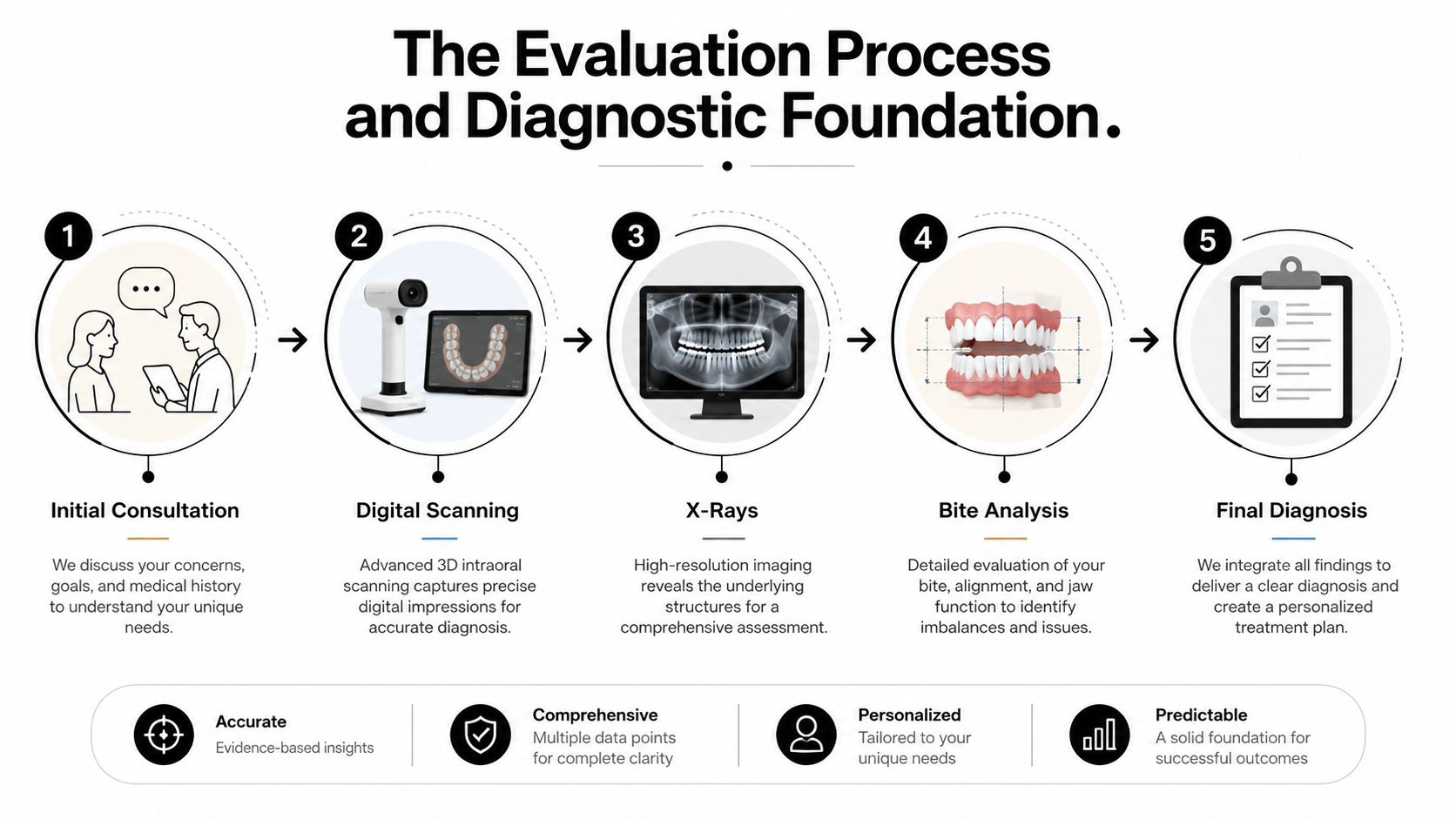
A strong treatment plan starts with answers, not materials. Before a dentist chooses between crowns, bridges, implants, or a larger reconstruction, the team has to understand what is failing, what can still be saved, and what kind of bite the final work needs to withstand.
A thorough evaluation goes well beyond a routine exam. It looks at teeth, gums, bite forces, jaw joints, and the shape of the bone that supports the mouth. Digital imaging matters here too, because the dentist is not only checking for decay. They are mapping where stress falls and whether the final restorations will have enough support to last.
What the dentist is trying to learn
The first question is simple, which teeth can still be saved? From there, the dentist has to sort out the rest of the picture. Are the gums stable, or is there active periodontal disease? Is the bite collapsing because back teeth are missing, or because worn teeth have shortened the vertical dimension?
The next question is mechanical. A reconstruction can look excellent and still fail early if it overloads the wrong teeth. An older review of full-mouth rehabilitation explains that centric relation, vertical dimension, and anterior guidance must be coordinated, because a mistake in one area can place extra force on both the restorations and the temporomandibular system (occlusal concepts in full mouth rehabilitation).
If the bite is unstable at the diagnostic stage, it will stay unstable after treatment unless the plan is built around that instability.
Why X-rays and bite analysis matter
A dentist uses dental X-rays to see what cannot be inspected directly, including root problems, bone levels, hidden decay, and old root canal issues. That view helps determine whether a tooth can be restored or whether replacement is the safer path.
Bite analysis shows how the upper and lower teeth meet under real chewing pressure. That matters because the final plan has to work while you are speaking, chewing, and grinding at night, not only when your mouth is still in the chair. If the evaluation skips those details, the restoration may fit visually but fail in function.
What complicates treatment
Red flags include uncontrolled gum inflammation, teeth that are too compromised to save, jaw discomfort, and signs of heavy grinding. These findings do not automatically rule out treatment, but they do change the sequence, the materials, and the amount of time needed to complete the case well.
Treatment Options and When Each Is Used
No single procedure solves every full-mouth case. Most treatment plans mix several categories, because the mouth rarely fails in only one way. Some teeth need rebuilding, some need replacement, some need gum stabilization, and some need alignment changes before any final work can be trusted.
Comparing the main options
| Treatment Type | Best For | Typical Timeline |
|---|---|---|
| Crowns and bridges | Teeth that are broken, heavily worn, or structurally weakened but still restorable | Often used once the supporting teeth and gums are stable |
| Dental implants | Missing teeth or teeth that can't be saved | Requires healing time after placement or extraction |
| Periodontal therapy | Gum disease, inflammation, and loose support around teeth | Usually comes before major restorative work |
| Orthodontics | Bite alignment problems, spacing, or uneven tooth positions | Often used before final restorations in complex cases |
| Full-arch implant solutions such as All-on-Four or All-on-Six | Extensive tooth loss or very compromised arches | Planned in phases, with healing and final prosthetics later |
For patients trying to compare fixed options, the practice's crowns for teeth page is a useful example of how one restorative tool fits into a larger plan. Crowns protect weakened teeth, but they don't solve gum disease, replace lost roots, or create a new bite on their own.
How dentists combine treatments
A common mistake is assuming one treatment category is “better” than the others. That's not how planning works. If the back teeth are missing, implants may be needed to rebuild support. If the gums are inflamed, periodontal therapy comes first. If the front teeth are crowded or tilted, orthodontics may make the final restorations more conservative and more predictable.
Full-arch solutions enter the conversation when the remaining teeth can't provide durable support or when the patient wants a fixed approach for an entire arch. A 2024 NIH-indexed review notes that modern fixed implant-supported prostheses, including All-on-Four and All-on-Six protocols, have reported implant survival rates ranging from 92% to 99% over 5 to 10 years, with some immediate-loading approaches showing over 95% survival even with follow-up extending to 10 years (NIH-indexed review). The same review reports prosthetic survival around 95%, which shows the restorative side has also become more dependable.
Why the mix matters
The goal isn't to use the most advanced option everywhere. It's to choose the least invasive plan that still creates a stable mouth. That's why a patient may hear about one crown, several crowns, bridges, implants, gum therapy, or a full-arch solution in the same consultation. The mix depends on what the teeth and supporting tissues can realistically sustain.
How Dentists Sequence Complex Treatment Plans
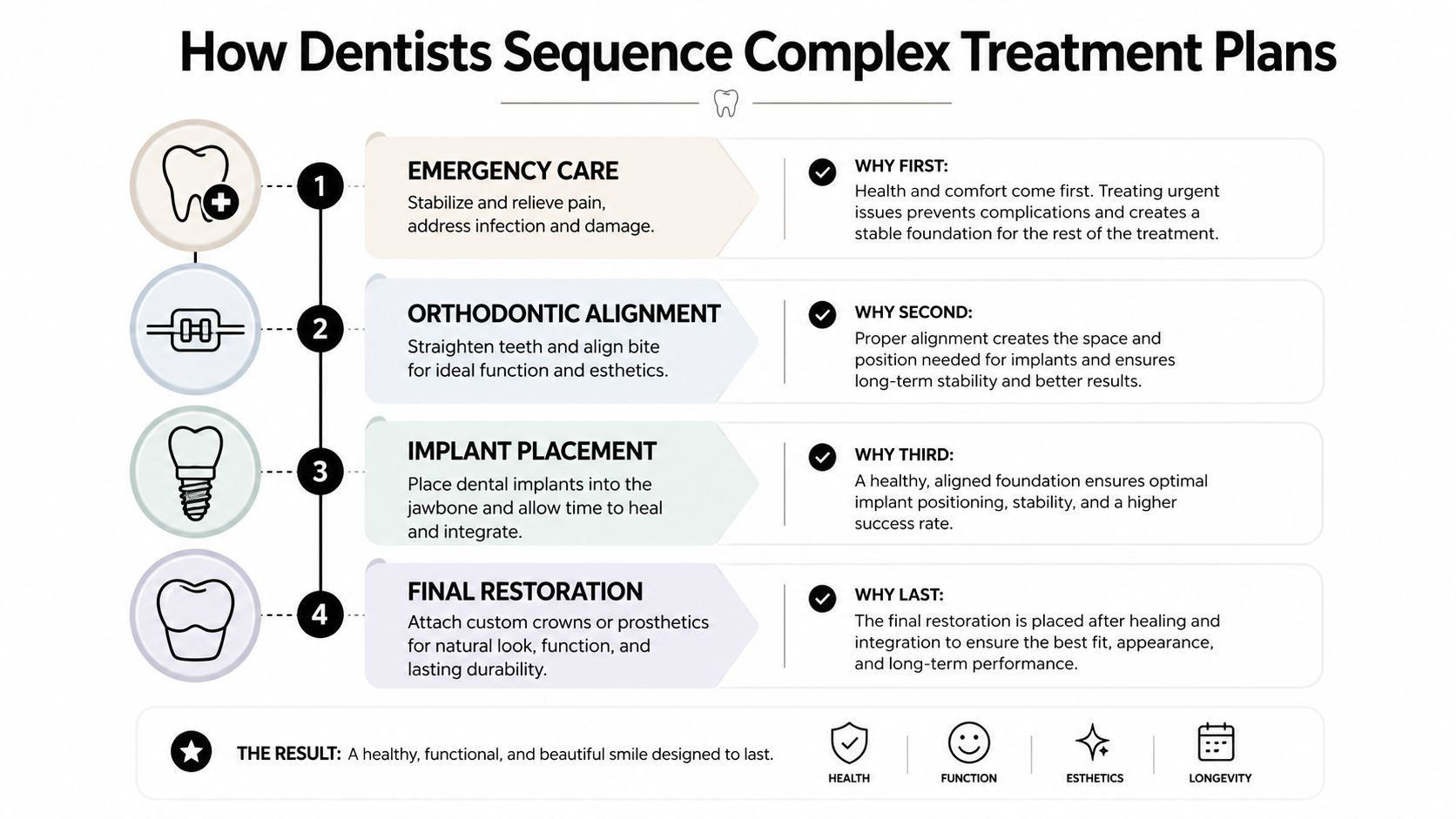
The order of treatment matters as much as the treatments themselves. If a dentist places expensive restorations into an unstable mouth, the final result can be undermined by untreated disease, uneven bite forces, or a lack of support behind the front teeth.
Step one is stabilization
Active infection, inflammation, and pain come first. That usually means treating gum disease, removing teeth that cannot be saved, and controlling urgent problems so the mouth is no longer in crisis. A dentist cannot build a durable plan on top of active breakdown.
Step two is rebuilding support
In cases with worn teeth or a reduced vertical dimension, the back teeth are often restored first. That creates the foundation for the rest of the bite. As noted earlier, posterior support is what allows the dentist to re-establish stable function and then shape the front of the bite around that base.
Step three uses provisional restorations
Temporary restorations are not just placeholders. They let the dentist test the new bite, verify comfort, and see whether the planned height and contact pattern are working in daily life. That trial period matters because the final restorations are harder to change after delivery.
A provisional phase also helps the team spot problems that are hard to predict from models alone. Chewing comfort, speech, facial support, and muscle response can all reveal whether the plan needs refinement before the final work is made.
Step four is finalization
Once the gums are healthy, the bite is stable, and the patient is functioning comfortably in temporaries, the final crowns, bridges, or implant prosthetics are made. Skipping phases may save time at first, but it usually creates more adjustments later.
The most expensive part of a reconstruction is often not the material, it is the correction required when treatment order was rushed.
In real practice, sequencing can also include an orthodontic phase, a surgical phase, or an implant-healing phase if the case requires it. That is why restorative dentistry rarely feels fast, but it does feel controlled when it is planned well. If implants are part of the plan, patients often review the basics of the dental implants healing process before they commit, because healing time affects every later step.
Realistic Timelines and What Affects Treatment Duration
Patients ask about timing early, and they should. Full mouth reconstruction isn't something you schedule like a cleaning. It unfolds according to biology, healing, and how many disciplines need to work together.
A simpler case may move through diagnosis, limited periodontal care, and final restorations in a few months. More complex rehabs stretch much longer because every phase has to heal before the next one can safely begin. The biggest reason isn't inefficiency, it's that tissues need time to settle before they can support precise final work.
What makes a case faster
Cases move more quickly when the teeth are mostly restorable, gum health is good, and the bite doesn't need major redesign. A patient who only needs several crowns and limited soft-tissue care may progress in a straightforward sequence because there's less healing between stages.
What slows things down
Bone grafting, tooth extractions, implant healing, and periodontal therapy all add waiting time. So do long-term provisional phases, especially when the dentist is testing bite height or esthetics before finalizing the restorations. If implants are part of the plan, the healing process itself becomes a major schedule driver, which is why patients often review the basics of dental implants healing process before they commit.
The practical issue is that each phase changes what the next phase can safely do. A gum infection can't be ignored just because the patient wants final crowns. An implant can't be restored before the bone and tissue are ready. A new bite can't be locked in until the temporaries prove that the jaw can tolerate it.
A careful plan can feel slower in the chair, but it usually feels faster by the time the case is complete because there are fewer reversals.
Why waiting isn't wasted time
The in-between periods let the mouth heal, but they also give the dentist data. If a temporary bridge is uncomfortable, that tells the team the bite needs adjustment. If the gums react poorly, that changes the hygiene and maintenance plan. Waiting is part of diagnosis in a complex case, not just a pause between appointments.
Long-Term Maintenance and Protecting Your Investment
The marketing around reconstruction often ends at the reveal. Real dentistry doesn't. Once the final restorations are in, the work shifts from building to preserving, and that part is just as important.
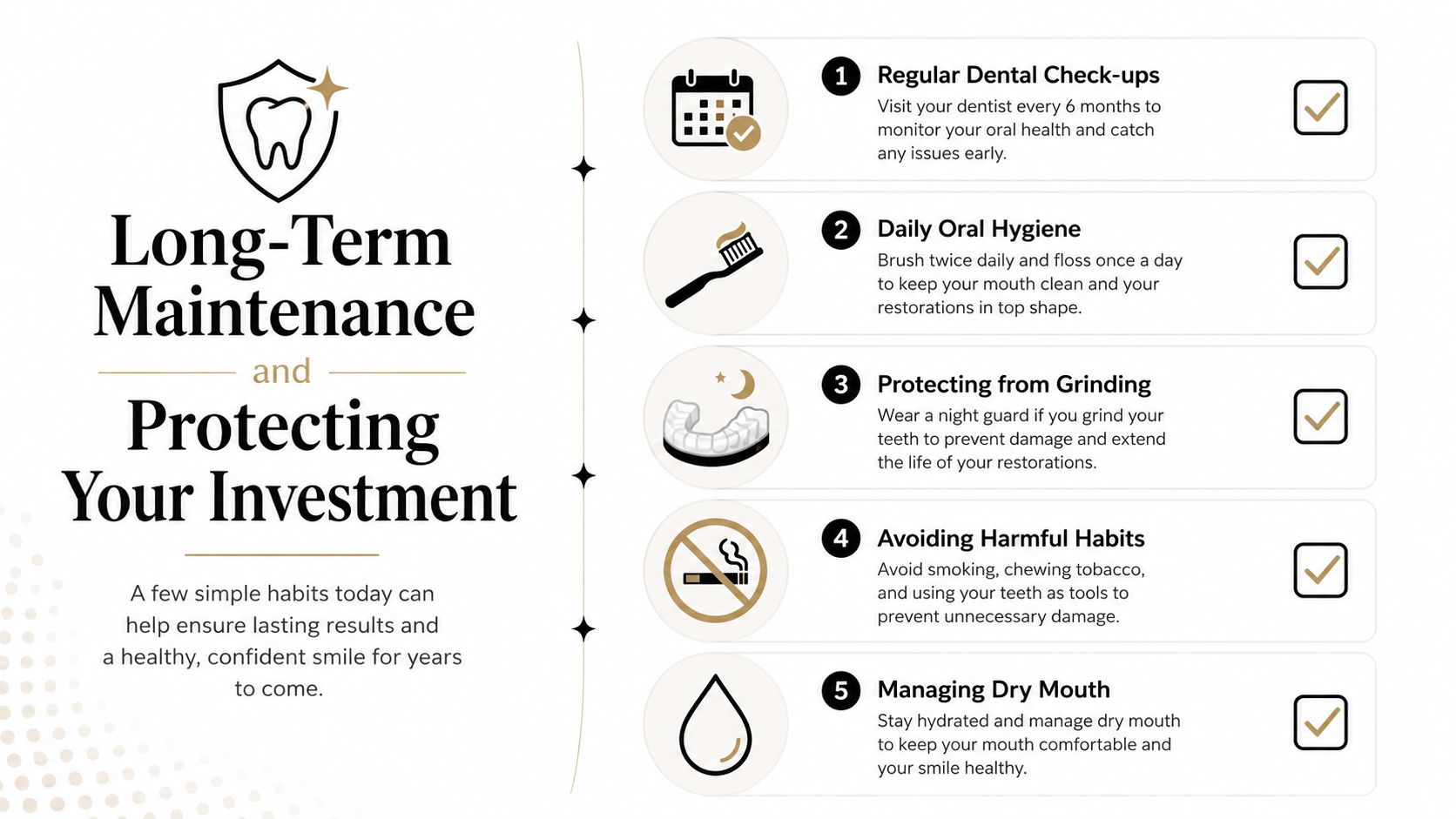
Full-mouth cases need ongoing hygiene, regular checkups, and a maintenance plan specific to the materials and the patient's habits. People who grind their teeth often need night guards, because even strong restorations can't ignore repeated overload. Patients with a history of gum disease need supportive periodontal care so the tissues around the restorations stay healthy.
What maintenance actually looks like
A good home routine matters, but it's not enough on its own. Professional cleanings, periodic adjustments, and monitoring for wear help catch problems before they turn into bigger repairs. If implants are part of the plan, patients can review 5 essential tips for keeping your dental implants clean as a practical starting point for daily care.
Useful question: ask your dentist what follow-up visits will look like after the final restorations are placed, not just before treatment begins.
What can go wrong
Even excellent reconstructions can face problems. Crowns can chip, screws can loosen, gum inflammation can return, and patients who clench or grind can accelerate wear faster than expected. The literature on prosthetic rehabilitation keeps emphasizing long-term provisionalization, occlusal recalibration, hygiene reinforcement, and periodic review because complex cases remain vulnerable without follow-up.
The maintenance burden is especially important for medically complex patients or those with limited access to care, because the long-term plan has to be realistic as well as ideal. If your dentist never discusses maintenance, that's a warning sign. A reconstruction is only as durable as the follow-up behind it.
Is Full Mouth Reconstruction Right for You
The best candidates usually have more than one major problem at the same time. Missing teeth, failing crowns, bite collapse, gum disease, severe wear, or pain from a misaligned bite all point toward a conversation about full mouth reconstruction instead of one-off fixes.
A useful consultation should answer three questions. What can be saved? What has to be replaced? And what order will give the safest, most predictable result? If the plan jumps straight to final cosmetic work without a serious diagnostic phase, the recommendation deserves a second look.
Questions worth asking
- What problem is driving the treatment plan? A clear answer should connect symptoms to structure, not just appearance.
- Which teeth are being preserved, and why? Saving teeth is good, but only if they can support the final plan.
- What happens if I grind or clench? The answer should include protection, not optimism.
- What is the maintenance schedule after treatment? Durable dentistry depends on follow-up.
A complex case also calls for a provider who can coordinate multiple disciplines, or work closely with specialists when needed. Paul L. Gregory, DDS in Midtown Manhattan provides restorative, periodontal, implant, orthodontic, diagnostic, and emergency care under one roof, which can matter when a case needs coordinated sequencing rather than isolated appointments.
If you're comparing recommendations, don't focus only on which option sounds fastest. Focus on whether the plan explains the bite, the gums, the missing teeth, and the maintenance strategy in a way that makes sense to you. If it doesn't, seek another opinion until it does.
If you're trying to decide whether your situation calls for a few targeted restorations or a true full mouth reconstruction, Paul L. Gregory, DDS can evaluate the whole picture and map out a plan that respects both function and longevity. Schedule a visit with Paul L. Gregory, DDS to review your options, ask the hard questions, and get a treatment sequence that fits your mouth, your timeline, and your goals.