

A dental bridge rarely announces that it's failing. In a 2025 retrospective study of patients with advanced periodontitis, 14.4% of bridges failed over an average follow-up of 16.1 years, and the failures tracked with poor hygiene and maintenance complications rather than with the porcelain itself (published audit of long-term bridge failure). Caries, endodontic problems, porcelain fracture and gum recession did the damage. The teeth holding the bridge up paid for it.
That's the uncomfortable part of this subject. The restoration in the middle of your smile can look perfect, feel solid, and still be losing the teeth that support it. So the answer to how to care for a dental bridge isn't a longer brushing session. It's a short, specific daily routine aimed at the margins and the abutment teeth, plus a clear list of quiet signals that earn a visit.
I'd tell a patient this on the day a bridge is seated and repeat it at every recall after that.
Daily Bridge Care Schedule at a Glance
A 2004 systematic review of conventional tooth-supported fixed partial dentures estimated a 10-year survival probability of 89.1%, but the probability of staying completely free of complications was only 71.1% (Wiley, Clinical Oral Implants Research). Those two figures describe different things. Survival counts a bridge that's still in the mouth. Freedom from complications counts one nobody has had to repair.
The same review shows what goes wrong across a decade. Loss of retention: 6.4%. Material fracture: 3.2%. Bridge loss from caries: 2.6%. Abutment-tooth fracture: 2.1%. Loss from recurrent periodontal disease: 0.7%. Decay and gum disease sit right there in the list, competing with mechanical failures that no amount of flossing could prevent.
| Task | How often | Why it matters |
|---|---|---|
| Brush bridge, gumline and supporting teeth with a soft brush and fluoride toothpaste | Twice daily | Removes plaque from the margins and the abutment teeth |
| Clean beneath each pontic | Once daily | Plaque and food collect where a regular toothbrush cannot reach |
| Check gums for bleeding, swelling or tenderness | Daily | Early signs of gum inflammation around the supporting teeth |
| Note changes in bite, fit, taste or sensitivity | Once a week | Catches loosening, cement washout or decay before pain starts |
Notice what the schedule doesn't include: anything aimed only at the artificial tooth. Biofilm collects at the crown margins and in the space under the pontic, and a regular toothbrush can't reach either. That's why a floss threader, an interdental brush or a bridge-specific cleaner earns a place in your routine, and why professional exams matter: the things that go wrong at a margin happen where you can't see them and where they rarely hurt at first.
Tonight, run a clean fingertip along the gumline above and below the bridge and feel for roughness or a lip where the crown meets the tooth. Then close your teeth together and notice whether the bridge meets the opposite teeth the way it did a month ago. Roughness and a changed contact are the two findings I'd want to hear about at the next visit rather than the one after.
First Weeks With a New Bridge
The first fortnight after a bridge is cemented is mostly about reading your own symptoms correctly. Mild tenderness of the gum under the pontic and a day or two of sensitivity around the abutment teeth are ordinary; that tissue has been retracted, prepared and impressed. What matters is the trend, not the presence, of discomfort.
Keep the two-week checklist short and repeatable.
- Food: stay soft on the new side and cut bites smaller than feels natural until the bite settles. A fresh bridge doesn't need a bagel test on day two.
- Under-bridge cleaning: start on day one with a floss threader, gently, even if the gum is sore. Sore gums are a reason to lighten the pressure, not a reason to skip.
- Brushing: twice daily with a soft brush and fluoride toothpaste, keeping the bristles off any spot that feels bruised.
- Bite check: each evening, close gently and feel for a high spot or an uneven contact on the bridge itself.
- Score it: compare how the bridge feels on day three, day seven and day fourteen, and note whether tenderness is fading or growing.
Call before the follow-up appointment if pain grows instead of fading, the bridge rocks when you touch it, the bite stays high, or floss catches on the same spot every single time. A high contact left alone is how a porcelain fracture starts. A margin that keeps catching is how a cavity starts at the edge of the crown.
The short follow-up visit after placement is worth keeping. It's the easiest moment to correct a heavy contact or a margin that's collecting food, while the cement is fresh and the gum is still easy to read. After that, the routine takes over.
Choose Your Tools and Clean Under the Bridge
A bridge can feel completely normal while plaque is building up on the abutment teeth underneath it. The tool that prevents that is whichever one reaches under the pontic, and which one that is depends on two things: whether the pontic sits tight against the gum or leaves a gap, and how snug the contact is with the neighbouring teeth. Answer those two questions and the tool list shrinks fast.
Match the aid to the gap
Bridge floss, sometimes sold as super floss, has a stiff end that threads under the pontic and a spongy section that widens into an open space. It suits tight contacts and it's the friendliest starting point if you've never cleaned under a bridge before. A floss threader does the same job with ordinary floss looped through it, which some people find easier to control and others find fiddly with wet hands. An interdental brush is the right answer when there's genuine space under the pontic and between the abutments, provided the size matches that space. A water flosser flushes loose debris and feels satisfying, though on its own it doesn't remove plaque from tooth surfaces.
| Cleaning aid | Best for | Watch out for |
|---|---|---|
| Bridge floss or super floss | Tight contacts between teeth and first-time users | Hard to thread without practice; needs a steady, gentle motion |
| Floss threader | Getting floss under the pontic | Can snag on rough margins; check with a dentist if it catches repeatedly |
| Interdental brush | Open spaces under the pontic and around abutments | Size must match the space; oversized brushes injure gums |
| Water flosser | Flushing loose food and debris after cleaning | Does not remove plaque from tooth surfaces on its own |
The once-a-day routine under the pontic
- Thread it under the pontic from the cheek side, keeping both ends of the floss in view.
- Hug each abutment. Curve the floss against the side of the supporting tooth so it wraps the surface, not the middle of the gap.
- Work the gumline gently, with a back-and-forth motion along the tissue. Don't snap the floss down into it.
- Add a brush where the anatomy allows, sized to the space. Have a hygienist check the fit before you commit to a size.
- Irrigate last. Use the water flosser to flush loosened debris after mechanical cleaning, never instead of it.
- Stop if a contact won't pass. Forcing floss through a tight spot frays it against the margin and tells you nothing. Ask for an adjustment.
Fixed partial denture literature identifies floss, floss threaders and interdental brushes as important adjuncts to conventional brushing (Folia Medica review of bridge maintenance), and it's blunt about what skipping them costs the supporting teeth. It also warns against two habits: scraping under the pontic with a sharp object, and forcing floss through a contact that won't take it. Fluoride toothpaste matters as much as the tool you pair it with. If you compare imported tubes, this guide to decoding Japanese toothpaste labels explains the fluoride concentrations and abrasive levels worth checking before you buy.
If your restoration is implant-supported rather than tooth-supported, the same discipline applies with different hardware, and the routine for cleaning around dental implants covers the alternatives.
What a clean result looks like
You're done when the floss comes out without food on it, the gum stops bleeding within about a week of consistent cleaning, and the space under the pontic no longer tastes of anything. Those are the quiet signs worth tracking, because a failing margin rarely announces itself with pain first.
If floss shreds on the same spot twice, don't buy a new tool or press harder. Book a check, because a shredded thread usually means a rough margin or a failing contact, and neither improves with more pressure.
The rule I'd keep: if a spot keeps catching, the problem is the bridge, not your technique.
Daily Habits That Protect Your Bridge
Force and sugar break more bridges than chewing ever does. Porcelain is hard, but the cement line beneath it and the root holding it are not, and both respond badly to repeated point loads.
The habits below are the ones worth pinning up where you brush.
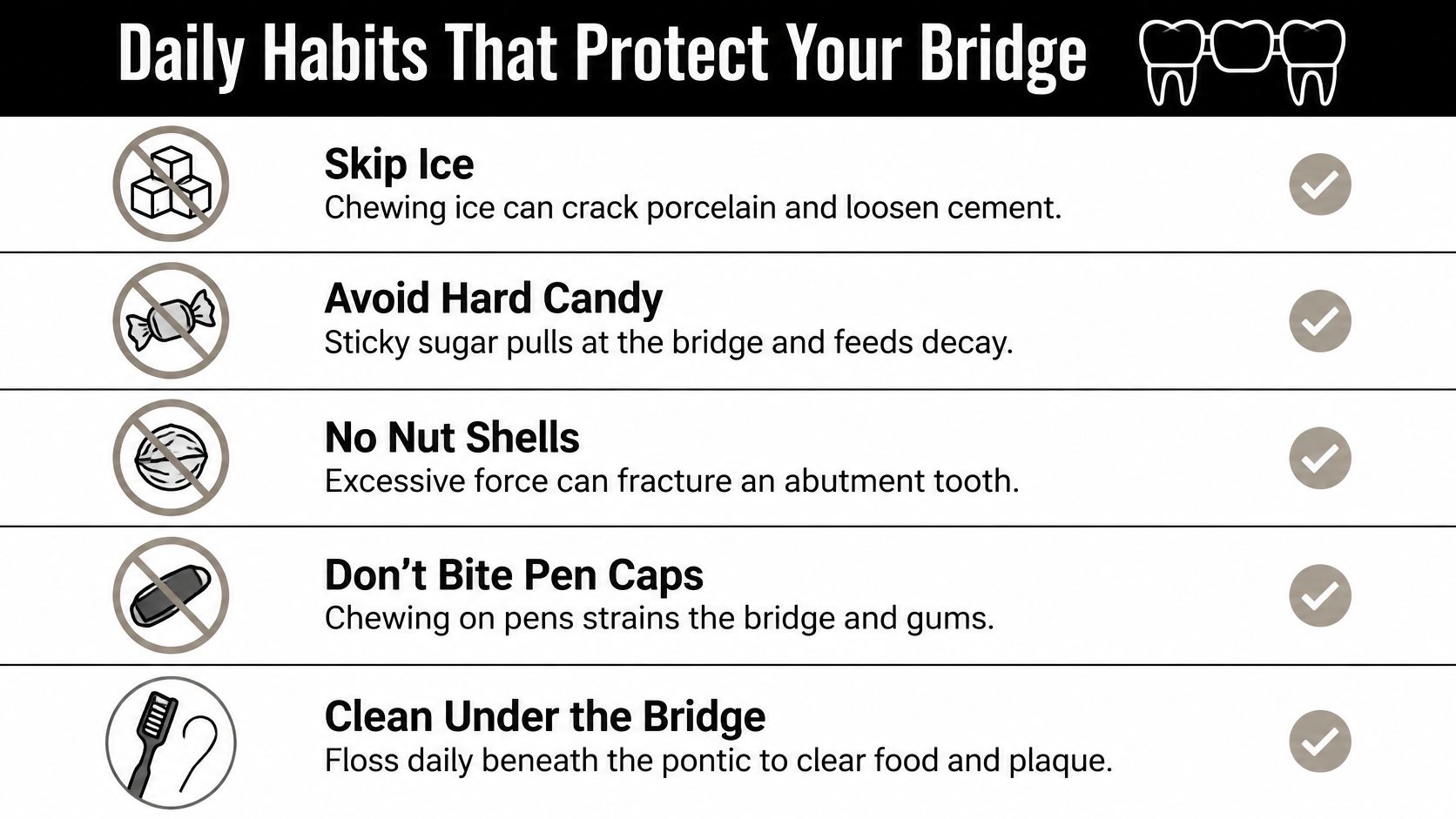
- Skip ice. Crunching ice cubes is a common way to crack porcelain or break the cement seal on a bridge.
- Treat hard candy and nut shells as off-limits on the bridge side. A shell fragment delivers a concentrated load that an abutment tooth wasn't designed to take.
- Keep pen caps and packaging out of your mouth. It sounds trivial until a crown chips on a plastic cap during a phone call.
- Space out the sticky sweets. Sugar feeds the plaque that decays a crown margin, so less frequent exposure gives the margins longer clean stretches between hits. A rinse with plain water after anything sweet helps wash away what you can't brush yet.
- Ask about grinding. If you wake up with a tight jaw or a partner mentions noise at night, say so. A night guard spreads the load that clenching puts on the supporting teeth.
- Mention smoking, dry mouth and diabetes. All three raise your risk at the gumline, and all three change how often you should be seen.
None of these habits announce themselves as damage. A bridge can feel perfectly fine while a margin decays underneath it, which is why the checklist works as prevention rather than a response to symptoms.
A bridge and a crown fail for the same reasons, which is why the habits that protect the aftercare routine for a tooth crown next door apply just as well to the abutment teeth holding your bridge.
If you'd rather see the threading motion once than read it three times, this walkthrough is worth two minutes.
If a habit is hard to give up, don't hide it. Say it out loud at your next visit so the plan can be built around it.
What to Do
The symptom patients mention most often isn't pain. It's a little blood on the floss, or a taste they can't place. Both deserve attention, because an apparently intact bridge can still be hiding recurrent decay at a crown margin, a dying pulp, periodontal breakdown or cement washing out beneath it. A long-term study found caries was the primary biological cause in failed cases, and that only 37% of bridges stayed entirely free of complications during follow-up (long-term analysis of bridge complications).
Cleaning problem or warning sign
Two or three weeks of improved cleaning should settle simple gum irritation. Bleeding that continues past that point stops being a technique issue and starts being a diagnosis question. A foul taste that keeps coming back near one part of the bridge usually means food is packing into a gap, and a gap that traps food widens.
| Symptom | Possible cause | What to do |
|---|---|---|
| Bleeding that continues after better cleaning | Gum inflammation or decay at the margin | Book an exam within a few weeks |
| Bad odor or foul taste near the bridge | Trapped food, infection or a failing margin | Book an exam within days |
| Sensitivity in one abutment tooth | Decay or a nerve problem in the supporting tooth | See the dentist promptly |
| Bridge feels loose or moves | Cement washout or fractured abutment | Urgent visit the same or next day |
| Floss shreds repeatedly on one spot | Rough margin or failing contact | Ask for an adjustment or margin check |
| Change in bite or chewing discomfort | Tooth shift, fracture or loosening | Promptly, before the bite worsens |
Timing matters more than intensity. Sudden looseness, swelling or severe pain needs same-day or next-day care, because an abutment that has fractured under a moving bridge gets more expensive by the hour. Persistent bleeding or new sensitivity bought you a few weeks, not six months. Floss that keeps catching warrants a call before the next scheduled cleaning.
A crown that lifts off an abutment is the same emergency in a different wrapper, and the steps for a tooth crown that falls off apply to a bridge abutment, with one addition: don't try to reseat a bridge yourself.
Pain is a late signal. By the time a bridge aches, the problem has usually been developing quietly for months.
How Often to See Your Dentist for Bridge Checks
"Nothing hurts, so nothing needs checking" is the assumption that costs people teeth. A 2007 systematic review of 579 fixed dental prostheses followed for as long as 25 years estimated survival at 96.4% after five years and 92.9% after ten (Wiley, Clinical Oral Implants Research). Those results come from monitored cases, not from bridges nobody looked at.
What the exam covers that your bathroom mirror can't: the margins where each crown meets the tooth, the contacts with neighbouring teeth, the gum tissue under the pontic, the way the bridge loads in your bite, and radiographs of the supporting teeth. A dentist reads all five in a few minutes and compares them with last time. That comparison is the whole value.
| Patient profile | Typical recall | Why the interval changes |
|---|---|---|
| Healthy gums and no recent decay | Every 6 months | Standard schedule for monitoring margins and supporting teeth |
| Elevated periodontal risk, such as past gum disease | Every 3 to 4 months | Gum breakdown can progress quietly around abutments |
| Smoker or patient with dry mouth or diabetes | Dentist sets the interval after each exam | These factors raise decay and gum risk for the supporting teeth |
The interval isn't fixed for life. It gets adjusted after each exam based on what the supporting teeth show, which is why a patient who has been stable for years can be moved to a closer schedule after one pocket deepens.
Gum health around a bridge is also a whole-body conversation, and dental wellness and general health is a useful read on why inflammation in the mouth rarely stays local. Pair the check with your routine dental cleaning and exam so the hygienist can clean around the bridge with the same eyes that inspect it.
Keep a short note on your phone between visits: dates when something bled, tasted odd, felt loose or caught the floss. A pattern across six weeks tells your dentist more than a single good day ever will.
Book Your Bridge Check-Up Before Problems Start
A bridge can feel completely normal while decay or gum breakdown develops under the margins and on the abutment teeth, so the best time to have it inspected is before there is a reason to. Margins, supporting teeth and gum tissue are easier to read when nothing is sore and nothing has shifted, and a small finding is far cheaper to fix than a failed abutment.
The clinic at 57 W 57th St near Central Park South serves patients from Midtown West and the broader New York metropolitan area. Bridges sit alongside cavity fillings, cleanings and exams, crowns, dentures and implants in the services list, so the bridge can be followed at the same place that handles everything around it. The practice is a full-service family dental clinic welcoming children, teens, adults and seniors under one roof, which helps when the bridge belongs to a parent rather than to you.
Patients notice the explanation as much as the treatment. "He even walked me through how to better care for an implant I had done years ago," one review reads, and that is the standard to expect for a bridge too.
Bring three things to the visit: your record of dates when something bled, tasted odd, felt loose or caught the floss, a description of your current cleaning routine, and a short list of questions. Ask which cleaning aid fits this bridge design, what brush size to buy, and how often your check-up interval should be. If the gums have been the recurring problem rather than the teeth, start with a dentist for gum disease rather than a routine visit. And if the bridge is ever remade, fit drives survival, which is why reducing crown remakes with CAD/CAM matters to anyone facing a second restoration.
Waiting for pain usually means waiting for more extensive work. A quiet bridge is exactly when the exam tells you the most.
Paul L. Gregory, DDS provides dental bridges along with the cleanings and exams, crowns, fillings and implants that keep the teeth around them healthy, at 57 W 57th St near Central Park South. The same team can follow your bridge and your routine cleanings year after year, so changes at the margins get caught while they are still small. Book a visit at Paul L. Gregory, DDS and bring your notes on anything that has changed since the bridge was seated.