

You're halfway through lunch when you feel a hard piece on your tongue. Your tongue finds a sharp edge on a back tooth, and your calendar has no free hour until evening. If your tooth filling fell out, the first decision isn't how to stick it back. It's whether you can protect the tooth until an appointment or need help now.
A missing filling doesn't automatically mean an emergency room visit. It does mean the tooth needs an assessment, because the right treatment depends on what failed: the filling, the surrounding tooth, or both.
Can a Lost Filling Wait Until Tomorrow
A small, comfortable gap can usually wait until a dental visit later today or tomorrow morning, provided you stop chewing on it. Severe pain, swelling, or a changed bite calls for faster attention. Breathing or swallowing problems belong in emergency medical care, not a routine appointment queue.
No pain doesn't prove the tooth is safe. Exposed dentin can collect food, a weakened cusp can break, and decay may already have developed beneath the old filling.
Lost filling symptoms and where to go
The NHS lost fillings and crowns fact sheet provides patient guidance for protecting the tooth while arranging dental care. Use the symptoms below to choose the setting rather than judging urgency by the size of the missing piece.
| What you notice | How urgent | Where to go | What to do until then |
|---|---|---|---|
| Small gap or rough edge, cold fades in seconds, no swelling, bite still even | Same day or next morning | Dental visit | Don't chew on that side; brush gently with fluoride toothpaste |
| Severe or worsening pain, sleep broken by sensitivity, bite won't close evenly | Same day | Urgent dental assessment | Rinse with lukewarm water; avoid hot, iced, and hard foods |
| Swelling, fever, pus, or a bad taste | Same day | Urgent dental assessment | Don't wait for the pain to settle |
| Trouble breathing or swallowing, choking, possible inhaled fragment | Now | Emergency medical care | Don't schedule a routine dental visit first |
| Bleeding that won't stop, or injury to the face or jaw | Now | Emergency medical care | Apply clean gauze to bleeding you can safely reach and seek emergency care |
A tooth that reacts briefly to cold is different from one that keeps aching after the drink is gone. Likewise, a slightly rough surface is different from a bite that suddenly won't meet normally. Don't repeatedly bite down to test it.
Keep the waiting period uneventful
Rinse with lukewarm water, brush gently with fluoride toothpaste, and leave that side out of chewing. Skip sticky sweets, hard snacks, and temperature extremes. These measures reduce irritation; they don't tell you whether the tooth is structurally sound.
If discomfort is becoming the main problem, the guidance on emergency tooth pain can help you describe what's happening when you call.
Practical rule: A painless gap between meetings is still a tooth that needs attention. Arrange care now rather than waiting for pain to make the decision.
An exposed tooth can worsen over days. Don't turn a manageable overnight wait into weeks of chewing around the problem.
What to Do in the First Hour
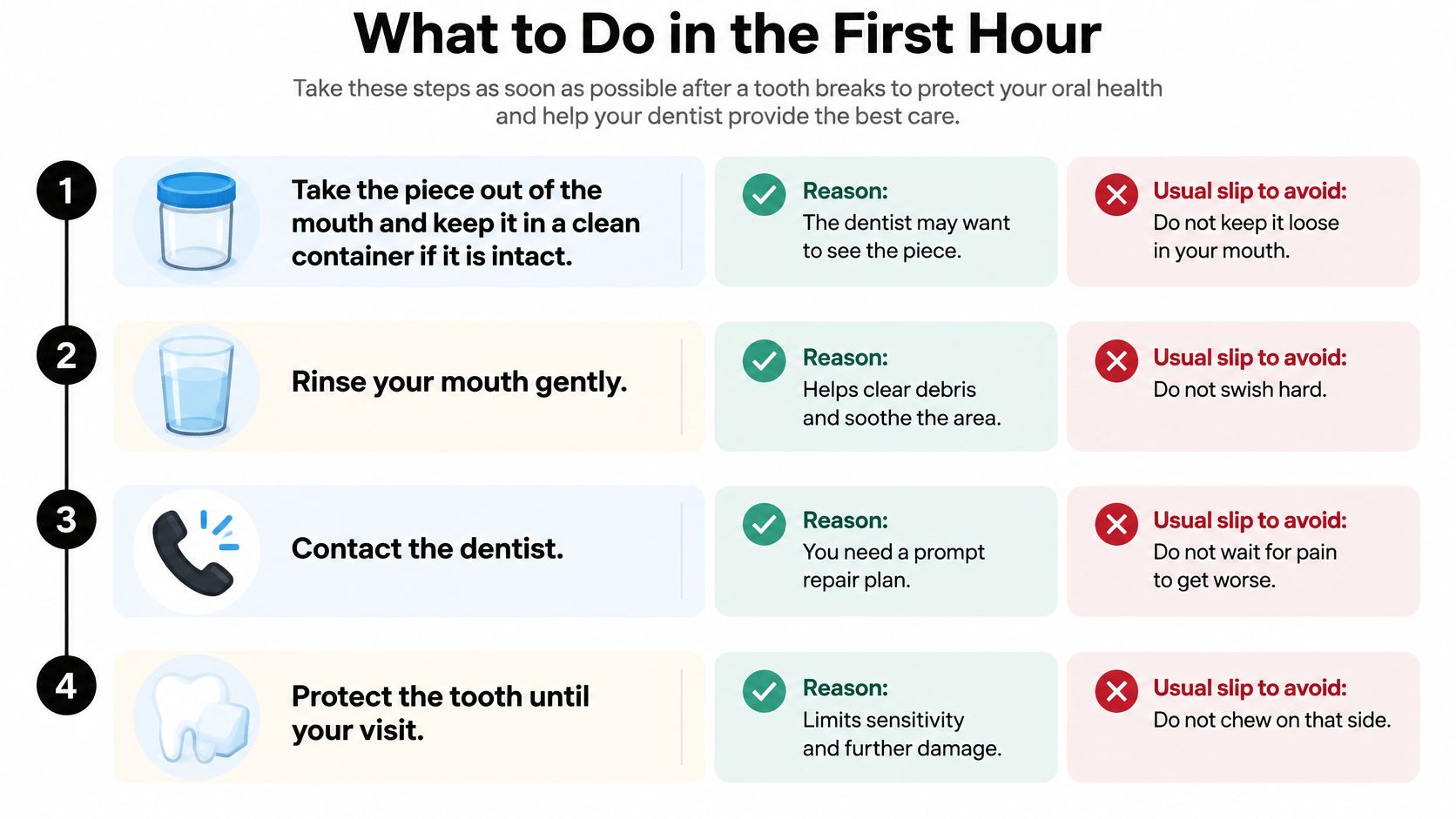
The filling is out, and you have a short window to protect the tooth before you can get it checked. Focus on keeping the area clean and comfortable. Don't try to glue the filling back in: Scottish Dental Clinical Effectiveness Programme guidance on displaced restorations identifies household adhesives as a pitfall.
A holding routine that won't make treatment harder
Remove and save the piece. Put an intact fragment in a clean container. Its shape may help the dentist tell filling material from a broken cusp. Don't leave it loose in your mouth or press it back into the cavity.
Rinse and look, without probing. Use lukewarm water and a bright mirror to check for a sharp edge, dark area, cracked cusp, or food-catching hole. Don't scrape with a pin, toothpick, or dental pick. A dark spot alone doesn't show how deep decay goes.
Cover a sharp edge. A small amount of orthodontic wax can cushion enamel rubbing your tongue or cheek. Sugar-free gum can briefly cover a sharp point, but don't pack it into the hole. Never use household glue, superglue, or nail adhesive.
Use temporary filling material only for a suitable defect. A clean, shallow opening without swelling or severe pain may benefit from a temporary barrier. Gently dry the accessible area with gauze, apply only enough dental material to cover the opening, and follow the product's setting directions before eating. Don't force material into a deep hole or leave a raised lump that changes your bite.
Keep brushing. Clean the gap gently with fluoride toothpaste and brush the rest of your mouth normally. Don't repeatedly pack food into the opening or scrub exposed dentin aggressively.
Use pain relief safely. Ibuprofen or acetaminophen may help if you can take them safely. Follow the label, and ask a pharmacist about medical conditions, pregnancy, or medication interactions. A wrapped cold compress against the cheek can ease throbbing. Don't put aspirin directly on the gum, where it can cause a chemical burn.
Make eating easy on the tooth. Choose scrambled eggs, soft pasta, or lukewarm soup, and chew on the opposite side. Skip ice, nuts, sticky candy, and very hot coffee. A temporary plug doesn't make normal chewing safe.
Call with useful details. Tell the office whether you have pain or swelling, whether your bite feels different, and whether a piece of tooth came away with the filling. Those details help the team choose an appropriate appointment.
Don't mistake comfort for completion
Wax can protect soft tissue, and temporary material can cover an opening. Neither checks for a crack or an inflamed pulp. A comfortable tooth may still need a different restoration if the remaining tooth is cracked or too weakened for another filling.
The video below offers another visual reference while you arrange professional care.
Why Fillings Fall Out After Years of Wear
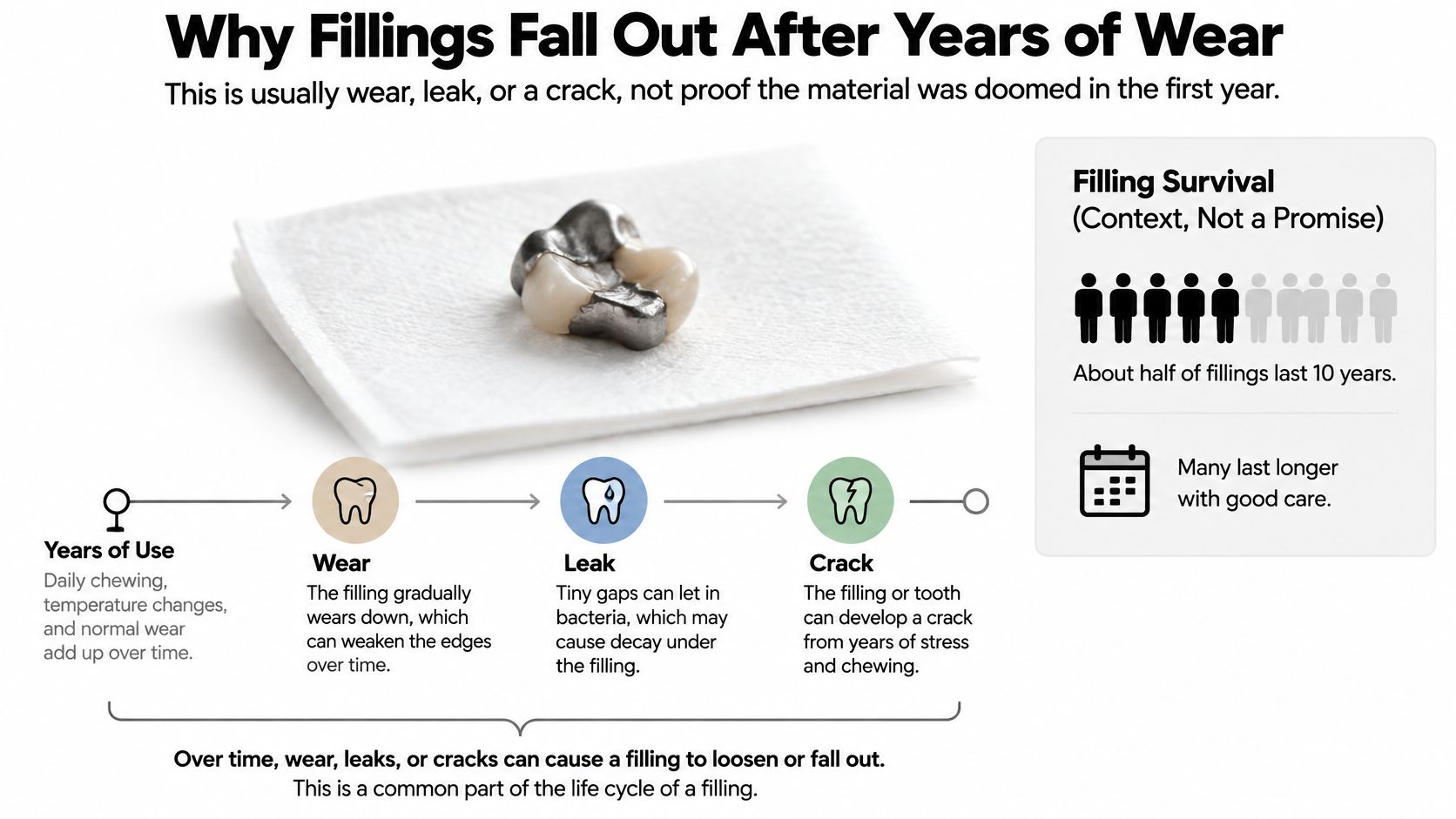
A filling that comes loose after years in place may have worn down, lost its seal, or fractured along with the tooth. The material's age alone doesn't explain what happened. The size of the original cavity, the strength of the remaining tooth, biting pressure, and the condition of the margins all matter.
Put lifespan figures in context
A systematic review of dental restoration longevity found that about 50% of restorations lasted between 10 and 20 years. That broad range describes groups of restorations, not a deadline for an individual tooth.
How long fillings typically last
| Restoration | Survival figure | What the figure means |
|---|---|---|
| Restorations in the review | About 50% lasted 10 to 20 years | Results varied by material, tooth, cavity size, technique, and setting |
A filling's age when it is replaced is not the expected lifespan of every filling. A small restoration with strong surrounding walls also faces different stresses from a broad restoration spanning several surfaces.
What the dentist actually looks for
- Decay at the margin or underneath. A compromised seal can let bacteria reach the tooth supporting the restoration. Replacing only the missing material would leave the cause untreated.
- A fractured surrounding wall. A cusp can break around an old filling even when much of the filling remains intact. The piece you saved may include both tooth and restorative material.
- Mechanical overload. Grinding, clenching, or a high bite contact can concentrate force on a thin wall. Large restorations leave less surrounding tooth to resist that load.
- Material or interface breakdown. Composite can wear or stain at its margins. Metal restorations can fracture, and the surrounding tooth can crack.
Frequent sugary drinks increase decay risk, while repeated acidic exposure can damage exposed tooth surfaces. Changing to a harder filling material won't address either cause.
For more on how long tooth fillings last, consider the condition of the tooth alongside the material. The examination needs to establish what broke, whether decay has returned, whether a crack extends further, and whether enough healthy structure remains for another filling.
Choosing a Repair Filling Onlay or Crown
If a filling falls out before a meeting, the key question is whether the tooth can safely wait for a simple repair or needs more coverage. The dentist checks how much sound tooth remains, whether the pulp is affected, and whether the area can be kept dry for bonding. The same material and shape that failed may not be the right replacement.
A systematic review of posterior restorations reported median survival exceeding 16 years for amalgam versus about 11 years for composite in permanent back teeth. Secondary decay was the leading cause of composite failure, while fracture was the main reason for amalgam replacement. The cause of failure matters more than appearance alone when choosing a material.
What replaces a lost filling
Fees depend on the tooth and the work required. The number of surfaces, access, decay removal, imaging, laboratory fabrication, and insurance benefits can all affect the bill.
| Option | Best when | Longevity signal | What drives the fee |
|---|---|---|---|
| Pharmacy temporary material | Clean, shallow hole without swelling; visit already arranged | Brief protection only | Product and package size |
| Chairside temporary dressing | A seal is needed while diagnosis or treatment is completed | Not a final restoration | Whether it is included in urgent care or billed separately |
| Composite filling | Small or moderate defect with solid walls and reliable isolation | Definitive restoration when appropriately selected | Number of surfaces, access, and time needed for decay removal and bonding |
| Amalgam filling | Suitable back tooth where a metal appearance is acceptable and the material is offered | Durable option, but surrounding walls still matter | Number of surfaces and whether the material is available |
| Repair of an existing restoration | Localized defect, sound remaining material, controlled moisture, no pulpal involvement | Can preserve the serviceable portion | Size of the repair and condition of the remaining restoration |
| Inlay or onlay | Larger defect or weak cusp that remains restorable | An onlay can protect vulnerable cusps | Restoration size and whether a laboratory or digital fabrication is used |
| Crown | Thin walls, substantial structural loss, or a restorable cracked cusp | Covers a weakened tooth | Tooth preparation, any buildup, and temporary coverage |
| Root canal plus a new restoration | Pulp disease in a tooth that can still be restored | Requires both pulp treatment and a durable final seal | Separate pulp treatment and restorative work |
Preserve sound tooth when it's sensible
A repair adds material to a serviceable restoration instead of removing it all. It can preserve enamel and dentin when the defect is limited, decay is manageable, bonding conditions are suitable, and enough sound structure remains.
A retrospective study of repaired and replaced restorations reported 10-year success of 43.4% for repairs versus 48.6% for replacements, with subsequent repairs increasing 10-year survival to approximately 74% in both groups. These figures are benchmarks, not guarantees. They do not support repairing extensive decay or an unstable crack.
The most conservative treatment is the smallest treatment that can work reliably, not automatically the smallest filling.
An inlay fits within the cusps; an onlay covers vulnerable cusps. A crown covers more of the tooth and usually requires more tooth preparation. The explanation of dental crowns at Grand Parkway Smiles offers additional context about crown coverage.
When another filling is the wrong next step
Spontaneous pain, lingering heat pain, or swelling calls for an assessment of the pulp before the opening is covered. Root canal treatment may preserve a restorable tooth with irreversible pulpal disease. Extraction may be necessary if the damage prevents a dependable restoration.
Ask for a written plan that separates urgent stabilization from the final permanent dental filling or other restoration. Insurance assistance does not guarantee coverage, so confirm your estimated responsibility before treatment.
A simple refill is a poor choice when deep decay has returned, a cusp is loose, the area cannot be kept dry, or an overloaded bite remains unaddressed.
Habits That Keep the Next Filling In
The next filling has a better chance when the dentist addresses the bite, the bacteria, and night grinding as parts of the same treatment plan.
A replacement can restore the shape of a tooth without changing the conditions that damaged the last restoration. Prevention needs to match the failure mechanism, not just add more brushing pressure.
Protect the margins
- Clean between teeth. Floss where the restoration meets the neighboring tooth. An appropriately sized interdental brush can help where space permits, but don't force it through a tight contact. Cleaning only the chewing surface leaves the proximal margin untouched.
- Use fluoride toothpaste consistently. Brush morning and evening with a soft brush, directing the bristles toward the gumline and restoration margins. If decay keeps recurring, ask whether prescription higher-fluoride toothpaste is appropriate rather than choosing an abrasive whitening paste.
- Change the sipping pattern. Finish sweet or acidic drinks with a meal instead of taking small sips throughout the workday. Keep water at your desk between meals. The repeated exposure matters even when each drink seems small.
For children in the same household, ask about fluoride and sealants on susceptible chewing surfaces. An adult's lost filling is a useful reminder to prevent cavities before children need restorations of their own.
Reduce force and catch small changes
Morning jaw soreness, worn tooth edges, and repeated chipping deserve a grinding assessment. A custom night guard may help protect teeth and restorations, but it won't treat decay or correct a poorly fitting filling.
A new restoration that feels high after the anesthetic wears off needs a bite check. Don't spend days trying to wear it down yourself. The dentist can identify the heavy contact with articulating paper and adjust the restoration without asking the remaining cusp to absorb the extra force.
- Keep a risk-based review schedule. A large restoration and a history of recurrent decay call for individualized dental cleanings and exams. Bitewing timing should reflect cavity risk and clinical findings, not an automatic calendar rule.
- Report changes early. New food trapping, floss that repeatedly shreds, lingering cold sensitivity, or pain when releasing a bite can justify an earlier check. Don't wait for another piece to detach.
After the permanent repair, follow the material-specific eating advice and wait until numbness clears before chewing. Don't test the tooth on ice or nuts. If the dentist asks you to postpone whitening because of sensitivity or the treatment performed, wait rather than improvising around that advice.
Get the Tooth Checked Near Midtown Today
If a filling has fallen out, call before the exposed area becomes harder to protect. Tell the front desk whether you have pain or facial swelling, and whether a piece of tooth came away with the filling.
Paul L. Gregory, DDS, at 57 W 57th Street near Central Park South and Columbus Circle, offers short-notice assessment of lost fillings and broken restorations. Wednesday and Friday appointments may be available, subject to scheduling. The practice helps with most insurance claims and can discuss anticipated fees before treatment.
A Midtown access point for Manhattan patients
The Midtown office serves patients from Midtown West and the broader New York metropolitan area, subject to transportation and appointment availability. Its location is near Central Park South and Columbus Circle.
Arrive prepared and leave with a definite plan
Bring the saved fragment, your medication list, and your insurance information. Describe any temperature sensitivity, pressure pain, grinding, or recent change in how your teeth meet.
The dentist can examine the remaining tooth structure and margins, perform appropriate cold or pressure tests, and take an X-ray when the defect is deep, painful, recurrent, or raises concern about a fracture. The aim is to identify what the tooth can support, not just cover the visible opening.
Before you leave, clarify whether the tooth can be restored with a filling or needs an onlay, crown, or pulp treatment. If a temporary dressing is placed, confirm the return appointment and which changes should prompt an earlier call.
Use the practice's guidance on how to get emergency dental care to arrange the right visit. Fit the appointment around your schedule, but let the tooth's symptoms and condition guide how long it can wait.
A lost filling needs an examination and a reliable seal. Visit Paul L. Gregory, DDS to ask about a short-notice Midtown assessment, protecting the exposed tooth, and discussing treatment and fees before proceeding.