

A tooth that had a root canal years ago starts aching when you bite down. You book an appointment, expecting a filling or a new crown, and hear a less familiar term: retreatment. It can sound as if the first treatment failed and the tooth is doomed, but neither conclusion follows from the word alone.
Root canal retreatment is one way to address a problem inside a previously treated tooth. Whether it's the right option depends on what caused the problem, whether the tooth can be restored, and how it'll be sealed afterward.
What Root Canal Retreatment Actually Means
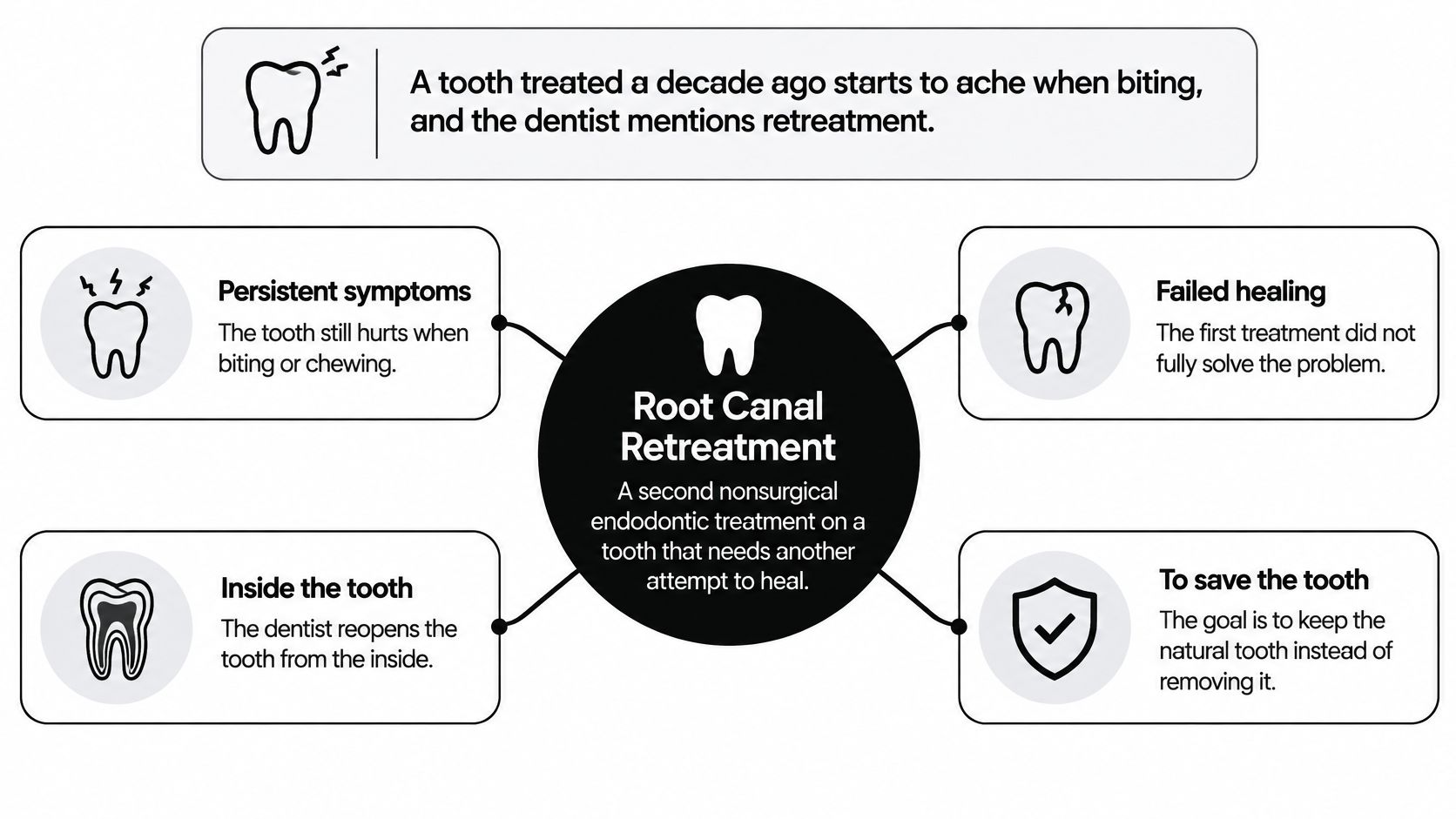
A tooth treated a decade ago starts to ache when biting, and the dentist mentions retreatment. The procedure is a second nonsurgical endodontic treatment on a tooth that already has a root filling. A dentist or endodontist may consider it when pain or infection returns, or imaging shows a dark area around the root tip.
The aim isn't to swap old filling material for new. The clinician needs to find and eliminate what's allowing bacteria to persist or return inside the tooth. Think of the first root canal as sealing a pipe inside a wall. Retreatment means opening the wall, finding the leaking joint, clearing the old sealant, and sealing it again.
The parts involved
The crown is the visible part of the tooth on top. Beneath it, the root filling runs down narrow channels called canals. The bone around the root tip is where inflammation or infection may appear as a dark area on an X-ray.
Unlike the first root canal, retreatment begins with work inside a tooth that has already been filled. The clinician must reach the canals and remove the existing root-filling material before cleaning and sealing them again. That extra repair work is one reason retreatment can require more time and technical skill than initial treatment.
If you're comparing retreatment with a first root canal, this overview of root canal dental treatment can help clarify how treatment of a tooth's canals fits into the bigger picture.
Retreatment is a repair attempt on the same tooth, not an automatic verdict on its future. The important questions are why the problem returned and whether the tooth can be treated and restored predictably.
Why a Root Canal Fails the First Time
A tooth may seem fine after a root canal, then develop a problem because bacteria remained in a canal or later found a way back inside. The cause matters: a missed canal calls for a different solution than a leaking crown. The American Association of Endodontists' guidance on retreatment and surgery describes common causes that may be treatable:
- Incomplete treatment: Part of the planned canal treatment was not completed, leaving an area that still needs attention.
- Missed canals: A canal hidden by the tooth's anatomy was not found during the first procedure.
- Poor filling of the canal space: The original filling did not adequately fill and seal the canal.
- Coronal leakage: Bacteria entered through the restoration on top of the tooth.
A loose crown or a crack at the edge of a filling can let saliva and bacteria reach a canal that was previously cleaned. The permanent restoration protects the treated tooth. If it is not placed for months, bacteria may re-enter before the tooth is fully protected. A root canal and its restoration work together: cleaning the canals addresses the inside, while the restoration helps seal and protect the tooth.
When anatomy or a complication gets in the way
Some canals are narrow, curved, calcified, or hard to locate. Complex anatomy can make it difficult to find and clean every canal, even when the clinician uses magnification and specialized instruments. A broken instrument, a ledge inside a canal, or a perforation can make cleaning and sealing more difficult. Posts or changes in the canal's shape can also obstruct access.
An untreated canal can act like a clogged side branch in a drain. The main line may look clear, but the hidden branch can still hold the problem. Similarly, bacteria may remain in an untreated canal even when the rest of the root filling looks adequate.
Retreatment is not suitable for every tooth. The tooth needs enough healthy structure to support a lasting restoration, and the canals must be reachable without making the tooth unsalvageable. If access through the tooth is blocked or unsuccessful, an endodontic surgical approach may be considered instead. Whether repair is realistic depends on the original cause, the tooth's condition, and the restoration that will protect it afterward.
The cause of the problem shapes the treatment plan. Symptoms can prompt an evaluation, but they do not identify the cause on their own.
Warning Signs That Point to Retreatment
Pain alone doesn't prove a root canal has failed. A tender tooth, gum symptom, or dark X-ray area can have more than one explanation, so a dentist needs to combine the history, clinical examination, and imaging before recommending treatment. This endodontic imaging guidance supports selective use of limited-field CBCT when conventional radiographs don't explain persistent or recurrent disease.
| Symptom | Common cause | Retreatment fit |
|---|---|---|
| Lingering pain or tenderness when biting | Reinfection, a crack, or traumatic bite force | Depends on whether a crack is ruled out |
| Swelling or a pimple-like bump on the gum | Infection draining from the root tip | Strong indicator for retreatment or surgery |
| Dark area around the root tip on X-ray | Apical periodontitis or a new periapical lesion | Strong candidate if the tooth is restorable |
| Cold or heat sensitivity that lingers for minutes | Missed canal or inadequate sealing | Good candidate if the canal can be reached |
| Sharp pain on one side of the chew | Crack or fracture | Retreatment may not help; restorability decides |
| Gum pain without root-tip involvement | Periodontal disease | Retreatment alone may not solve it |
| Pain that doesn't change with testing | Non-dental pain, sinus or nerve pain | Diagnose the source before retreating |
Read the table as a guide to questions for the examination, not a self-diagnosis checklist. Biting pain, for example, can reflect reinfection, a crack, or bite forces. The clinician needs to check for a crack and assess whether the tooth can be restored before deciding that retreatment is likely to help.
A dark area near the root tip can be consistent with inflammation or infection, but an X-ray finding alone doesn't prove that retreatment is needed. If regular images don't explain ongoing symptoms, a limited-field CBCT scan can give a more detailed view of the root and surrounding area. It isn't necessary for every patient, and the potential diagnostic benefit should be weighed against added radiation and cost.
Ask what the examination confirms: Which finding points to the root canal, and what else could explain the pain?
Antibiotics can sometimes calm an acute flare, but temporary relief doesn't show that the source inside the tooth has been removed. For guidance on signs that may need prompt attention, see this overview of dental abscess symptoms and treatment. A careful diagnosis matters because pain can also come from periodontal disease, a crack, sinus or nerve pain, or another non-dental source.
How Retreatment Is Performed Step by Step
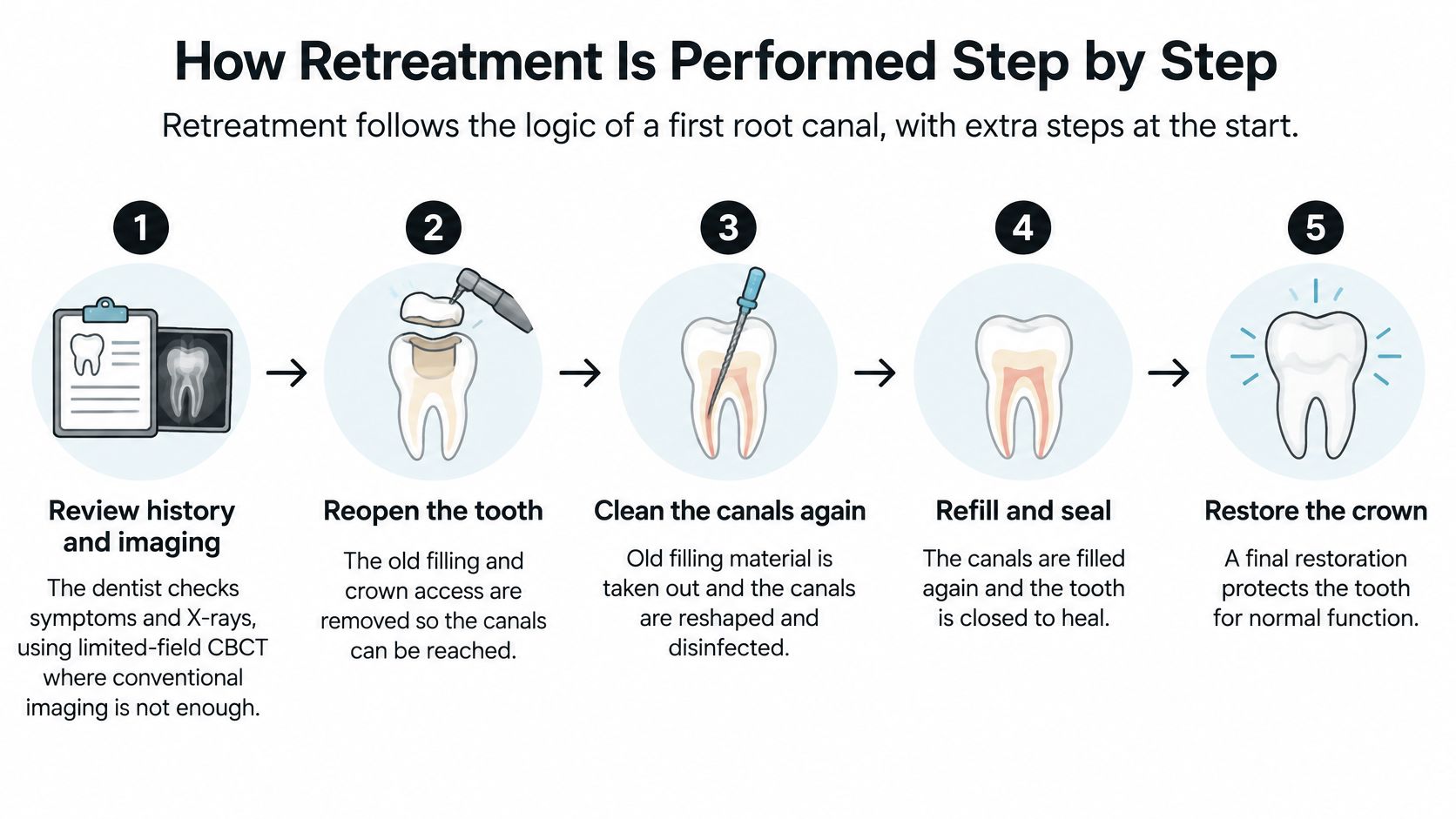
Retreatment follows the logic of a first root canal, with extra steps at the start. Before treatment, the clinician needs to establish why the tooth hasn't healed or why the problem returned, and whether the tooth can be restored. The American Association of Endodontists' patient guide to retreatment describes the central goal as finding and addressing the cause of persistent or recurrent disease, not just replacing the old filling.
Review history and imaging. The dentist asks about symptoms and checks conventional X-rays. If those images don't explain the problem, limited-field CBCT may help clarify the anatomy or lesion before a decision is made.
Numb the tooth and protect it. Local anaesthetic helps keep the procedure comfortable. A rubber dam isolates the tooth, helping keep saliva and bacteria away from the canals.
Reopen the tooth. The clinician accesses the tooth through the crown or old restoration, removing what's needed to reach the root filling. That route gives access to the canals that need to be treated again.
Remove the old root filling. Specialist files and, when appropriate, solvents help take out the existing material. Clearing it gives the clinician a chance to inspect and clean the canal space rather than sealing over a problem.
Inspect for the cause. Under magnification, the clinician checks for missed canals, ledges, broken instruments, or contamination. Finding the reason for persistence helps determine how to clean and seal the tooth effectively.
Disinfect and reshape the canals. Irrigating solutions help clean the canal spaces as the clinician reshapes them for a new filling. Medication may be placed between visits when the case calls for it.
Fill the canals again. Once the canals have been cleaned and prepared, the clinician places new root-filling material. The aim is to seal the canal system against further bacterial entry.
Restore the seal promptly. A core build-up and crown, or a suitable permanent filling, protects the tooth above the root. Delaying this final restoration is a common way bacteria can re-enter, even after the canals have been cleaned.
The appointment may take longer than an initial root canal because the old filling must first be removed and the canal system reassessed. Mild tenderness for several days can occur after treatment. A follow-up X-ray helps the clinician assess healing over time.
The process is easier to follow when you can see the sequence laid out:
The following video offers another visual explanation of root-canal care:
Realistic Success Rates and What Shapes Them
A retreatment's outlook depends first on why the original treatment failed. The tooth's anatomy, its condition and restoration also matter, so one headline percentage can hide differences between cases. These figures come from different causes and follow-up periods. Use them as a starting point for discussing your own tooth, not as a guarantee.
| Factor | Reported success | What it signals |
|---|---|---|
| Retreatment corrects technical inadequacies alone | 94% | Strong outcome when the fault is a fixable filling error |
| Retreatment undertaken for restorative purposes | 96.2% | Highest group when the tooth is being rebuilt |
| Underlying problem is a missed canal | 81.7% | A missed canal may be treatable if it can be found |
| Underlying problem is a short root filling | 66.4% | Lower result; the filling must reach the full canal length |
| Underlying problem is an overextended filling | 62.2% | Lowest group; material past the root tip can irritate tissue |
| Nonsurgical retreatment at 2–4 years, systematic review | 70.9% | An earlier snapshot while healing continues |
| Nonsurgical retreatment at 4–6 years, systematic review | 83.0% | Later results in teeth that were sealed well |
The American Association of Endodontists' endodontic education materials summarize the cause-specific results in the first five rows. A separate systematic review of retreatment and surgical outcomes found weighted success of about 70.9% at 2–4 years and 83.0% at 4–6 years for nonsurgical retreatment. The higher later figure reflects healing that can continue over time in successfully disinfected and sealed teeth. It does not mean every tooth will recover.
Ask your clinician which cause best fits your case and what the examination and imaging show. A missed canal may be manageable if it can be located and treated. A short or overextended filling presents a different challenge, and neither group's percentage can predict an individual result.
What counts as success
Success is usually judged by more than the X-ray. The tooth should remain in the mouth, feel comfortable during function, show no signs of ongoing infection, and avoid the need for further treatment. An X-ray helps assess healing around the root, but it is only one part of the picture.
The starting condition can make the outlook less favorable, particularly for molars, teeth with large existing lesions, repeated procedures, or treatment spread over multiple visits. Ask whether the tooth is restorable and how its final crown or filling will protect it. A durable restoration and a well-sealed root canal both matter: saving the tooth is useful only if it can continue to function.
Apicoectomy, Extraction and Implant Compared
When a root canal has not healed, the next option depends on what caused the problem and whether the tooth can still be restored. Nonsurgical retreatment works from inside the tooth. An apicoectomy, also called endodontic microsurgery, reaches the root tip through the gum, removes infected tissue and a small portion of the tip, then seals the end. Extraction removes the tooth; a replacement can be considered afterward.
| Option | Keeps natural tooth | Reported success | Best suited when |
|---|---|---|---|
| Nonsurgical retreatment | Yes | 65.5% in 351 teeth with apical periodontitis | Canals can still be reached and the tooth is restorable |
| Apicoectomy or endodontic microsurgery | Yes | 77.6% in 107 teeth with apical periodontitis | A canal is blocked or the lesion persists after retreatment |
| Extraction with an implant | No | Outcome depends on restorability and bone support; no direct success comparison | The tooth can't be restored or has a severe root fracture |
| Extraction with a bridge or partial denture | No | Outcome depends on restorability and bone support; no direct success comparison | An implant isn't suitable because of bone loss, timing, or other factors |
A 2023 clinical study reported success rates of 65.5% for nonsurgical retreatment of 351 teeth and 77.6% for endodontic microsurgery of 107 teeth in cases involving apical periodontitis. The groups were separate, not a head-to-head trial, so the results do not show which option is better for a particular tooth. The study on retreatment and endodontic microsurgery reports the sample sizes and outcomes.
A systematic review found different results at different follow-up periods: endodontic surgery had higher reported success at 2–4 years, 77.8% versus 70.9%, while nonsurgical retreatment had higher reported success at 4–6 years, 83.0% versus 71.8%. The review comparing retreatment and endodontic surgery gives this comparison. These figures should not be combined with the separate study above into a single ranking. Treatment choices also depend on restorability, periodontal support, the lesion, access to the canals, and the existing restoration.
Matching the option to the tooth
- When the tooth is restorable: Retreatment may suit a tooth whose canals can be reached and sealed reliably.
- When access is blocked or a lesion persists: Surgery may reach the root tip when further work through the tooth cannot address the source predictably.
- When the tooth can't be restored: Extraction may be considered, particularly with a severe fracture or substantial loss of supporting bone or gum.
An implant replaces the missing tooth, not its natural root. A bridge or partial denture may also replace a tooth when an implant is unsuitable. Each option depends on the tooth's condition and the support available at the site. For a closer look at the trade-offs, read this guide to root canal versus extraction. For an overview of replacement approaches, missing tooth solutions in Liverpool describes options that may be discussed after extraction.
Choosing Your Next Step After a Failed Root Canal
A tooth with a previous root canal can still be considered for retreatment, but the next step depends on why the treatment failed and whether the tooth can be restored. A general dentist may assess a straightforward case when the canal system is accessible. A specialist endodontist may be appropriate if a canal seems blocked or sharply curved, an instrument has broken, a perforation is suspected, or a lesion remains after retreatment. For guidance on finding one, read about a root canal specialist near you.
At the first visit, ask:
- What finding points to the likely cause? Ask how the examination and imaging distinguish a canal problem from a crack, gum condition, or another source. An X-ray finding helps guide the assessment, but the dentist needs to interpret it alongside the tooth's condition.
- Has a crack been ruled out? A crack can affect both the chance that retreatment will help and whether the tooth can be restored.
- What will protect the tooth afterward? Ask whether you'll need a crown or another permanent restoration, and when it should be placed. The final restoration matters because the treated tooth needs to be sealed and protected for continued use.
Paul L. Gregory, DDS, at 57 W 57th St, near Central Park South and Columbus Circle, provides endodontic treatment, including retreatment when indicated, as well as restorative care, crowns, implants, and emergency assessment with short-notice appointments. The practice serves patients from Midtown West and the broader New York metropolitan area.
Arrange an examination and imaging review before choosing between retreatment, surgery, or extraction. The cause of failure, the tooth's starting condition, its restorability, and the planned final restoration all shape the decision.
Paul L. Gregory, DDS also assesses previously treated teeth and provides crowns to protect treated teeth. If you have pain or an X-ray finding around a tooth with an old root canal, visit Paul L. Gregory, DDS to arrange an examination and discuss your options.