

You're in the chair, your cheek is numb, and your dentist says you'll need a permanent dental filling. It sounds final, like a problem solved for good. Then you get home and wonder what permanent promises, how long it lasts, and what happens if it chips five years from now.
That confusion is normal, and it's worth clearing up before you choose a material or agree to replace an old filling. A filling is a durable repair, not a lifetime guarantee, and the smartest decisions come from understanding the tooth underneath it.
What a Permanent Dental Filling Actually Means
Think of a permanent dental filling as a custom-shaped plug. Your dentist removes decayed, softened tooth structure, cleans the space, and fills it with a material that seals the hole and rebuilds enough shape for comfortable chewing. It's closer to a precisely fitted patch than to regrowing the original enamel.
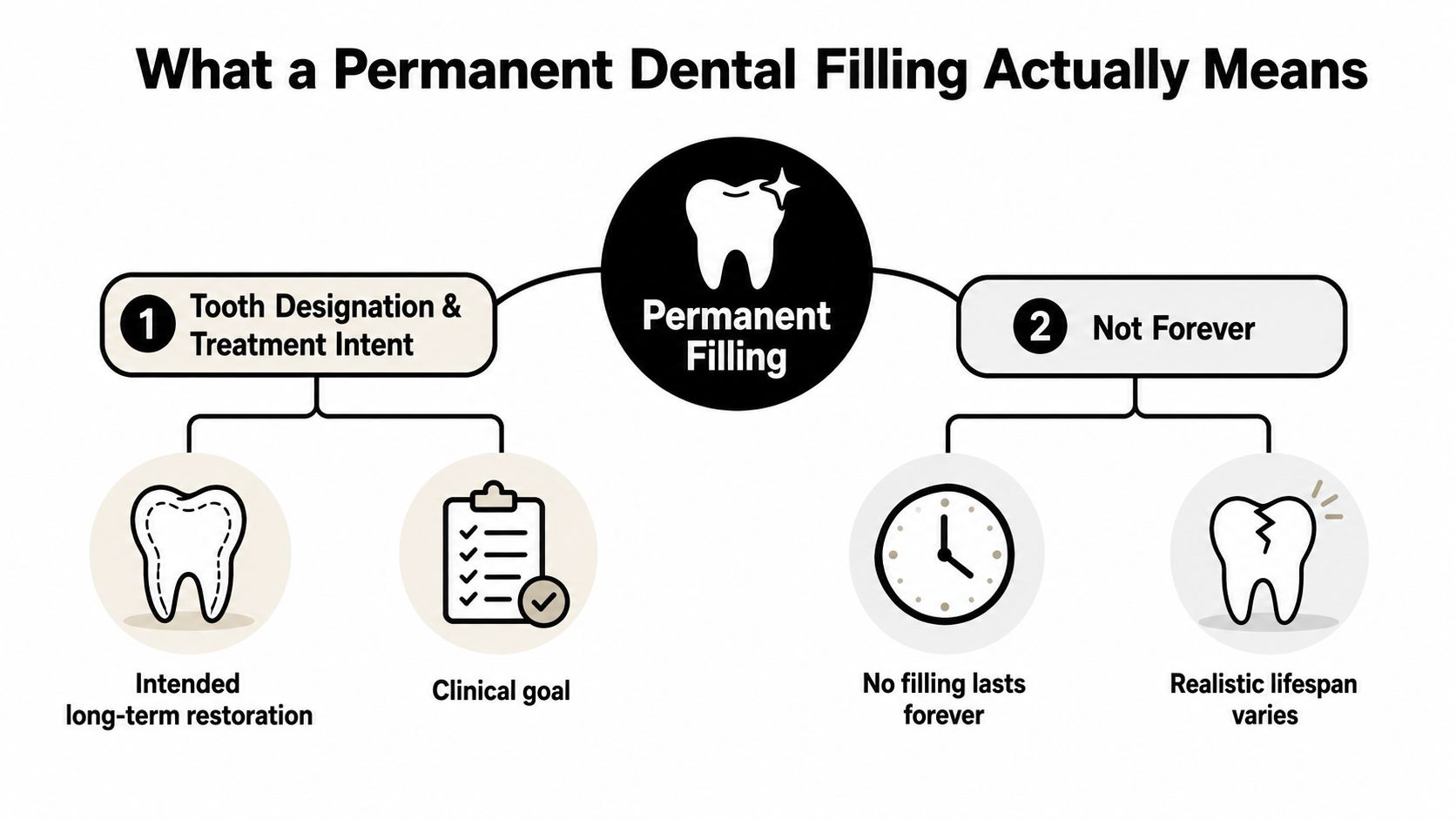
The word permanent describes the tooth and the intent, not an unlimited lifespan. The treatment goes into a permanent, adult tooth and it's meant to stay for years, unlike a temporary filling placed to protect a tooth for a short period. The National Institute of Dental and Craniofacial Research explanation that fillings generally do not last a lifetime is the honest starting point.
This diagram separates the label from the lifespan so the rest of the decisions make more sense.
Direct Fillings and Indirect Restorations
A direct filling is placed soft into your tooth and hardened in your mouth during one visit. Composite resin and amalgam work this way. An indirect restoration, such as an inlay or onlay, is made outside your mouth from a scan or impression and then cemented in place.
That distinction matters because bigger cavities don't always suit a direct patch. If a lot of tooth wall is missing, your dentist may need a stronger, custom-made piece instead. The label on the treatment matters less than whether the remaining tooth can support it.
Why Fillings Are So Common
You're not dealing with a rare problem. Untreated decay in permanent teeth affects approximately 2.5 billion people worldwide, according to the World Health Organization estimate cited in Global Burden of Disease 2021 data. Fillings stay common because decay stays common, even for adults who brush well.
Many patients walking into a practice at 57 W 57th St already have one or more fillings from years ago. So the question often isn't just how to place a new one. It's how to judge the old ones, protect the tooth around them, and avoid replacing more tooth structure than you need to.
Practical rule: Judge a filling by the seal, the bite, and the health of the surrounding tooth, not by the word permanent.
Comparing the Main Filling Materials
No material wins in every mouth. A 2023 ADA systematic review covering 38 studies found no clinically important overall difference among several direct materials, although evidence was limited and outcomes varied, as summarized in the ADA overview of amalgam and other direct restorative options. Your dentist matches the material to cavity size, location, moisture, and bite load.
Permanent Filling Materials at a Glance
| Material | Best Use | Strengths | Weaknesses |
|---|---|---|---|
| Composite resin | Front teeth, small to moderate cavities | Tooth-colored, bonds to tooth, conservative shaping | Technique sensitive, saliva can weaken bonding |
| Dental amalgam | Back teeth under heavy load | Strong, durable, cost-effective | Silver color, doesn't bond like composite |
| Glass ionomer | Gumline lesions, root surfaces, non-load areas | Bonds in tricky spots, useful near the gumline | Less suited to heavy chewing surfaces |
| Ceramic or gold inlay | Larger defects needing custom strength | Precise fit, strong in selected cases | Indirect process, more involved than a direct filling |
Composite Resin
Composite is plastic mixed with powdered glass, and it's the usual choice for a chipped front edge or a visible cavity because it blends with your tooth. It's generally more expensive and more technique sensitive, since saliva contamination can stop it bonding reliably. If you're planning whitening, ask about timing and why fillings don't lighten with natural enamel, since an older composite may stand out after bleaching.
Composite also shrinks slightly as it hardens, so your dentist often places it in controlled layers. That careful layering helps reduce stress at the edge where filling meets tooth. Done well on the right cavity, it looks natural and preserves tooth structure.
Amalgam, Glass Ionomer, and Inlays
Amalgam is a metal alloy containing mercury, silver, tin, copper, and sometimes zinc. It doesn't look natural, but it's strong and long-lasting, which is why dentists still consider it for some deep molar cavities. Glass ionomer suits a different job, such as a notch near the gumline where chewing force is low and access is awkward.
Ceramic and gold inlays step in when a direct filling would be too large or too weak for the space. You can compare that path with a dental gold filling option for larger restorations if your dentist raises an indirect approach. The choice isn't cosmetic versus old-fashioned, it's load, seal, and remaining tooth.
- Visible tooth: Composite usually leads because appearance matters and forces are lighter.
- Deep molar cavity: Amalgam or an inlay may handle pressure better.
- Gumline defect: Glass ionomer often fits the location and moisture conditions.
How the Filling Procedure Works Step by Step
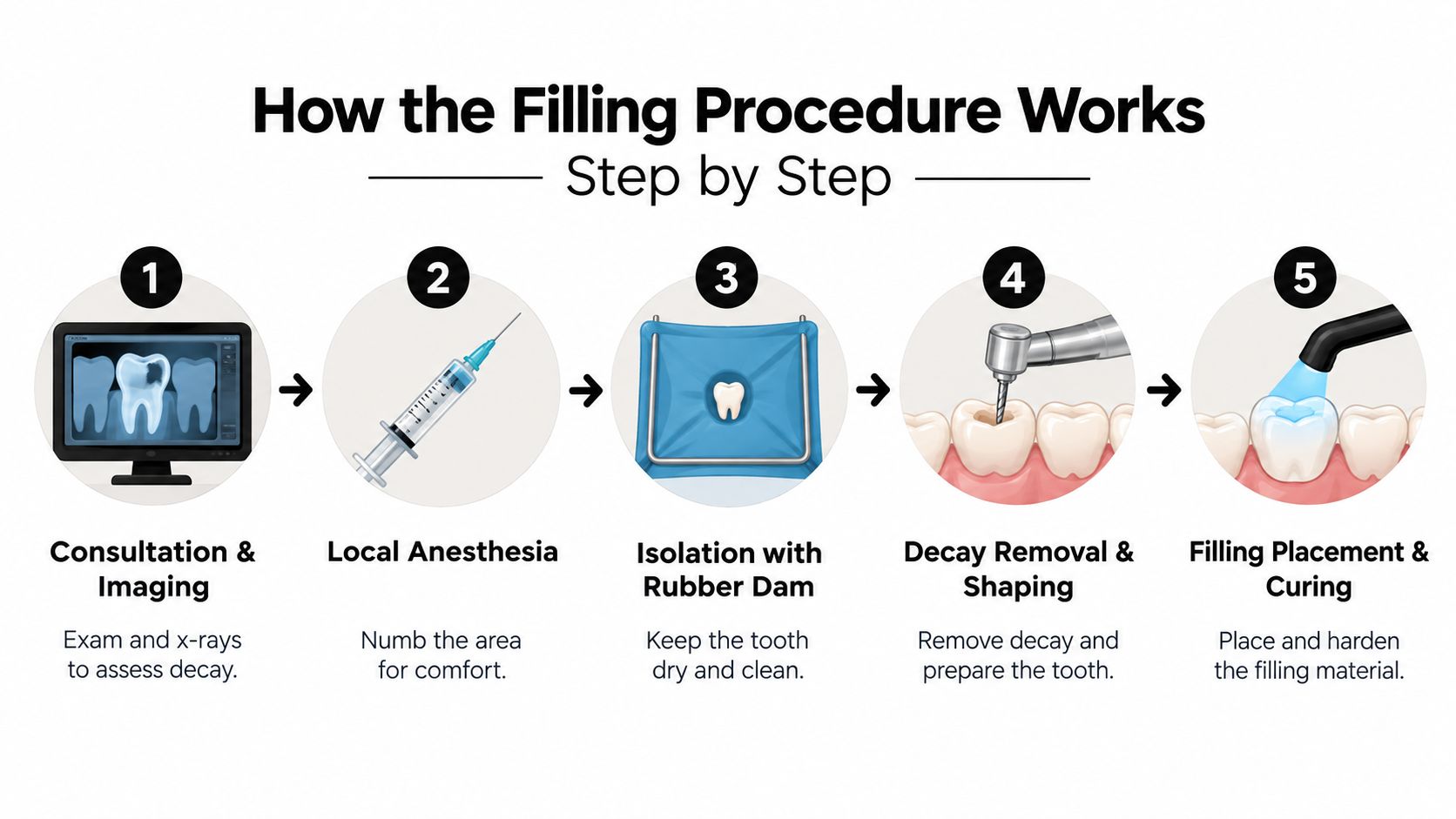
Your appointment starts before any drilling, with an exam and imaging when needed. Your dentist checks where the decay ends, whether the nerve looks threatened, and how your bite hits that tooth. That planning shapes everything that follows.
The steps below show the basic flow from assessment to hardening the material.
Numbing, Isolation, and Removing Decay
First, your dentist uses local anesthesia so the area goes numb. Then the tooth is isolated, often with a rubber dam or cotton rolls, to keep it dry and clean. That dry field isn't a fussy extra for composite, since saliva or blood on the bonding surface can create a weak edge.
Next, decayed and unsupported tooth structure is removed and the cavity is shaped. If the decay runs deep, your dentist may place a liner or base to protect the pulp inside the tooth. You can see the broader chairside sequence in this overview of how dentists fill cavities step by step.
Placing, Shaping, and Checking Your Bite
For composite, your dentist etches and bonds the surface, places the material in layers, and hardens each layer with a curing light. Amalgam is packed into the prepared space and carved before it sets. Either way, the goal is to rebuild the contact with the neighboring tooth and the chewing anatomy you lost.
This short video helps you picture the placement and finishing stages before your own visit.
Finally, you bite on articulating paper so your dentist can spot high points and adjust them. The filling is polished so plaque doesn't cling as easily and your tongue doesn't catch a rough edge. If it still feels high once the numbness wears off, that's worth a quick return visit.
How Long a Permanent Filling Actually Lasts
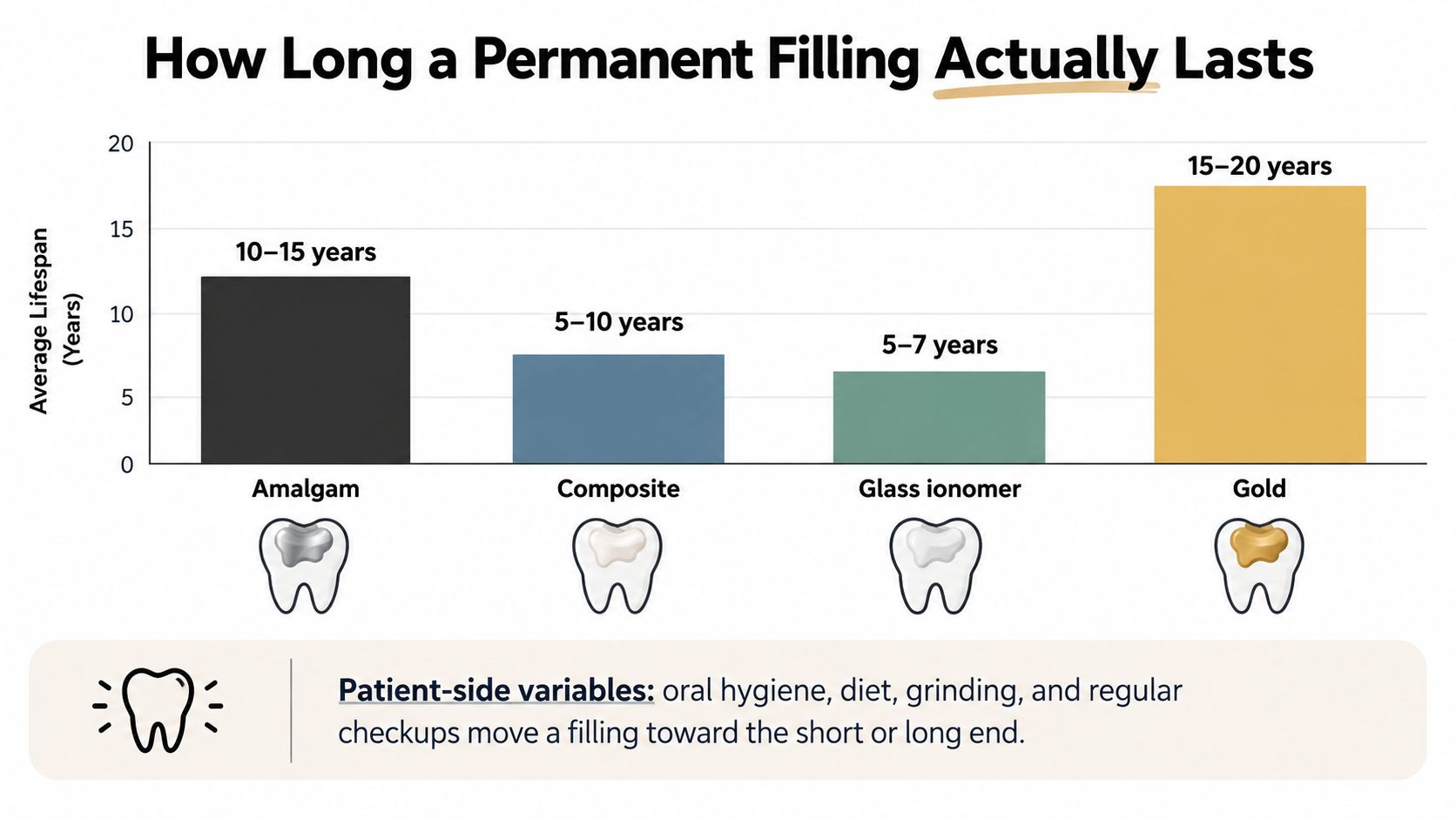
Two fillings can look identical on day one and age very differently. A systematic review found that approximately 50% of routine restorations survived 10 to 20 years, with wide variation by material, size, patient, and operator, according to the York evidence review of restoration longevity. That range is more useful than any promise of forever.
The chart below gives you a rough visual for how material ranges compare, but your personal risk factors move you within those ranges.
What the Survival Numbers Actually Say
Reported median survival has ranged from approximately 5 to 23 years for amalgam and about 17 years for composite in reviewed studies, while one analysis reported 10-year survival of roughly 60% for amalgam versus 50% for composite, as detailed in a systematic review comparing amalgam and composite longevity. Another dataset of more than 700,000 tooth-colored fillings found 16% failed within five years, and among failures, 53% involved recurrent decay and 23% involved tooth breakage, per the ADA summary of direct restoration materials research.
Don't read those figures as a countdown clock for your mouth. They mix small front fillings with large molar restorations, careful brushers with high-risk patients, and different reasons for replacement. Your dentist reads your filling in context, not as an average.
Why Your Filling May Sit at the Short or Long End
Cavity size is a major driver, since a filling replacing one small surface faces less stress than one rebuilding several walls. Bruxism, or grinding and clenching, loads the edges night after night. Dry mouth, frequent sugar, and plaque left at the margin raise decay risk where the filling meets tooth.
Failure also comes in two different forms, and they need different fixes. Recurrent decay means bacteria found a gap or plaque trap at the edge. Fracture means the filling or the tooth itself cracked under force, which points more toward bite protection or covering a weak cusp.
A filling doesn't expire on a date. It wears out through decay at the edge, force through the tooth, or both.
Aftercare That Extends the Life of Your Filling
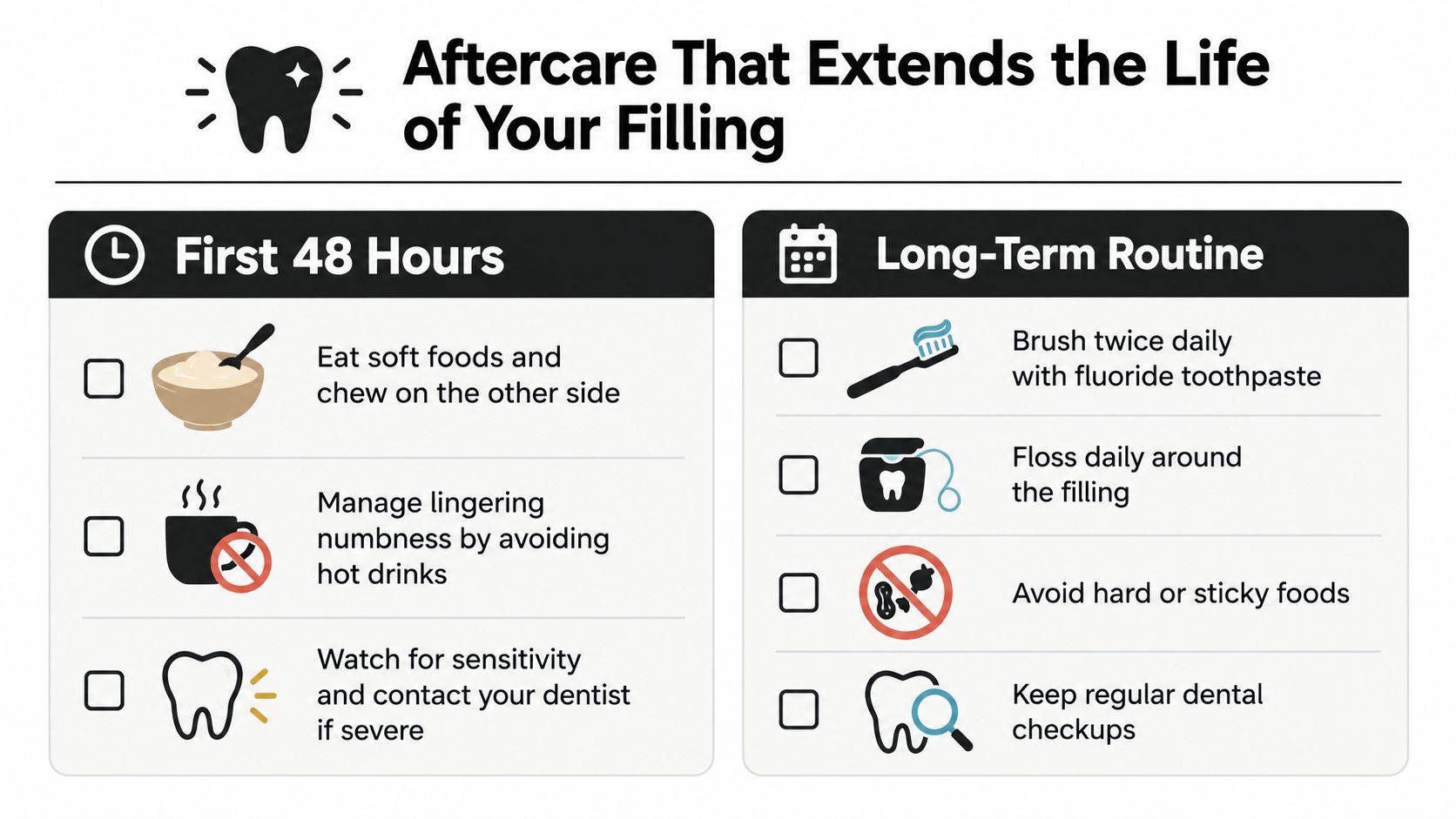
Good aftercare starts while you're still numb. Don't chew hard food on that side until sensation returns, since you can bite your cheek or overload a fresh restoration without feeling it. Mild sensitivity to cold or pressure can settle as the tooth calms down.
Use this checklist to separate the first two days from the habits that protect the filling for years.
The First 48 Hours
Stick with softer foods at first and favor the other side of your mouth. Avoid very hot drinks while you're numb, since you can't judge temperature well. If your bite feels uneven after the anesthesia fades, call rather than waiting it out, because a high spot concentrates force on one point every time you close.
Some sensitivity is common, but certain symptoms deserve prompt attention. Lingering hot or cold pain, pain on biting that isn't improving, a sharp edge catching your tongue, or a visible crack all warrant a call. A small adjustment early can prevent a bigger fracture later.
Habits That Protect the Margin
Brush twice daily with fluoride toothpaste and pay attention to the edge where filling meets tooth, since plaque loves that transition. Floss daily, sliding the floss gently through the contact instead of snapping it against the margin. Regular dental cleanings and exams to monitor filling margins let your dentist catch early wear or decay while it's still small.
- Night grinding: Ask about a night guard if you wake with jaw soreness or worn edges.
- Sugar frequency: Fewer sweet snacks and drinks between meals means fewer acid attacks at the margin.
- Hard objects: Don't use filled teeth to crack ice, nutshells, or packaging.
Aftercare isn't about being perfect for a week. It's the steady routine that keeps bacteria, acid, and force from undoing careful work.
Repair, Replace, or Upgrade to a Crown
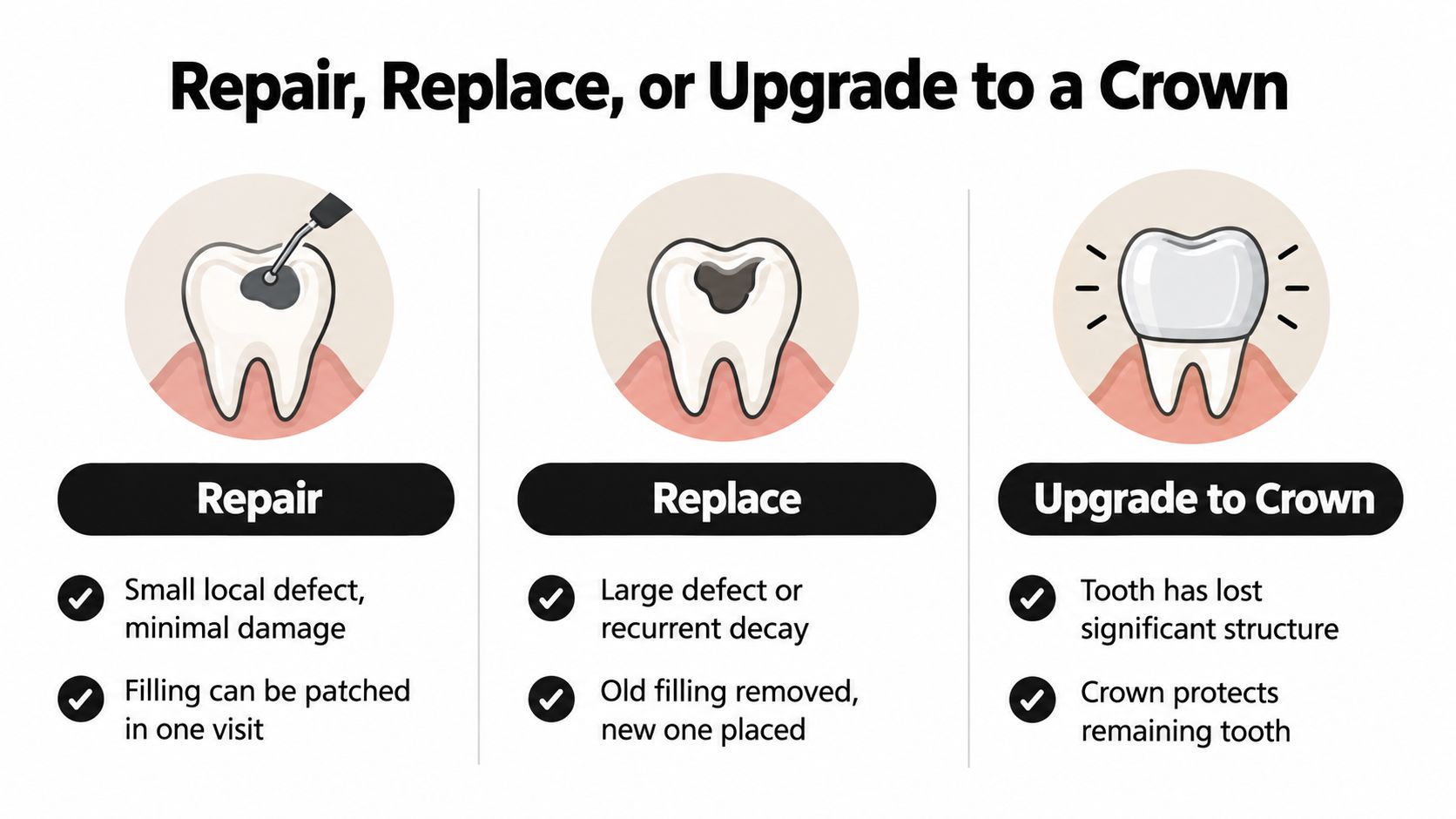
Here's the assumption worth challenging: a chipped or stained filling doesn't always need total replacement. Every full replacement tends to remove a bit more healthy tooth, making the next restoration bigger. Sometimes the conservative move protects you better.
These three paths show how the size of the defect changes the recommendation.
When Repair Makes Sense
A localized defect, such as a small chip or a rough margin with no active decay underneath, may be repairable. Your dentist can clean the area, bond new composite to the existing filling, and reshape it in one visit. That approach preserves tooth structure and buys time.
The evidence here is nuanced. A Cochrane review found no eligible randomized trials directly comparing repair with replacement of defective resin composite fillings in adults, as noted in the Cochrane review on repair versus replacement. So there's no strong rule that replacement always wins, and your dentist has to judge the defect in front of them.
When Replacement or a Crown Is the Better Call
Replacement fits better when decay has spread under the filling, the margin is open, or a large portion has fractured. At that point, patching the surface would seal in the underlying issue. Your dentist removes the old material and decay, then rebuilds the tooth from a clean base.
An onlay or crown enters the conversation when the tooth itself is the weak link. If a cusp has cracked or the remaining walls flex under biting force, another direct filling may fail the same way. You can review dental crown services for structurally weakened teeth to understand how full or partial coverage redistributes force.
- Surface stain only: Often monitor or polish, since discoloration doesn't always mean decay.
- Open margin with decay: Usually replace, because bacteria are already getting underneath.
- Cracked cusp: Often cover with an onlay or crown, because the tooth wall needs protection.
Failure patterns also differ by material. Secondary caries is most commonly associated with composite failure, while fracture is most commonly associated with amalgam replacement, with median survival exceeding 16 years for amalgam versus about 11 years for composite in posterior teeth in a recent evidence summary on posterior restoration failure. That pattern helps your dentist decide whether the problem is hygiene and seal, or force and structure.
Living With a Permanent Filling in a Busy Manhattan Schedule
A permanent dental filling fits into your life best as a monitored restoration, not a finished transaction. At each hygiene visit, ask your dentist to check the margin, the bite, and the tooth walls around older work. Imaging when indicated can reveal decay under a filling that you can't see or feel yet.
That rhythm works whether you're coming from Midtown, Chelsea, the Upper West Side, the Upper East Side, Lenox Hill, Turtle Bay, Hell's Kitchen, the Theatre District, Gramercy Park, the West Village, Greenwich Village, NoHo, the East Village, SoHo, Tribeca, Hudson Yards, Chinatown, or Wall Street. Neighborhood doesn't change the biology. Consistent follow-up does.
Bring three questions to any second opinion about an aging filling. Is the margin sealed, is there active decay, and is the remaining tooth strong enough for another filling cycle or does it need coverage? If cost is part of your planning, reviewing the average cost of a tooth filling without insurance helps you budget before a small problem becomes urgent.
Teledentistry can help you triage sudden sensitivity or a fractured edge, and short-notice visits matter when a filling breaks before a work trip. The goal stays simple. Catch changes early, repair conservatively when you can, and upgrade only when the tooth needs it.
If you have a new cavity, a sensitive old filling, or a restoration you're not sure whether to repair or replace, Paul L. Gregory, DDS at 57 W 57th St offers tooth-colored fillings, crowns, onlays, and second-opinion evaluations with modern diagnostics and short-notice availability for urgent problems. Book an exam, bring your questions about material and longevity, and get a conservative plan for your tooth by visiting Paul L. Gregory, DDS.