

Bone grafting rebuilds or preserves jawbone so a dental implant has a solid foundation, and it's needed in roughly 1 in 4 implant cases. For a patient who has finally scheduled treatment, hearing “you need a graft first” can sound like an unexpected detour, but it often means your dentist is planning for stability rather than forcing an implant into inadequate bone.
You may be wondering whether this means another surgery, several extra months, or a material taken from somewhere you'd rather not involve. Those concerns are reasonable. The answer depends on the size of the defect, the condition of the gum and bone, the implant site, and your priorities. A small graft may happen during implant placement, while a larger graft may need time to heal before the implant is inserted.
When an Implant Needs More Bone to Succeed
A patient in Midtown Manhattan might arrive ready to replace a missing front tooth before a demanding work schedule, only to hear that the implant needs a bone graft first. The immediate questions usually come quickly: “Why can't we place the implant today? Will I need another appointment? How long will I be without a tooth?”
Bone grafting for dental implants adds or preserves bone where the jaw has become too thin, too short, or too soft to support an implant securely. A dental implant is not placed into the gum. It needs to sit in the jawbone and gradually form a stable connection with that bone. If the foundation is weak, the implant may not achieve the stability needed for a durable restoration.
A useful analogy is a building site. Before constructing on soft or uneven ground, an engineer may create a proper concrete footing. The footing isn't the building itself, but it gives the building a stable base. A graft serves a similar purpose in selected areas of the jaw, creating volume and structure that can support later implant treatment.
A major review describes grafting as a foundational procedure in implant dentistry and reports that it's required in about 1 in every 4 dental implant cases, with estimates that up to half of implant procedures may involve grafting (review of bone grafting in implant dentistry). That makes it a routine part of treatment planning, not automatically a sign that something has gone wrong.
The three questions that matter most
- Is the defect small or extensive? A shallow area around an implant may sometimes be managed at the same visit. A larger missing section may need staged reconstruction first.
- How healthy is the site? Active gum disease, infection, poor soft-tissue coverage, and the quality of the remaining bone all influence timing.
- What are your priorities? Some patients focus on avoiding animal-derived materials. Others place greater weight on minimizing a donor site, reducing appointments, or choosing a material that resorbs at a particular pace.
Your first step is a detailed evaluation, not a guess based on how the gum looks in a mirror. A dental implant candidacy evaluation can help determine whether you can proceed directly, need a same-day graft, or would benefit from a staged plan.
Why Jawbone Shrinks After Losing a Tooth
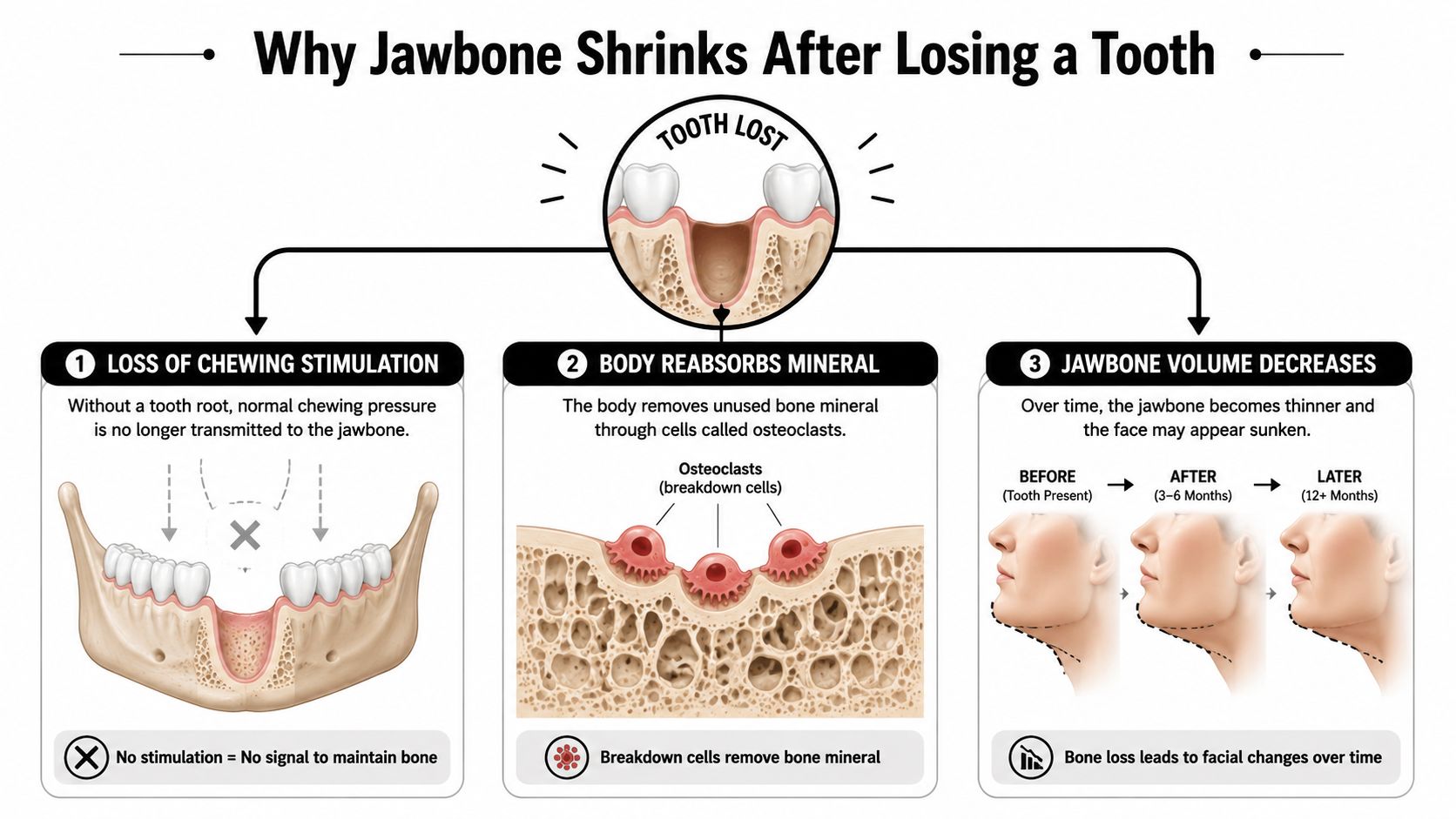
Natural teeth transmit chewing forces into the surrounding jawbone through their roots. That stimulation helps the bone maintain its structure. Once a tooth is removed, the root is gone, and the area no longer receives the same mechanical signal. The body then begins to remodel the ridge, gradually reducing the bone available at the site.
Think of the jawbone as a scaffold built around the tooth root. Remove the central support, and the scaffold no longer receives the same load. It may become narrower and lower over time, particularly when the extraction site isn't preserved or when gum disease has already damaged the supporting tissues.
What creates an implant site problem
Several situations can leave less usable bone than an implant requires:
- Extraction without site preservation: After a tooth is removed, a ridge-preservation graft can help maintain the socket's form while the area heals.
- Long-term tooth loss: The longer a space remains without a root or implant, the more opportunity the ridge has to remodel.
- Periodontal disease: Gum disease can destroy the bone that supports a tooth, leaving an irregular or reduced ridge even after the tooth is removed.
- Injury or surgical change: Trauma and previous procedures can alter the shape and volume of the jaw.
The implant needs enough height and width for primary stability. “Primary stability” means the implant is firmly held at placement, before the longer biological process of integration has completed. Bone that is too thin, too soft, or too irregular may not provide that initial hold without reconstruction.
Evidence on ridge preservation shows that grafting after extraction can significantly reduce vertical and horizontal bone loss compared with extraction alone. It doesn't stop physiologic resorption completely, however, and reviews don't identify one universally superior material or technique. The appropriate choice depends on the defect's shape, the soft-tissue seal, and when the implant is planned (evidence on ridge preservation after extraction).
That's why a graft isn't prescribed only because a tooth is missing. Your dentist has to assess the three-dimensional anatomy and decide whether the remaining bone can support the planned implant without additional preparation.
Comparing Graft Materials From Your Own Bone to Synthetic Options
Patients often hear four terms and are left with a list rather than a decision: autograft, allograft, xenograft, and synthetic graft. Each describes where the material comes from, but the source alone doesn't tell you which option is right. The important questions are how the material behaves in your defect, how quickly it remodels, and whether it fits your health and personal preferences.
| Material Type | Source | Key Advantage | Main Consideration |
|---|---|---|---|
| Autograft | Your own bone | Contains your own living bone and avoids donor compatibility concerns | Requires a second surgical site and can add donor-site discomfort |
| Allograft | Processed human donor bone | Avoids harvesting bone from another part of your body and provides a structural scaffold | Some patients have questions or preferences about donor-derived materials |
| Xenograft | Usually animal-derived mineral material | Provides a stable scaffold and is widely used in oral reconstruction | Patients who avoid animal-derived products may prefer another option |
| Synthetic substitute | Laboratory-made material, such as β-TCP | Can avoid human or animal tissue and offers a tailored substitute option | Resorption and long-term behavior can vary, especially in larger defects |
The biologic distinction matters because the graft doesn't remain unchanged forever. Your body interacts with the material while new vital bone grows into and around it. A review of core biopsies taken after 3 to 6 months reported about 17% to 27% vital bone with mineralized materials and about 28% to 53% with unmineralized products (review of graft material biology). Those findings don't mean one category is automatically better. They show why the material's remodeling behavior matters at the point when your dentist is deciding whether the site is ready.
Which graft material is best?
There isn't one winner for every patient or every defect. Current evidence reports broadly comparable findings for commonly used allograft and xenograft materials in oral and maxillofacial preparation before implants. A recent review of β-TCP also described implant survival comparable with other standard substitutes or native bone, while noting that longer-term histologic evidence is still needed for resorption behavior in larger defects (review of graft materials and oral implant preparation).
That leaves room for legitimate patient preferences. Someone who wants to avoid animal-derived products may prioritize a synthetic option. Someone who wants to avoid a second surgical site may prefer a donor or substitute material. A clinician may favor a material that maintains space in a broad defect, or one that remodels more readily in a smaller site.
The practical answer: “Natural” doesn't automatically mean better, and a stronger-feeling material isn't automatically the right choice. The best graft is the one matched to the defect, the timing, the biology, and your priorities.
If you're interested in how digital planning and modern implant systems fit into the larger treatment process, you can review dental implant technologies and treatment options. Your dentist should still explain the specific material proposed, why it fits your site, and what alternatives are reasonable.
What the Bone Grafting Procedure Actually Involves
The procedure is easier to understand when you separate planning, placement, and healing. It isn't one mysterious event. It's a sequence designed to identify the defect, protect the graft, and verify that the site is ready before an implant carries normal chewing forces.
The consultation comes first
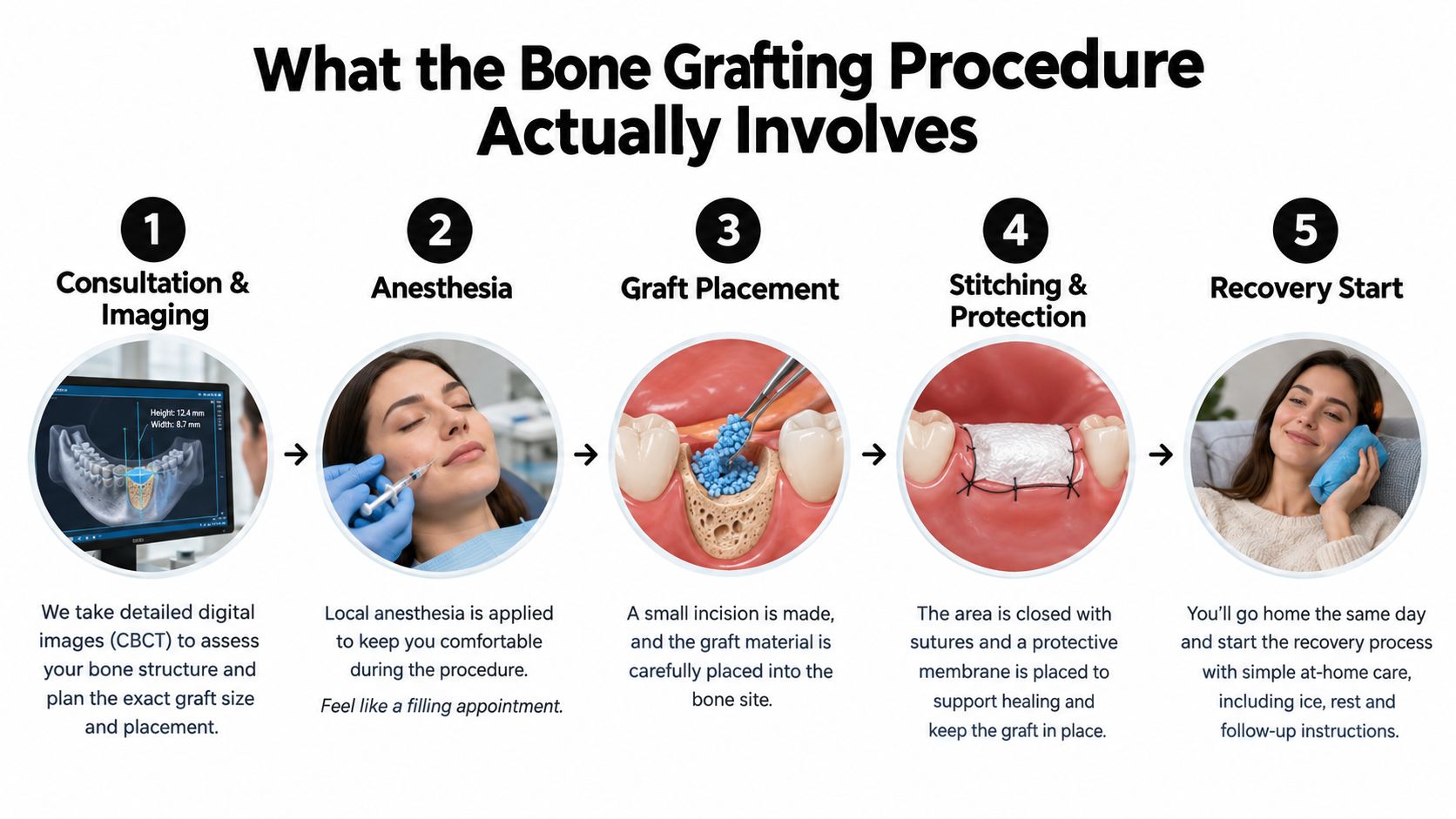
Your dentist examines the gums and teeth, reviews your medical history, and uses diagnostic imaging to assess the ridge in three dimensions. Digital scans can show the available bone volume and help the clinician plan the position of the future implant rather than placing a graft based only on the visible surface.
Local anesthesia is used to numb the area. For many patients, the sensation is similar to a standard extraction or filling appointment: pressure and movement may be noticeable, but sharp pain shouldn't be. Sedation may be discussed if anxiety is a significant concern.
The clinician then reaches the area through the gum, prepares the site, and places the selected graft material where volume is missing. A membrane may cover the graft to help protect it from soft-tissue interference while healing. The gum is then closed with sutures, which may dissolve or require removal depending on the material used.
The timing has two main paths
Minimal, simultaneous grafting may be appropriate when the defect is limited and the implant can still be positioned securely. In that situation, the graft and implant may be completed during the same visit. This can reduce separate surgical appointments, but it's only suitable when the site's dimensions and biology allow predictable initial stability.
Staged grafting is used when the missing bone is more extensive or when the implant would not be adequately supported immediately. A hospital patient guide explains that minimal grafting can be performed at implant placement, while more extensive grafting is typically completed at least four months earlier. Another clinical guide describes healing commonly taking 3 to 6 months (patient information on bone grafting timing).
The choice isn't based on how anxious or busy you are, although those practical concerns deserve attention. It's based on defect size, site biology, soft-tissue coverage, and whether the implant can be stable on the day of placement.
Afterward, expect instructions for protecting the site, cleaning gently, eating softer foods, and monitoring swelling. You can also watch a visual explanation of the dental implant procedure to understand how grafting can fit into the broader sequence.
The Healing Timeline and What to Expect at Each Stage
The waiting period can feel harder than the procedure because you can't see the new bone developing. Healing happens gradually, and the absence of visible change doesn't mean the graft is inactive.
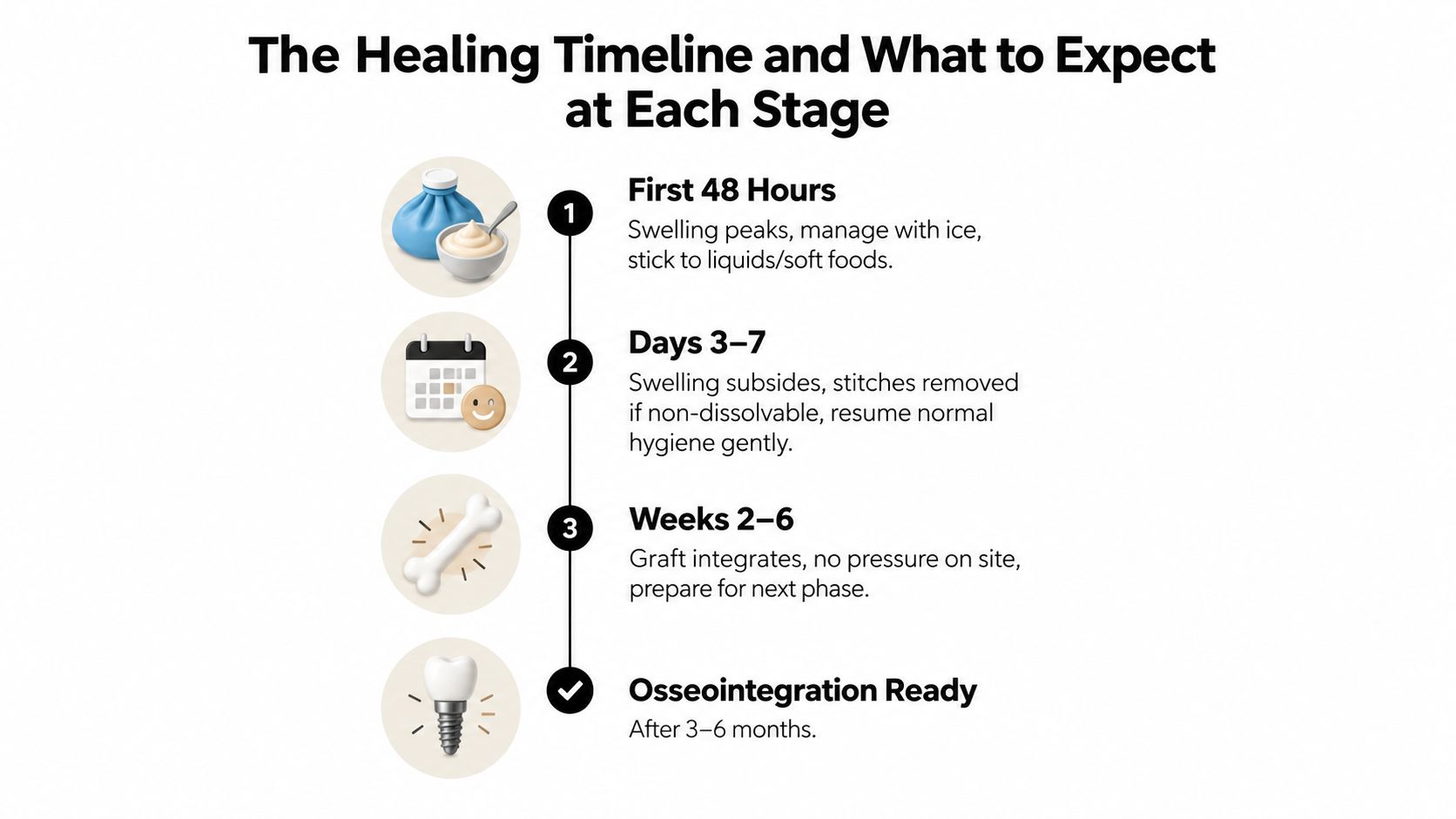
In the first days, swelling and tenderness are common. Your care instructions may include a soft diet, avoiding pressure on the graft, and gentle cleaning around the area. The goal is to protect the wound and maintain the soft-tissue seal while the initial healing response begins.
What the graft is doing beneath the gum
During the following weeks, the graft acts as a framework for your own bone to grow into and around. Some materials are gradually resorbed as new tissue develops. Others can remain as structural particles for longer while the site matures. The desired result is a stable ridge containing enough healthy, vital bone for implant placement.
The material affects the tissue composition found at evaluation. As reported in the biopsy review above, the proportions of vital bone and residual substitute can differ by material category. That's one reason your dentist doesn't judge readiness by the calendar alone.
How readiness is confirmed
At the planned review, the clinician examines the soft tissue and evaluates the ridge with imaging. The assessment may also consider whether the site feels stable and whether there are signs of infection, membrane exposure, or inadequate integration. If the bone isn't ready, placing the implant immediately may create more risk than allowing additional healing.
Healing can be affected by smoking, uncontrolled medical conditions, active gum disease, poor plaque control, and pressure on the surgical area. These aren't reasons to assume a graft will fail, but they are reasons to discuss your health openly before treatment. Following instructions protects the investment you're making in the next stage.
The practical timeline is therefore individualized. A limited graft may be combined with implant placement, while a larger reconstruction generally needs the healing interval described in the clinical guidance above. Your treatment plan should state which path applies to you and what milestone will determine the implant date.
Success Rates Risks and Honest Trade-Offs
Grafting is widely used because implants can perform very well in reconstructed sites. A systematic analysis of enhancement methods reported implant survival in grafted bone ranging from 97.3% to 100%, with a mean survival of 98.5%, across studies involving 223 implants placed after 3 to 6 months of grafting (systematic analysis of implant survival in grafted bone). The same evidence base includes real-world treatment at substantial scale, including a clinical series of 45,715 implants placed with bone-augmentation procedures in 17,600 patients.
Those findings support a calm conclusion: grafting is mainstream implant therapy, not an experimental workaround. They don't promise an identical result for every patient, because individual health, site anatomy, hygiene, and surgical planning still matter.
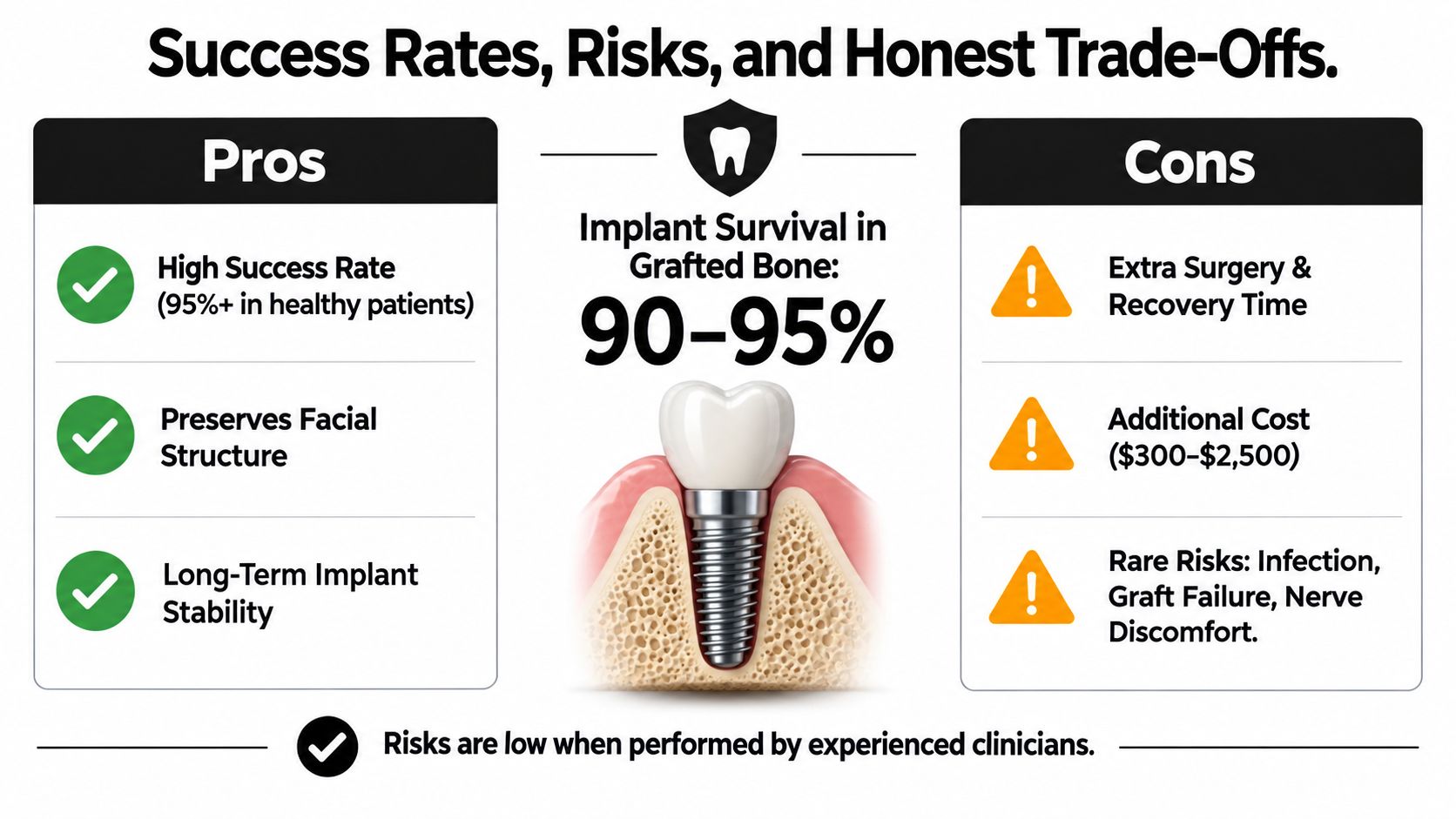
What you may gain
- A usable implant foundation: Grafting can create or preserve the bone volume required for stability.
- More restorative flexibility: A prepared ridge may allow the dentist to position the implant in a way that supports the planned crown or bridge.
- Better site preservation after extraction: A preservation graft can reduce, though not eliminate, remodeling of the ridge.
- A planned rather than rushed treatment: Staging gives the clinician time to improve the site before placing the final implant.
What you're accepting
- An additional procedure: Staged grafting means another surgical phase instead of direct implant placement.
- A healing interval: The implant may need to wait until the graft has matured enough to support it.
- Temporary swelling and discomfort: Tenderness and swelling can occur during the early recovery period.
- Biologic uncertainty: Infection, membrane exposure, inadequate integration, or graft loss can occur, although careful planning and aftercare reduce avoidable problems.
- More financial planning: A graft adds treatment steps and associated fees, so ask for the total proposed sequence rather than judging the implant price alone.
The right decision isn't “grafting at any cost.” It's whether the added step creates a sounder path to the restoration you want, and whether another treatment option would meet your functional and cosmetic needs with fewer compromises.
Alternatives and Your Next Step Toward an Implant
A graft isn't the only possible route. Depending on the remaining bone, the implant team may consider a shorter or narrower implant, a carefully angled position, or an All-on-4 full-arch solution that uses available bone differently. A conventional bridge or removable denture may also be appropriate, particularly when surgery, healing time, or medical factors make grafting less attractive. The feasible choices depend entirely on how much bone remains and where it is located.
Use your consultation to ask four direct questions:
- What does the three-dimensional evaluation show?
- Can my graft and implant be completed together, or do I need a staged plan?
- Which material are you recommending, and what alternatives avoid animal-derived products?
- What is the complete sequence, including healing, temporary teeth, and final restoration?
If you're comparing a fixed bridge with an implant, this guide to dental implants versus a bridge can help frame the conversation. A Midtown practice that coordinates diagnostics, extraction, grafting, and implant restoration in one setting may also make scheduling easier for busy professionals, but the clinical plan should come before convenience.
Paul L. Gregory, DDS provides implant dentistry, bone grafting, and site preservation as part of restorative care, with digital diagnostics and treatment planning at its Midtown Manhattan office. Visit Paul L. Gregory, DDS to arrange an evaluation and discuss whether you need same-day grafting, staged grafting, or an alternative to grafting altogether.