

You've lost a tooth, or you're wearing a denture that moves when you eat, and you want to know whether dental implants are realistic for you. Many patients assume the answer depends mainly on age. A 58-year-old teacher may worry that she's too old, while a younger patient with gum disease, heavy tobacco use, or poorly controlled diabetes may assume implants are automatically safe.
The better question is more specific: Can your bone, gums, general health, daily habits, and restorative goals support healing and long-term maintenance? Dental implant candidacy isn't a simple yes-or-no label. It's an individualized risk assessment. A systematic review reported 10-year implant-level survival of 96.4% in appropriately selected situations, which shows why dentists focus so carefully on the condition of the site and the patient before treatment begins. The long-term review indexed by PubMed supports the importance of careful selection.
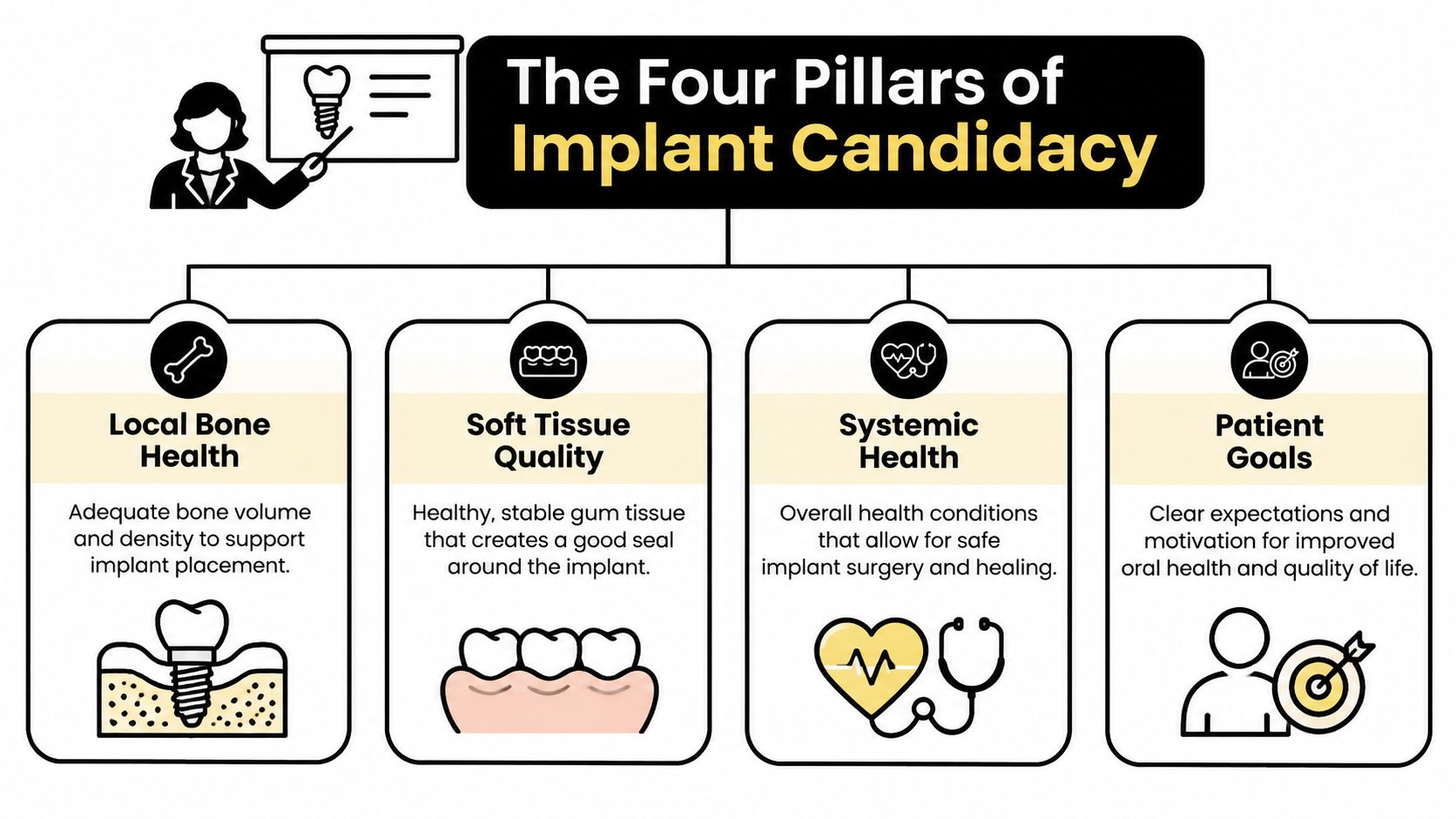
The Four Pillars of Implant Candidacy
A 58-year-old teacher once told her dentist, “I assumed implants were for younger people.” She had completed jaw growth, no active gum infection, and health conditions that were being managed with her physician. Her age alone didn't answer the question. Her risk profile did.
Four connected pillars help organize that assessment:
Local bone and soft tissue conditions
The implant needs a stable foundation. Dentists assess whether the jaw has enough bone width, height, and quality, along with gum tissue that can protect and clean around the future restoration. If the foundation is limited, grafting or staged treatment may improve the site rather than end the conversation.Systemic health and healing capacity
Dental implants require surgery followed by a biological process called osseointegration, in which bone bonds to the implant surface. Conditions that affect immunity, blood flow, or bone turnover can make healing less predictable. A controlled condition isn't the same as an untreated one, so your medical history needs a careful review.Lifestyle and medication modifiers
Tobacco use, oral hygiene, grinding, alcohol intake, and certain medications can shift the balance. These factors don't always create an absolute prohibition, but they can change surgical timing, monitoring, and the type of maintenance plan you'll need.Restorative goals and patient commitment
An implant isn't just a screw placed in bone. It supports a crown, bridge, or denture that must fit your bite, appearance, chewing needs, and ability to clean it. You'll also need to attend follow-up visits and maintain the surrounding tissues.
Practical rule: A weakness in one pillar doesn't always eliminate candidacy. It often means the dentist must reduce that risk before placing the implant.
Adults with completed jaw growth, healthy gums, and enough bone to support osseointegration are usually strong candidates. Major references emphasize that bone and gum status matter more than age alone, while implant placement generally waits until skeletal growth is complete, often around age 18 or later. Learn more about dental implant treatment and candidacy.
What Dentists Evaluate Inside the Mouth
A patient may have a healthy-looking smile and still need a closer examination before implant treatment. Your dentist studies the proposed site much like an engineer studies a building site, assessing the foundation, surrounding structures, forces, and future maintenance that will support the restoration.
Gum health comes first
Untreated periodontal disease can damage the bone and soft tissue an implant needs. The dental team may measure pocket depths, check for bleeding on probing, assess recession, and examine inflammation around neighboring teeth. They may also evaluate the width of keratinized tissue, the firmer band of gum that can make cleaning and tissue stability more manageable around an implant.
Active gum disease does not automatically rule out implants. The infection and inflammation usually need treatment first, followed by evidence that the gums can remain stable. Patients who need periodontal care may explore nonsurgical gum disease treatment before implant planning.
Bone is measured in three dimensions
A two-dimensional dental X-ray offers useful information, but a CBCT scan shows bone volume and nearby anatomy from multiple angles. The evaluation includes:
- Width and height: The ridge must accommodate an implant in a position that supports the final tooth.
- Density and quality: Dense, stable bone can provide stronger initial support, while softer bone may call for different planning and healing expectations.
- Anatomic boundaries: The maxillary sinus in the upper jaw and the inferior alveolar nerve in the lower jaw must be respected.
- Prosthetic space: There must be enough room for the implant, abutment, and crown to function without compromising cleansability or appearance.
Dentists sometimes describe bone quality using the Lekholm and Zarb classification, which broadly distinguishes denser cortical bone from softer, more porous bone. You do not need to memorize its categories. Two patients can have similar-looking gaps but very different bone conditions beneath them, so the same treatment plan may not suit both.
Bite forces can change the design
Clenching or grinding can place heavier forces on an implant restoration. The dentist may examine tooth wear, muscle tenderness, the relationship between upper and lower teeth, and available space. A night guard or a modified restoration may become part of the plan.
| Assessment | What Is Measured | Why It Matters |
|---|---|---|
| Periodontal examination | Pockets, bleeding, inflammation, and gum attachment | Stable gums reduce the risk of complications around the implant |
| Soft tissue review | Keratinized tissue and gum thickness | Healthy tissue supports cleaning, comfort, and appearance |
| CBCT imaging | Bone height, width, density, and anatomy | Three-dimensional planning helps avoid fragile or unsafe positions |
| Occlusal analysis | Bite contacts, wear, clenching, and grinding | Load management protects the implant-supported restoration |
| Restorative assessment | Space, tooth position, and planned crown shape | The implant must serve the final tooth rather than merely fill the gap |
The goal is to determine whether the implant can be positioned as part of a stable, cleanable, functional restoration. A short ridge, inflamed gum, or demanding bite may change the sequence or design, rather than end the discussion about candidacy.
Systemic Health and How It Shapes Healing
Osseointegration takes place inside the body, so your medical history matters. After placement, the tissues must control inflammation, deliver blood and oxygen, remodel bone, and protect the surgical site from infection. A condition that disrupts any of those processes may require treatment or medical coordination before surgery.
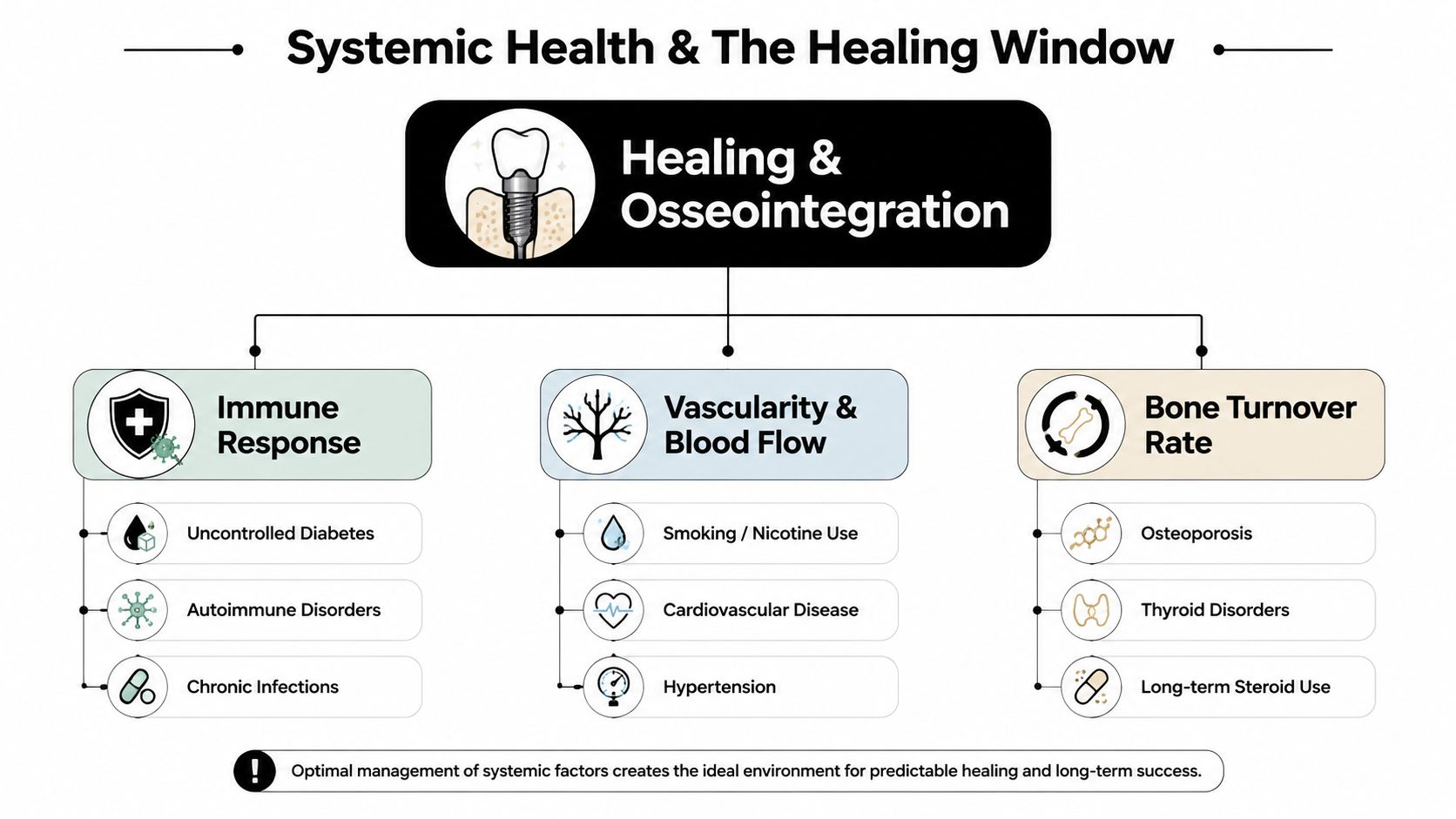
Conditions that need careful management
Dentists commonly pay close attention to uncontrolled diabetes, active chemotherapy, significant immunosuppression, and recent major cardiovascular events. Recent or ongoing antiresorptive therapy, including bisphosphonates or denosumab, also deserves a detailed medication review because the reason for treatment, route, timing, and dose influence surgical planning.
Untreated sleep apnea may also matter, particularly when it affects oxygenation, sleep quality, or the practical use of a night guard. These concerns aren't handled by guessing. Your dentist may communicate with your physician and request updated medical information before recommending surgery.
A patient taking stable metformin with good glycemic control presents a different clinical situation from someone with undiagnosed or poorly controlled diabetes. The medication itself isn't the whole story. The relevant questions are whether the condition is controlled, whether healing is likely to be predictable, and whether the patient can safely undergo the procedure.
Absolute and relative contraindications
Some medical circumstances may make implant surgery inappropriate until the situation changes. Others are relative contraindications, meaning they increase risk but may be managed with timing changes, medical clearance, a modified surgical approach, closer follow-up, or a different restoration.
A medical condition should trigger a better plan, not an automatic assumption that treatment is impossible.
The decision belongs with the dental and medical teams. Bring a complete medication and supplement list, describe previous surgeries and healing problems, and report conditions even if they seem unrelated to your teeth. Good candidacy means more than being healthy in general. It means being medically prepared for this particular surgical and restorative process.
Why Age Alone Is the Wrong Question
Chronological age doesn't measure bone quality, immune function, dexterity, oral hygiene, or the ability to attend maintenance visits. That's why an older adult with controlled medical conditions and stable gums may be a stronger candidate than a younger adult with active periodontal disease and habits that interfere with healing.
Long-term evidence supports this individualized approach. One review reported 10-year survival of about 97% and 20-year survival around 75%, while a large comparison found a 2% failure rate over 10 years in both patients over 65 and younger groups. The Journal of Oral Medicine and Oral Surgery review describes why older adults shouldn't be excluded because of their birth year.
A newer systematic review found five-year survival of 96.8% in patients over 75 and 92.1% in those aged 65 to 75. Those figures don't guarantee an individual result, and they don't erase the importance of bone density, healing capacity, or maintenance. They do show why “Am I too old?” is an incomplete question. The PubMed review of implant outcomes in older adults supports judging candidacy by health and treatment conditions rather than age alone.
The concern that deserves attention
Older patients may have lower bone density, reduced dexterity, multiple medications, or limited caregiver support. Those factors can affect surgical planning and the long-term ability to clean around an implant-supported crown or denture. A dentist may therefore favor a design that's easier to remove, inspect, and maintain.
Younger patients have a different concern. Implants are generally delayed until skeletal growth is complete because a growing jaw can continue changing around a fixed implant. In practice, candidacy usually begins after jaw maturation, often around age 18 or later, rather than at a particular upper-age cutoff.
The useful question is, how well can this jaw heal, support the restoration, and remain maintainable over time? Patients comparing implants with other tooth replacement options may also benefit from reviewing before-and-after denture photos with a dentist.
Lifestyle and Medication Factors That Shift the Odds
Some candidacy factors are fixed. Others can change before treatment. That distinction gives patients practical options instead of forcing them to self-disqualify.
| Factor | Typical Impact on Implant Success Odds |
|---|---|
| Tobacco use | Nicotine and other tobacco exposures can reduce blood flow and make healing less predictable. Stopping before and during healing may improve the treatment environment. |
| Diabetes | Controlled diabetes may be compatible with implant treatment, while poor control can increase concerns about infection and integration. Medical coordination is important. |
| Antiresorptive medication | Oral osteoporosis therapy and intravenous oncology therapy don't carry identical considerations. The dentist needs the exact drug, route, reason, and treatment history. |
| Oral hygiene | Plaque control protects the gums around the implant and supports long-term maintenance. |
| Bruxism | Clenching and grinding can increase mechanical load, so a night guard or adjusted design may be appropriate. |
| Alcohol use | Heavy use can complicate general health, medication management, and recovery. Honest disclosure helps the team plan safely. |
Tobacco changes the healing environment
Nicotine constricts blood vessels, which can limit circulation to healing tissues. Smoking, chewing tobacco, and vaping all deserve discussion. A surgical team may recommend a tobacco pause before and after placement, but the exact plan should come from the clinician who knows the procedure and your health history.
Medication history needs precision
“Bone medication” isn't specific enough for an implant consultation. Bring the medication name, dosage, route, prescribing reason, and dates of use. A patient receiving treatment for osteoporosis may require a different conversation from a patient receiving intensive intravenous therapy for cancer.
Daily maintenance is part of candidacy
An implant can't develop a cavity like a natural tooth, but the surrounding gum and bone can still become inflamed when plaque remains. If arthritis, vision problems, or limited dexterity make cleaning difficult, the dentist may recommend adapted brushes, water flossers, caregiver assistance, or a restoration designed for easier access.
Honest assessment: These factors shift risk. They don't automatically decide the case. The safest plan comes from discussing them before surgery, not hiding them or assuming implants are impossible.
When Bone Is Short and Grafting Changes the Answer
“Not enough bone” can mean several different things. The ridge may be too narrow, too short, too soft, or shaped by nearby anatomy that limits implant positioning. Long-standing tooth loss, periodontal disease, and expansion of the maxillary sinus after tooth loss can all contribute.
The first step is three-dimensional imaging and restorative planning. The dentist determines where the final tooth should sit, then works backward to see whether the existing ridge can support that position. This prevents a common mistake, placing an implant wherever bone happens to remain and then trying to force the crown into an awkward location.
Three common ways dentists rebuild the site
- Sinus lift: In the upper back jaw, the dentist carefully creates additional space beneath the sinus membrane and places graft material. An internal approach and a lateral-window approach may be considered based on the anatomy.
- Ridge augmentation: Guided bone regeneration, particulate grafting, or a block graft can rebuild a ridge that lacks width or height. A membrane may help contain the graft while the site heals.
- Socket preservation: When a tooth is extracted, placing graft material in the socket can help preserve the ridge during healing. It doesn't guarantee that later implant placement will require no additional augmentation, but it can protect the site from further collapse.
Immediate implant placement is most favorable when the socket walls remain intact, the buccal bone plate is present, and the implant can achieve primary stability. Expert guidance recommends grafting a bone-to-implant gap greater than 2 millimeters and considering staged placement when the socket is compromised. The implant treatment guideline explains these site-selection principles.
Staged or simultaneous treatment
If the bone is borderline but stable enough, the dentist may graft and place the implant during the same procedure. If the alveolus is damaged or stability can't be achieved predictably, the team may graft first, allow the site to mature, and place the implant later.
That approach extends treatment, but it can create a more favorable foundation. A patient who was initially told “you don't have enough bone” may need a different sequence rather than a permanent rejection. Review the dental implant procedure to understand how surgical planning, grafting, and restoration fit together.
A Realistic Treatment Timeline From Consult to Crown
Implant treatment is usually a sequence of biological and restorative steps, not one appointment. The chair time may be limited, but the body needs time to heal between stages.
The usual phases
Consultation and records
The dentist reviews your goals, medical history, gum health, bite, photographs, digital scans, and radiographs. A CBCT may be needed to assess the site in three dimensions.Preparatory treatment
Active gum disease, a damaged tooth, infection, or insufficient bone may need attention first. Extraction, socket preservation, or grafting can change the schedule.Implant placement
The surgeon places the implant in the planned position. Immediate loading may be considered only when the site and initial stability support it.Osseointegration
Bone gradually bonds with the implant. The upper jaw often requires more healing time because its bone can be softer than bone in the lower jaw.Restoration
Once integration is confirmed, the dentist places or exposes the abutment, records the implant position, evaluates the bite, and delivers the final crown, bridge, or denture.
Most elapsed time reflects healing, not time in the dental chair. Your schedule may also include temporary teeth, dietary adjustments, work planning, and follow-up visits. Patients considering treatment should ask how many appointments are expected and which steps might change if grafting becomes necessary.
Immediate protocols can shorten the visible gap between surgery and a temporary tooth, but they aren't suitable for every site. The final decision depends on bone, stability, infection status, bite forces, and the design of the restoration. Read about the dental implant healing process before planning travel or major work commitments around surgery.
Your Candidacy Checklist and Next Steps
Bring this checklist to your consultation. It turns a broad question into specific decisions:
- Bone assessment: Ask whether 3D imaging shows enough height, width, density, and prosthetic space.
- Gum stability: Confirm that active periodontal infection has been treated and that you can maintain healthy tissues.
- Medical readiness: Review diabetes, immune conditions, cardiovascular history, sleep apnea, and every prescription or supplement.
- Healing habits: Discuss tobacco, alcohol, grinding, oral hygiene, and any assistance you may need during recovery.
- Treatment sequence: Ask whether extraction, socket preservation, ridge augmentation, or a sinus lift may be needed.
- Long-term maintenance: Understand how the restoration will be cleaned, inspected, and repaired if necessary.
A borderline finding rarely tells the whole story. Grafting can improve a deficient site, periodontal treatment can stabilize inflamed tissues, and medical coordination can clarify whether a controlled condition is compatible with surgery. The important step is obtaining an individualized assessment rather than relying on age or a single X-ray.
Schedule a consultation with a periodontist or implant-focused general dentist, request a CBCT when appropriate, and bring an up-to-date medication list. Ask directly about grafting likelihood, expected treatment duration, temporary tooth options, and maintenance requirements before committing.
Paul L. Gregory, DDS evaluates implant candidacy through medical history, gum health, digital imaging, restorative planning, and options such as bone grafting and site preservation. Visit Paul L. Gregory, DDS to discuss whether your bone, health, and treatment goals support a personalized dental implant plan.