

What makes a denture transformation convincing, the brightness of the smile or the clinical details behind the image? Before and after dentures photos are most useful when you examine the treatment category, starting condition, photographic timing, and stated outcome together. Lighting, camera angle, patient positioning, healing, denture type, and individual anatomy can all change how a result appears.
The galleries below include complete, partial, immediate, conventional, and implant-supported examples. Treat each image as evidence of a particular treatment journey, not as a promise of the same result for every patient. If you need an individualized assessment, Paul L. Gregory, DDS can provide local consultation, digital imaging, and denture planning in Midtown Manhattan.
1. Dentures Manhattan NYC from Dr. Paul Gregory, DDS
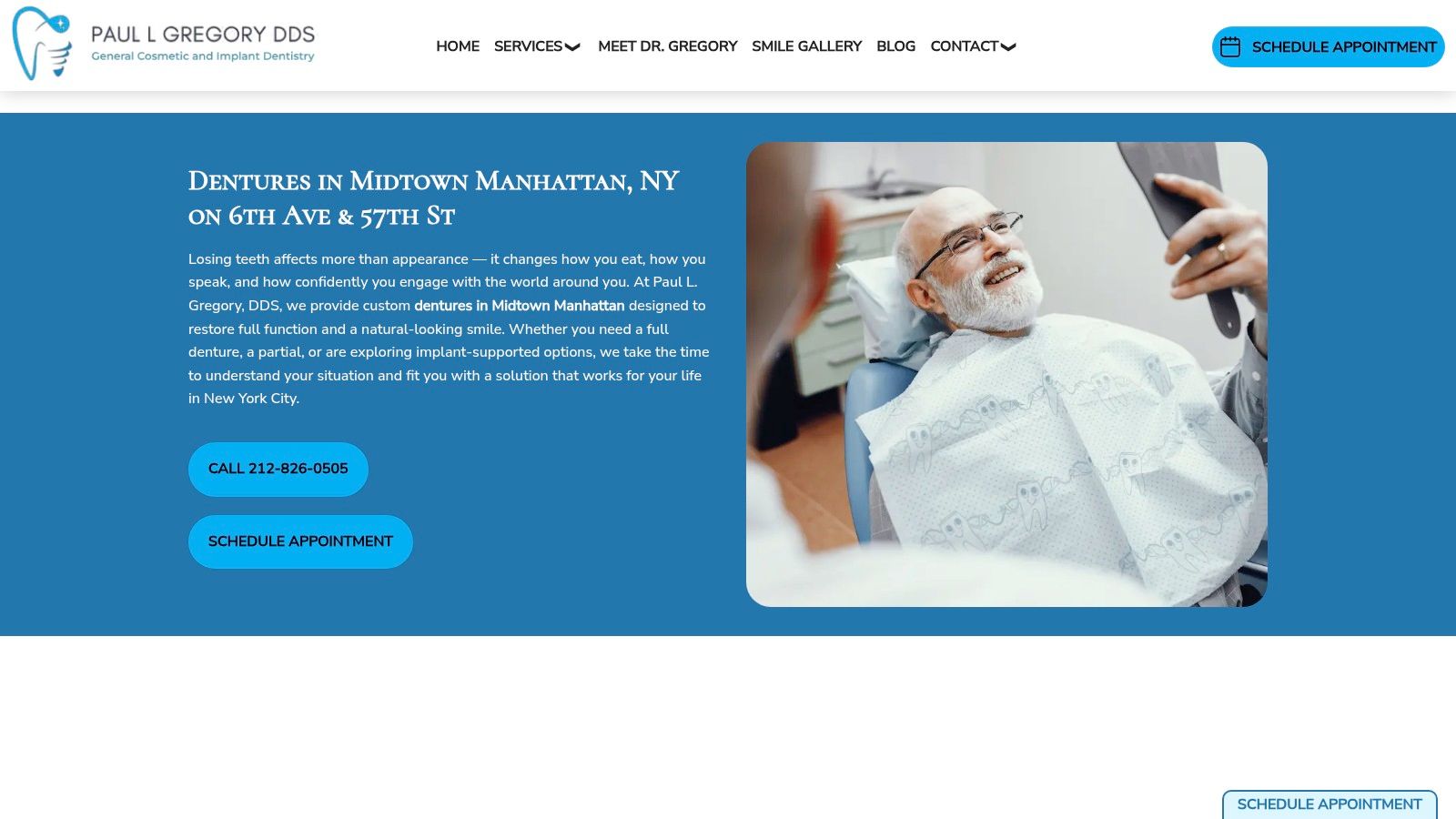
A local practice gallery becomes more useful when you can connect the image to an actual evaluation process. Dr. Paul L. Gregory's Midtown Manhattan practice provides partial, complete, and implant-supported dentures, allowing patients to compare options based on the number of missing teeth, available support, lifestyle, and functional goals.
The visual result can show changes in tooth display, lip support, smile line, and facial balance. It can't show whether the appliance feels stable during chewing, how speech changed during adaptation, or whether the patient needed later adjustments. Those questions require a consultation and follow-up, not just a photograph.
What to examine in the gallery
Look for the relationship between the upper front teeth and the lips. A well-planned complete denture should be judged against the patient's facial proportions, not against a generic ideal smile. Ask whether the image represents a removable conventional denture, a partial restoration, or an implant-retained design, because those categories have different support and maintenance requirements.
Paul Gregory's workflow can include digital impression scanning, high-resolution imaging, X-rays, intraoral scans, staged fabrication, try-ins, and adjustment visits. The practice also coordinates restorative and implant-related care when a denture plan needs crowns, implants, extraction care, or soft-tissue treatment.
Practical rule: A local before-and-after image is most valuable when the dentist can explain the starting anatomy, treatment type, design choices, and follow-up plan behind it.
Patients comparing results should ask:
- Treatment category: Is the example partial, complete, immediate, or implant-supported?
- Photographic stage: Was the after image taken at insertion, after adjustment, or after healing?
- Functional goal: Was the priority appearance, chewing stability, speech, facial support, or a combination?
- Practical planning: What are the expected visits, maintenance needs, insurance considerations, and total fees?
Implant-supported dentures may require surgery, possible bone grafting, and a longer treatment pathway, and not every patient is an immediate candidate. A Midtown Manhattan practice may also have different fees from a community clinic, so transparent discussion of coverage and out-of-pocket costs matters. For patients who want coordinated planning near Central Park South and Columbus Circle, Paul Gregory's denture services offer a starting point for an individualized comparison.
2. Aspen Dental Dentures Before and After
Aspen Dental's dedicated denture gallery is useful for readers who want to review a broad mix of full, partial, immediate, conventional, and implant-supported examples. The range matters because an immediate denture taken around extraction care should not be interpreted in the same way as a final conventional denture or an implant-retained restoration.
The page combines visual examples with educational material, patient stories, and information about denture services. That combination helps readers ask better questions about timing. An image may represent the first appearance after delivery, while another may show a later refinement, and the page context should clarify what the photograph is intended to demonstrate.
Questions for a large network gallery
Start by identifying the treatment type. Does the image show a single arch or both arches? Is the appliance removable? Does the caption mention implants, immediate placement, relining, or adjustments? Without those details, a polished smile can create unrealistic expectations.
A national network also requires local verification. The clinical team, laboratory relationship, available diagnostics, appointment flow, and fees can differ from one office to another. Readers considering implant-supported treatment should understand the distinction between a denture that rests on the gums and one retained by implants. For background on how implant treatment differs from conventional denture planning, review this guide to dental implant procedures.
Aspen Dental can be a strong browsing resource because it provides many examples and patient-focused explanations. It's less useful as a guarantee of what a particular local office will deliver. Save the images that resemble your starting condition, then ask a nearby dentist to explain which details are transferable and which depend on anatomy, bone support, implant candidacy, or laboratory design.
3. Affordable Dentures & Implants Success Stories
Affordable Dentures & Implants presents a denture-specific collection that includes complete, partial, immediate, and snap-in examples. Its value lies in the way the gallery connects images with treatment stories, including comments about comfort, fit refinement, and adapting to the appliance after delivery.
That context changes how you read the photos. A smile can look complete on the first day while the patient is still learning how to speak, chew, and manage pressure points. If a story discusses adjustments or fit changes, those details are more clinically useful than a simple statement that the smile looks natural.
Compare the timeline, not just the smile
A network with many clinics and on-site laboratories in many locations may offer a different production pathway from a private practice that sends work to an outside laboratory. That doesn't make one approach automatically better. It means you should ask who designs the teeth, who performs the try-in, how remakes are handled, and where adjustments take place.
The gallery can also help patients distinguish a conventional removable denture from an implant-retained or “snap-in” design. Those restorations may look similar in a front-facing image, but they differ in how they're supported and maintained. If you're weighing implant treatment, read about dental implant costs and planning before treating a gallery image as a budget reference.
Patient stories are useful, but they're still individual accounts. They can describe comfort and confidence from one person's perspective, yet they can't predict your bone anatomy, gag reflex, oral tissues, bite, or adaptation period. Use this gallery to build questions about treatment stages and fit refinement, then get a personalized examination and written fee discussion.
4. American College of Prosthodontists Photo Gallery
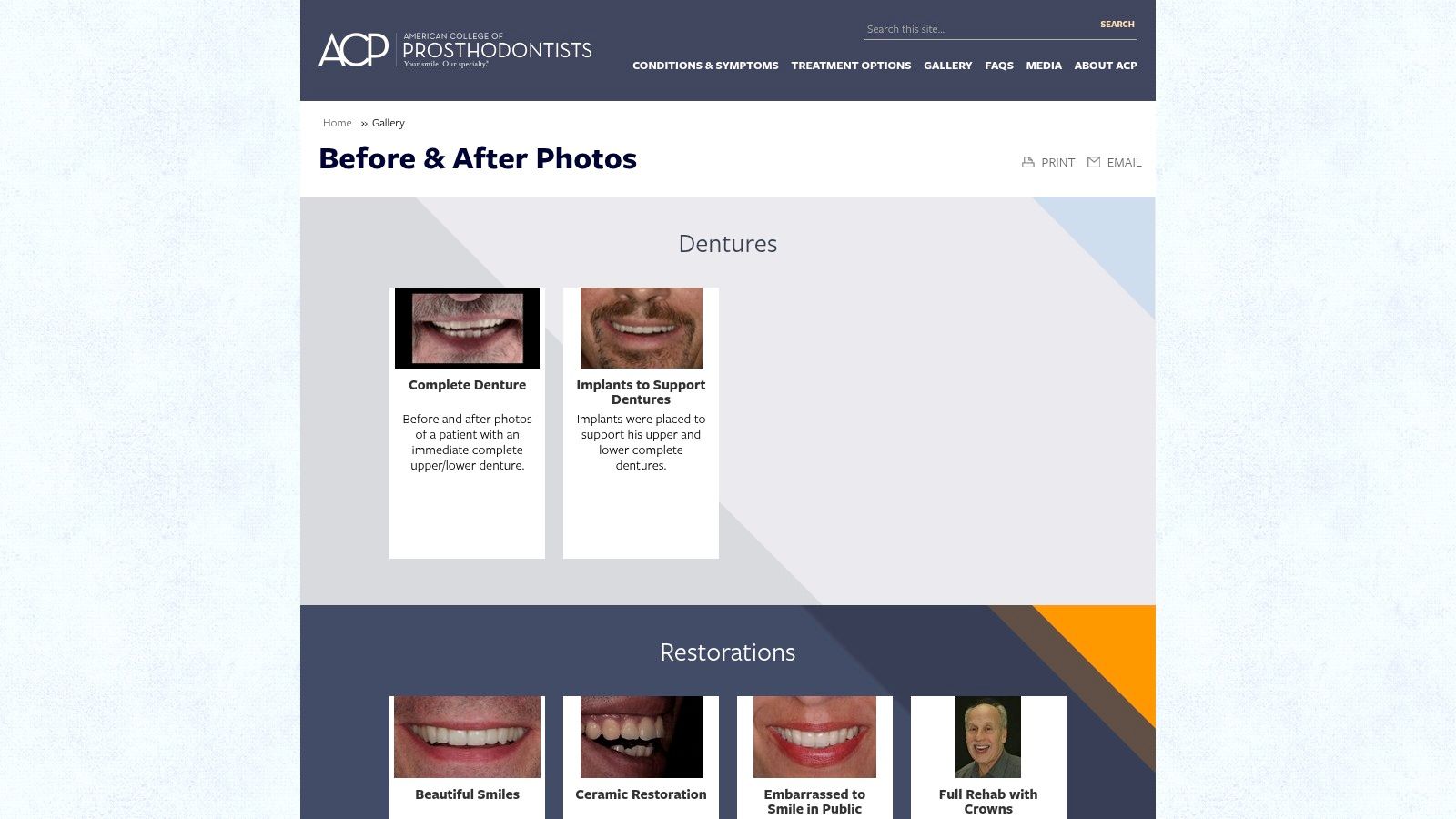
The American College of Prosthodontists gallery works best as a specialty-level reference, rather than as a direct booking site. Its cases include complete dentures, immediate dentures, and digitally designed prostheses, giving readers a way to study how prosthodontic treatment can address both appearance and function.
A specialty gallery may contain fewer examples than a large dental network, but its educational value is different. Look for the treatment description, the type of prosthesis, and the stated objective. A case involving a digitally designed restoration may have planning considerations that don't apply to a basic removable denture.
Separate visible results from invisible performance
Before-and-after images can show tooth arrangement, gingival display, facial support, and smile symmetry. They can't independently confirm retention, chewing efficiency, phonetics, tissue tolerance, or the patient's satisfaction. Those outcomes need clinical evaluation and patient-reported follow-up.
The distinction matters because a denture can photograph well while still requiring adjustments. Conversely, a patient may have an excellent functional result even if the photograph uses different lighting or a less flattering angle. For broader rehabilitation questions, full-mouth reconstruction planning can help explain why some cases involve more than replacing visible teeth.
Use the ACP gallery to compare design principles. Ask whether the teeth appear proportionate to the face, whether the gumline looks plausible, and whether the final image preserves the patient's individual character. A specialty benchmark should encourage realistic expectations, not encourage patients to select a smile from a menu.
5. Markowitz Dental of Washington, DC Complete Dentures Gallery
Markowitz Dental's complete denture gallery stands out because the cases include concise captions describing the problem, the clinical goal, and the proposed solution. That makes the page more valuable than a collection of attractive smiles with no explanation.
Read each caption before studying the after image. If a case describes a remake, esthetic refinement, fit issue, or phonetic concern, the photograph becomes easier to interpret. You can then ask whether the visible change reflects altered tooth position, improved lip support, a revised occlusal arrangement, or a different camera setup.
Caption quality changes the comparison
A useful caption should answer practical questions:
- Starting condition: What was missing, failing, uncomfortable, or visually unbalanced?
- Treatment objective: Was the clinician addressing fit, tooth display, facial support, phonetics, or appearance?
- Treatment stage: Does the after photo show insertion, refinement, or a later result?
- Limits of the image: Which outcomes remain impossible to judge from the photograph alone?
A private-practice gallery also gives you a consistent photographic style. Similar lighting and positioning can make comparisons easier, although no gallery removes the influence of anatomy or expression. A single practice's portfolio shouldn't be treated as a universal sample of what every patient will experience.
The strongest lesson here is that clinical captions protect readers from overinterpreting visual change. If you're searching for a denture provider, ask whether your consultation will include the same level of explanation. You should understand why a specific tooth arrangement, base design, material, or adjustment plan suits your mouth, not merely whether the final smile looks appealing.
6. Stellar Dental Full Dentures Gallery
Stellar Dental's YourClassicSmile gallery focuses on complete-arch denture cases, making it useful for comparing tooth shapes, smile lines, gingival display, and lip support across different patients. The photos are clinical rather than purely studio-styled, so readers may see how results appear in ordinary treatment documentation.
Start with the face, not the teeth. Check whether the upper lip appears more supported, whether the lower third of the face looks balanced, and whether the tooth display suits the patient's age and facial proportions. These observations can suggest the design intention, but they don't prove how the denture performs during eating or speaking.
What a complete-arch gallery can teach
The page helps demonstrate that complete dentures don't have one universal appearance. Tooth width, length, shade, arrangement, gum contour, and smile line can all be selected to fit the patient. A natural-looking result may include slight variation rather than a perfectly uniform row of teeth.
The gallery doesn't publish a universal fee, and a visual example can't provide a reliable estimate for your case. The cost and treatment pathway depend on the examination, required extractions or tissue care, denture type, laboratory work, and possible implant planning. A consultation at a practice with broader restorative services, such as Paul Gregory's smile gallery, can help connect visual preferences with a clinically appropriate plan.
When comparing this gallery with others, look for consistency. Are the before and after images taken from similar angles? Is the patient smiling in both? Does the after image show the same facial expression? If not, treat the visual difference cautiously. The gallery is a useful design reference, but it can't replace an assessment of the supporting tissues, bite, and denture stability.
7. Cranford Dental Dentures and Partials Gallery
Cranford Dental's gallery is particularly helpful for understanding the difference between an immediate denture, a conventional denture, and a partial restoration. Its staged cases may show pre-extraction images, same-day immediate dentures, and later healed outcomes, giving readers a more realistic view of transition.
An immediate denture is designed for use around the extraction period, so the early image isn't necessarily the final appearance. Tissues can change during healing, and the appliance may need adjustment, relining, or replacement with a definitive denture. A day-one photograph should therefore answer, “How does this patient leave treatment?” rather than, “What will the final result look like forever?”
Read the stages in order
Cranford's mix of complete and partial cases also helps patients compare conservative treatment with full-arch replacement. A partial denture may preserve remaining teeth and replace selected spaces, while a complete denture replaces an entire arch. The visible difference may be subtle in a smile photo, but the planning, support, hygiene, and maintenance questions are different.
Photography varies between cases, particularly in lighting and angle. That makes the gallery valuable for understanding process, but less reliable for ranking one result against another. Focus on whether the captions identify the stage and treatment type.
A same-day result and a healed result answer different clinical questions. Don't compare them as though they represent the same point in treatment.
Bring examples from this gallery to a consultation and ask what would happen between each stage. Patients with complete tooth loss should also understand the broader context. The World Health Organization's edentulism data identifies complete tooth loss as a major global health issue, with the burden increasing among older adults. That context reinforces why treatment planning should address comfort, function, oral tissues, and long-term maintenance, not only the smile shown in a photograph.
Before & After Dentures Photo Comparison, Top 7 Providers
| Provider / Gallery | Complexity 🔄 | Resource requirements ⚡ | Expected outcomes 📊⭐ | Ideal use cases 💡 | Key advantages ⭐ |
|---|---|---|---|---|---|
| Dentures Manhattan NYC – Dr. Paul Gregory, DDS | Moderate–High, consultation, digital scans, staged fabrication, optional implants | High, digital imaging, lab fabrication, possible implant surgery; higher out-of-pocket cost | Predictable, esthetic fits with improved stability when implant‑retained (4/5) | Patients wanting tailored, implant‑ready solutions and Midtown convenience | Digital workflow, experienced clinician, expedited/urgent options |
| Aspen Dental | Low–Moderate, standardized DSO protocols across many offices | Moderate, nationwide clinics and educational assets; pricing varies locally | Large sample of outcomes; quality varies by office (3.5/5) | Those seeking many before/after examples and broad geographic access | Broad case gallery, patient stories, nationwide availability |
| Affordable Dentures & Implants | Low–Moderate, denture-focused, immediate and snap‑in workflows | Moderate, network clinics, many with on-site labs for faster turnaround | Functional, budget-tiered outcomes; variability by clinic (3.5/5) | Budget-minded patients comparing immediate or implant‑retained options | High case volume, on-site labs, practical success stories |
| American College of Prosthodontists (ACP) | Moderate, specialty‑curated cases including CAD/CAM examples | Low for browsing, educational resource; clinical care requires external referral | Specialty-level esthetics and function; fewer but high-quality examples (4/5) | Patients wanting specialist benchmarks and realistic expectations | Specialist‑curated gallery, educational emphasis, non-commercial reference |
| Markowitz Dental (DC Smile Center) | Moderate, private practice workflows with focused case notes | Moderate, single-office resources; travel may be needed | Clear clinical improvements explained in captions; cosmetic focus (4/5) | Those who want clinical rationale and concise problem/solution summaries | Case captions that clarify decisions, strong clinical photography |
| Stellar Dental (YourClassicSmile), Full Dentures | Low–Moderate, general/restorative complete‑arch workflows | Moderate, private-practice resources; consult required for pricing | Realistic complete‑denture esthetics and fit examples (3.5/5) | Comparing tooth shapes, smile lines, and lip support across cases | Variety of complete‑denture cases, realistic clinical photos |
| Cranford Dental, Dentures & Partials | Moderate, includes immediate same‑day and staged approaches | Moderate, practice-based labs/photography; smaller gallery size | Multi-stage visibility shows day‑one vs healed outcomes (3.5/5) | Patients evaluating immediate‑denture transitions or conservative partials | Step-style photos, clear day‑one vs healed comparisons |
Turn Photos Into Better Questions
The best way to use before and after dentures photos is to turn each image into a short clinical conversation. Start by identifying the restoration: partial, complete, immediate, conventional, or implant-retained. If the gallery doesn't state the category clearly, don't assume that a stable-looking smile came from a standard removable denture.
Next, check the photographic stage. Does the after image show delivery day, an early adjustment, or a healed and refined result? A longitudinal service evaluation measured denture satisfaction before provision, immediately after delivery, and later during the early wear period, supporting the idea that denture outcomes should be followed over time rather than judged from an insertion-day photograph alone (denture satisfaction evaluation).
Use the image to assess visible targets, not invisible guarantees. You can examine tooth display, lip support, gumline, facial balance, and proportion. You can't confirm retention, chewing comfort, speech, tissue health, or durability from a side-by-side image. A clinical study of edentulous older adults found measurable external facial changes after complete denture placement, including differences across facial scan surfaces and changes around the mouth and facial profile (facial scan study). That evidence supports careful documentation, while also showing why facial change shouldn't be reduced to a cosmetic smile comparison.
Ask these questions before choosing a treatment:
- Treatment type: Is the example comparable to the restoration being proposed for you?
- Photographic timing: Was the image taken immediately, after healing, or after several adjustments?
- Functional goal: Does the plan address chewing, speech, facial support, stability, appearance, or all of these?
- Caption quality: Does the provider explain the problem, treatment, stage, and limitations?
- Photo consistency: Are lighting, angle, expression, and patient positioning reasonably similar?
- Treatment complexity: Does the case involve extractions, implants, grafting, or broader reconstruction?
- Follow-up care: Who handles pressure spots, relines, repairs, maintenance, and future replacement?
- Total fees: Which examinations, imaging, laboratory stages, adjustments, and restorations are included?
Patient expectations matter, too. One clinical study reported that post-treatment esthetic satisfaction exceeded patients' expectations after complete denture delivery, without a difference by sex or age (complete denture esthetic satisfaction study). That finding supports discussing your goals openly, but it doesn't make any gallery image a guarantee.
Save two or three examples that resemble your starting condition and bring them to your consultation. Ask the dentist to identify which features are realistic for your anatomy and which depend on treatment choices that may not apply to you. Paul L. Gregory, DDS can help patients in Midtown Manhattan evaluate denture options with digital diagnostics, individualized planning, staged try-ins, and follow-up care.
Paul L. Gregory, DDS offers complete and partial dentures, implant-supported treatment planning, digital scanning, high-resolution imaging, and coordinated restorative care in Midtown Manhattan. Bring your saved before and after dentures photos to discuss realistic goals, treatment stages, candidacy, follow-up, and fees. Visit Paul L. Gregory, DDS to request a personalized evaluation.