

You bit down, felt that sharp little crack, and now you're sitting there with a mouth that suddenly feels fragile. Maybe it was a pretzel in Midtown, a seed in a salad, or a weekend bite into something hard, but the feeling is the same, panic first, then a hundred questions. Broken tooth what to do starts with one simple rule, don't try to be your own dentist for the next hour.
A broken or cracked tooth is a time-sensitive dental problem because the right move now can change what's possible later. The NHS advises saving the fragment in milk or saliva and getting to a dentist as soon as possible during working hours, while Cleveland Clinic recommends symptom control with ice packs, salt-water rinses, and NSAIDs before the visit, and practice-based data show that prompt evaluation can preserve teeth that would otherwise worsen. If you're in Manhattan and need a quick way to get guidance before you decide whether to come in, a teledentistry consult can help you sort the next step without wasting time on guesswork. Teledentistry options
When a Tooth Breaks in the Middle of a Busy Day
It usually happens at the worst possible time. A Midtown professional bites into lunch, feels a crack, and keeps chewing because there's a meeting in ten minutes. A parent hears the click of a tooth breaking at a birthday party and smiles through it. A tourist near Central Park South notices a jagged edge and hopes it's just a chip.
That first instinct to ignore it is common, and it's the wrong one. So is rinsing hard and repeatedly, as if force will “clean it out.” So is opening ten browser tabs and trying to self-diagnose a fracture from a photo in bad lighting. The better move is simple, stabilize the mouth, protect the tooth, and get professional eyes on it quickly.
Practical rule: the next 30 minutes matter more than the next 30 hours.
You don't need to decide whether it's “bad enough” on your own. You need to keep the piece, reduce irritation, and avoid making a small break worse. That's the mindset I'd want if you called my office from a cab on the way uptown. If the tooth is clearly broken, act like it matters now, because it does.
The rest of the plan is straightforward. Control the symptoms, save whatever broke off, and get a dentist to look at the tooth before you chew on it again. If the break is small, fine, you've still earned the right response. If the break is deeper than it looks, you've bought yourself time.
Your First 30 Minutes After the Break
Start with a gentle rinse. Warm salt water is the simplest choice, and it helps clear blood and debris without roughing up the area. Use it like a rinse, not a forceful swish, then spit softly.
A cold compress comes next. Hold it against the cheek in 15-minute intervals, because the point is to calm swelling and blunt the pain response, not to freeze your face. If you have a headache or jaw soreness too, the cold helps there as well.
For pain, use an over-the-counter NSAID if you normally can take one safely. Cleveland Clinic recommends NSAIDs for short-term symptom control before the dental visit, and that makes sense because inflammation is part of what hurts. Don't put aspirin directly on the gum, and don't try home repairs with glue, nail products, or anything else that belongs in a hardware drawer, not a mouth.
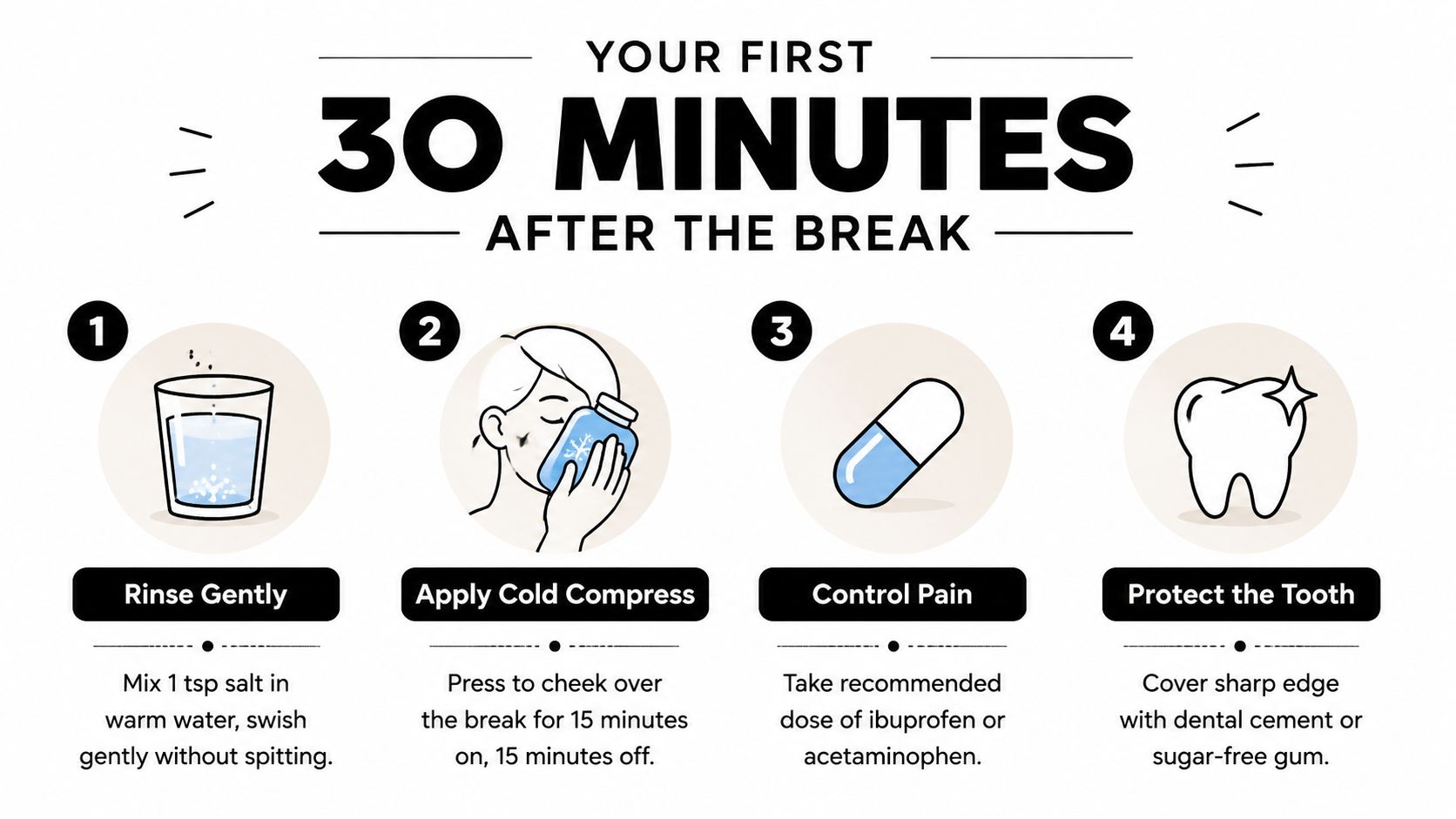
Keep your hands off the fracture line. Don't chew on that side, don't probe it with a fingernail, and don't keep testing it with your tongue every thirty seconds. If the edge is sharp, cover it only with dental wax or sugar-free gum until you can be seen.
If there's active bleeding, use gauze with gentle pressure, not tissue that falls apart and sticks.
If you're deciding where to go after you've settled the pain, a dentist who handles urgent restorations can tell you whether the tooth needs same-day protection or just a quick stabilization visit. Cavity filling options are part of that conversation when the break has exposed weakened or decayed structure.
Saving and Transporting the Broken Piece
The fragment matters. In some cases, a dentist can reattach it if you save it properly, and the handling mistake that ruins the chance is simple, don't scrub it. Touch it only by the biting surface, never by the root side or the rough broken edge.
The best storage options are milk or saliva, because they help protect the surface until you get to the dentist. The NHS specifically advises milk or saliva, and that's the advice I'd follow, not a napkin, not a dry pocket, and not a sink full of tap water. If you're at a restaurant in Midtown and the piece lands on the tablecloth, ask for a clean cup immediately and place it in milk if you can get it.
Quick checklist for the fragment
- Find it fast: Check the plate, your lap, and the floor before it gets thrown away.
- Pick it up by the crown: Hold the visible chewing surface, not the root area.
- Rinse lightly if needed: Use gentle water only if there's visible debris, then stop.
- Store it correctly: Put it in milk or saliva until you leave.
- Bring it with you: Tell the office exactly when the break happened.
If the piece was swallowed, don't panic. That's not ideal, but it changes the priority from reattachment to evaluating the tooth that remains. If the piece was tossed with a napkin, move on, bring the tooth in anyway, because the visible fracture still tells the dentist plenty.
A broken fragment is not the same as a fully knocked-out permanent tooth. For a tooth that's completely out, WebMD's emergency guidance is different, rinse the mouth, gently reinsert the tooth into the socket if possible, and hold it in place with gauze while seeking immediate care, touching only the crown and not the root. That's a separate emergency sequence, and the timing is critical.
Reading Symptoms Without Panic
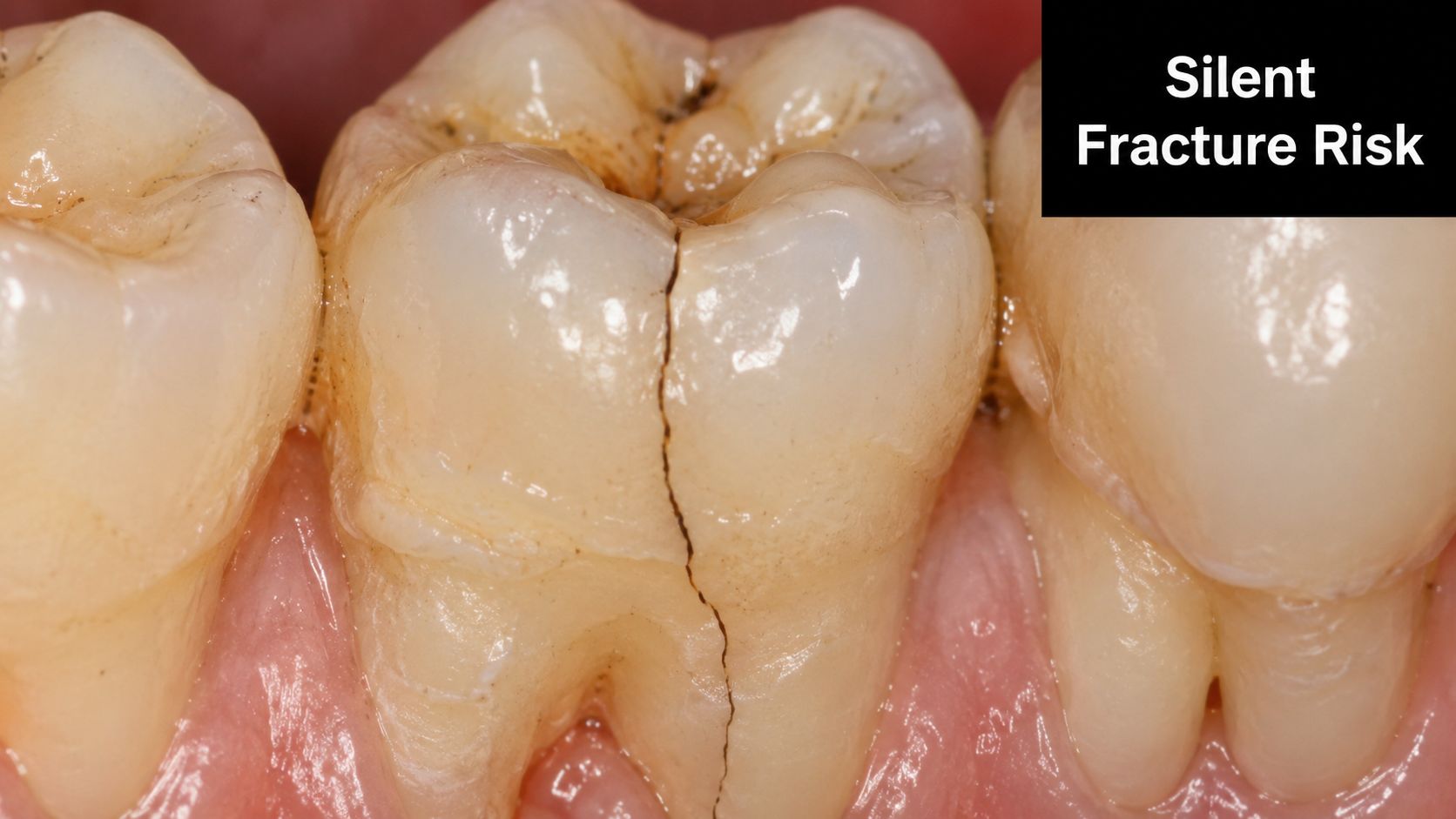
A painless chip can still be a problem. That's the part people miss, and it's why “if it doesn't hurt, I'll wait” is a bad rule. Cleveland Clinic notes that cracks reaching the pulp can lead to infection and may require a root canal or extraction, while StatPearls explains that some fractures are only detected with imaging or dental testing.
The question isn't, “Does it hurt right now?” It's, “What does this break pattern suggest underneath?” A rough edge that only catches your tongue can be minor. Sharp pain when you bite and then release pressure points more toward a deeper crack. Lingering sensitivity to cold or heat is more suspicious than a quick sting.
Visible darkening near the gumline deserves attention too, because that can signal a deeper structural problem rather than a cosmetic chip. The same goes for a tooth that feels slightly “off” when you close, even if the pain is mild. Teeth don't always announce the serious stuff loudly.
Use this at-home read
- Rough edge only: likely a smaller chip, still worth checking.
- Pain on biting release: more concerning for a crack through enamel or dentin.
- Lingering temperature sensitivity: the nerve may be irritated.
- Visible dark line or gumline change: don't sit on it.
Busy adults tend to bookmark dental problems for later. That works for a loose retainer. It's a poor plan for a fracture, because the tooth can keep splitting before it starts to hurt.
What Happens at the Emergency Visit
The first part is a focused exam. The dentist checks mobility, bite alignment, the gums around the tooth, and whether the break looks like a simple chip or something deeper. That exam often tells a lot before any machine comes into play.
Next comes imaging. Digital X-rays or intraoral imaging help show how far the fracture runs and whether the root or surrounding bone is involved. If the tooth is cracked in a way that isn't obvious in the mouth, testing can reveal it. That's why “it looks fine to me” isn't a diagnosis.
The office may also use bite tests, cold testing, or transillumination, which means shining light through the tooth to look for fracture lines. These checks help separate a stable chip from a split that needs more serious treatment. In a modern Manhattan practice, this is usually efficient, and the patient doesn't need to brace for a long ordeal.
If you want urgent care from a Midtown office that handles short-notice stabilization and broader restorative planning under one roof, emergency dental care is the right service to ask for when you call. Bring the fragment if you saved it, and tell the front desk whether the tooth hurts on biting, on cold, or not at all. Those details help the dentist triage faster.
The honest expectation is this, the first visit often focuses on diagnosis and stabilization. Definitive treatment may happen that day, or it may be scheduled once the tooth is quiet and the plan is clear.
Matching the Break to the Right Fix
The fix depends on how much tooth is left and whether the nerve is involved. A tiny cosmetic chip is a different animal from a fracture that reaches the pulp or runs below the gumline. That's why treatment is chosen by structure, not by guesswork.
| Broken Tooth Treatment Options at a Glance | |||
|---|---|---|---|
| Fracture Type | Typical Symptoms | Likely Treatment | Timeframe |
| Small chip | Rough edge, little to no pain | Bonding or reshaping | Same day or soon after |
| Larger break | Sensitivity, visible loss of structure | Composite or porcelain restoration, sometimes a crown | Prompt visit |
| Deep crack | Pain on biting, lingering sensitivity | Root canal plus crown if the pulp is involved | Urgent treatment |
| Fracture below the gumline | Ongoing pain or non-restorable structure | Extraction, then implant or bridge planning | As soon as diagnosed |
A crown is often the right move when the tooth is structurally compromised, and a root canal enters the picture when the nerve is affected. In the right case, these treatments preserve the tooth instead of replacing it. Crowns and tooth restoration usually come up when enough natural tooth remains to support a full covering.
Here's the practical logic I use with patients. If there's solid tooth left and the fracture is contained, save it. If the nerve is exposed or threatened, treat the nerve. If the break goes too far under the gum, talk about replacement before the tooth fails completely.
A same-day fix isn't always the final fix, but it often protects the tooth while options are still open. Delay makes the repair smaller in scope and the problem larger in consequence.
Why the Same-Week Visit Is Worth It
A broken tooth is one of those problems that looks manageable until it starts changing under pressure. Get it checked the same week, because the first visit is where you find out whether you are dealing with a simple chip or a crack that runs deeper than it looks. The point is simple. A tooth can feel fine and still need fast treatment.
Early evaluation changes the odds. In practice-based data, posterior teeth with visible cracks had a survival rate above 98% over follow-up, and restoratively treated teeth had a 14% failure rate, which shows what good timing can preserve and what waiting can cost. That is not scare talk, it is the reason speed matters in real treatment decisions. NHS guidance on broken and cracked teeth
The broader cracked-tooth literature points the same way. Cracked teeth are a common adult dental issue, especially in the 30 to 50 age range, and published survival rates for treated teeth have ranged from 82% to 96%. One review also reported 80% success at 3 years for monitoring without restorative treatment versus 91.7% for root-canal-treated teeth under similar conditions, which is why a quick exam matters before a small crack turns into a full structural problem. Review of cracked-tooth literature
Pain is a bad guide on its own. A painless chip can still hide a deep fracture, while some teeth ache early and others stay quiet until the crack reaches the nerve. Read the signs, not just the pain level. Sharp pain on biting, sensitivity to cold, or a feeling that the tooth catches when you run your tongue over it all point to a tooth that needs prompt attention.
The money decision is straightforward too. A prompt visit usually preserves more choices than a late one. Once a fracture spreads, the conversation shifts from repair to extraction, implant planning, or more extensive rebuilding. If you want a clear sense of how long the next step may take, learn how long a root canal takes here: https://dentistmanhattannewyork.com/2026/08/how-long-does-a-root-canal-take/
If you are in Midtown, call for short-notice scheduling and say clearly that you have a broken tooth and want urgent evaluation. Bring the fragment in a small container of milk if you saved it, and ask about Wednesday or Friday special appointments if your schedule is tight. If the tooth is painless, do not use that as a reason to wait. Painless does not mean harmless.
Paul L. Gregory, DDS provides emergency assessment and stabilization for broken and chipped teeth in Midtown Manhattan, along with restorative treatment when the tooth can be saved. If you need a calm, direct plan for the next step, visit Paul L. Gregory, DDS and ask for prompt evaluation so the fracture gets handled before it grows into a bigger problem.