

You've finished the active treatment, the gums are calmer, and now the card in your hand says it's time to come back again. That next visit can feel a little confusing, especially if you were expecting a regular cleaning and instead heard a new term like periodontal maintenance. For many patients, this is the moment where the plan shifts from fixing a problem to keeping it from returning.
Dental periodontal maintenance is the long-term part of gum disease care, and it matters because periodontitis is common in adults. The ADA reports that roughly 42% of dentate U.S. adults age 30 and older have some form of periodontitis, with about 7.8% classified as severe in its 2025 adult non-surgical ongoing periodontal care measure, which defines appropriate ongoing care as at least two maintenance-type visits during the reporting year for adults 30+ with a history of periodontitis (ADA 2025 adult non-surgical ongoing periodontal care measure). That makes this part of care less like a bonus polish and more like a chronic-disease routine, similar to how someone with high blood pressure keeps following up after the initial diagnosis is treated.
What Happens After Active Gum Therapy
A patient might sit in the chair after scaling and root planing or gum surgery and ask, “So what now?” That question makes sense. The infection has been treated, the mouth feels different, and the recall card suddenly turns a big diagnosis into a date on the calendar.
The answer is ongoing periodontal maintenance, a long-term recall plan, not a one-time finish line. The focus shifts from fixing the problem to watching for the smallest signs that it is returning, then responding early before more tissue is affected. That matters because periodontal disease usually does not stay gone after a single round of treatment.
For a patient, the visit can seem straightforward on the surface. You return, the clinician checks the gums again, cleans the hard-to-reach areas, and compares what is happening now with what was found before. Underneath that routine, though, the appointment is tracking a condition over time, the way a mechanic keeps checking a car that has already needed major work.
That is why many practices build a long-term recall plan right after active therapy ends. The goal is not to keep repeating the same cleaning, it is to protect the teeth, the bone, and the gum attachment that were at risk in the first place. If you want to see the treatment phase that comes before this stage, the basics of periodontal therapy explain why the maintenance phase is a different kind of care.
Practical rule: if your gums needed deep treatment once, the success story is what happens after that.
The best way to think about this phase is as the maintenance loop that follows repair. You are no longer in emergency mode, but you are also not back to a routine cleaning for a mouth that has never had gum disease. The plan becomes more careful, more personal, and more focused on measuring whether the disease stays quiet.
Understanding Periodontal Maintenance
A patient may leave active gum therapy feeling like the hard part is over, then discover the next phase asks for a different kind of attention. Periodontal maintenance is the follow-up visit built for that stage. It is designed for people with a history of periodontitis, where the goal is to keep an eye on changes before they turn into more tissue loss.
A regular prophylaxis is meant for prevention in a mouth that has not already shown this pattern. Periodontal maintenance serves a different purpose. It is built for a mouth that has already developed pockets, inflammation, and bone loss, so the clinician looks below the gumline as part of the visit, not just at the visible tooth surfaces.
Periodontal maintenance works like a monitoring system rather than a one-time fix. The mouth gets checked again and again because gum disease can stay quiet for a while and still return if the support system stops. That is why many practices use a long-term recall plan after active therapy ends, so the teeth, the bone, and the gum attachment are watched in a way that matches the risk.
The visit also has a different purpose from a cosmetic polish. The clinician is checking how well the disease is controlled, not just making the teeth feel smooth. That usually means an updated health review, gum measurements, targeted cleaning, and a plan for the next recall interval. If you want to compare that with a standard hygiene appointment, the basics of teeth cleaning show why the two visits do not serve the same role.
| Visit Step | What the Clinician Does | Why It Matters |
|---|---|---|
| Update medical history | Reviews health changes and medications | Gum stability depends on the bigger health picture |
| Periodontal charting | Measures pockets and checks bleeding | Tracks whether disease is quiet or active |
| Targeted cleaning | Removes plaque and hardened buildup | Lowers bacteria where brushing can't reach |
| Home care review | Checks brushing, flossing, and tools | Daily habits affect long-term control |
| Treatment plan update | Decides on the next recall interval | Keeps care matched to current risk |
Practical rule: if the appointment is measuring gum disease, it's not just a cleaning.
That distinction helps patients ask better questions too. Instead of asking only how shiny the teeth look at the end, ask what changed in the pockets, whether bleeding improved, and whether your home care is matching the plan.
What Happens During a Maintenance Visit
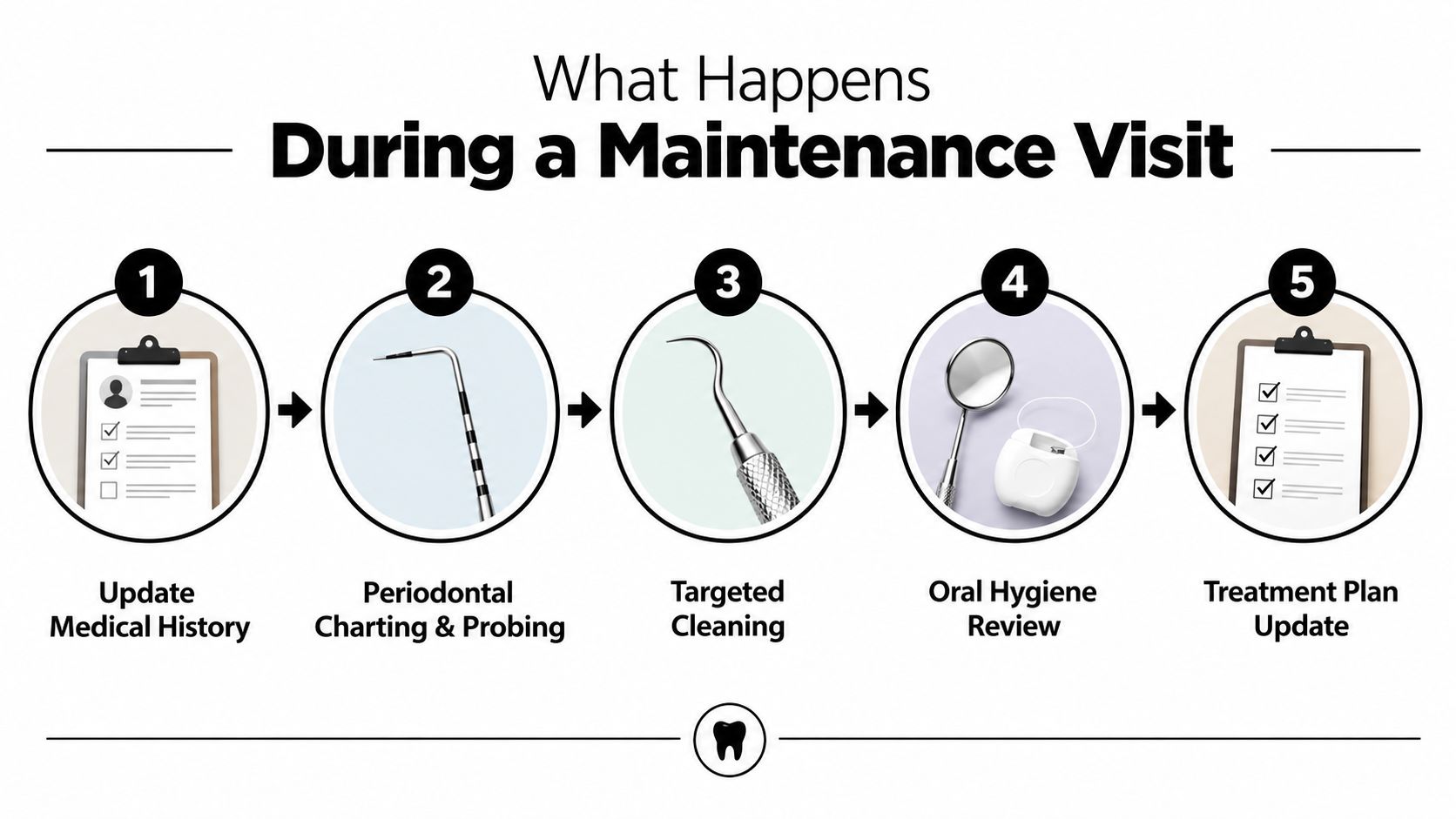
A maintenance visit usually begins with a quick check of what has changed since the last appointment. The hygienist or dentist updates your health history because medications, stress, smoking status, and general health can change how gum tissue responds. This is also the time to mention soreness, bleeding, loose teeth, bad taste, or any area that feels different from before.
Next comes periodontal charting, which sounds technical but works like a map of each tooth's support system. The clinician measures pocket depth and checks bleeding points, then compares those findings with earlier visits. Those measurements matter because gum disease often shifts slowly before pain shows up.
After that, the cleaning is more focused than a routine hygiene appointment. The clinician removes plaque and tartar from above and below the gumline, and may clean root surfaces where pockets are present. If the tissue looks irritated or a site needs more help, localized antimicrobial treatment or site-specific root debridement may be considered based on clinical judgment and the current exam.
If imaging is needed, it becomes part of the larger diagnostic picture. A dentist may use dental X-rays to check bone levels, spot hidden decay, or compare changes over time.
The visit then turns toward daily life. You should leave with clear guidance on where plaque is still collecting, which areas need more attention, and whether your current recall interval still makes sense. That keeps the appointment tied to measurable gum control, not just the feel of freshly cleaned teeth.
Helpful question to ask: “Which areas are stable, and which ones need extra attention at home?”
Here's a simple way to picture the flow of the appointment:
- Health review. The team checks for changes that affect gum stability.
- Gum measurements. Pocket depth and bleeding are recorded.
- Targeted debridement. The clinician cleans areas a regular cleaning can miss.
- Home-care coaching. You get specific feedback, not generic advice.
- Plan update. The recall schedule is adjusted if needed.
The visit is designed to keep measuring, cleaning, and adjusting before a small change turns into a bigger one.
How Often You Should Be Seen
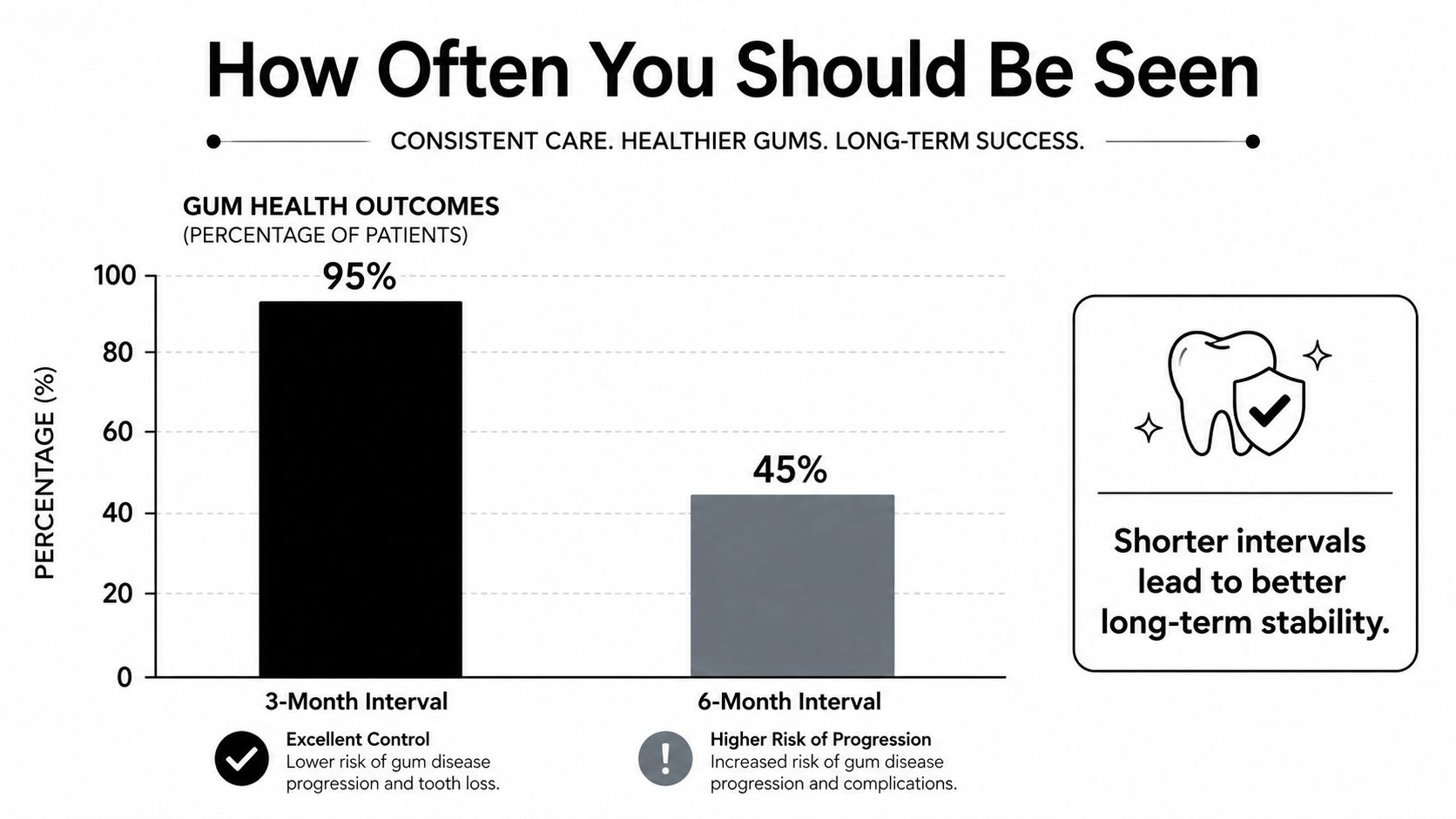
People often ask for one simple answer, like “Is every three months really necessary?” The honest answer is that the right interval depends on your history, but shorter recall has historically been linked with better stability. In one comparative study summarized in the periodontal literature, recurrence was 8% with 3-month maintenance, compared with 12% at 6 months and 20% at annual intervals (periodontal maintenance interval review).
The same body of literature also described a long-term pattern that patients can understand easily. People who returned for maintenance about every 5.5 months over 5 years averaged 0.12 teeth lost per year, while those coming about every 11.6 months lost 0.36 teeth per year, and intervals longer than 3 to 4 months were associated with being 5.6 times more likely to lose teeth (periodontal maintenance interval review). Those numbers don't mean every patient needs the same clock, but they do show why stretching recall too far can weaken the progress gained from treatment.
That's why many clinicians think in a realistic range rather than a single rule. Healthy mouths often live on a six-month preventive schedule, but periodontal maintenance usually tightens that pace because the goal is to catch recurrence early, not after obvious damage has returned. The British Society of Periodontology guidance summarized in the literature notes that stable patients in maintenance usually need recall intervals from 3 to 9 months, with detailed charting annually (periodontal maintenance interval review).
The practical takeaway is simple. If your gums are stable, your home care is strong, and your risk is low, the schedule may be less frequent. If there's bleeding, deep pockets, smoking, diabetes concerns, or previous recurrence, the interval usually gets shorter.
Why Maintenance Is Not a One-Size-Fits-All Schedule
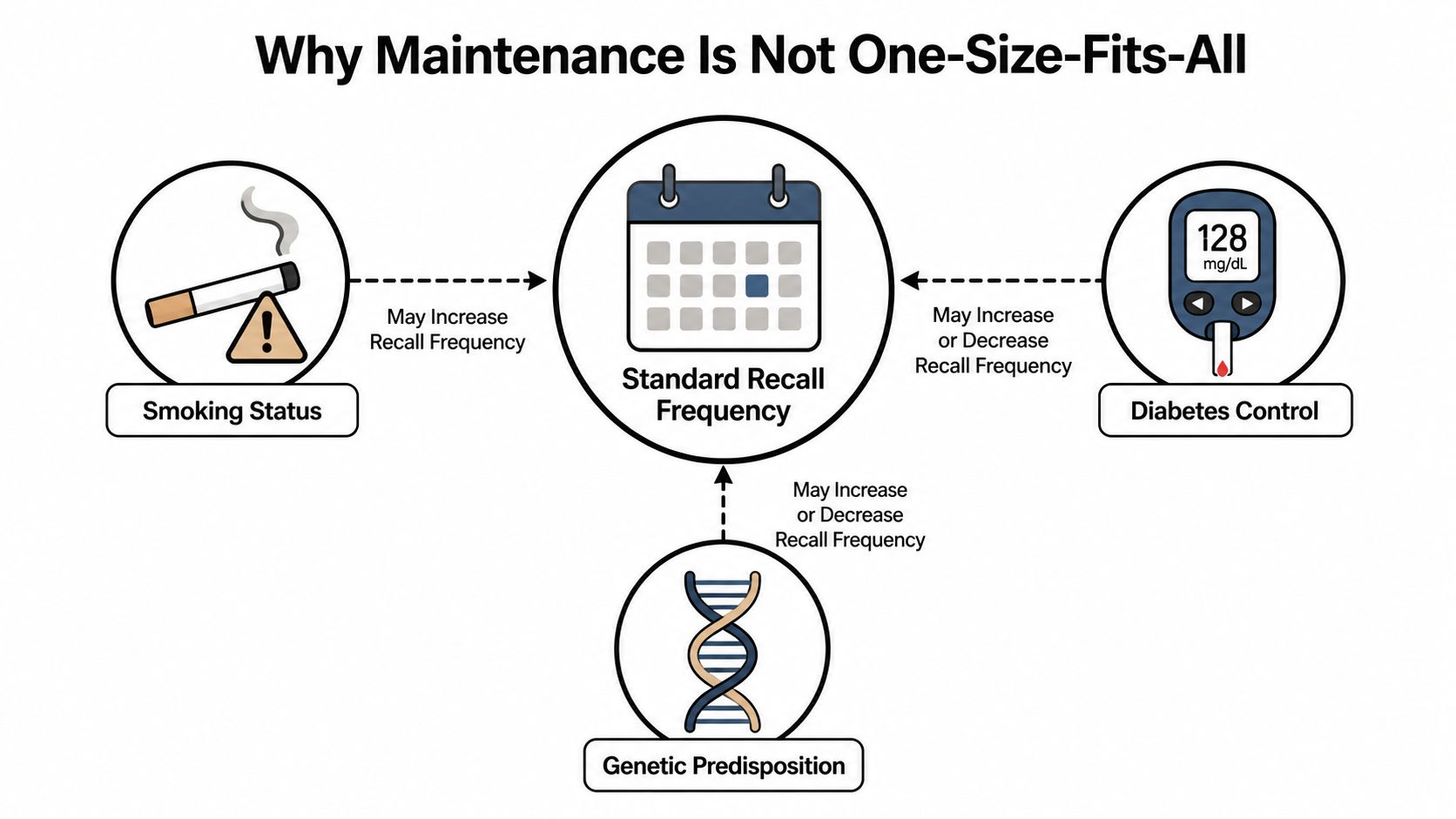
A 3-month cleaning may sound neat on paper, but periodontal care does not work that way in real life. Some patients keep plaque under control and stay stable for long stretches. Others have deeper pocketing, ongoing inflammation, implants, or habits that make disease return more easily.
A risk-based plan looks at the whole picture. Smoking, diabetes control, the quality of daily home care, how severe the original disease was, and whether implants are present all affect how closely the mouth needs to be watched. The maintenance interval is a prevention plan, not a fixed calendar rule.
Implants need their own kind of follow-up because the tissue around them behaves differently from natural teeth. For a clearer explanation of how implant healing and recall fit into oral care, see the dental implants healing process overview. It helps show why the same schedule does not always fit every mouth.
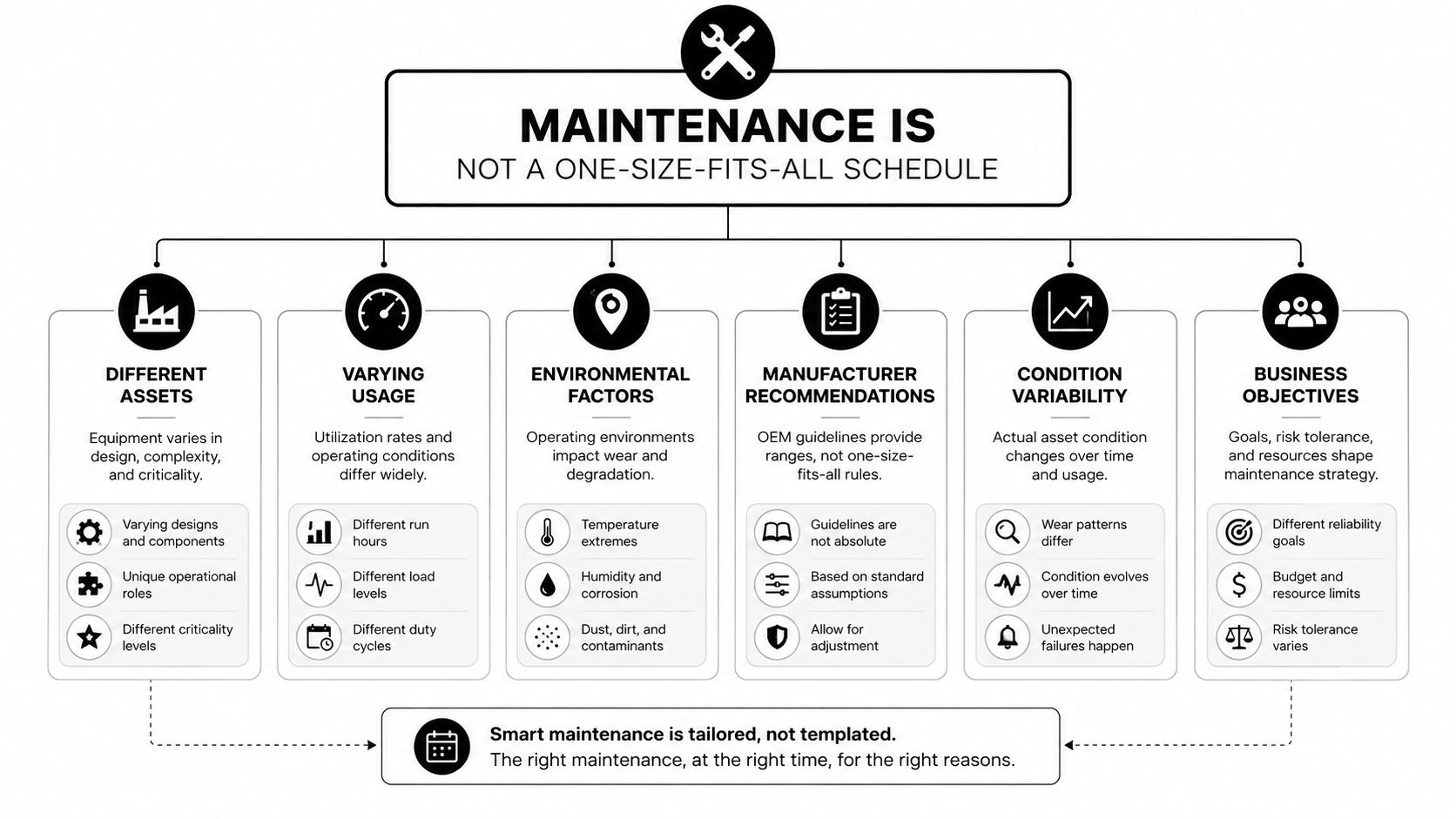
Home care matters just as much as the visit interval. A patient who brushes thoroughly, flosses reliably, and shows little bleeding may not need the same cadence as someone who struggles to keep plaque off the back teeth. The clinician is balancing your biology, your habits, and the history of the disease.
Simple rule: the schedule should match the risk, not the other way around.
That is also why the interval can change over time. A person may start with closer follow-up, then move to longer spacing once the gums stay stable. Someone else may need shorter spacing if inflammation returns or if implant tissues need closer monitoring, as noted earlier in the interval review.
Costs, Coverage, and Keeping Appointments
Recurring care means recurring cost, and that's where many patients fall behind. A 2025 study of patients at federally qualified health centers found that 86.21% reported lack of financial resources and lack of insurance coverage as major reasons for discontinuing periodontal maintenance care, while 76.86% cited substance use and education disparities as additional barriers (2025 FQHC periodontal maintenance barriers study). The numbers are specific, but the underlying issue is familiar to a lot of people. Even insured patients can hit friction from deductibles, timing, and unclear benefits.
That's why it helps to read your plan language before the visit gets postponed. Ask whether periodontal maintenance is covered differently from a routine cleaning, whether frequency limits apply, and whether documentation of periodontal history is needed for benefits processing. If the office can document medical necessity clearly, the claim is easier to understand and less likely to become a surprise later.
Scheduling friction is the other quiet barrier. Busy professionals often know the appointment matters, but they keep moving it because the calendar is packed and the mouth feels “fine.” The problem is that periodontal disease can stay quiet until the tissue has already changed, so waiting for symptoms is a bad test of whether care is still working.
A practical approach is to treat the recall like any other standing health commitment. Put it on the calendar before the day fills up, choose appointment times that fit your work pattern, and ask the office to tell you what has to happen if you need to reschedule. If you're comparing benefit language and out-of-pocket expectations, the insurance guide at stress-free smiles and dental insurance at our Manhattan office can help you ask more precise questions.
Practical rule: the best maintenance plan is the one you can actually keep.
That may sound obvious, but it's the difference between a plan that lives on paper and one that protects your gums year after year.
Common Questions About Ongoing Gum Care
A common question at this stage is simple: “Is this just a cleaning?” It helps to separate the two. A regular cleaning is designed for prevention in a generally healthy mouth, while periodontal maintenance follows treated gum disease and includes closer monitoring of the tissues that were already affected.
Patients also ask what happens if a visit is skipped or the interval gets stretched. One missed appointment does not erase all progress. The concern is that gum disease can change between visits, like a small leak that spreads before anyone notices the floor getting wet. By the time bleeding or looseness shows up, the disease may already be active again, so the recall plan is meant to catch change before it becomes obvious.
Implants can change the schedule too. They need their own follow-up because the surrounding tissues and the cleaning access are not the same as natural teeth, so the recall plan may need to reflect that difference instead of treating every tooth and every implant the same way.
If you still are not sure how to tell maintenance from a standard cleaning, ask one straightforward chairside question, “What are you measuring today, and what would make the schedule change?” A clear answer usually shows whether the visit is preventive polishing or disease-specific follow-up.
The most useful mindset is consistency. Gum disease is manageable when the routine is realistic, the home care is specific, and the recall is customized to the patient rather than copied from a generic schedule.
If you want a periodontal plan that feels practical instead of confusing, Paul L. Gregory, DDS provides periodontal therapy, supportive maintenance, and the kind of careful follow-up that helps patients stay ahead of recurrence. Visit Paul L. Gregory, DDS to ask about maintenance scheduling, gum health monitoring, and a recall plan that fits your needs in Midtown Manhattan.