

You just walked out of the dental chair with a thick lower lip, a folded aftercare sheet in your coat pocket, and a calendar full of afternoon meetings waiting back at your desk. The numbness feels manageable right now, so it's tempting to assume the hard part finished the moment the ultrasonic scaler clicked off.
In reality, the chair session only resets the clock. What happens during your scaling and root planing aftercare over the next six weeks, and the recall interval you commit to once the tissue tightens, decides whether those periodontal pockets stay shallow a year from now or gradually slip back into inflammation.
Most recovery sheets stop at lukewarm soup and salt water. Below is the clinical sequence I walk patients through: day-by-day healing milestones, real food and scheduling trade-offs, exact brushing technique, and the risk-based maintenance plan that keeps deep-cleaning results intact.
Why Healing Gums Need More Than a One-Time Deep Cleaning
A patient leaves the chair with smoother root surfaces, a numbed mouth, and a cleaning plan that can fail unnoticed if the next six weeks are treated like ordinary recovery. According to the American Academy of Periodontology guide to nonsurgical periodontal treatments, scaling and root planing (SRP) is a nonsurgical periodontal procedure that clears bacterial deposits and calculus below the gumline while smoothing contaminated root surfaces so inflamed tissue can heal against cleaner anatomy. That makes it a targeted first step against active gum disease, not an ordinary preventive visit.
The same guidance notes that while many patients don't require additional periodontal procedures immediately afterward, most need continuing maintenance therapy to preserve their health. That matters because gum disease is chronic in behavior. A deep cleaning reduces the bacterial load and removes theCalculus that home brushing cannot reach, but it does not change the patient's susceptibility, anatomy, or daily plaque control.
The payoff shows up most clearly over a full year. In a 2024 randomized study published in the Journal of Periodontology and reported by Medical Dialogues, patients who received conventional scaling and root planing alongside supportive periodontal care every six months saw their mean bleeding-on-probing percentage decline from 14.7% to 7.9% after one year. That result is the practical argument for pairing treatment with a recall plan. Instrumentation can create the conditions for healing, and maintenance is what keeps the result from drifting back toward inflammation.
Why Recovery Unfolds in Weeks Rather Than Days
Gum healing happens in stages. Surface soreness often settles during the first week as swollen tissue deflates and hugs the smoothed root more tightly. Deeper changes take longer. Measurable reductions in pocket depth and bleeding depend on tissue maturing around the cleaned root surface, and that process cannot be judged accurately on day two.
Biofilm also begins organizing again quickly. The first weeks of brushing, interdental cleaning, eating choices, and medication use carry real clinical weight. I treat the chair session as the reset point, and the home-care period as the part that determines whether the pocket stays shallow.
Clinical reality: Deep cleaning removes the irritant, but it never resets your underlying susceptibility to gum disease. Smoking, poorly controlled diabetes, and tight molar furcations keep pushing inflammation back even in a thoroughly treated mouth.
The Four Levers You Actually Control
After treatment at a periodontal dentist in Manhattan, four day-to-day choices drive how cleanly your gums reattach:
- Comfort and tenderness management: Protecting fresh tissue from trauma during the first few days while keeping discomfort predictable enough that you don't abandon home care.
- Food and drink choices: Fueling yourself without jabbing tender gum margins, wedging seeds into healing pockets, or scalding numb tissue.
- Daily plaque removal: Brushing gently at the gumline and cleaning between teeth every day, even when a spot still looks slightly pink.
- Re-evaluation and recall timing: Showing up for the measurement visit that confirms which pockets closed and sets your true maintenance cadence.
Mild aching, brief cold sensitivity, and light bleeding on your toothbrush are normal signs that swollen tissue is settling down, not evidence that the procedure went wrong. The trade-off is simple. You can be cautious with tender tissue and still keep the mouth clean, or you can avoid brushing out of fear and give plaque the opening it needs to recolonize the pocket.
Your Aftercare Timeline From Day One to Week Six
Knowing which phase you're in takes the guesswork out of recovery. Use the timeline below to match what you're feeling right now against what your gums need.
| Timeframe | What you may notice | What to do |
|---|---|---|
| Day 1 | Numbness for roughly 2-4 hours, pink-tinged saliva, no pain while anesthetic holds | No chewing until numbness clears, no vigorous rinsing or spitting, skip intense exercise, take your usual analgesic before the anesthetic fades |
| Days 2-3 | Peak tenderness, light bleeding when brushing, slight puffiness | Warm salt water rinses from 24 hours, 4-6 times a day; soft food; gentle brushing with a soft brush |
| Days 4-7 | Bleeding largely stops, cold sensitivity appears | Keep brushing and cleaning between teeth; cool drinks; hold crunchy and seeded foods |
| Week 2 | Tenderness mostly gone, tissue looks less red | Finish the chlorhexidine course if prescribed; do not self-start antibiotics |
| Weeks 3-4 | Gums look pinker and firmer, less bleeding on brushing | Stay with twice-daily brushing and daily interdental cleaning |
| Weeks 4-6 | Occasional sensitivity, a few sites still bleed | Write down the sites that bleed or feel tender for the re-evaluation |
What Changes Under the Gumline Each Week
Day 1 is mostly about letting local anesthetic wear off without accidental trauma. Biting a numb cheek or sipping scalding coffee creates far more soreness than the root planing itself. Skip forceful swishing, spitting, or poking treated pockets with your tongue so delicate clots along the root surface stay undisturbed. Taking your usual clinician-approved over-the-counter analgesic, such as acetaminophen or ibuprofen if safe for your medical history, before full sensation returns keeps the evening dull rather than sharp.
Days 2 and 3 usually bring the peak bruised feeling because tissue swelling peaks after the anesthetic fades. A review of nonsurgical periodontal aftercare protocols indexed on PubMed Central (PMC4949770) highlights transient tenderness, gradual bleeding reduction, and temperature sensitivity across the first 24 to 48 hours, paired with gentle soft-bristle brushing, directed interdental cleaning, and strict tobacco avoidance. Starting gentle warm salt water rinses roughly a day after treatment, mixing about half a teaspoon of table salt into a glass of warm water four to six times daily, calms surface tissue without stinging.
Days 4 through 7 mark the handoff from gum soreness to tooth sensitivity. As puffiness drops away from newly smoothed roots, microscopic dentin tubules briefly meet cool air and water. Keep brushing and cleaning between teeth anyway; avoiding a sensitive spot lets sticky plaque rebuild fast.
Week 2 is where prescribed antimicrobials finish their run. That same clinical protocol review notes that chlorhexidine is the most frequently studied post-SRP antiseptic and is commonly used for approximately 2 weeks, strictly under clinician direction because brown tooth staining and altered taste are real trade-offs. Never self-start leftover oral antibiotics for routine soreness. When isolated deep pockets need targeted antimicrobial help, clinicians place localized medication such as ARESTIN periodontal therapy directly inside the pocket rather than dosing your whole body.
Weeks 3 through 6 show visible tissue remodeling. Gums shift from glossy dark red toward paler, firmer pink, and slight gaps between teeth can appear as swollen tissue deflates to its true attachment level. Between weeks four and six, jot down any specific molar or gum edge that still bleeds or aches so your clinician can examine it directly at re-evaluation.
The Day-One Work and Evening Call
Post-treatment soreness doesn't follow one universal clock. It can pass within hours for one patient and linger for several days for another, depending on pocket depth, anesthesia, and whether tobacco or blood thinners are in the picture. I'd keep day one deliberately light rather than booking a high-stakes client presentation right after leaving the chair, whether your morning starts at a Midtown desk or your evening ends at a Theatre District show.
What to Eat and Drink While Your Gums Settle
You don't need a liquid diet after a deep cleaning, just a short-term filter that protects fragile gum margins from sharp edges, trapped seeds, and extreme heat. Screenshot this table before you head home so meal decisions stay effortless all week.
| Food or drink | What to choose | When |
|---|---|---|
| Cold proteins | Greek yogurt, cottage cheese, eggs, soft fish, seedless protein shakes | Day 1, once numbness clears |
| Cooked vegetables | Steamed carrots, mashed potato, soft squash | Days 1-7, served warm not hot |
| Grains | Pasta, rice, oatmeal, soft bread without crust | Days 1-7 |
| Soft fruit | Banana, soft melon, applesauce | Days 1-7; skip berries and seeded fruit for about a week |
| Soup | Blended vegetable or chicken soup | Lukewarm for the first 48 hours |
| Crunchy and seeded foods | Skip chips, nuts, seeded crackers and crusty bread | Hold for about a week so nothing lodges in healing pockets |
| Spicy and acidic foods | Judge by sensitivity, usually fine within a few days | After day 3 for most patients |
| Coffee and tea | Cool to warm, no very hot drinks | After 48 hours for hot; iced is fine sooner |
| Alcohol | Skip it, especially alongside prescribed analgesics | First few days |
| Carbonated drinks | Limit them | First week, because of acidity and temperature |
Three Rules That Govern Every Row
First, eat nothing at all until numbness disappears completely. Even a soft sandwich can turn into a painful cheek bite when your lip and tongue can't feel pressure.
Second, if only one side of your mouth was treated, chew exclusively on the untreated side until the treated quadrant feels normal again. Splitting meals into smaller, more frequent portions also reduces jaw fatigue after sitting open in the chair.
Third, make plain, room-temperature water your default drink. Hydration keeps saliva flowing, rinses away loose food film between meals, and avoids the acidity and sting of seltzer or citrus. If you want an easy way to stay consistent while skipping your usual hot coffee or afternoon soda, checking your daily water intake targets through Calorie Genie AI can help you keep fluid levels steady during recovery.
Cold sensitivity that sticks around for days or even a few weeks is normal exposed-root physics. It isn't a reason to skip meals or immediately switch through half a pharmacy aisle of toothpastes.
Navigating a Next-Day Client Lunch
Say you have a business lunch booked the afternoon after a right-side deep cleaning. Scan the menu for a lukewarm blended soup, soft flaky fish such as poached salmon or cod, and mashed potatoes, paired with still water. Pass on the sourdough bread basket, hold the chili oil, and skip the hot espresso at the end so you walk back to the office comfortable instead of nursing a throbbing gumline.
Managing Activity, Work and Treating One Side
Smart recovery starts on your calendar before the hygienist even picks up a curette. Instead of hoping soreness bends around your week, structure your work, workouts, and travel around how healing tissue behaves.
Scheduling Around Meetings, Flights and Workouts
- Protect your first two days from high-demand obligations: Book treatment on a lighter calendar day rather than the morning of a client pitch, and avoid scheduling a long flight or a full-day conference right after the procedure when talking for hours or eating plane meals adds unnecessary irritation.
- Pause intense workouts on day one: Heavy lifting, spin classes, and hard runs raise blood pressure and can restart oozing along freshly instrumented pockets. Ease back into moderate exercise once numbness clears and tenderness drops; if a workout makes throbbing or bleeding flare up, stop and call the office.
- Use late-day appointments to your advantage: If your workday is packed, grabbing a late-afternoon slot lets you head straight home, sleep off the early soreness, and start the next morning noticeably more comfortable.
One-Sided Treatment and Travel Prep
Treating one quadrant or one side per visit is often far more practical than numbing your entire mouth in a single sitting. You keep a comfortable chewing side all week and can talk normally sooner. Ask your dentist whether staging the remaining quadrants makes sense for your schedule before locking in a full-mouth session.
When work puts you on a train or plane during recovery, pack a small zip pouch in your carry-on with an extra-soft toothbrush, your sized interdental brushes, any clinician-prescribed rinse, and your recommended pain reliever. Skipping evening hygiene or missing an analgesic dose mid-flight invites stiffness you didn't need.
If soreness lasts longer than a few days or starts interfering with sleep and focus at work, treat it as a signal for clinical reassessment rather than something to power through. Keeping up with scheduled dental cleanings and exams after you heal prevents minor flare-ups from slowly building into another multi-visit round of deep scaling.
Brushing Routine and When Bleeding Needs a Call
Home plaque control determines whether your gums stay tight after the office work finishes. In an early clinical study indexed on PubMed (PMID 6750073), a single episode of subgingival root planing paired with improved oral hygiene produced favorable clinical changes within approximately 1 month, and those improvements held for an additional 3 months. Longer-term durability depends on what happens after week six: in a 2025 12-month follow-up study published in the Journal of Clinical Medicine, the scaling-and-root-planing group's plaque percentage climbed from 1.00% at six weeks to 3.71% at one year.
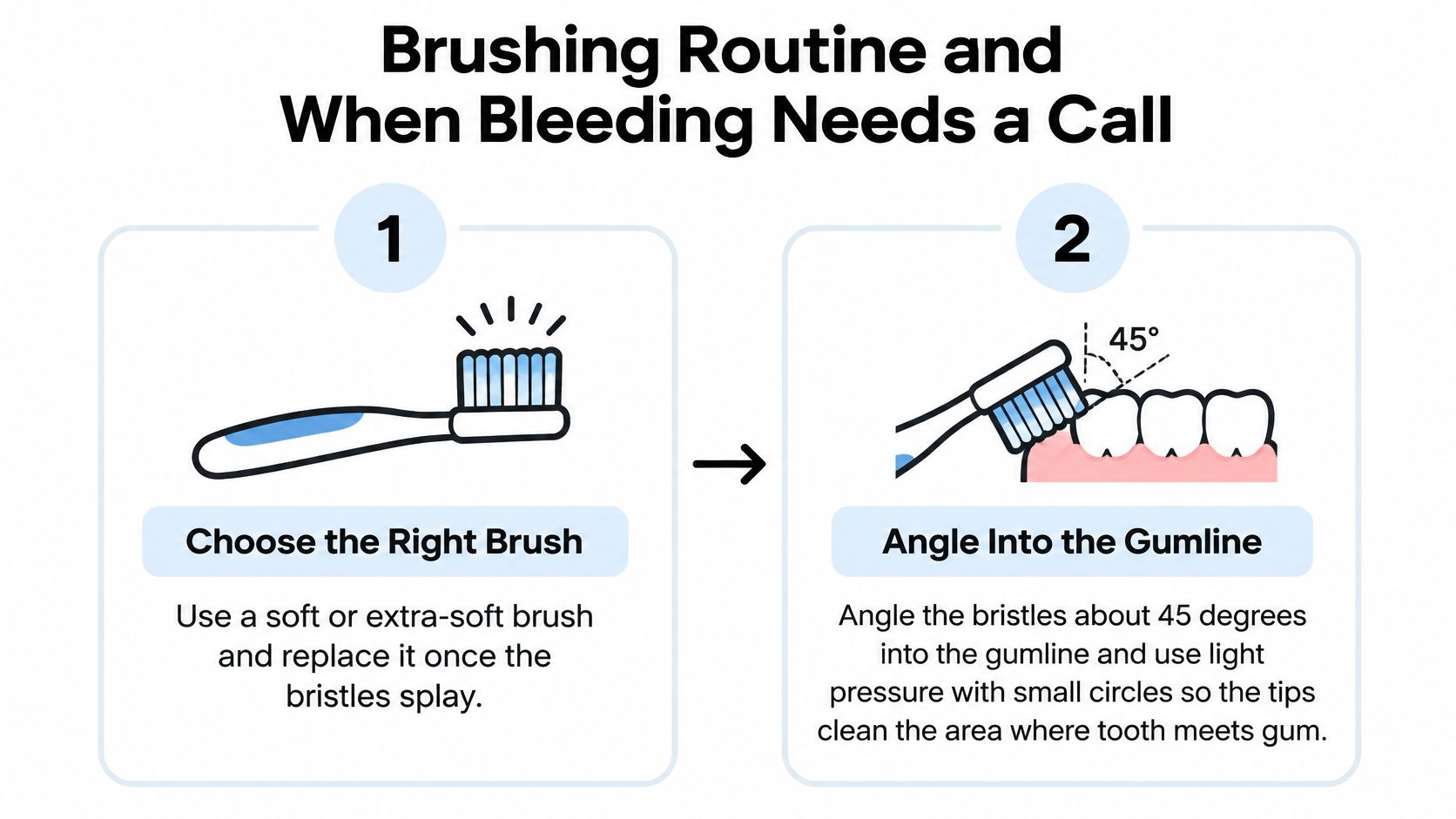
Before diving into the full seven-step routine, look at the two foundational habits that prevent mechanical trauma while lifting biofilm right where the tooth meets the gum.
Seven Steps for Daily Cleaning Without Irritating Tissue
- Choose a soft or extra-soft brush: Pick an ultra-soft manual brush such as a Curaprox Ultra Soft, or a pressure-sensing electric brush like an Oral-B iO or Philips Sonicare on its sensitive mode, and swap the head as soon as bristles splay.
- Angle bristles 45 degrees into the gumline: Use fingertip pressure rather than a fist grip, making tiny circles so the bristle tips sweep the shallow sulcus instead of scrubbing horizontally across raw tissue.
- Stick to two full minutes morning and night: Spend equal time on back molars, and never scrub a tender spot harder thinking extra force will clean faster.
- Clean between every tooth once a day: Slide TePe or GUM Proxabrush interdental brushes sized snugly to each gap, or use waxed floss where contacts are tight, including the spots that still bleed lightly.
- Keep cleaning through light early bleeding: Pink foam on days one through three usually reflects leftover inflammation draining out, not fresh injury arriving. Skipping that zone lets plaque recolonize the pocket and keeps it bleeding.
- Skip stiff bristles and aggressive scrubbing: Hard brushes and sawing strokes abrade tender gums and expose even more root surface, which can worsen long-term tissue loss and eventually push you toward gum recession treatment.
- Dry and replace your brush cleanly: Rinse the head thoroughly after each use, store it upright to air-dry, and switch to a fresh brush once your initial healing course wraps up.
A countertop water flosser like a Waterpik works nicely as a bonus flush around bridges or tight molars, yet it supplements rather than replaces physical interdental brushes. Hold off on abrasive whitening toothpastes and strong alcohol-based mouthwashes for a couple of weeks so you don't sting exposed dentin. If you're restocking gentler daily essentials for recovery, browsing the EcoQuest Purifiers oral hygiene range is a convenient way to review everyday oral care supplies alongside your clinician's recommendations.
For a quick visual walk-through of post-SRP home care, watch this short clinician demonstration on protecting healing gums.
Normal Healing Versus Symptoms That Need a Call
Knowing where normal recovery stops saves you from both needless worry and dangerous delays. Easing tenderness, faint pink saliva early on, cold sensitivity lasting several weeks, and slight mobility in teeth that already felt a bit loose before treatment all fall inside normal healing.
By contrast, post-operative guidance from CPI Dental advises contacting your dental office when bleeding continues beyond roughly 48 hours or when symptoms escalate rather than fade. Call promptly if you run into any of the following red flags:
- Heavy or restarting bleeding: Blood that pools in the mouth, soaks gauze, or starts back up after tapering off.
- Pain climbing after day three: Aching that intensifies instead of softening, or wakes you at night.
- Swelling, fever, or a foul taste: Puffy cheeks, a tender bump along the gumline, pus, or chills signaling localized infection.
- A sudden bite change: A tooth that shifts noticeably or hits earlier when you close down.
Don't just switch toothpaste for stubborn pain: Persistent or sharp sensitivity deserves an actual clinical exam rather than guessing with desensitizing gels.
At our office, Dr. Gregory tries minimum fixes first and tells patients upfront if additional procedures are required. That diagnostic discipline matters when symptoms linger: one patient who came to Dr. Gregory with major sensitivity and pain after a dental procedure at another New York City practice had the issue fixed on the first visit, with ongoing checks to prevent future sensitivity, supported by advanced AI systems to review X-rays, a clean office, and accommodating appointment scheduling.
The same measured standard applies at re-evaluation. Residual deep pockets that still bleed need targeted re-instrumentation rather than blanket polishing and hopeful waiting, and stubborn sites that fail to respond get assessed for surgical access. Smoking, diabetes, complex molar furcations, and slipping plaque control keep driving relapse, which is why structured maintenance reduces risk without ever erasing it completely.
Re-Evaluation, Recall Intervals and Booking Your Next Visit
The appointment four to six weeks after your final scaling session is not a quick check-in. It's a full measurement audit. Your clinician re-probes every site, scores plaque, logs bleeding on probing, checks gum recession, tooth mobility, and molar furcation involvement, reviews any lingering sensitivity, and lays those numbers side by side against your pre-treatment baseline.
According to clinical guidelines summarized on PubMed Central (PMC7891343), structured supportive periodontal care follows a repeatable sequence: reassessing medical history and risk factors, coaching plaque and interdental technique, clearing supragingival biofilm and calculus, probing residual sites, and performing localized subgingival instrumentation wherever deep pockets remain. Those appointments typically run 45 to 60 minutes and occur at individualized intervals of 3 to 12 months.
How Risk Profiles Set Your True Recall Interval
Defaulting every periodontal patient to a standard six-month cleaning ignores how differently mouths relapse. An evidence review from the NCBI Bookshelf (NBK401539) identifies clinical guidelines recommending supportive periodontal therapy every 3 to 6 months for chronic periodontitis, noting that while maintenance helps prevent recurrence, smoking and difficult-to-clean molar furcations remain major relapse risks.
The interval gap shows up sharply in outcomes and long-term cost. A 2024 study published in the Journal of Pharmacy and Bioallied Sciences reported that patients attending periodontal-maintenance visits every three months had a 40% lower disease-recurrence rate than those attending every six months. Meanwhile, a 2025 study of active periodontal therapy in the Journal of Periodontology found that 12.4% of patients accounted for 64% of total retreatment spending, underscoring why high-risk mouths save far more trouble and money by staying on tighter recalls.
| Risk profile | Suggested recall | What happens at the visit |
|---|---|---|
| Low risk (no smoking, pockets 4 mm or less, little bleeding, strong plaque control) | 12 months | Probing, professional plaque and calculus removal, hygiene coaching |
| Moderate risk (a few 4-5 mm pockets, bleeding at a handful of sites) | 6 months | Probing, supragingival cleaning, localized subgingival instrumentation where a site bleeds |
| Elevated risk (residual 5 mm pockets, plaque control slipping) | 4 months | Full periodontal charting, targeted re-instrumentation, oral hygiene retraining |
| High risk (smoker, diabetes, furcation involvement, progressive attachment loss) | 3 months | Charting, re-instrumentation of residual pockets, review of home care and risk factors |
| Every patient after scaling and root planing | 4-6 weeks after treatment | Re-probe, plaque score, bleeding on probing, recession, mobility, furcation check, sensitivity review |
The meaningful benchmark isn't reaching an arbitrary visit count. It's stable probing depths, controlled bleeding, and zero progressive attachment loss. Your clinician should only lengthen your recall interval after inflammation stays consistently quiet across visits.
Your Before-You-Leave Booking Checklist
Before walking out of the practice after your deep cleaning, lock in four small steps while your chart is still open:
- Schedule your 4-to-6-week re-evaluation immediately: Waiting until life slows down usually turns six weeks into six months.
- Write down your tentative maintenance interval: Note whether you're tracking toward a three-, four-, six-, or twelve-month dental periodontal maintenance plan rather than assuming a routine six-month polish.
- Restock your exact interdental sizes: Confirm which proxy brush widths fit your newly de-swelled spaces so you aren't guessing at the pharmacy.
- Start a quick symptom note on your phone: Track any tooth that still bleeds or aches so your re-evaluation targets the exact right millimeter.
When pockets stay deep despite strong home care, or when an urgent flare-up hits mid-week, keeping all phases under one roof simplifies follow-through. At Paul L. Gregory, DDS, our services span scaling and root planing, gum reduction, crown lengthening, frenectomy, and osseous surgery alongside ARESTIN treatments, oral surgery, dental emergencies care, X-rays, teledentistry, and sleep apnea treatment, so escalation or quick remote check-ins don't require starting over with a stranger.
Fitting Recall Visits Into a Manhattan Schedule
Manhattan isn't one uniform commute, and official city maps from NYC Community Boards treat its neighborhoods as distinct districts for good reason. Patients coming from Midtown, Turtle Bay, Hell's Kitchen, the Theatre District, Hudson Yards, or Lenox Hill can often slip a 45-to-60-minute recall appointment into an early morning or late afternoon near 57th Street. If you live or work in the Upper West Side, the Upper East Side, Chelsea, Gramercy Park, West Village, Greenwich Village, NoHo, East Village, SoHo, Tribeca, Chinatown, or Wall Street, pairing your periodontal maintenance visit with a lighter work-from-home day or an errand uptown keeps your recall interval intact all year long.
If you're recovering from a deep cleaning or overdue for your periodontal re-evaluation, our Midtown team provides gentle scaling and root planing, localized ARESTIN therapy, AI-assisted X-ray diagnostics, and individualized periodontal maintenance designed around your exact risk profile. Book your follow-up measurement visit or request a consultation with Paul L. Gregory, DDS to keep your gums stable well past week six.