

About 178 million Americans are missing at least one tooth, and roughly 40 million are missing all of them, according to the American College of Prosthodontists. That's not a niche problem for retirees in Boca Raton. It's your coworker in Hudson Yards, your neighbor in Hell's Kitchen, and probably someone sitting in a Midtown office right now wondering whether a dental implant is worth the time, money, and healing.
The short answer is that implants work extremely well when the conditions are right. The longer answer is that "right" means more than having the budget for it. It means enough bone, controlled gum disease, realistic expectations about healing time, and a plan for keeping the implant clean for decades. This guide walks through what determines candidacy, what the treatment stages look like, what a fair Midtown quote includes, and the part most patients never hear about: who monitors the implant after the crown goes on.
Who Qualifies for a Dental Implant in Midtown
Candidacy is not a yes-or-no question. It is a set of factors your dentist weighs together, and age changes which ones carry the most weight. Tooth loss becomes more common as people get older, and years spent without a tooth usually mean bone that has thinned in the meantime. A 35-year-old who lost a tooth six months ago in a bike accident starts from a very different place than a 68-year-old whose molar was extracted a decade ago.
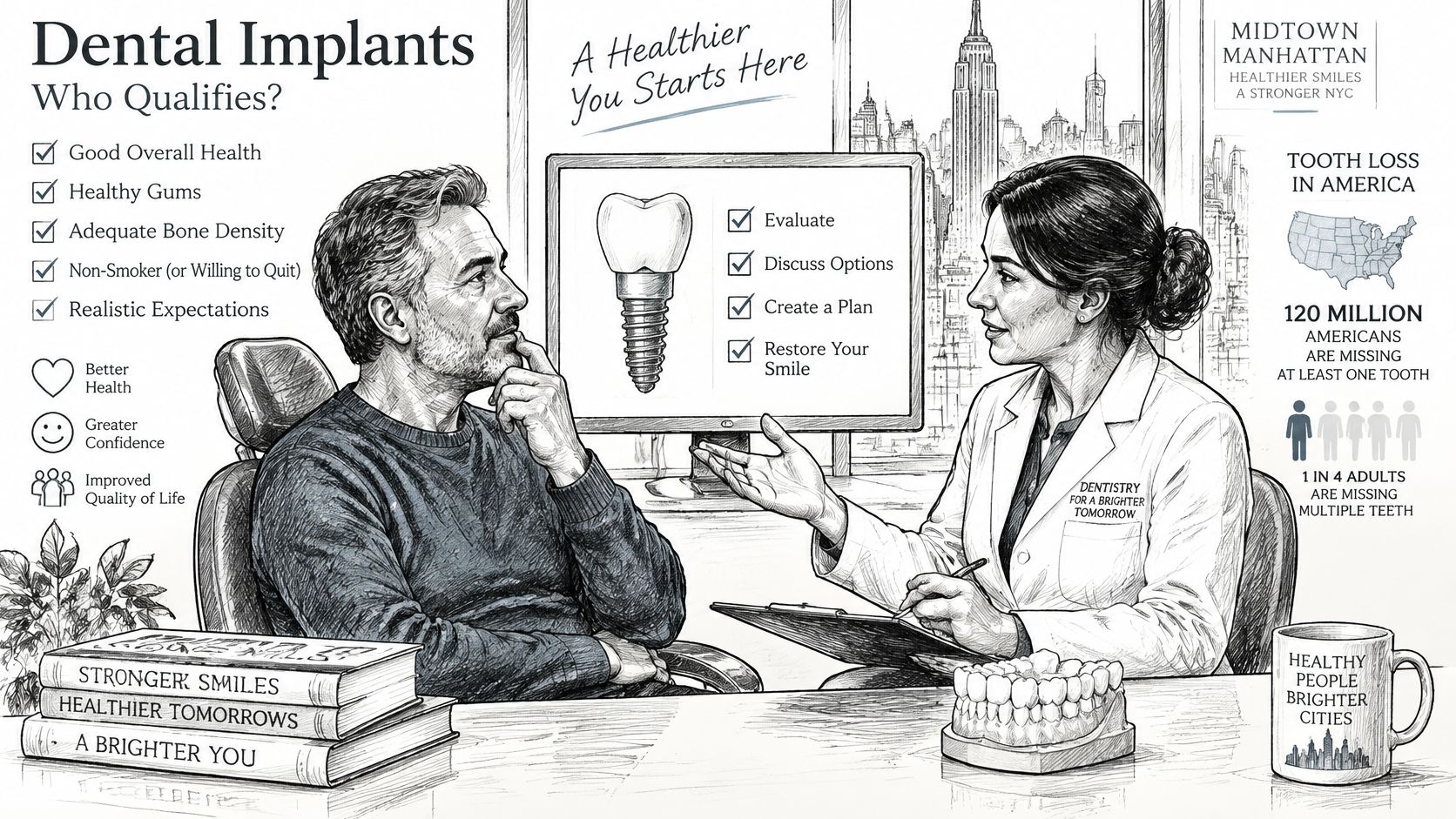
An implant works like a screw set into a wall. The screw holds only when solid material surrounds it, and no one would hang a shelf on a wall that has rotted behind the drywall without repairing it first. Bone behaves the same way. Once a tooth is gone, the bone that held its root stops receiving stimulation and slowly resorbs. The longer the gap, the thinner that bone may become.
Candidacy factors and what happens when they are not ideal
| Factor | Why it matters | If it is not ideal |
|---|---|---|
| Jawbone volume | Holds the implant under chewing load | Grafting or site preservation before placement |
| Gum health | Gum disease can undermine the implant over time | Treat periodontal disease before surgery |
| Smoking | Slows healing and raises complication risk | Quit before surgery; ask the surgeon about the timing |
| Diabetes control | Affects infection risk and healing speed | Coordinate blood sugar control with the physician |
| Bone-active medications | Some drugs, including bisphosphonates, affect bone | Review full medication history before surgery |
| Daily cleaning ability | Determines long-term plaque control around the crown | Adjust crown design and hygiene plan |
If the bone has thinned, a bone graft or sinus lift may be needed first, particularly in the upper back jaw where the sinus sits close to the implant site. This adds healing time, but skipping it is worse: placing an implant into insufficient bone risks failure, nerve injury, or an implant that looks correct for a year and then loses support.
Properly placed implants succeed at high rates, but that figure comes with conditions attached. Bone volume, periodontal health, smoking, systemic disease, oral hygiene, and surgical planning all shape an individual outcome, and so does everything that happens after the crown goes on. No reputable Midtown dentist will quote a single number for every patient. What they will do is tell you which factors are working against you and which can be corrected before surgery.
That last row of the table deserves more attention than it usually gets. An implant is a decades-long maintenance commitment, and candidacy includes your willingness to hold up your end of it. A candidate with modest bone who cleans carefully and returns for recall visits is often a safer bet than a candidate with perfect bone who disappears once the crown feels fine. So add one question to your consultation list: who monitors this implant after the crown is delivered? Ask how often it will be X-rayed, who checks the bone level around it, and what the hygienist looks for at each cleaning. The answers tell you whether the practice treats an implant as a finished job or as something it stays responsible for.
A consultation, then, is a treatment planning session. The question it answers is concrete: what has to change before an implant becomes predictable for you, and who keeps it that way afterward.
Treatment Stages From First Visit to Final Crown
Implant treatment takes months because living bone sets the schedule, and each stage exists to protect that healing. Knowing what happens at each step also tells you where your case can speed up or slow down.
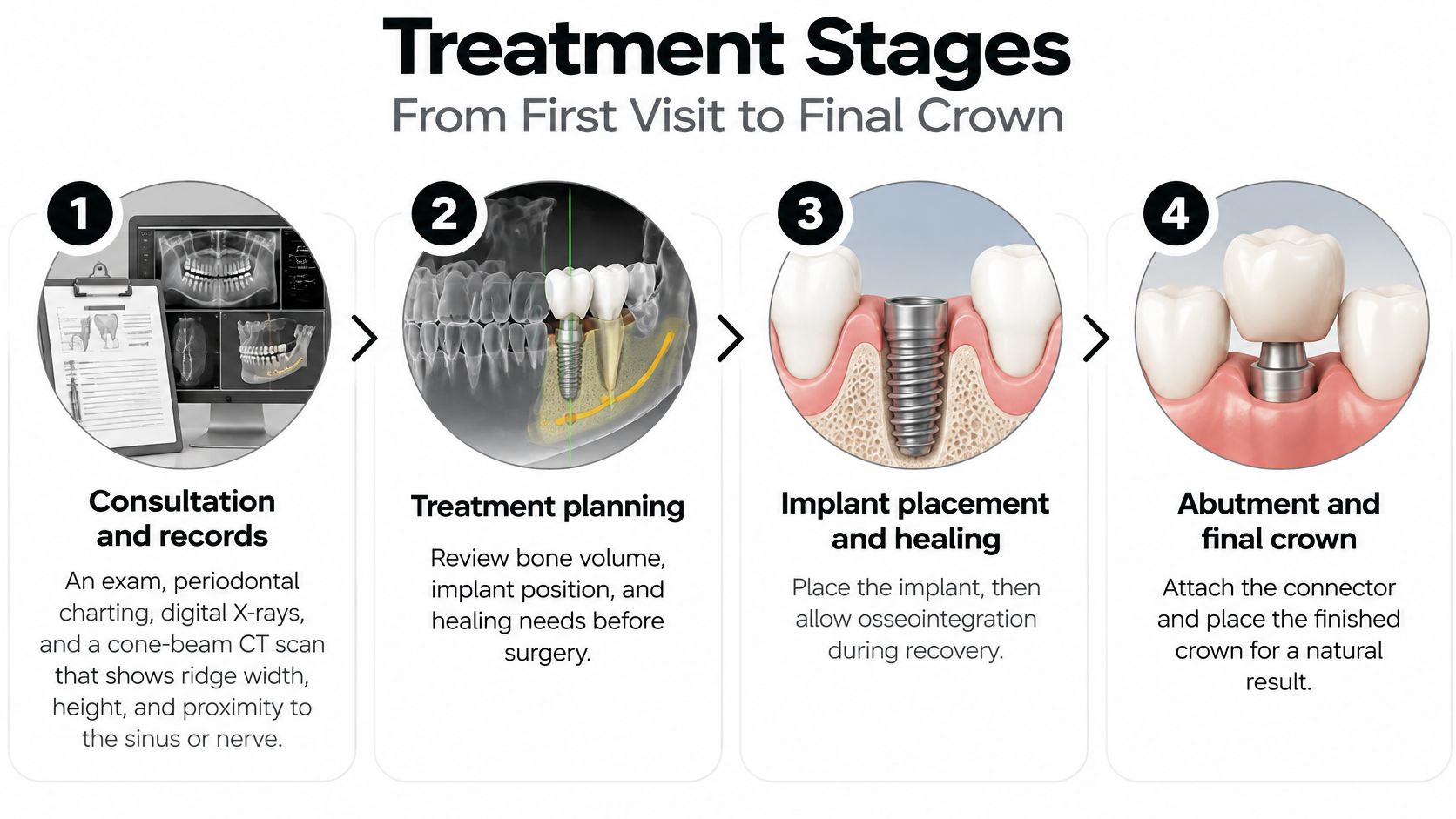
1. Consultation and records. An exam, periodontal charting, digital X-rays, and a cone-beam CT scan show ridge width, height, and proximity to the sinus or nerve. A limited-field scan is preferred over a large one because it captures only the area of interest at a lower radiation dose while still providing the cross-sectional view that two-dimensional X-rays cannot.
2. Treatment plan. The clinician plans the implant position backward from the final crown. The bite, the neighboring teeth, and the gum line dictate where the post goes, so the plan starts with the finished tooth and works in reverse. This is also when the plan decides whether extraction, grafting, or a sinus lift precedes placement.
3. Extraction and grafting, if required. An infected tooth or a compromised socket may need months of healing before the implant goes in. When the tooth comes out cleanly and bone volume holds, the site can sometimes be prepared and used sooner.
4. Implant placement. Usually done under local anesthesia, with sedation available for anxious patients. The titanium post is seated in the bone through a small gum incision. This is the "surgery" part, and it's often over in under an hour for a single implant.
5. Osseointegration. Living bone fuses to the implant surface, the way new bone knits around a fracture. This is the longest wait. FDA documentation on the Osseotite implant system notes that older protocols commonly allowed roughly 3 to 4 months of healing in the lower jaw and 5 to 6 months in the upper jaw or areas with softer bone before loading. Newer implant surfaces and techniques may shorten those windows, but they do not eliminate them.
6. Abutment connection. Once healing is adequate, a connector is placed above the gum line. This is a brief visit that exposes the implant if it was covered during healing.
7. Impression or digital scan, then crown fabrication. The scan captures the implant's exact position, and the crown is made over several weeks.
8. Crown delivery. The bite is checked, cleaning instructions are given, and the first maintenance visit is booked. This last step matters more than it looks, because it is where the implant moves from a surgical project into a monitored part of your dentition.
The gap between those two healing windows reflects a real difference in bone. Lower-jaw bone tends to be denser, and documented clinical series generally report slightly more implant losses in the upper jaw than in the lower. Density is one reason grafting comes up so often in upper-jaw cases, and one reason your clinician may wait longer before loading an upper implant.
Practical rule: The implant is the root, the abutment is the connector, and the crown is the visible tooth. Confusion about these terms is the most common source of sticker shock in quotes.
From first visit to final crown, the timeline usually spans several months, and crown delivery marks the start of maintenance rather than the end of treatment. Two questions belong in your consultation. First, what is the healing calendar, stated in named months rather than a vague "it depends"? Second, once the crown is seated, who checks the implant at recall visits and how often? A good answer names the healing windows and names the person responsible for watching the implant afterward.
Restoration Options and What Each One Replaces
The number of missing teeth changes the design problem. A single screw suits one hole in the wall. A long shelf needs several anchors spaced to carry the load. Implant restorations follow the same logic.
Restoration options compared by missing-tooth pattern
| Option | Teeth replaced | Implants needed | Best fit |
|---|---|---|---|
| Single implant crown | One tooth | One | Isolated gap with healthy neighbors |
| Implant-supported bridge | Two to four teeth in a row | Two | Several adjacent missing teeth |
| Traditional bridge | Two to four teeth | None; uses neighboring teeth | Neighbors already need crowns |
| Implant-supported overdenture | Full arch, removable | Two to four | Lower-jaw instability with removable comfort |
| Full-arch fixed bridge | Full arch, fixed | Four to six, often angled | Extensive loss with sufficient bone |
| Removable partial denture | Several teeth, removable | None | Budget constraints or a temporary solution |
The single trade-off that changes the choice for most Midtown patients is what happens to the neighboring teeth. A traditional bridge avoids implant surgery entirely, and that's appealing when you're balancing work travel and recovery time. But it requires grinding down the healthy teeth on either side of the gap to serve as anchors. Those teeth lose enamel structure permanently. If they are already heavily restored or crowned, that's less of a loss. If they're intact, an implant preserves them and spreads the chewing load through the bone instead.
For a full arch, the decision hinges on bone and stability. An implant-supported overdenture snaps onto two to four implants and can be removed for cleaning. It's a major step up from a loose lower denture. A fixed full-arch bridge, sometimes called All-on-4 when four implants are angled to maximize available bone, stays in the mouth and cannot be removed at home. Each has a different cleaning routine, cost, and revision path.
The principle that should guide the choice is deceptively simple: the best restoration is the one the bone, gums, and daily cleaning routine can support long term. A dental implant versus denture comparison should include every option, because the right answer for a 70-year-old with a resorbed lower ridge is not automatically the same as the right answer for a 40-year-old with one missing bicuspid.
What a Midtown Implant Quote Includes
Two reference points frame the Midtown price conversation. A 2026 New York City cost estimate puts a single implant, abutment, and crown at about $5,565, though the site itself describes that figure as an editorial estimate rather than collected prices. A 2025 industry survey of 278 practices across six U.S. metro areas reported a national median of $4,000 for a complete single-tooth implant. Neither number is your quote. The city figure shifts with the provider, the implant system, and whether bone grafting is needed, while the national median smooths over exactly the variables that change a Midtown bill.
A dental quote works like a contractor's bid: the total means little until you see what is itemized underneath it.
Line items in a single-implant quote
| Line item | Included in single-implant estimate | What can add cost |
|---|---|---|
| Consultation and CBCT scan | Often billed separately | Scan field size and records transfer |
| Extraction | Sometimes | Fractured, infected or surgically removed tooth |
| Bone graft or sinus lift | No | Insufficient bone volume at the site |
| Implant post | Yes | Choice of implant system |
| Abutment | Yes | Custom versus stock abutment |
| Crown | Yes | Material, such as porcelain or zirconia |
| Sedation | No | Oral or IV sedation for anxiety |
| Temporary tooth | Sometimes | Needed during the healing period |
| Maintenance visits | No | Recall frequency and hygiene needs |
The line-item breakdown is the only honest way to compare quotes. One office advertises "$1,500 implants" and bills the abutment, crown, and imaging separately. Another quotes $5,000 all-in and sounds expensive until you realize the first office's total reaches $5,800. Ask for every component in writing before comparing totals.
Insurance and staging across plan years
Many private dental plans classify implants as major or cosmetic care and set an annual maximum that covers only part of a full implant fee. Timing then matters. If the extraction and graft happen in December and the implant goes in January, you may be able to draw on two plan years instead of one. Staging treatment around insurance limits is legitimate planning, not gaming the system, but it requires a dentist who will map the calendar with you rather than rush to surgery.
The table's last row deserves a second look. Ask who monitors the implant after the crown is delivered, and whether those recall visits sit inside the quoted fee or arrive as separate charges. A quote that ends at crown delivery answers only half the cost question, because years of maintenance visits are where the long-term expense lives. At a practice that places implants, All-on-4 restorations, and bone grafts, such as Paul L. Gregory, DDS on West 57th Street, the consultation is the right place to pin down which of those components your case needs.
Reality check: The fastest or cheapest-looking plan is not automatically appropriate if infection, gum disease, or uncontrolled risk factors have not been addressed first. Geographic convenience does not eliminate biological variables.
A detailed implant cost breakdown should separate every line item before you sign anything. If a quote doesn't, treat that as a warning sign.
Caring for Your Implant During Recovery and Beyond
Recovery follows a predictable course. Swelling usually peaks in the first two to three days, eating shifts to soft foods, and over-the-counter pain relief often covers the discomfort. Most patients return to work within a day or two for a single implant, though a full-arch case is a different recovery.
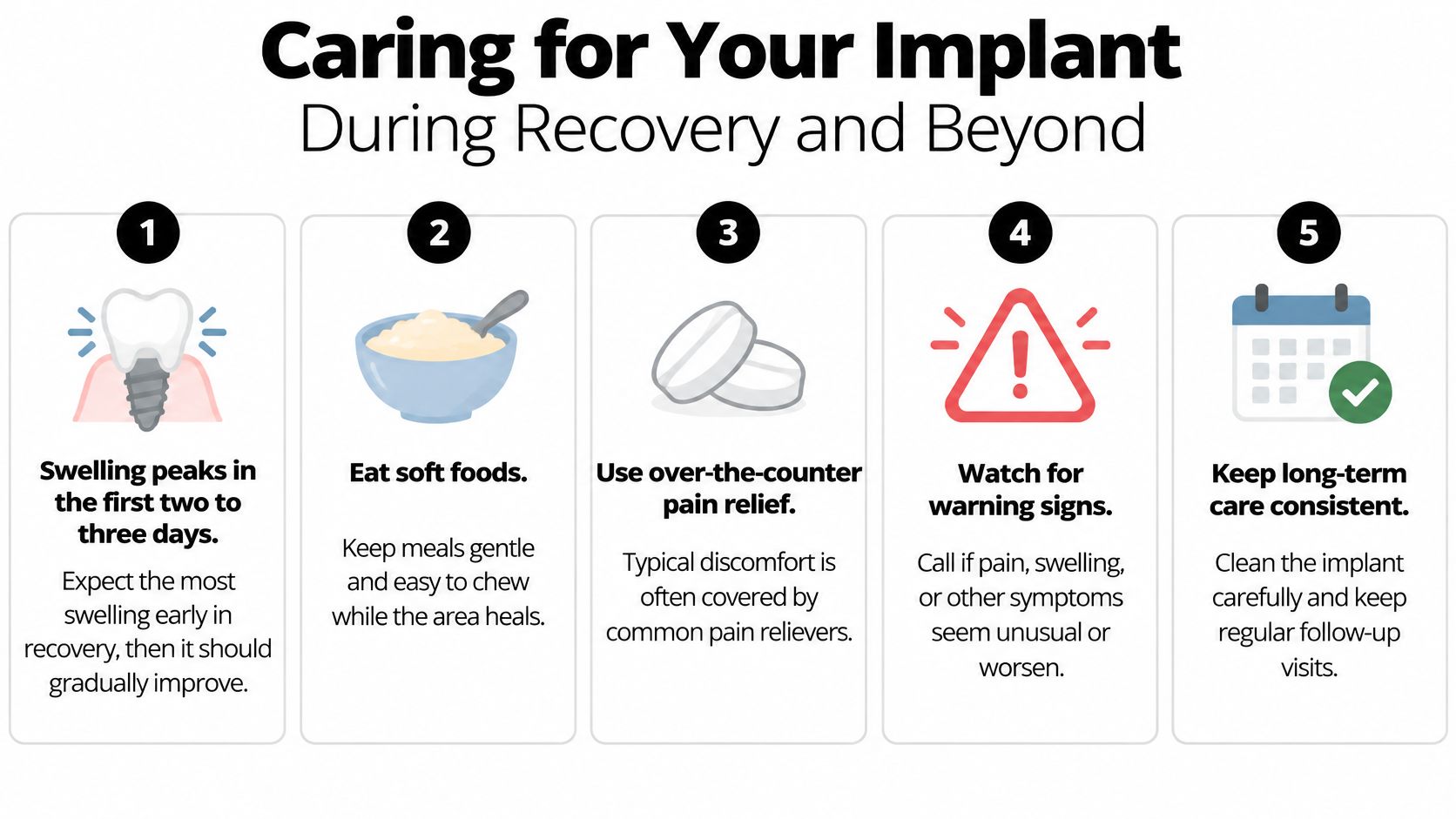
Call the office the same day if you notice fever, pain that worsens after the first few days, pus, or a loose implant or crown. These are not normal recovery symptoms.
The assumption that's quietly wrong
Many patients assume an implant is the end of the story. It isn't. A 2025 systematic review found peri-implant mucositis in 46% of patients and peri-implantitis in 21%, with risk indicators including prior periodontitis, diabetes, smoking, and alcohol use. Those numbers are not personal predictions, because prevalence varies with diagnostic criteria, patient populations, and follow-up duration. But they do reframe the treatment. An implant is a prosthodontic device with biological maintenance requirements, not a set-it-and-forget-it appliance.
Peri-implant mucositis is soft-tissue inflammation with bleeding. It's reversible if treated early. Peri-implantitis is inflammation with progressive crestal bone loss, and it's much harder to reverse. The gap between the two is where maintenance saves the implant.
Recall schedule by peri-implant risk profile
| Risk profile | Recall interval | Visit focus |
|---|---|---|
| Stable patient with no gum disease history | At least once a year | Cleaning, probing and imaging when indicated |
| Prior periodontitis, smoking, diabetes or alcohol use | Every 3 to 6 months | Biofilm removal and home-care review |
| Prior peri-implantitis | Every 3 to 6 months | Monitoring for bone loss and early treatment |
Daily care means brushing and interdental cleaning around the crown, with prosthetic access designed for floss or brushes. If the crown blocks every cleaning tool you own, that's a design problem, not a personal failure. Understanding how to clean dental implants is part of the treatment plan, not an afterthought.
Transition checklist for any new dentist: Bring implant records, radiographs, restorative component details, hygiene history, and the responsible clinician's contact information. Busy Manhattan professionals change jobs, move, travel, and switch dentists. When you walk into a new office with a five-year-old implant, the first question should be: who has been watching this thing?
The unanswered question that generic implant pages skip is exactly this. Who monitors the implant after the crown is delivered, and what happens when early inflammation is detected? The answer should be a named clinician and a scheduled recall, not a shrug.
Where Midtown Implant Patients Travel From
Midtown is not one neighborhood in New York City's official geography. Midtown, Times Square, Herald Square, and Midtown South fall within Community District 5. Turtle Bay sits in Community District 6. Chelsea and Hudson Yards are in Community District 4, where Hell's Kitchen is listed under the Clinton neighborhood name. The Upper West Side is in Community District 7, while the Upper East Side and Lenox Hill are in Community District 8.
Neighborhood and community district map for planning your visits
| Area | Community district | Travel context |
|---|---|---|
| Midtown, Times Square, Herald Square, Midtown South | 5 | Core service area, short trip |
| Turtle Bay | 6 | Adjacent, easy access |
| Chelsea, Hudson Yards, Hell's Kitchen (Clinton) | 4 | Close, particularly from Hudson Yards |
| Upper West Side | 7 | Uptown but convenient via Columbus Circle |
| Upper East Side, Lenox Hill | 8 | Farther, longer cross-town trip |
| SoHo, Tribeca, West Village, Greenwich Village, NoHo, East Village, Chinatown, Wall Street | 1, 2, 3 | Downtown, plan for longer follow-up visits |
Paul L. Gregory, DDS serves patients from Midtown West, Central Park South, Columbus Circle, the Upper West Side, and Hell's Kitchen. The patient base extends well beyond Manhattan, reaching Long Island City, Astoria, Brooklyn, Queens, the Bronx, Staten Island, Hoboken, Jersey City, Weehawken, and Fort Lee. For patients coming from downtown areas like SoHo, Tribeca, the East Village, Chinatown, and Wall Street, the trip runs longer, so plan consultation and follow-up visits accordingly.
Distance matters more for implants than for most dental work. A filling is a single appointment. An implant is a consultation, surgery, healing checks, crown delivery, and then years of periodic maintenance visits. Someone traveling from Lenox Hill or Fort Lee should weigh that commitment before booking, because a patient who lives or works near 57th Street keeps recall appointments far more easily. The location question is really a maintenance question: the right office is the one you can reach without rearranging your week.
Patients based near Columbus Circle and the surrounding blocks can learn more about the Midtown West practice area before scheduling a consultation.
Book Your Implant Consultation in Midtown
The consultation decides candidacy, so arrive ready. Bring a list of current medications, including bone-active drugs like bisphosphonates. Have a clear account of smoking and alcohol use, diabetes status if applicable, the history of any extraction or gum disease, and any imaging from other offices.
Ask for these five things at the consultation:
- A cone-beam CT scan and an explanation of whether it changes the surgical plan.
- An itemized quote with grafting, sedation, and temporary tooth listed separately.
- An insurance coverage estimate and how treatment can be staged across plan years.
- The recall schedule for your risk profile, named in months rather than "regular checkups."
- The name of the clinician who will monitor the implant after the crown is delivered.
Paul L. Gregory, DDS is an experienced cosmetic dentist in Midtown Manhattan, with the practice at 57 W 57th Street near Central Park South and Columbus Circle. If you're managing a busy schedule and need help coordinating appointment reminders or follow-up calls, practices often use dental phone staffing options from Heyline to keep communication consistent. That's the level of organization implant care deserves.
The best time to ask these questions is before any surgery is scheduled. A practice that answers them clearly is one that understands what implant success requires.
Dr. Gregory and the team at Paul L. Gregory, DDS provide dental implant consultations, surgical placement, bone grafting, and final restorations from their Midtown Manhattan office at 57 W 57th Street. If you're weighing a single implant, a bridge, or a full-arch option, the consultation is where your candidacy becomes clear and your quote becomes line-item transparent. Call (212) 826-0505 or visit Paul L. Gregory, DDS to book your implant evaluation and get a plan you can follow through.