

ARESTIN is 1 mg of minocycline microspheres placed in cleaned pockets after scaling and root planing. FDA trials found about 1.42 mm of pocket reduction at nine months versus 1.18 mm with scaling alone, an extra 0.24 mm.
That fraction of a millimeter is the honest size of ARESTIN periodontal therapy. A pocket that starts near 6 mm doesn't become a shallow, easy-to-clean sulcus because a powder went in. Scaling and root planing do most of the work. The antibiotic is a local add-on for selected sites that still look inflamed after the roots are smooth.
Busy patients often hear "antibiotic in the gums" and picture a cure, or a reason to skip the deep cleaning. Neither reading fits. The powder doesn't grow bone back, and it doesn't replace the probe, the scaler, or the cleaning you do at home. What it can do is trim a little more depth from some pockets that were already instrumented. The useful questions are who that small gain is for, what the chair time involves, and when another cartridge is the wrong call.
How Much Pocket Depth ARESTIN Actually Adds
The figure patients come for is 0.24 mm. That is the average extra pocket-depth reduction at nine months when ARESTIN is added to scaling and root planing. It isn't a forecast that a tooth will stay in the mouth.
Two significant multicenter, investigator-blind, vehicle-controlled trials enrolled 748 adults with generalized moderate-to-advanced periodontitis, according to the 2017 FDA labeling for ARESTIN. Trial OPI-103A included 368 participants with a mean baseline probing depth of 5.90 mm. Trial OPI-103B included 380 participants at 5.81 mm. Each person received scaling and root planing alone, scaling plus the bioresorbable polymer vehicle, or scaling plus 1 mg ARESTIN.
At nine months the pooled mean pocket-depth reduction was 1.18 mm with scaling alone, 1.10 mm with scaling plus vehicle, and 1.42 mm with scaling plus ARESTIN. The minocycline arm added 0.24 mm versus scaling alone and 0.32 mm versus the vehicle. The FDA labeling states that the ARESTIN group achieved statistically significantly greater probing-pocket-depth reduction than both comparison groups at nine months. That supports an adjunct, not a stand-in for mechanical debridement.
How many people crossed the endpoint
Averages hide how many patients hit a set probing goal. In those same pooled studies, 40.5% treated with scaling plus ARESTIN reached the specified probing-depth reduction endpoint at nine months, compared with 32.87% on scaling alone and 28.98% on scaling plus the inert vehicle, as summarized in ARESTIN professional clinical efficacy data. The gaps are 7.63 percentage points over scaling alone and 11.52 points over the vehicle arm.
| Approach | Mean pocket reduction at 9 months | Patients meeting probing endpoint | What it shows |
|---|---|---|---|
| Scaling and root planing alone | 1.18 mm | 32.87% | Mechanical cleaning baseline |
| Scaling plus polymer vehicle | 1.10 mm | 28.98% | Carrier alone adds no benefit |
| Scaling plus ARESTIN | 1.42 mm | 40.5% | Extra 0.24 mm and 7.63 points versus scaling alone |
Picture the pocket as a narrow crevice. The microspheres are a slow-release antibiotic left in a groove that has already been scraped clean. The empty polymer didn't beat scaling in these averages, which is a useful check. The carrier isn't the treatment. The minocycline is.
The average gain is real and statistically significant. It is also modest, and the trials measured probing depth, not guaranteed tooth retention.
A deeper site that still bleeds after instrumentation is where that fraction of a millimeter is more likely to matter than a whole-mouth average. A tooth with advanced bone loss still needs maintenance, and sometimes surgery, whether or not a cartridge was used.
How Minocycline Microspheres Work in a Pocket
Say a lower molar has a 6 mm pocket on the tongue side. Plaque and calculus sit on the root inside that deepened space between tooth and gum. The clinician scales and root planes that surface first. Only then does the powder go in.
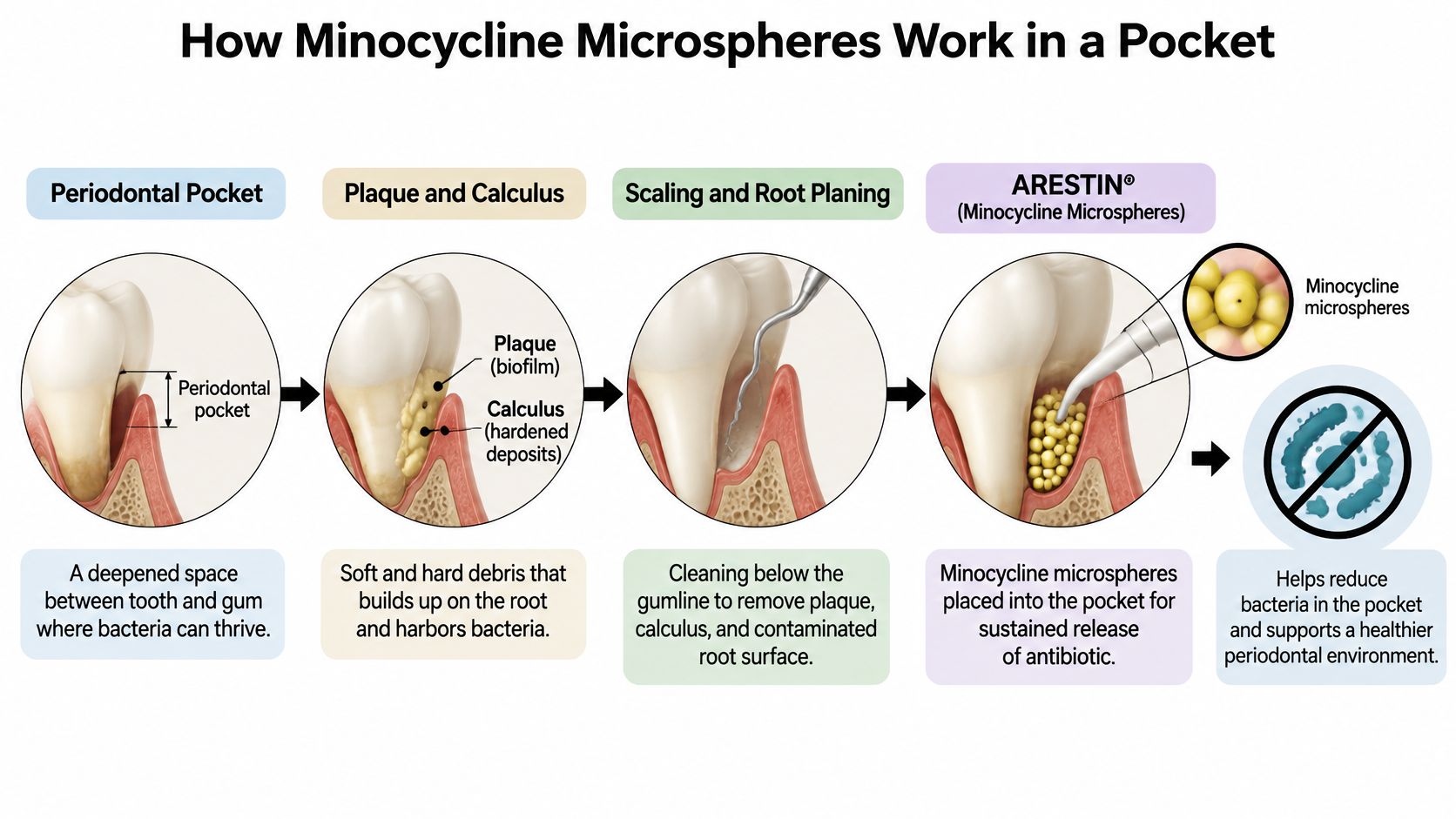
Each cartridge holds 1 mg of minocycline, a tetracycline-class antibiotic, bound in roughly 3 mg of resorbable polymer microspheres. The tip is seated at the base of the chosen pocket. The powder is expressed while the tip is withdrawn, so the dose stays in that groove instead of circulating the way a pill would through the gut and bloodstream.
Think of it once as a dissolving sponge left in one cleaned groove, not a medicine spread over every tissue. The polymer holds minocycline against the pocket wall while the body gradually resorbs the carrier. That's why the treated spot gets a short pause from brushing and flossing.
What stays unrepaired
The powder doesn't regenerate lost bone, close a furcation, or replace daily plaque removal. Nonsurgical gum disease treatment still starts with cleaning the root and keeping it clean afterward.
Trial protocols placed the drug in pockets of at least 5 mm. How many cartridges you need changes with the number of deep sites, their depth, and the shape of the root. Two people with a similar diagnosis can leave with very different doses. One may need a few sites around two molars. Another may have deep pockets around most back teeth.
Practical rule: Place it in selected residual sites after the roots are clean. Don't fill every shallow sulcus just because a cartridge is open.
A 2 or 3 mm sulcus is a normal or nearly normal space. It isn't the target. The decision is which leftover deep, inflamed sites still justify a local dose.
Who Should Get ARESTIN and Who Should Wait
Sort the decision before anyone talks about a slot on the schedule.
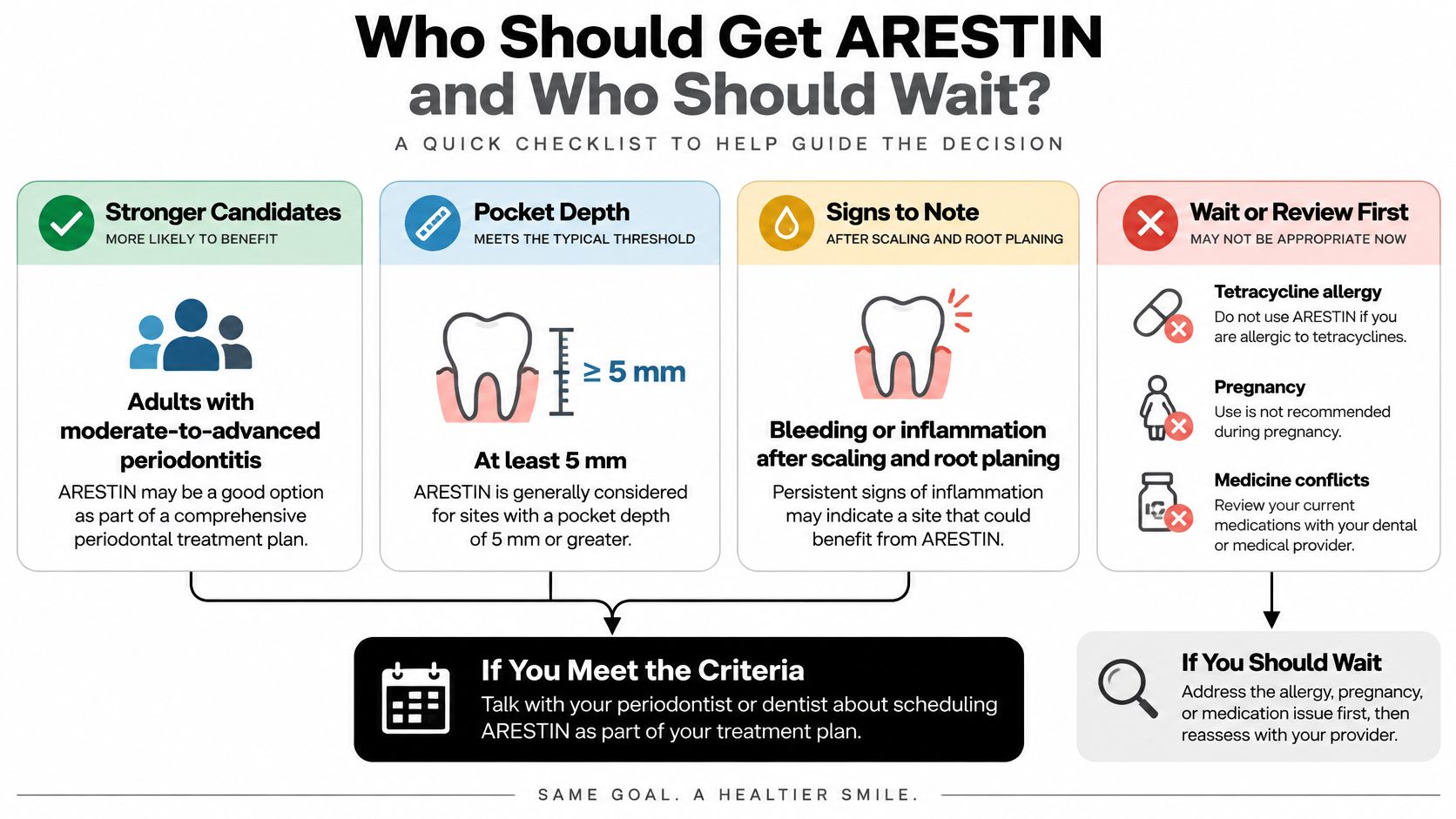
Yes, discuss selected sites if you're an adult with moderate-to-advanced periodontitis and pockets still at least 5 mm, with bleeding or inflammation, after a thorough scaling and root planing. Furcations and narrow root grooves that instruments struggle to reach belong in that same talk.
Maybe, after new numbers if inflammation returns at maintenance on sites you already know are deep. That's a fresh probe, not an automatic refill.
Not now if the plan is to medicate every tender gum, skip the cleaning, or repeat cartridges on a calendar with no new chart.
Three months next to two years
A randomized controlled study of 20 patients and 60 periodontal sites found that scaling plus minocycline microspheres produced an additional probing-depth reduction of 0.85 ± 0.03 mm at three months compared with scaling alone, and a clinical-attachment-level difference of 0.50 ± 0.45 mm, as described in this PubMed Central review of local minocycline. The same source describes a 24-month randomized study of inflamed interproximal pockets. Probing depth, attachment level, and bleeding improved in both the scaling-plus-minocycline group and the scaling-only group, with no significant between-group advantage for the microspheres.
Read those side by side. Three months can show a measurable bump. Two years of maintenance didn't show a clear edge for the drug over scaling alone. Judge the result by serial probing depth, bleeding on probing, and attachment. Don't judge it by a promise that the tooth is saved.
Minocycline is tetracycline-class, so a tetracycline allergy, pregnancy, nursing, age, and a prior tetracycline reaction can take it off the table. A dentist for gum disease should screen those before a cartridge is opened. Smoking, diabetes control, and home care move the odds more than another cartridge.
| Situation | Recommendation | Reason |
|---|---|---|
| Pocket still 5 mm or deeper with bleeding after scaling | Discuss site-specific ARESTIN | Matches the adjunctive indication and trial pocket depth |
| Hard-to-reach furcation or root groove after debridement | Consider selected sites | Local dose reaches anatomy instruments may miss |
| Recurrent inflammation at maintenance on known deep sites | Reassess, then consider a repeat only if probing justifies it | Repeat use needs a new clinical reason |
| General gum tenderness or pockets under 5 mm | Do not use as a routine add-on | Indication is pocket-depth reduction with scaling, not every inflamed site |
| Tetracycline allergy, pregnancy, or nursing | Avoid and choose another plan | Tetracycline-class drug with label restrictions |
| Skipping cleanings or daily plaque control | Fix maintenance first | Microspheres do not replace mechanical care |
If the row that fits you is a yes or a careful maybe, the next question is what the appointment feels like.
What Happens During an ARESTIN Visit
The visit follows the mouth, not a product demo. Nothing is placed on a dirty root, and nothing is placed before the history is checked.
The 2024 FDA labeling for ARESTIN describes a locally delivered, sustained-release formulation with 1 mg of minocycline per unit-dose cartridge and about 3 mg of polymer. Clinical-trial protocols treated pockets at least 5 mm deep, with as many as 122 cartridges in one visit and up to three applications at 3-month intervals. That 122-cartridge figure is a research ceiling, not a typical mouth.
The order you'll feel in the chair
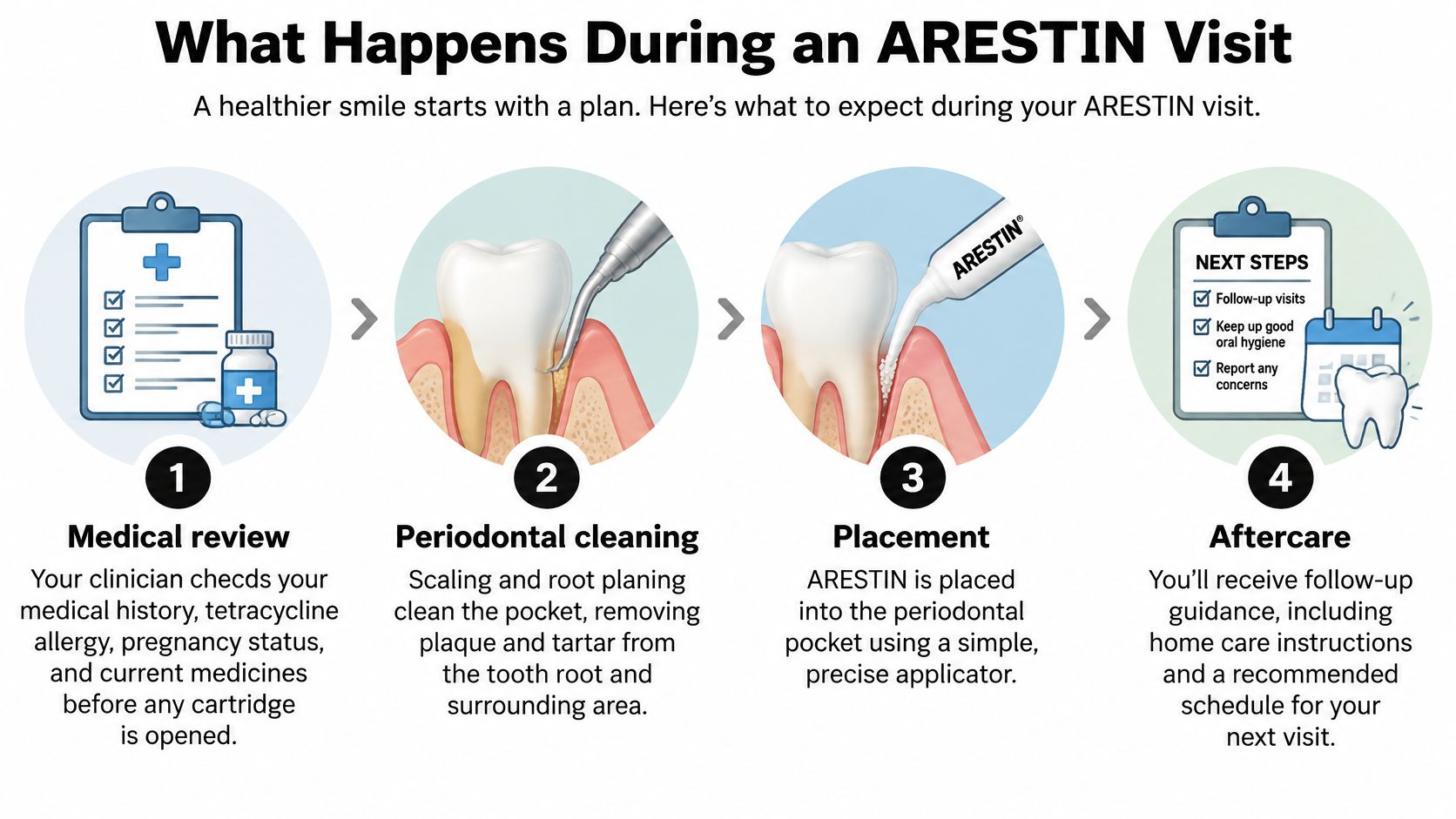
- History before the cartridge is opened. Allergy to tetracyclines, pregnancy, nursing, and current medicines are reviewed first. A hypersensitivity history stops the plan. The label treats this as a tetracycline-class drug, so the screen isn't a formality.
- Charting that decides the map. Probing depth, bleeding, furcation, and root shape are written down. Only sites that still meet the depth and inflammation bar stay on the list.
- Cleaning before any powder. Periodontal scaling and root planing removes plaque and calculus from the chosen roots. Placement on an uncleaned surface misses the point of the adjunct.
- Isolation and tip to the base. The site is kept dry enough to see, and the cartridge tip is carried to the bottom of the pocket, not parked at the gum margin.
- Dispense while withdrawing. Microspheres fill that pocket as the tip comes out. The dose stays local instead of exposing the whole body the way a systemic antibiotic would.
- Repeat only where the chart says so. Dose varies with the number, depth, and geometry of pockets. A few deep molars are a common pattern. A mouthful of cartridges is not.
- Write the sites down. Depth and bleeding at those exact spots are what the next visit compares. Memory of "we treated the back teeth" isn't enough.
You may feel pressure from the cleaning more than from the powder. Numbness follows whatever anesthetic the scaling needed, not a separate shot for the microspheres. You won't leave with a take-home prescription for this local dose. The restrictions start when you stand up, and they're short, specific, and easy to undo if you treat the area like a normal tooth that same evening.
Side Effects Restrictions and Stewardship
Separate a nuisance from a reason to get help. Tender gums, mild swelling, or a brief odd taste where powder sat are the local effects people notice. The scaling itself often causes more sensitivity than the microspheres.
Because minocycline is a tetracycline, allergy was already screened. Rash, swelling of the face or throat, or trouble breathing isn't a wait-and-see symptom. That's urgent care. Pregnancy, nursing, and a known tetracycline reaction belong in the do-not-treat column, decided before the visit, along with medicine interactions and age.
The short rules after you leave
- Brush and floss pause: Skip brushing and flossing the treated spots for 12 hours. The rest of the mouth keeps its normal cleaning.
- Food for about a week: Avoid hard, crunchy, or sticky foods so the microspheres aren't scraped or pulled out.
- Hands off the site: Don't poke the area with picks, proxy brushes, or irrigators during that window.
One cartridge isn't a resistance crisis. Repeating it on every inflamed site, with no new probing, is how a modest adjunct turns into sloppy antibiotic use.
A 2024 systematic scoping review found that local and systemic antibiotics used in periodontitis temporarily increased antibiotic resistance among subgingival microorganisms, although many organisms remained susceptible during treatment, which is why the narrow indication in the 2012 FDA label for ARESTIN matters. That finding doesn't prove one application creates a clinical resistance problem. It does argue against treating every site, or refilling on a schedule, without a new reason. The indication is adjunctive pocket-depth reduction with scaling, not a standing treatment for sore gums, and not a substitute for daily plaque control.
Reassessment at about three months should compare depth, bleeding, and attachment on the treated sites. Improvement supports dental periodontal maintenance on a set interval. Unchanged deep bleeding sites may justify one further local dose, a surgery referral, or a harder look at plaque control, smoking, and diabetes. The polymer is gone long before that visit. The cleaning habit is the treatment that continues.
Decide and Book Around Manhattan Schedules
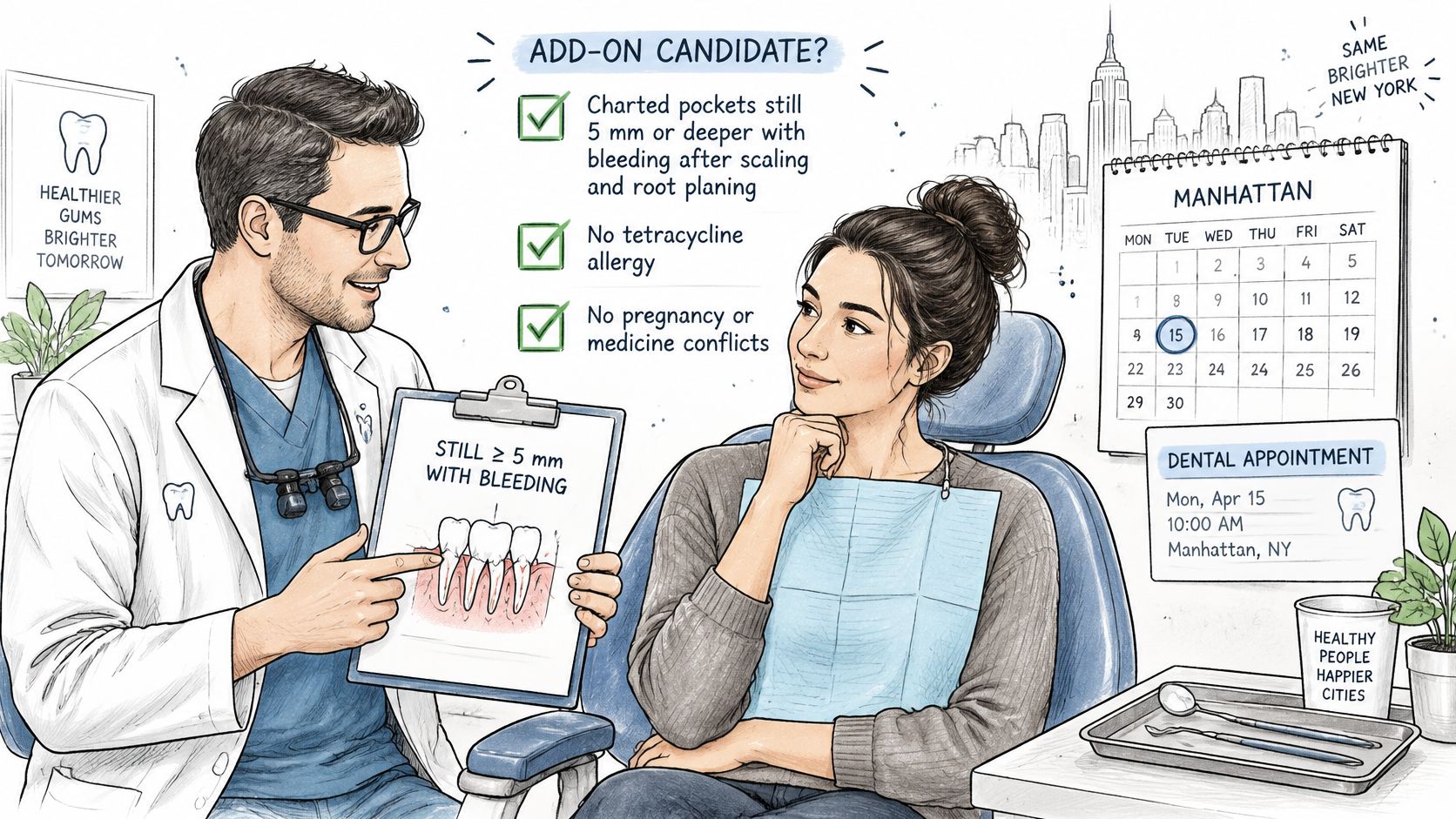
Three checks decide whether an add-on is even a conversation.
- Depth and bleeding: Do charted pockets stay about 5 mm or deeper, and do they still bleed, after a real scaling and root planing visit rather than a polish?
- Safety screen: Is there no tetracycline allergy, pregnancy, or nursing barrier?
- The follow-through: Will you keep the cleaning pause, the week of careful eating, and a three-month reassessment, instead of expecting the powder to save a tooth by itself?
If all three are yes, site-specific treatment is a reasonable discussion. If the last visit was only a polish, or every shallow site is being treated by habit, wait and fix the mechanical care. If pockets stay deep despite cleaning and a chosen local dose, ask about the maintenance interval, smoking, diabetes, and whether osseous surgery or a periodontal referral belongs in the plan.
Match the chair time to the neighborhood
Midtown office workers near the Theatre District or Hell's Kitchen can book a lunch-adjacent slot and keep the overnight no-brush window, then floss the rest of the mouth as usual. Commuters from the Upper West Side, Upper East Side, Lenox Hill, or Turtle Bay, passing Columbus Circle, should schedule before a speaking-heavy afternoon so numbness from the cleaning isn't competing with a presentation.
Patients from Chelsea, the West Village, Greenwich Village, NoHo, the East Village, SoHo, and Gramercy Park can pair the visit with a downtown-to-Midtown trip and plan soft foods before dinner. Hudson Yards, Tribeca, Chinatown, and Wall Street patients with early meetings should skip a crunchy breakfast the next day and leave treated sites alone until the 12-hour mark. Questions about what a plan might cover belong with dental insurance for periodontal treatment, sorted before you assume every cartridge is included.
In every one of those schedules the clinical choice is the same. Only residual deep bleeding sites after cleaning receive a cartridge. One place to have that chart reviewed and, if it fits, to book the visit is Paul L. Gregory, DDS, at 57 W 57th Street, near Central Park South and Columbus Circle. Bring a medicine list and records of any prior gum treatment so the screen isn't guessed from memory.
Paul L. Gregory, DDS provides periodontal evaluation, scaling and root planing, ARESTIN placed only in selected pockets, and supportive maintenance for patients who need a modest adjunct rather than a cure. If your chart still shows deep bleeding sites after a real cleaning, bring that history to a visit and ask whether a local dose belongs on those sites alone. You can start at Paul L. Gregory, DDS.