

You've been told that a full arch of teeth can be fixed to implants, and now you're facing a deceptively simple choice: All-on-4 or All-on-6. The instinct is to assume that six implants must be stronger, safer, or longer lasting than four. In practice, the answer depends on your bone, bite, prosthesis design, health, hygiene, and the way your clinician manages risk.
The more useful question is not, “Which number is better?” It's, “Will two additional implants meaningfully reduce failure or maintenance problems in my mouth?” Both designs can work well when the treatment plan matches the anatomy and the demands placed on the restoration.
Introduction to the Full Arch Decision
Consider a patient who has worn a loose upper denture for years. Eating has become cautious, social situations feel uncomfortable, and the patient wants teeth that stay in place. During the consultation, the clinician presents two fixed full-arch options. One uses four implants, with the back implants angled. The other uses six implants, placed across a broader area of the jaw.
The patient's first reaction is understandable: “If six supports the bridge, why wouldn't I choose six?” That question treats implant count as the entire treatment. It isn't. The number of implants matters, but it's only one part of a larger mechanical and biological system.
All-on-4 uses a carefully planned arrangement to support a full arch with fewer surgical sites. The tilted posterior implants may help the surgeon use available bone while avoiding certain grafting procedures. All-on-6 adds two implants, which can broaden support and distribute forces across more points. Whether that added support changes your actual risk depends on where the implants can be placed, how hard you bite, and how the final bridge is designed.
The clinical questions behind the number
Your clinician will typically assess:
- Bone volume and anatomy: A CBCT scan can show the height, width, density, sinus position, and nerve location relevant to implant placement.
- Bite forces: Clenching, grinding, a powerful bite, and a long unsupported bridge can increase mechanical demands.
- Jaw location: The upper and lower jaws don't present identical bone and loading conditions.
- Prosthetic design: Cantilever length, material, framework, access for cleaning, and whether the bridge is one piece all affect daily performance.
- Maintenance capacity: A fixed bridge still needs professional care and detailed home hygiene.
- Treatment complexity and cost: Two additional implants may increase the surgical and prosthetic workload, while a grafting procedure may alter the balance.
A full-arch restoration also has more than one definition of success. An implant can remain integrated while the bridge develops a fracture, screw problem, worn teeth, or hygiene-related complication. Patients need to evaluate both implant survival and prosthesis performance, not just whether the titanium implants remain in bone.
This guide examines how each approach works, where the evidence converges, where it diverges, and when two extra implants may justify their added complexity. Neither option is universally superior. Both can succeed when the plan is individualized.
How All on 4 and All on 6 Work
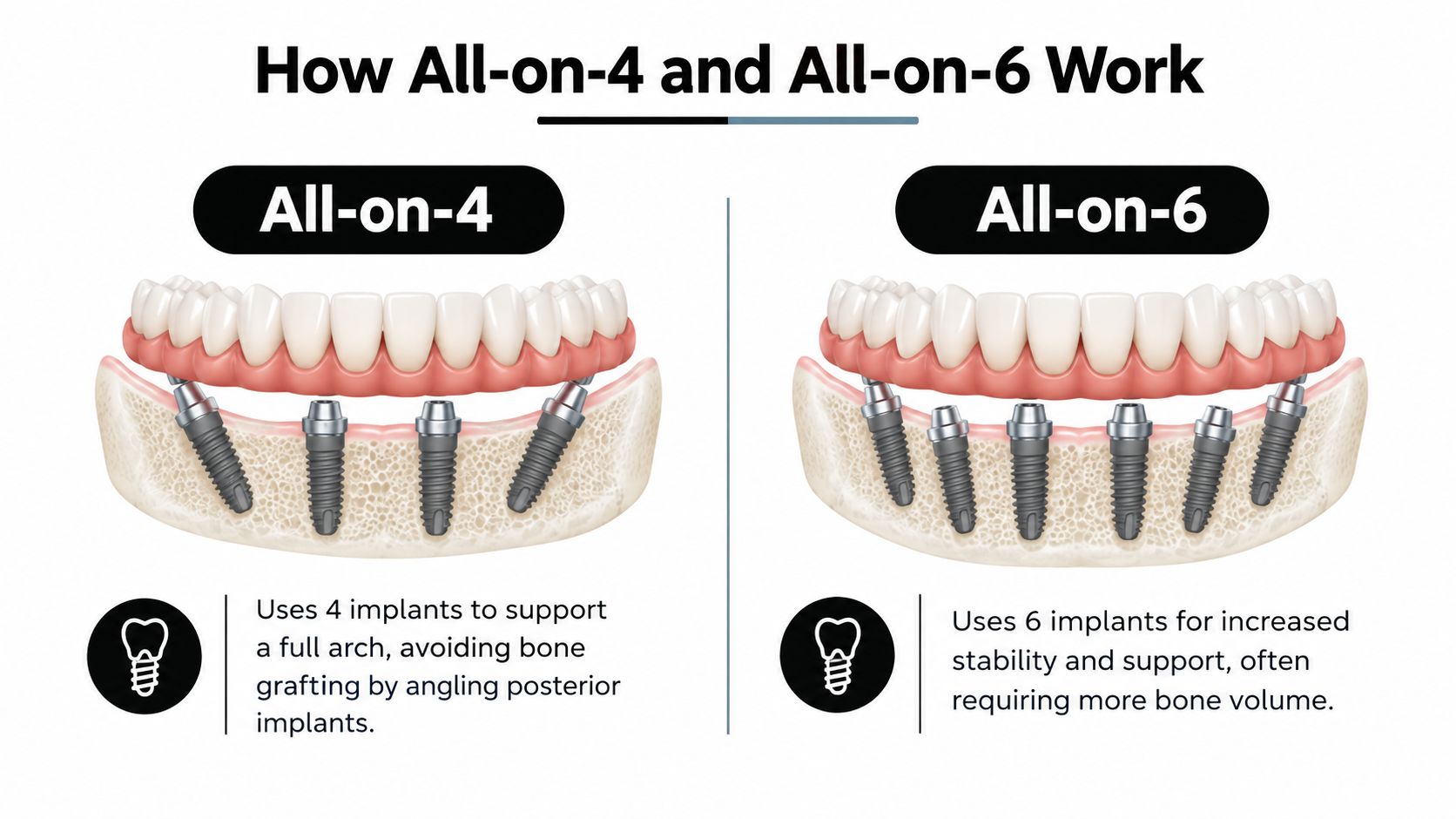
The name describes the support structure. All-on-4 uses four implants to carry a fixed full-arch prosthesis. Two implants are generally positioned in the front, while the posterior implants are tilted to use available bone and help support the back portion of the bridge without placing every implant vertically.
That angle has a purpose. In an atrophied jaw, the posterior bone may be limited, or important structures may restrict conventional placement. Tilting the posterior implants can help the surgeon engage usable bone and reduce the need to extend farther backward. It doesn't create bone, and it isn't suitable for every anatomy, but it can make a fixed arch possible in situations where a traditional plan might require grafting.
All-on-6 follows the same full-arch principle but adds two implants. The six implants can be distributed across a wider area when the jaw has enough suitable bone. The broader footprint may improve force distribution and provide additional support for the bridge, especially when the clinician wants more posterior spread or redundancy.
What treatment usually involves
Planning comes first. The team reviews your medical history, examines the gums and remaining teeth, evaluates your bite, and uses three-dimensional imaging and digital scans to design the implants and prosthesis together. Guided surgery may help transfer that plan to the mouth, but digital tools support clinical judgment rather than replace it. You can read more about related dental implant technologies before your consultation.
On surgery day, the clinician may remove failing teeth, place the implants, and attach a provisional fixed bridge if the implants have adequate initial stability and the case is appropriate for immediate loading. “Immediate” refers to the temporary teeth being attached promptly. It doesn't mean the implants have finished healing or that the final bridge is already in place.
During healing, the bone integrates with the implant surfaces. The provisional bridge protects the treatment area while the team monitors healing, bite forces, hygiene, and comfort. Once the implants and tissues are ready, the provisional is replaced or converted into the planned definitive prosthesis.
Strength isn't just an implant-count issue
Six implants can distribute load across more supports, but the bridge material, framework, bite scheme, cantilever, and maintenance plan still matter. Four well-positioned implants can support a durable restoration, while six poorly planned implants won't automatically solve a prosthetic design problem.
Neither option should be described casually as “permanent” in the sense of requiring no future care. The implants are intended as a long-term foundation, but the prosthetic teeth and supporting components can need adjustment, repair, replacement, or professional servicing over time.
All on 4 vs All on 6 Head to Head Comparison
The clearest comparison looks at the factors that change treatment, not just the number printed in the name.
Implant distribution
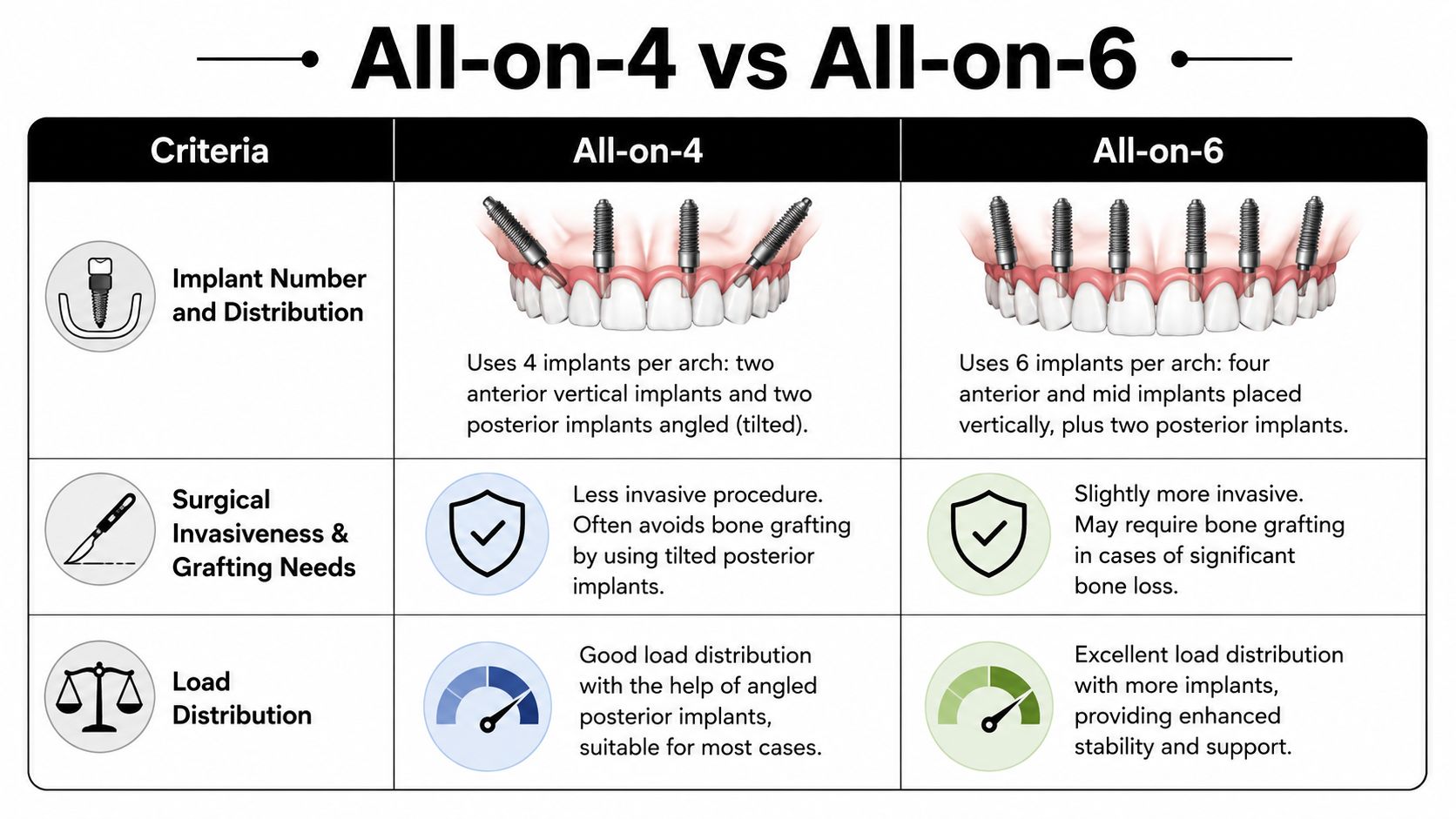
All-on-4 concentrates support into four strategically positioned sites. The posterior implants are often tilted, allowing the clinician to work with the bone that remains. This can be useful when posterior bone is limited or when the patient wants to avoid a more involved grafting pathway.
All-on-6 adds two support points and may permit a wider front-to-back distribution when the anatomy allows it. The design can reduce the distance between support points, but the implants still need adequate bone, safe positioning, and a prosthesis that fits the patient's functional needs.
Surgery and grafting
Fewer implants generally mean fewer implant osteotomies and fewer components to place, although the overall procedure can still be complex. All-on-4 is often considered when angled posterior placement may avoid certain grafting procedures.
All-on-6 requires two additional implant sites. If those sites lie in areas with insufficient bone, the patient may need augmentation or a different plan. More implants can therefore improve support in one patient while making surgery more involved in another.
Load distribution and cantilever
A full-arch bridge must extend across the space occupied by many teeth. If the back teeth sit beyond the last implant, that extension is called a cantilever. Longer cantilevers can create more force on the implants, particularly when a patient bites hard or grinds.
Biomechanical differentiator: A 2023 three-dimensional finite-element study reported smaller maximum principal stress values in cortical bone and implant components with All-on-6 than with All-on-4 under vertical and horizontal loading, and concluded that the six-implant design had more favorable biomechanics for an edentulous mandible. Read the full biomechanical study.
That finding explains why a clinician may favor six implants for a patient with high functional demand. It doesn't prove that every patient will experience better clinical outcomes, because computer models and clinical follow-up answer different questions.
Prosthesis stability and repair
Six implants can give the prosthesis more support points and may offer additional redundancy if one implant later develops a problem. Four implants simplify the foundation, but the bridge design becomes especially important because each implant carries a larger role in the support pattern.
Retrievability matters in both plans. A screw-retained bridge can usually be removed by the dental team for inspection or repair, but the number and location of implants affect access, framework design, and how a repair is managed.
Hygiene and daily access
A full-arch bridge isn't self-cleaning. Patients need to clean under the prosthesis, around each implant, and along the gumline using tools selected by the dental team. More implants mean more implant-gum interfaces to maintain, while the shape of the bridge and the available cleaning space may matter even more than the count.
The best design is one you can clean consistently and that your clinician can inspect and service without unnecessary difficulty. A theoretically stronger foundation doesn't compensate for a prosthesis that traps debris or a maintenance routine that you can't sustain.
Survival Rates Bone Loss and Complications Over Time
A patient may hear that six implants provide more support and assume they must last longer. Long-term comparisons are less straightforward. The useful question is when two additional implants meaningfully reduce failure risk or future treatment, rather than which number is automatically superior.
All-on-4 was formally introduced in the late 1990s as a full-arch implant concept. A 2026 meta-analysis found one-year implant survival of 99.20% for All-on-4 and 100% for All-on-6, mid-term survival of 99.66% versus 98.55%, and long-term survival of 98.14% versus 97.50%. It also found similar marginal bone loss, 0.77 millimeters versus 0.85 millimeters at short term, and 1.28 millimeters versus 0.94 millimeters at five years. Review the pooled survival and bone-loss evidence.
| Outcome | All-on-4 | All-on-6 |
|---|---|---|
| One-year implant survival | 99.20% | 100% |
| Mid-term implant survival | 99.66% | 98.55% |
| Long-term implant survival | 98.14% | 97.50% |
| Short-term marginal bone loss | 0.77 mm | 0.85 mm |
| Marginal bone loss at five years | 1.28 mm | 0.94 mm |
Why pooled results don't settle every case
A pooled analysis combines different patients, jaws, implant systems, surgical protocols, prostheses, and follow-up methods. The authors cautioned that substantial heterogeneity limits a simple ranking. An average result cannot determine whether your upper jaw, bruxism, bone pattern, or proposed cantilever makes six implants worth the added surgery.
Bone loss also depends on the biological setting. Smoking, periodontal history, systemic health, plaque control, implant position, and prosthesis contours can change the risk even when group averages look similar. Bone integration is only one part of the healing process, so follow-up remains important after the bridge is delivered.
Implant success isn't prosthesis success
A separate retrospective study of immediately flapless full-arch rehabilitation reported cumulative implant survival of 89.7% for All-on-4 and 99.0% for All-on-6 after a mean follow-up of 6.46 years, while prosthesis success was 58.8% for All-on-4 and 43.8% for All-on-6. Mean marginal bone resorption was 1.56 millimeters and 1.20 millimeters, respectively. Examine the long-term retrospective findings.
Those findings do not establish a universal rule. They show that technical or prosthetic problems can occur while implants remain integrated. Fractured teeth, worn materials, screw complications, fit issues, and hygiene difficulties all affect long-term treatment.
Ask what happens after delivery, not only whether the implants integrate. A sound plan includes recalls, professional cleaning, bite evaluation, repairs, and a clear process for handling complications.
Candidacy and Real World Use Cases for Each Option
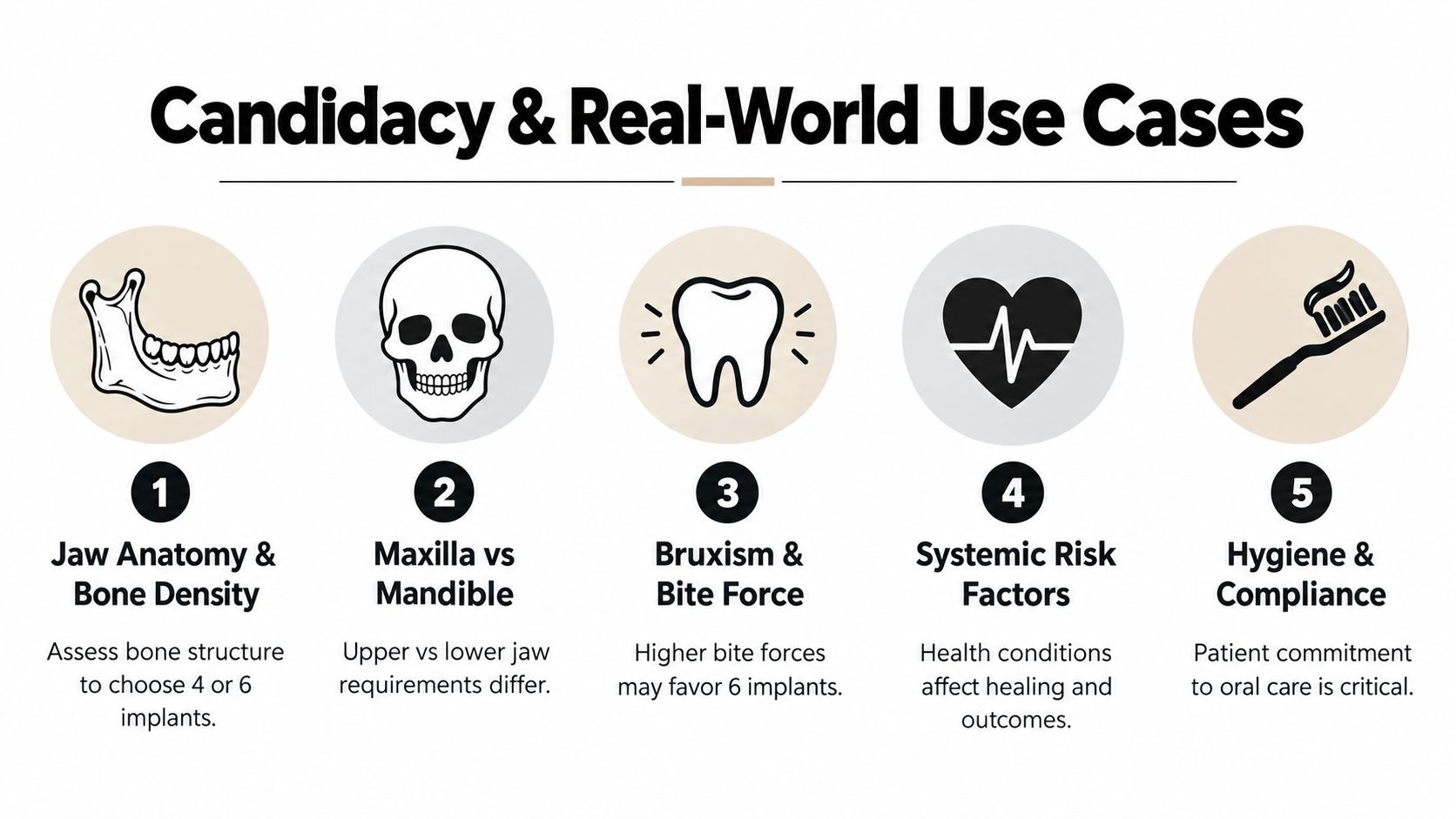
The right configuration starts with the jaw, but it ends with the person. Two patients can have similar scans and receive different recommendations because their bite forces, health, expectations, and ability to maintain the bridge aren't identical.
Situations that may favor All-on-4
A patient with limited posterior bone may benefit from a plan that uses tilted posterior implants rather than immediately pursuing grafting. This is especially relevant when the patient wants a fixed arch but prefers fewer surgical sites and a more efficient foundation.
All-on-4 may also fit a patient whose lower jaw offers suitable bone and whose bite is moderate and well controlled. The decision still depends on imaging, implant positioning, and prosthetic design. Fewer implants aren't a shortcut around diagnosis.
A patient who struggles with lengthy treatment may value a plan that avoids additional procedures when clinically appropriate. That preference needs to be balanced against the consequences of implant loss, repair access, and future maintenance.
Situations that may favor All-on-6
Six implants may be attractive when the jaw has enough bone for broader distribution and the clinician wants more support across the arch. A patient with heavy clenching, grinding, or substantial bite force may benefit from a design that reduces stress concentration, although the clinician must also manage the bite and protect the prosthesis.
The upper jaw deserves careful planning because bone anatomy and density differ from the lower jaw. A six-implant plan may be considered when the available maxillary bone supports it, but implant count alone doesn't replace an assessment of sinus anatomy, bone quality, prosthetic space, and hygiene access.
Health and behavior affect either plan
Uncontrolled medical conditions, active periodontal disease, smoking, poor plaque control, and inconsistent attendance can undermine either configuration. The clinician may need to stabilize the gums, review medications, coordinate medical care, or adjust the timing before surgery.
Hygiene capacity is practical candidacy, not a minor detail. If a patient can't clean under a fixed bridge or attend maintenance visits, adding implants won't remove that risk. Guidance on who is a good candidate for dental implants can help you prepare, but only an individual examination can determine suitability.
The long-term study mentioned earlier is a useful warning. In that cohort, All-on-6 showed higher implant survival, but lower prosthesis success. That combination reinforces the need to match the entire treatment system to the patient rather than selecting six implants based on a single assumed advantage.
Cost Maintenance and Long Term Value Considerations
The less expensive option at surgery isn't automatically the less expensive option over the life of the restoration. A responsible estimate should include implants, abutments, provisional and final prostheses, imaging, extractions, anesthesia, possible grafting, follow-up, hygiene care, and likely repair pathways.
All-on-4 may reduce the number of implant components and may avoid some grafting procedures when angled posterior placement is suitable. All-on-6 adds two implants and their components, and it may require more available bone in the planned sites. The difference must be calculated for your anatomy, not inferred from a generic price per implant.

Maintenance belongs in the budget
Both options require professional monitoring and daily cleaning. The practice may need to remove the bridge for inspection, evaluate tissue health, check the bite, retighten or replace components, and repair worn or fractured prosthetic teeth.
More support points can add redundancy, but they can also add areas requiring cleaning and components that must be inspected. Four implants can simplify some aspects of the foundation, while a failure affecting one implant may have a greater effect on the support pattern. The bridge contour and access for hygiene often determine the practical burden.
What the evidence means for value
A comparative study of immediate full-arch fixed prostheses found no significant difference between All-on-4 and All-on-6 for implant survival, prosthesis survival, biological complications, technical complications, or marginal bone loss. It reported a hazard ratio of 1.0 for implant survival, with no statistically significant differences in marginal bone loss during the first, fifth, or tenth year. Review the comparative clinical evidence.
That evidence supports a total-cost view. Pay for the design that offers a sound fit for your anatomy and risks, then confirm how the practice handles maintenance and repairs. For a broader discussion of dental implant costs, ask for a written treatment estimate that separates surgical, prosthetic, and follow-up charges.
How to Choose the Right Option With Your Clinician
A good consultation should produce a reasoned answer, not a sales pitch built around implant count. Ask your clinician to show you the CBCT scan and explain where bone is available, where each implant would go, and whether the posterior implants need to be tilted.
Then ask how the proposed bridge will manage force. The important details include cantilever length, implant spacing, bite design, framework material, tooth material, provisional loading, and the plan for the definitive prosthesis.
Bring this checklist:
- Anatomy: Is there enough bone for four or six implants in the planned positions?
- Risk: Which personal factors raise the chance of biological or mechanical complications?
- Prosthesis: What restoration will be used initially, and what is the long-term design?
- Maintenance: How will I clean under it, and how will the team inspect or remove it?
- Contingency: What happens if an implant, screw, framework, or tooth develops a problem?
- Fees: Which services are included, and which future repairs or replacements are separate?
The most important decision point is whether the extra two implants change your risk enough to justify additional surgery, components, and cost. They may matter when the jaw permits a wider support pattern and the patient places high functional demands on the bridge. They may add complexity without a clear outcome benefit when four implants can be positioned well, the prosthesis is carefully designed, and the patient can maintain it.
A 2026 systematic review and meta-analysis found broadly similar pooled survival for both concepts, while cautioning that heterogeneity limits simple ranking. Its reported survival figures were 99.20% versus 100% at one year, 99.66% versus 98.55% at one to five years, and 98.14% versus 97.50% at five years or more for All-on-4 and All-on-6, respectively. Read the systematic review and meta-analysis.
Before accepting a final recommendation, make sure the clinician has reviewed your records, imaging, bite, health history, and maintenance expectations. A dental implant procedure should be planned around those details, not selected from a menu based only on four versus six.
Paul L. Gregory, DDS evaluates full-arch implant options with modern diagnostics and restorative planning, including All-on-4 treatment for patients seeking a fixed alternative to removable dentures. Visit Paul L. Gregory, DDS to schedule a consultation and discuss whether four or six implants fits your anatomy, bite, health, and long-term maintenance goals.