

You're sitting in a Midtown dental office with two missing back teeth, trying to compare a single implant and crown with a full-arch solution such as All-on-4. The brochure shows sleek scans, computer-guided surgery, ceramic materials, and promises of precision. Your practical question is simpler: which technology is likely to improve your result, and which one mainly sounds modern?
That distinction matters. Dental implant technologies can improve planning, fit, surgical control, and restoration design, but no scanner or robotic system replaces a careful diagnosis, healthy tissues, thoughtful surgery, and consistent maintenance. The right choice depends less on owning the newest device than on matching a tool to your bone, gums, bite, medical history, and goals.
What a Modern Dental Implant Actually Does
The patient across from the dentist has lost two molars. One option is a single implant for each missing tooth, with separate crowns. Another discussion turns toward replacing an entire arch with a fixed prosthesis supported by several implants. Both sound like “implant treatment,” but they solve different problems.
A modern implant has three connected parts:
- The implant post sits inside the jaw and functions as an artificial root.
- The abutment connects that post to the visible restoration.
- The crown, bridge, or full-arch prosthesis replaces the part of the tooth or teeth you see and use.
The post isn't a screw holding a crown in place. Its shape, threads, diameter, length, and surface are selected to create initial mechanical stability and encourage the surrounding bone to heal against it. The design aims to spread chewing forces through the jaw in a way that resembles a natural root, although an implant doesn't reproduce every feature of a living tooth.
The patient-centered question: Don't ask only which implant system is newest. Ask what problem the system solves in your mouth.
A natural tooth has a periodontal ligament between its root and the bone. That tissue provides a small amount of movement and helps the body sense pressure. An implant lacks that ligament. Instead, the post becomes directly integrated with the jawbone through a biological process discussed below.
Traditional bridges and dentures rest above the gumline. A bridge can replace a missing tooth by using neighboring teeth for support, while a denture replaces several teeth through a removable base. An implant-supported restoration uses the jawbone for support and can avoid preparing healthy neighboring teeth in a single-tooth case. The choice still depends on anatomy, hygiene, cost, comfort, and long-term maintenance.
A useful overview of dental implants can help you understand the basic treatment sequence. The more important consultation question remains direct: does a particular technology meaningfully improve stability, comfort, safety, or maintenance for your case, or is it mainly a premium feature?
How Osseointegration Makes Implants Last
An implant becomes dependable through healing, not through the metal alone. Osseointegration describes the direct structural and functional contact between living bone and a load-bearing implant without fibrous tissue. Modern implant dentistry became a clinical field in 1965, when Per-Ingvar Brånemark placed the first osseointegrated dental implants in Gösta Larsson. Brånemark later coined the term in 1976, and Larsson's fixed prosthesis reportedly remained in place until his death 40 years later. These historical details are documented in this account of Brånemark's 1965 milestone.
The biological sequence
The clinician prepares the site carefully, places the implant below the gumline, and allows the surrounding tissues to begin repairing. A blood clot forms around the surgical area, bringing cells and growth factors that start the healing response.
As healing progresses, bone-forming cells move toward the implant's microscopic surface. Over approximately six to twelve weeks, bone can grow onto that textured surface and lock the post into the jaw. The exact timing varies with the site, bone quality, implant stability, grafting, and the person's health.
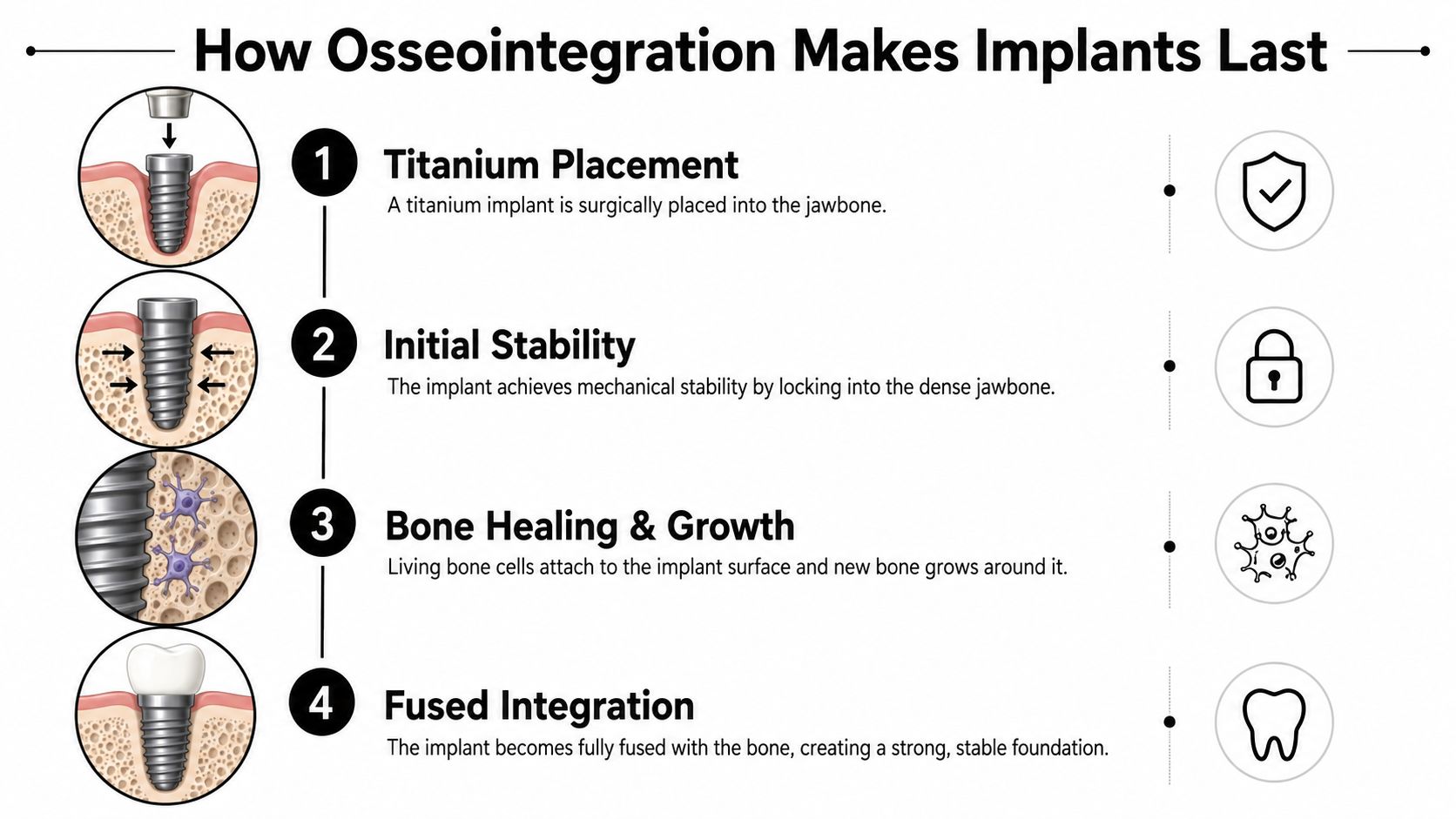
This healing differs from what happens around a natural tooth. A natural root is cushioned by the periodontal ligament, while an integrated implant is joined directly to bone. That direct connection provides stability, but it also means the implant depends on careful force control and healthy surrounding tissue.
What healing feels like in daily life
Your dentist may recommend a softer diet during early healing because chewing forces can disturb the developing interface. Smoking can slow healing, and uncontrolled diabetes can interfere with tissue repair and infection control. These factors don't automatically rule out treatment, but they deserve attention before surgery.
Some patients need a second-stage procedure to uncover the implant after it heals beneath the gum. Others receive a design that leaves the implant accessible during healing. Your dental implant healing process guide can provide general context, but your clinician must determine the appropriate sequence for your anatomy.
Surface engineering supports this bone response, yet a modified surface can't compensate for poor placement, excessive loading, untreated gum disease, or inadequate home care. The technology helps create conditions for integration. Biology still has to complete the work.
Implant Materials Beyond Titanium
Material selection usually comes down to four patient priorities: how the implant may look through the gum, whether metal is a concern, how the design interacts with available bone, and how strong the long-term evidence is.
Commercially pure titanium remains the default for a reason. It has a long clinical track record, and manufacturers can modify its surface to support bone attachment. Titanium is also strong and relatively forgiving during implant design and restoration planning. For many patients, the most evidence-based choice is not the most exotic material. It's a well-planned titanium implant placed in a healthy, maintainable environment.
Zirconia is a tooth-colored ceramic. It can appeal to patients with thin gum tissue in the smile zone or those who prefer a metal-free option. That aesthetic benefit is real in selected situations, but “metal-free” doesn't automatically mean better. Zirconia is more brittle than titanium, and its long-term clinical evidence still trails titanium's established history.
Newer alloy approaches include titanium-zirconium and β-type alloys. Materials such as Ti-6Al-4V and Roxolid are discussed for situations where strength or a narrower implant design may be useful. The clinician still has to assess whether the proposed benefit matters for your bone volume, bite, restoration, and surgical plan.
Recent reviews describe titanium as the gold standard while also examining zirconia, titanium-zirconium alloys, β-type alloys, and PEEK. They highlight trade-offs involving stress shielding, aesthetics, brittleness, bioactivity, manufacturing, and the need for careful clinical selection in this review of emerging dental implant materials.
Dental Implant Materials Compared
| Material | Aesthetics | Allergy/Sensitivity | Bone Preservation | Evidence Strength |
|---|---|---|---|---|
| Commercially pure titanium | Usually favorable, though gray color may matter with thin tissue | Metal concerns require individual review | Well established when properly planned and maintained | Strongest long-term track record |
| Titanium-zirconium alloy | Similar to titanium | Still a metal-based option | May support narrower designs in selected anatomy | Established but not as extensive as conventional titanium |
| β-type titanium alloy | Similar to titanium | Metal-based, with composition reviewed case by case | Being explored for stress and biological considerations | Developing evidence |
| Zirconia | Tooth-colored and attractive in selected visible areas | Metal-free ceramic option | Clinically useful in selected cases, with limitations | Long-term evidence trails titanium |
| PEEK and other emerging materials | Depends on the final design and covering restoration | Material-specific evaluation is required | Being explored for biological and mechanical trade-offs | Early or developing evidence |
The practical conclusion is straightforward: choose the material after discussing the clinical problem, not before. Ask why a dentist recommends titanium, zirconia, or an alloy for your specific site, and ask what evidence supports the choice.
Guided Surgery and Digital Planning
Guided surgery isn't one gadget. It's a connected workflow that starts with diagnosis and ends with transferring a plan accurately to the mouth.
From scan to surgical plan
A cone-beam computed tomography scan, or CBCT, maps the jaw in three dimensions. It can show bone height and width, the position of nerves, the relationship to the sinus, and areas where grafting may be needed. That information is more useful than a two-dimensional image when the implant must avoid nearby anatomy.
Digital impressions add the shape of the teeth, gums, and bite. Software can combine the CBCT data with the digital model so the clinician plans the implant in relation to the final crown, bridge, or full-arch prosthesis. This is an important change in thinking. The team isn't planning a post in isolation. They're planning a restoration that must look right, clean well, and receive manageable chewing forces.
The software helps determine position, angle, and depth. In some cases, a 3D-printed surgical guide transfers that plan to the surgical site. The guide can reduce guesswork, but it doesn't eliminate judgment. Its accuracy depends on the scan, the planning process, the guide's fit, and the surgeon's ability to respond to what the tissues show.
A digital X-ray explanation for teeth can make the broader role of digital imaging easier to understand. CBCT is different from a routine dental image, and your clinician should explain why the additional imaging is justified.
Where advanced guidance helps
Guided planning is particularly valuable when bone is limited, nerves or sinuses are close, or several implants must line up with one prosthesis. It can also support a minimally invasive approach and make immediate temporary teeth more predictable when the patient meets the biological and mechanical requirements.
Dynamic navigation adds real-time visual guidance during surgery. Robotic systems may add another layer of control, but neither approach replaces examination, tactile feedback, or the ability to change the plan when the anatomy differs from the scan.
The evidence gap matters. A recent review describes movement toward AI-guided planning, robotics, additive manufacturing, and patient-specific designs, while noting that long-term clinical validation remains limited, especially for robot-assisted surgery. It also identifies cost, workflow complexity, and follow-up duration as important constraints in this review of advanced implant technologies.
Single Implants, Bridges, and All-on-4
These treatments aren't competing versions of the same procedure. They correspond to different patterns of tooth loss.
A single implant replaces one missing tooth with one post, one abutment, and one crown. It usually preserves the neighboring teeth because they don't need to serve as bridge supports. Cleaning resembles caring for an individual tooth, although the implant and gum still need specific hygiene techniques.
An implant-supported bridge replaces several adjacent teeth using implants as supports. The number of implants depends on the span, bone, bite, restoration design, and surgeon's plan. A bridge may reduce the number of surgical sites compared with placing a separate implant for every missing tooth, but cleaning beneath the prosthesis requires instruction and commitment.
All-on-4 is a full-arch strategy. Four implants, sometimes more, support a complete fixed prosthesis. The back implants are often angled to use available bone and avoid anatomical structures, which can reduce the need for grafting in selected patients. Immediate temporary teeth may be possible, but they're not guaranteed by the label alone.
Dental Implant Treatment Options Compared
| Option | Best For | Typical Support | Key Trade-Off |
|---|---|---|---|
| Single implant and crown | One missing tooth with suitable surrounding conditions | One implant, one abutment, one crown | Requires adequate local bone and careful cleaning around the implant |
| Implant-supported bridge | Several adjacent missing teeth | Two or more implants supporting a connected restoration | Cleaning beneath the bridge can be demanding |
| All-on-4 full arch | Extensive tooth loss or an unusable arch | Four implants, sometimes more, supporting a full-arch prosthesis | Requires maintenance, sufficient conditions, and commitment to the prosthesis |
| Removable overdenture | Patients who want added denture stability without a fixed arch | Implants retaining a removable denture | The appliance still comes out and needs regular cleaning |
A full-arch plan doesn't automatically suit someone missing two molars, just as a single crown isn't a solution for an arch with widespread tooth failure. Remaining teeth, bone volume, gum health, medical conditions, budget, and fixed-versus-removable preferences should drive the recommendation.
Patients comparing fixed implant teeth with conventional dentures may also benefit from reviewing denture treatment examples, while remembering that photographs can't replace an examination or three-dimensional planning.
Benefits, Risks, and Who Is a Good Candidate
Implants can restore a missing tooth without reducing healthy neighboring teeth for a conventional bridge. A well-designed restoration may look and feel natural, support biting, improve speech, and prevent the movement associated with some removable dentures. Because the implant receives functional forces through the jaw, it may also help limit the bone shrinkage that follows tooth loss.
Those benefits come with surgical and maintenance responsibilities. Possible complications include infection, poor bone healing, loosening of components, implant fracture, damage to a crown or bridge, and injury to nearby nerves or sinus structures. The risk profile changes with the site, surgical difficulty, health history, bite, hygiene, and restoration design.
Dental Implant Benefits, Risks, and Candidate Factors
| Benefits | Risks and Limitations | Candidate Factors |
|---|---|---|
| Replaces missing teeth with fixed or removable implant-supported teeth | Infection and inflammation around the implant can occur | Healthy or treatable gums |
| Can avoid preparing healthy neighboring teeth in a single-tooth case | Bone healing may be delayed or fail | Adequate bone or a plan to rebuild it |
| May support chewing, speech, and denture stability | Components, crowns, bridges, or prostheses can loosen or break | Effective daily oral hygiene |
| Functional loading may help limit post-extraction bone shrinkage | Surgery can affect nearby nerves or sinus structures | Realistic expectations and willingness to attend maintenance |
| Can be tailored to single-tooth, bridge, or full-arch needs | Treatment may require grafting, staged care, or medical coordination | Medical conditions reviewed and managed |
Risk management begins before surgery
Poorly controlled diabetes, heavy smoking, untreated gum disease, significant radiation therapy, certain medications, and inadequate bone can make treatment more difficult. These factors often require management rather than an automatic “no.” A dentist may recommend periodontal treatment, bone grafting, sinus elevation, site preservation, or coordination with your physician first.
Suspected titanium sensitivity deserves a careful medical and dental review. Titanium allergies are uncommon, and switching materials without confirming the concern can create a different set of compromises.
Your guide to dental implant candidacy can help you prepare for a consultation. Long-term care includes professional maintenance, cleaning around the implant, tobacco avoidance, and a night guard when grinding threatens the restoration.
Maintenance matters: The placement appointment starts the treatment. Daily cleaning and scheduled reviews protect the tissues and the restoration afterward.
Choosing the Right Implant Plan for You
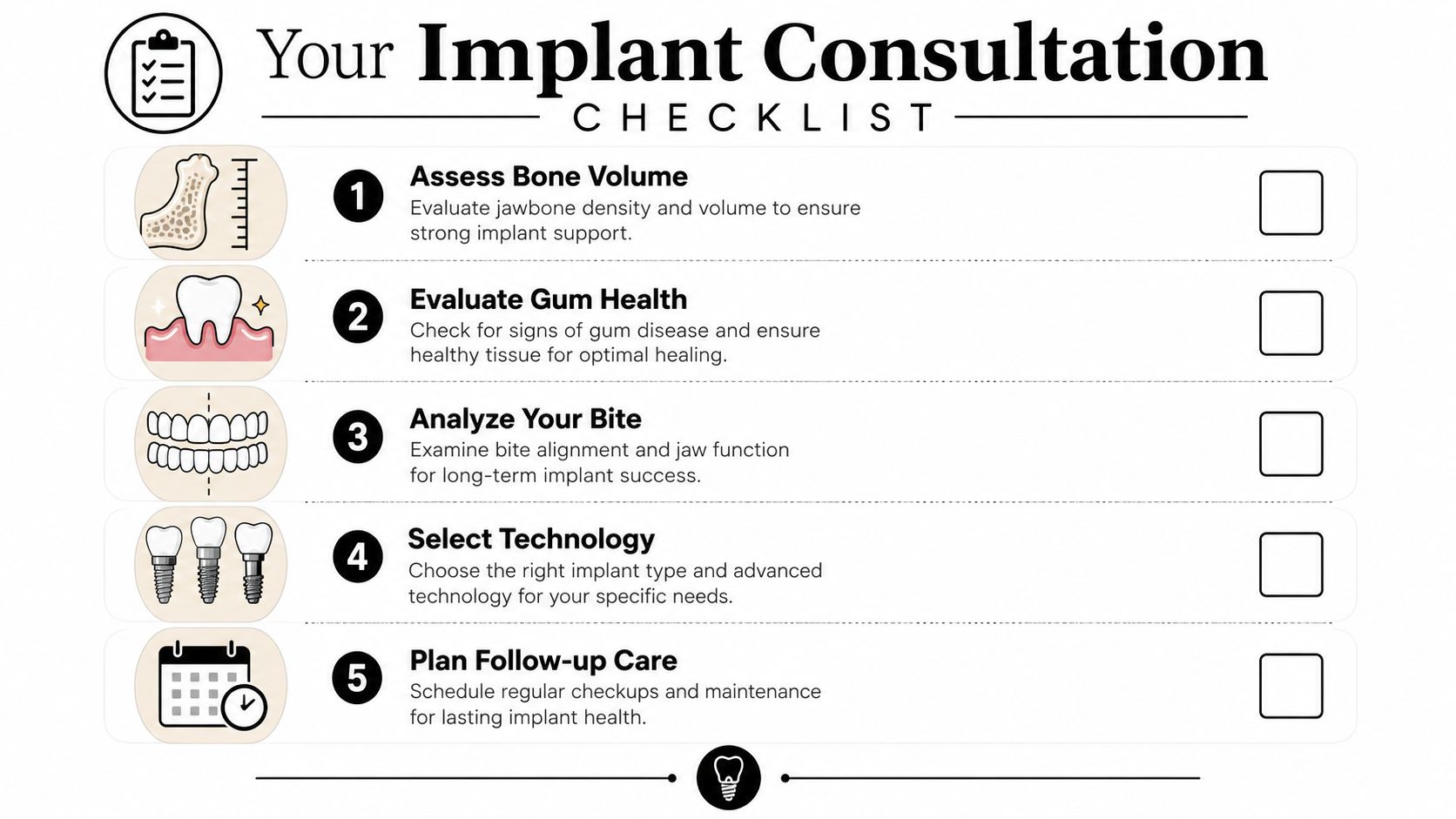
A sensible decision starts with the diagnosis, not the device. The clinician should assess bone volume, gum health, bite force, remaining teeth, medical history, and your preference for fixed or removable teeth. Technology then supports the plan.
Use this simple framework during a consultation:
- Identify the problem. Is one tooth missing, are several adjacent teeth absent, or is the entire arch failing?
- Check the foundation. Does the bone support an implant now, or is grafting and staged healing needed?
- Match the restoration. Would a single crown, multi-unit bridge, removable overdenture, or full-arch prosthesis be practical to clean and maintain?
- Select useful technology. CBCT, digital impressions, guided surgery, or another system should answer a specific clinical need.
- Plan the years afterward. Discuss hygiene, maintenance visits, bite protection, repairs, and replacement of prosthetic components.
Consider three familiar Midtown situations. A healthy 45-year-old replacing one molar may need a single implant and crown, with digital planning if the nerve, sinus, or bone contours make positioning difficult. A 62-year-old denture wearer with moderate bone loss may be better served by an implant overdenture or full-arch plan after evaluating retention, bone, hygiene, and expectations.
A patient taking bisphosphonate therapy may need a careful medication review, medical coordination, treatment of active dental disease, and staged grafting rather than an immediate implant. The important point isn't the patient's age or the name of the medication alone. It's the complete risk assessment.
A practice such as Paul L. Gregory, DDS offers implant dentistry alongside diagnostic, restorative, periodontal, and maintenance care, allowing the consultation to address the surrounding teeth and tissues as well as the implant itself.
Bring these questions to your visit:
- Which finding makes this technology useful for me?
- What are the alternatives, including conventional bridges or dentures?
- What evidence supports the material and surgical approach?
- What happens if healing is slower than expected?
- How will I clean and maintain the final restoration?
If you're considering a single implant, an implant-supported bridge, or an All-on-4 full-arch restoration, Paul L. Gregory, DDS can evaluate your bone, gums, bite, and overall treatment goals with modern diagnostic tools. Visit Paul L. Gregory, DDS to schedule a consultation and discuss which dental implant technologies serve your needs.