

For most patients, Invisalign takes 12 to 18 months. Minor alignment cases can finish in 6 to 9 months, while complex bite corrections can stretch to 18 to 30 months or longer.
That's the honest answer I give in consultation. The calendar matters, because Invisalign isn't one uninterrupted stretch of tray wear, it has a setup phase, an active treatment phase, and sometimes a refinement phase that adds time after the first set of aligners is done.
The Real Invisalign Timeline Most Patients Experience
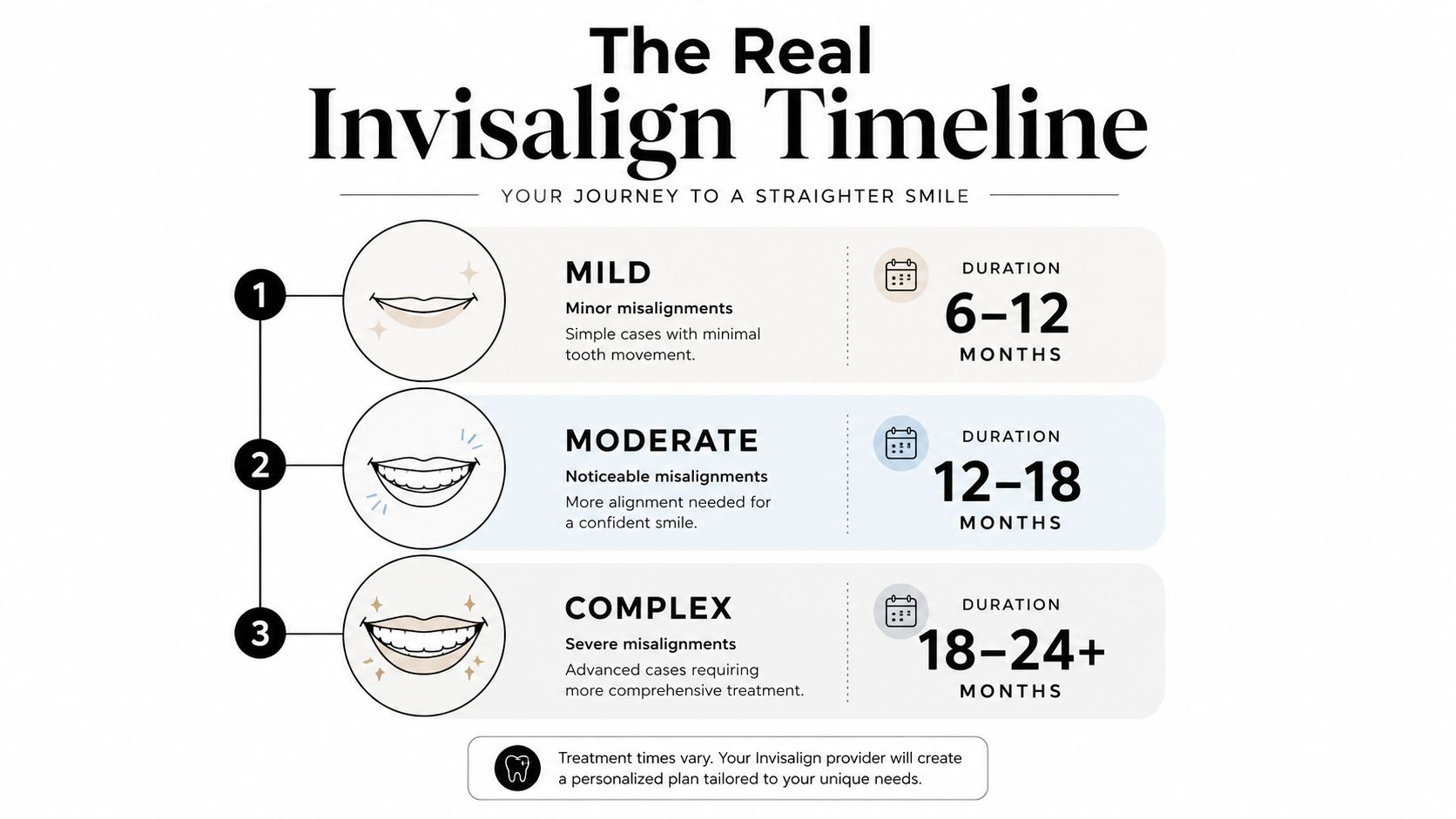
The most useful way to think about how long does Invisalign take is to stop looking for one average and start looking at three separate phases. For most patients, the overall course is a medium-length orthodontic process, not a quick cosmetic fix, and typical treatment commonly lands around 12 to 18 months with broader ranges of 6 to 24 months depending on the case. Clinical experience also shows that real-world treatment often clusters around one to one-and-a-half years, not a few weeks.
Phase one is the pre-treatment setup
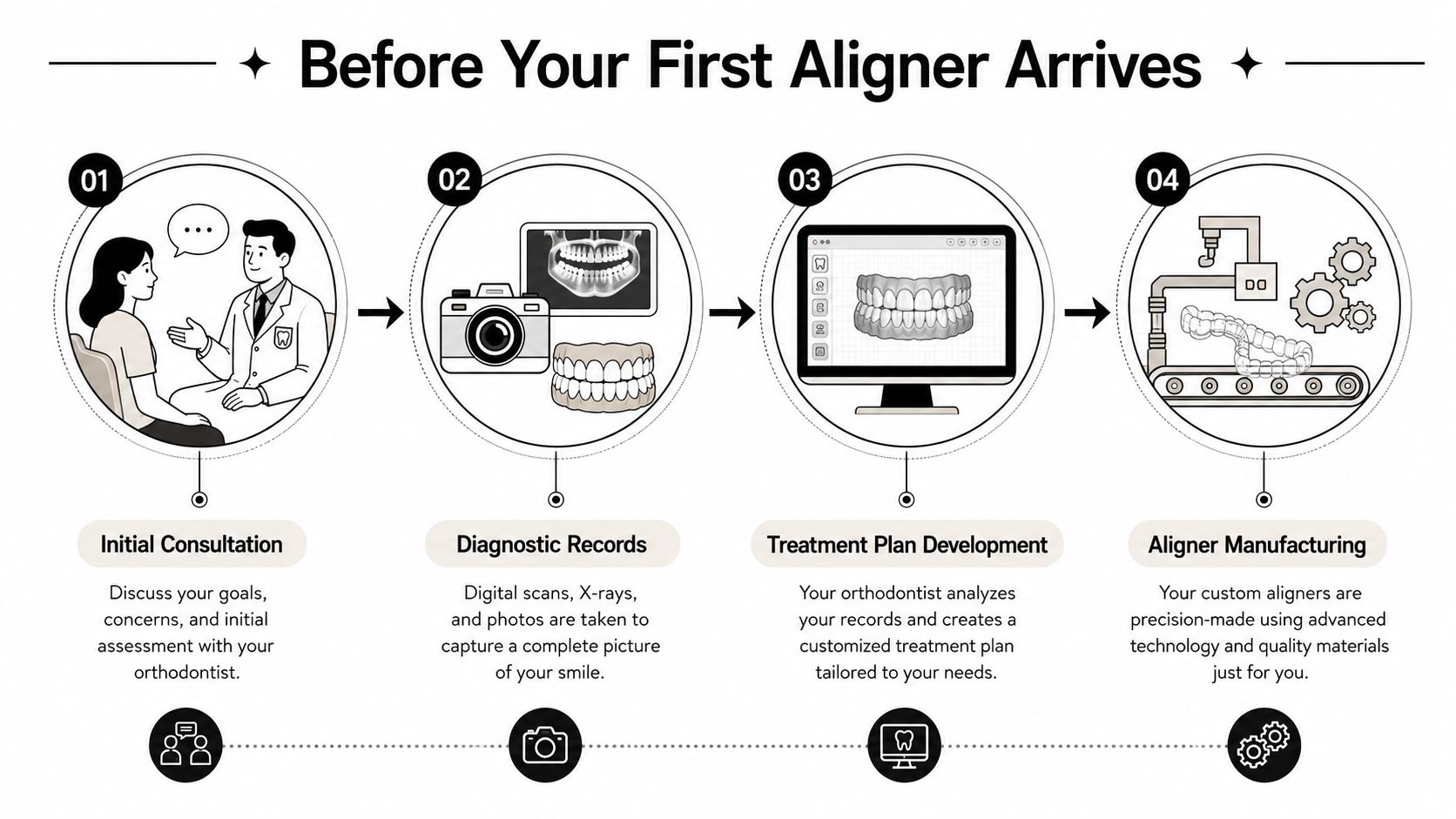
Before you wear a single aligner, the practice has to gather records, plan tooth movement, and send the case to the lab. That's why the calendar starts before tray wear starts. In practical terms, the scan-to-first-tray period often adds a few weeks that patients don't count at first.
Phase two is the active aligner phase
This is the part commonly envisioned, the period when you wear trays, change them on schedule, and come in for progress checks. For simpler cases, that phase can be relatively short. For moderate crowding or spacing, it usually runs much longer, and for bite correction it can become the dominant part of the timeline.
Phase three is refinement and retention
The first set of aligners doesn't always finish the job completely. Refinement aligners, small adjustments, and retention each extend the total calendar commitment. That's why the number of trays on day one is not the same thing as your final end date.
Practical rule: If a treatment estimate sounds unusually fast, ask whether it includes the time before the first tray and any refinement sets after the initial series.
If you're comparing options, the Invisalign page at Paul L. Gregory, DDS is a straightforward place to review what the treatment looks like in a Midtown setting.
What Happens Before Your First Aligner Arrives
The delay before the first tray is normal, and patients are usually more frustrated by that pause than by the treatment itself. Once the consultation is done, the office needs records, planning time, and lab fabrication time before the aligners are ready. That's why the first phase has a real calendar footprint even though you're not actively wearing anything yet.
The setup steps that add time
A typical visit sequence starts with an exam and a conversation about goals. Then come digital scans, X-rays, and photos, followed by treatment planning and approval. After that, the aligners are manufactured and shipped back to the office.
The important part is that this isn't wasted time. The dentist uses the records to decide whether the case is simple enough for aligners alone or whether it needs attachments, bite correction, or other adjustments to keep treatment predictable.
In practice, that production delay is often about 2 to 4 weeks before the first aligners arrive. If a second refinement set is needed later, that adds more months to the total timeline. The wait can feel slow, but it's the part that makes the active phase less improvisational.
The most efficient offices don't skip records to save days. They use them to avoid months of rework later.
A detailed case also depends on diagnostic imaging, which is why the office may request dental X-rays before treatment begins. For busy patients, that front-loaded planning often prevents avoidable delays after treatment is already underway.

Treatment Duration by Case Complexity
Case complexity is the biggest reason one person finishes Invisalign quickly while another needs much longer. A small alignment correction and a bite correction are not the same clinical project, even if they both use clear aligners. Real-world averages from clinical literature show treatment commonly landing around 13.35 months in one university-based cohort and 18 months in another comparative study.
| Invisalign Treatment Duration by Case Type | Typical Duration | Common Conditions |
|---|---|---|
| Mild | 6 to 9 months | Small gaps, slight crowding, limited front-tooth alignment |
| Moderate | 12 to 18 months | Noticeable crowding, spacing, mild bite correction |
| Complex | 18 to 30 months or longer | Significant bite correction, rotation, comprehensive movement |
Mild cases usually move fastest because the tooth movements are simpler and fewer refinements are needed. Moderate cases tend to sit in the middle because they combine alignment with more precise finishing. Complex cases need longer because the teeth, bite, and final fit all have to line up together.
That's why a friend's six-month story doesn't predict your timeline. Two smiles can look similar from the outside but need very different mechanics underneath. The person with a small gap between front teeth may be done quickly, while the patient with crowding and bite imbalance has a far longer road.
For patients comparing aligners and braces, the treatment page for Orthofx or Invisalign is one way to think through the trade-offs before committing.
Why Refinements Extend Your Treatment Beyond the Original Estimate
A lot of people assume the first set of aligners is the whole plan. It usually isn't. Refinements are additional aligners ordered after the initial series, and they're part of normal orthodontic care rather than a sign that something went wrong.
Why the first estimate changes
Teeth don't always move exactly as predicted on the first pass. Small differences in tracking, bite settling, or patient wear can leave details unfinished. When that happens, the dentist may order extra aligners to fine-tune the result.
Compliance matters too. If trays aren't worn long enough each day, the teeth won't track as planned, and the case often needs extra time. That's one reason treatment estimates are always more reliable when they come from a provider who has already reviewed your records.
Align Technology's clinical evidence reports the G6 protocol required a mean of 2.1 years with about 35 ± 5 aligners, plus up to 7 additional months for refinement or additional aligners. That's the clearest reminder that the published tray schedule is often only part of the full timeline.
The smartest mindset is to treat the first estimate as a working plan, not a promise carved in stone.
If you want a broader view of aligner care, the clear aligner orthodontics category shows how refinement fits into modern treatment planning.
How Aligner Change Frequency Affects Your Total Duration
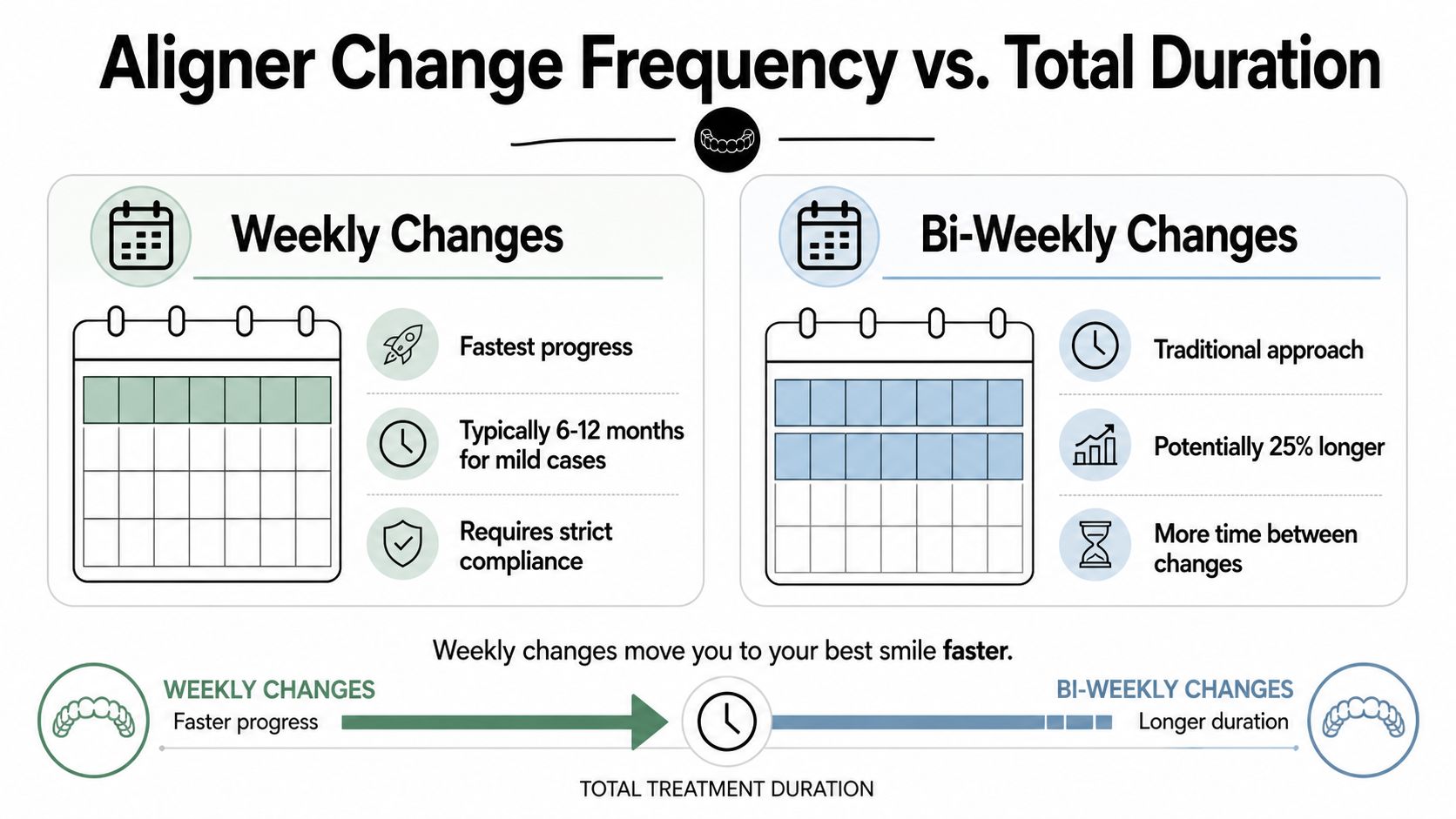
The speed of your treatment also depends on how often you switch trays. In a clinical study, the mean treatment duration in the 7-day aligner-change group was 5 months versus 9 months in the 14-day change group. That's a major difference, but it only works when the movement is monitored and the teeth are tracking as expected.
What patients can actually control
The biggest controllable factor is wear consistency. If you leave trays out too often, the schedule slips. If you keep them in as directed, the dentist can judge whether you're a candidate for a faster tray-change protocol.
- Wear time: Keep aligners in for the prescribed schedule, especially during workdays and travel.
- Tray changes: Don't accelerate changes on your own. The dentist has to confirm movement quality first.
- Appointment timing: Keep follow-ups on schedule so refinements, if needed, happen early instead of late.
The faster protocol isn't a loophole. It's a treatment choice, and it only belongs in cases where the orthodontist can verify that the teeth are responding properly. When used well, it shortens the active phase. When used casually, it just creates extra problems.
Planning Invisalign Around a Busy Professional Schedule
For Manhattan professionals, the timeline isn't just about biology, it's about calendar management. The treatment fits best when the office visit pattern is simple and the daily wear routine is realistic. Teledentistry can help with check-ins between visits, especially for patients who can't spare repeated in-office appointments, and you can review that option through teledentistry.
What a workable schedule looks like
The first month usually concentrates on records, planning, and tray delivery. After that, the active phase is mostly about routine: wear the aligners, keep the teeth clean, and show up for progress checks. If a refinement set is needed, the calendar extends, but the routine itself stays familiar.
Travel and late meetings are manageable if you plan ahead. Carrying the next aligner case, a toothbrush, and cleaning supplies makes a difference when your day runs long. The office can also use digital reviews for certain follow-ups, which cuts down on unnecessary office time.
Where the practice matters
A dentist who plans around your actual calendar can make the process easier to live with. In Midtown, Paul L. Gregory, DDS offers Invisalign care with modern diagnostics and a customized treatment timeline during consultation, which is exactly what busy patients need when they're trying to balance treatment with work.
Invisalign goes smoother when the schedule is built around your life, not the other way around.
If you're trying to fit treatment between client meetings, commuting, and travel, the cleanest approach is to ask upfront how many visits are likely, which ones are essential, and which ones can be handled remotely.
Common Questions About Invisalign Treatment Length
Is Invisalign faster than braces? Sometimes, but not always. A peer-reviewed review found Invisalign was associated with shorter treatment duration than fixed appliances overall, and one comparison reported 19.52 months for Invisalign versus 23.62 months for conventional braces. The answer still depends on your bite, your compliance, and whether refinements are needed.
What if you miss wear time on a few days? Progress slows, and the calendar usually stretches. Invisalign depends on steady daily wear, so inconsistent use is one of the easiest ways to lose time.
Can you speed it up on your own? No. The only safe way to shorten the timeline is to follow the plan closely and let the dentist decide whether a faster change protocol is appropriate.
How long do retainers last after Invisalign? Retainers are the part that protects the result after active treatment ends. The exact wear schedule is individualized, but you shouldn't think of completion as the end of orthodontic maintenance.
If you want a clear timeline based on your own teeth, schedule a consultation with Paul L. Gregory, DDS. You'll get a treatment plan built around your bite, your schedule, and the exact number of months it should take, not a guess that ignores the details.