

Osseous surgery recovery time runs about 2 to 4 weeks, the main postoperative window in which swelling, tenderness, bleeding and trouble chewing steadily improve. The tissues keep maturing well past that window, which is why two people can follow the same instructions and describe completely different recoveries.
So why does a gum that looks pink and calm still feel off limits for a steak six weeks later? Because visible healing and structural healing run on separate clocks, and only one of them shows up in the mirror. Knowing which clock you're reading changes how you plan the next month.
How Long Osseous Surgery Recovery Takes
When can you go back to a normal meal or a hard workout after osseous surgery? Symptom relief and finished tissue repair answer that question on different dates. Use the stage table as the lookup, then follow one rule: hard chewing and strenuous activity wait for your dentist, not for the week the soreness fades.
The main postoperative recovery is 2 to 4 weeks, according to the Cleveland Clinic review of osseous surgery. Swelling, tenderness, bleeding, and difficulty chewing improve across that stretch. The review is describing that main recovery window, not the last stage of biological maturation.
Three things move the range. How many teeth were treated, how severe the periodontal disease was, and how well your body heals. That review also notes recovery usually runs longer than after a routine cleaning or an uncomplicated filling, because osseous surgery reshapes supporting bone and repositions gum tissue.
What happens in each stage
| Stage | Typical Timing | What Is Happening | What to Do |
|---|---|---|---|
| Early healing | Days 1–3 | Clot forms within 24 hours; swelling and tenderness peak | Take medication as directed, rest, and eat soft foods |
| Fragile wound | Days 7–14 | Wound is still mechanically vulnerable; sutures are often reviewed around 1–2 weeks | Avoid brushing or chewing over the site until cleared |
| Main recovery | Weeks 2–3 | Wound closure occurs and discomfort largely eases while surface healing is not yet complete | Resume normal activity gradually with your dentist's approval |
| Flap reattachment | Weeks 4–5 | Gum flap reattaches to the tooth and alveolar bone | Keep follow-up visits and a gentle hygiene routine |
| Full connective repair | Weeks 7–8 | Deeper connective tissue repair completes | Return to your full hygiene routine under dentist guidance |
Weeks 2–3 mean wound closure, with discomfort largely easing, while the surface is still unfinished. A review of periodontal wound healing stages places clinical epithelialization at about 1 month, deeper connective-tissue repair at roughly 7 to 8 weeks, and full flap reattachment to the tooth and alveolar bone at about 4 to 5 weeks. That review also notes the wound stays mechanically vulnerable during roughly days 7–14. The second week is not the time to test a bite on crusty bread.
The days that matter most
The first several days set the foundation. A clot is forming, and swelling is at its height. Follow the postoperative instructions and protect the site then, and the later stages tend to stay on track.
Planning rule: Block out two to four weeks for work, travel, and demanding schedules. Treat the return of comfort as a milestone, not clearance. Hard chewing and strenuous activity resume only after your dentist examines the site and says the tissue can take that load.
Feeling normal at weeks 2–3 means the surface is closing and the soreness has eased. Deeper repair is still underway.
Why Comfort Returns Before Healing Ends
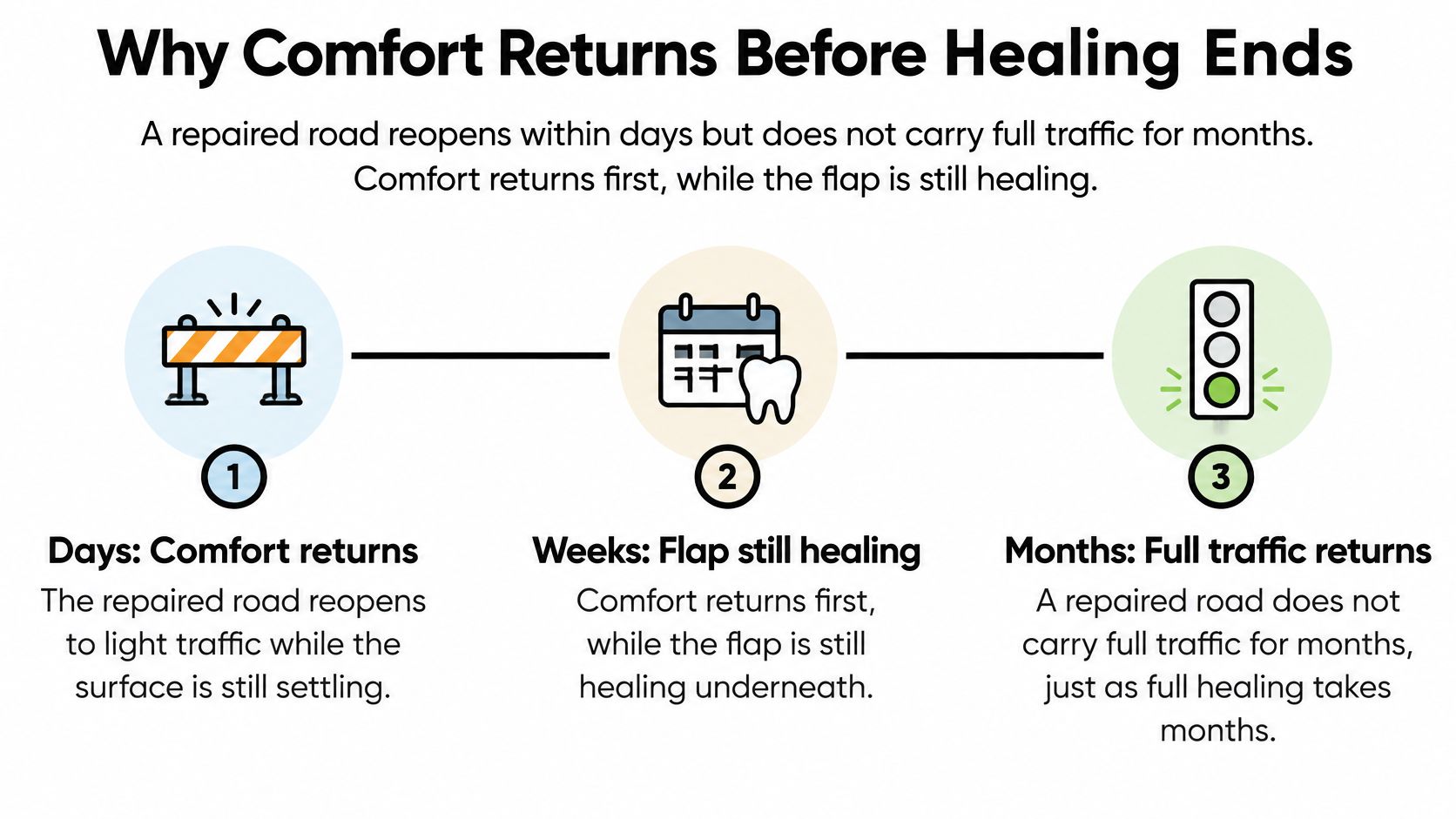
Think about a road repair. Crews reopen the lane within days so traffic can move, but the surface is still settling and the road won't carry full traffic for months. Your gum follows the same logic. Comfort returns first, while the flap is still reattaching underneath and the connective tissue is still remodeling.
That gap is where most confusion lives. A site can look sealed, feel fine to the tongue, and still be mid-repair at a structural level. Surface closure and reattachment continue well after the soreness fades, so a calm pink gum is a good sign, not a green light.
Practically, this is why brushing directly over the site, flossing around it, hard foods and strenuous exercise stay restricted even when you feel ready. The restriction isn't punishment for slow healing. It's protection for tissue that's rebuilding while it feels normal.
How the follow-up schedule tells the real story
Postoperative monitoring commonly extends past the initial recovery window. A clinical study of periodontal flap surgery recorded plaque at one week, healing at one and two weeks, and periodontal probing depth and bleeding again at six weeks and three months.
That schedule isn't arbitrary. Early visits check wound closure and hygiene technique. Later visits judge tissue stability and take periodontal measurements, which only mean something once the tissue has settled. Your appointments are a better progress report than your own eyes, and the periodontal maintenance visit schedule is what keeps those measurements from drifting back to where they started.
Judge healing by the appointment schedule and your surgeon's clearance, not by how the gum looks.
Factors That Speed Up or Slow Healing
The average timeline describes a straightforward case. Several factors push recovery longer or pull it shorter, and it helps to know which ones sit in your hands.
| Factor | Effect on Recovery | What Helps |
|---|---|---|
| Number of teeth or sites treated | More surgical areas usually extend recovery beyond the 2–4 week average | Ask whether treatment can be staged |
| Severity of periodontal disease | Deeper pockets and advanced bone loss mean more tissue to reshape and slower repair | Keep maintenance visits and treat disease early |
| Plaque control | Bacteria sustain inflammation at the wound and slow early healing | Use the rinse and cleaning method your dentist prescribes |
| Smoking | Slows tissue repair and can make healing less predictable | Stop smoking before and after surgery |
| Systemic health | Uncontrolled conditions such as diabetes slow repair | Keep existing conditions well managed and tell your dentist |
| Medications and supplements | Some affect bleeding or healing | Share a full list with your dentist before surgery |
| Concurrent regenerative procedures | Added procedures can extend the healing period | Ask for the combined expected timeline before surgery |
Plaque control is the one you influence most
Bacteria keep inflammation alive at a wound that's temporarily fragile. A randomized controlled study of 30 patients having osseous resective surgery compared a protocol of chlorhexidine rinsing plus sonic-toothbrush use from postoperative day 1 against a comparison protocol. The rinse-and-sonic group showed lower early wound-healing scores, greater plaque reduction and a milder inflammatory response on days 7, 14 and 28, with differences statistically significant at P < 0.01.
The lesson isn't to scrub an operated site harder. It's that cleaning instructions should protect the flap while limiting biofilm, which often means carefully controlled cleaning of accessible areas plus an antiseptic rinse for the surgical zone.
What you can change and what you should disclose
Sort the list into two piles. The first is behavior: smoking, hygiene, showing up for maintenance, following the rinse protocol. Those are yours to control, and they carry real weight.
The second is information you owe your dentist. Medications and supplements that affect bleeding or healing, uncontrolled diabetes, a history of slow healing, and any plan to add a regenerative procedure at the same time. Say it before surgery, not after.
If gum disease is still at an earlier stage, non-surgical gum disease treatment can sometimes reduce how much tissue needs reshaping in the first place. That's worth asking about before committing to a surgical date.
Daily Care and Pain Control Questions
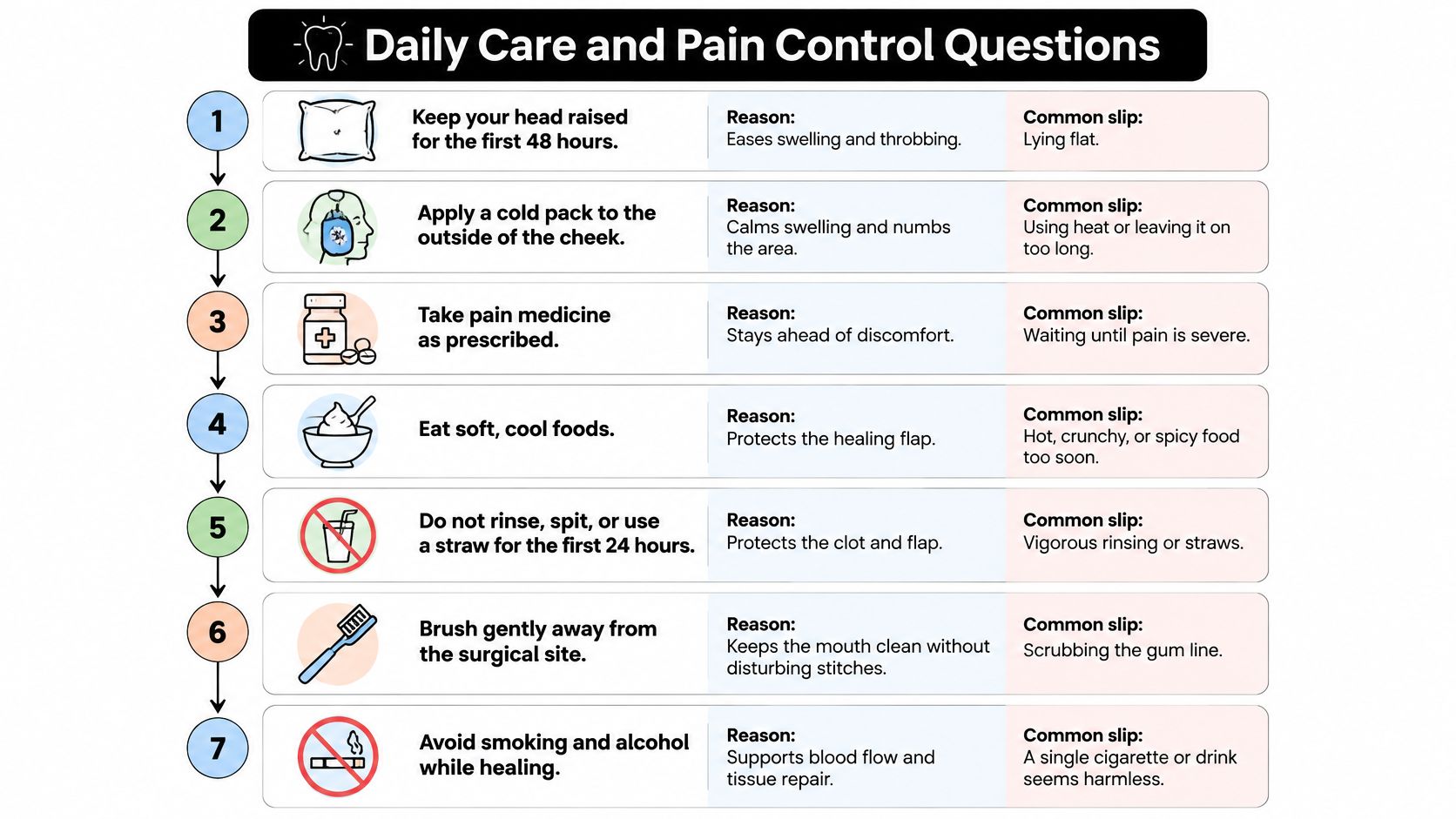
Small choices in the first week decide most of how the recovery goes. Think of the blood clot over the operated bone as scaffolding. Everything you do either protects it or knocks it loose. Below is the daily routine, with the biological reason behind each step and the mistake that usually undoes it.
- Keep your head raised for the first 48 hours. Elevation eases swelling and that throbbing, pulsing feeling. The common slip is lying flat on the sofa or sleeping without an extra pillow.
- Apply a cold pack to the outside of the cheek in short intervals early on. Cold calms swelling and numbs the area. The mistake is using heat too soon or leaving ice against bare skin long enough to damage it.
- Take pain relief as prescribed, timed before discomfort builds. Pain signals amplify once they get going, so staying ahead of pain is easier than catching up to it. Waiting until it's severe is the usual error.
- Eat soft, cool foods and stay off the operated side. Soft food protects the healing flap. Hot, crunchy or spicy food too soon irritates the site and can increase bleeding.
- Rinse only as directed, starting after your surgeon's time limit. Vigorous swishing can disturb the clot that everything else depends on. No straws either, since suction does the same damage.
- Keep brushing away from the site until you're cleared. Plaque near a fragile wound sustains inflammation, but so does a toothbrush scrubbing the gum line. Brush everything else normally.
- Avoid smoking, alcohol and strenuous exercise for the period your surgeon specifies. Smoke, alcohol and exertion all interfere with healing tissue and blood flow. One cigarette feels harmless and isn't.
What pain relief and add-ons actually deliver
Painkillers make the first days manageable. Whether anti-inflammatory medication shortens the overall recovery is a different question. A systematic review and meta-analysis of perioperative anti-inflammatory drugs in periodontal surgery concluded the evidence remains moderate-to-low certainty, with important limitations and a need for better randomized trials.
Platelet-based adjuncts such as platelet-rich fibrin are more nuanced. The research base on them is still small, and reviews report more consistent early soft-tissue healing and comfort benefits, while long-term regenerative effects stay uncertain. In practical terms, an adjunct may improve early symptoms in selected cases. It is not a guaranteed shortcut through the whole recovery window.
This distinction mirrors the bigger picture of recovery. Feeling comfortable sooner is not the same thing as bone and gum tissue finishing their repair, and no add-on on the market closes that gap. Before accepting either option, ask which outcome is being improved, by how much, what it costs, and whether it conflicts with your medications.
Here's a quick guide to aftercare following scaling and root planing if your surgical site was preceded by that treatment.
A recovery on track looks like this: swelling eases after the first few days, pain shrinks week by week, and bleeding stops within a few days. The order matters. Comfort improves first, and tissue strength follows well behind it, so keep treating the site gently even after it stops complaining.
Warning Signs That Mean You Should Call Your Dentist
Swelling and soreness that peak in the first days and then ease are expected. Symptoms that worsen, persist or spread after those early days are the ones to act on. That single rule sorts most of what you'll notice.
| Symptom | Usually Normal? | Action |
|---|---|---|
| Swelling and mild soreness in the first 3 days | Yes | Use cold packs and prescribed pain relief |
| Bleeding that continues or soaks through gauze | No | Call your dentist promptly |
| Pain that increases after day 3 instead of easing | No | Call your dentist |
| Fever or chills | No | Call your dentist promptly |
| Pus, foul taste or spreading redness | No | Call your dentist urgently |
| Numbness that does not fade | No | Call your dentist for review |
| Loose tooth or changed bite | No | Schedule a visit with your dentist |
| Trouble breathing or swallowing | No | Seek emergency care immediately |
Two of these deserve emphasis. Fever, chills, pus or a foul taste point toward infection and need prompt contact, especially when paired with spreading redness. An abscess or spreading dental infection is not something to watch over a weekend.
Numbness that doesn't fade, or a tooth that suddenly feels loose or sits differently when you bite, should be reported for review rather than monitored at home.
Emergency rule: trouble breathing or swallowing, or heavy bleeding that won't stop with firm pressure, means emergency care immediately. Don't wait for office hours.
Sutures are commonly reviewed in the first 1 to 2 weeks, so a missed follow-up is itself a reason to call and reschedule. Keep your surgeon's number, a list of your current medications, and a note of when each symptom started. That turns a worried call into a fast, useful one.
Confirm Your Recovery Plan with a Midtown Dentist
If your recovery is following the expected arc, keep your follow-up visits and let the surgeon confirm what's healed. If a warning sign appears, call early instead of waiting for the next scheduled check. That decision point is the whole game.
Paul L. Gregory, DDS is a Midtown Manhattan practice at 57 W 57th St, where osseous surgery sits alongside scaling and root planing, gum reduction, crown lengthening and frenectomy as part of periodontal care. Dr. Gregory tries the minimum fix first and tells patients upfront when additional procedures are required, so the plan is clear before surgery rather than after. The office also offers short-notice visits and makes every effort to schedule dental emergencies as quickly as possible. If you're still weighing whether surgery is the right step, the practice's guide to finding a dentist for gum disease walks through what to look for.
Patients come from Chelsea, Midtown, Hell's Kitchen, the Theatre District, Hudson Yards, Turtle Bay, Lenox Hill, the Upper East Side and the Upper West Side. Others travel in from Gramercy Park, the West Village, Greenwich Village, NoHo, the East Village, SoHo, Tribeca, Chinatown and the Wall Street area. New York City and MTA maps of Manhattan treat these as distinct neighborhoods, which is why access and travel time differ so much from one to the next.
Have these ready when you call:
- Your surgery date and how many days it's been
- Which teeth or sites were treated
- Current medications, including anything for pain
- Symptoms and when they started, in plain language
- Your questions about the timeline, especially hard chewing, exercise and returning to normal brushing
Paul L. Gregory, DDS offers osseous surgery and the periodontal care around it, from scaling and root planing through post-surgical maintenance, at a Midtown office that's easy to reach from anywhere in Manhattan. If you're planning surgery or unsure whether your recovery is on schedule, bring your questions to an appointment and get a timeline built around your case rather than a generic estimate. Visit Paul L. Gregory, DDS to schedule your visit and confirm exactly when you can return to hard chewing, exercise and your normal hygiene routine.