

It's late, your tooth is throbbing, and you're searching “root canal needed” while wondering whether you'll sleep tonight. You may already have a dentist's recommendation, but still feel unsure about what makes the treatment necessary.
The decision depends on the condition of the pulp inside your tooth, not on how much it hurts alone. A painful tooth may recover with a filling. A tooth that feels perfectly comfortable may need treatment.
Why a Toothache Does Not Always Mean a Root Canal
Say cold water makes an old filling sting. You stop drinking, the sensation disappears, and the tooth feels normal again. Compare that with a tooth that keeps aching after the drink is gone, or starts throbbing without anything touching it. Those patterns deserve different investigations, even if you describe both as severe pain.
The pulp is the soft tissue containing nerves and blood vessels inside the tooth. Its condition generally falls into these categories:
- Reversible pulpitis: The tissue is irritated but can recover when the cause is addressed, sometimes with a replacement molar filling.
- Irreversible pulpitis: The pulp can no longer recover predictably.
- Pulp necrosis: The tissue has died, sometimes without producing ongoing pain.
Pain tells you something is wrong. Only a test tells you what.
Strictly speaking, dentists use several tests together, not a single result in isolation. The useful questions are whether the pulp can recover, whether infection has reached the surrounding tissues, and whether the tooth can be restored.
That's the distinction to understand if you have a lingering ache, a failing old filling, or a recommendation you want explained before agreeing to treatment.
Signs That Point to a Root Canal and What Each One Means
| Sign or symptom | What it usually points to | How soon to act |
|---|---|---|
| Sharp pain to hot or cold that lingers approximately 30 seconds or more after the stimulus is gone | Symptomatic irreversible pulpitis, the pulp may not recover | Book within a few days |
| Spontaneous throbbing pain, often worse at night or when lying down | Irreversible pulpitis or infection | Book within a few days |
| Pain when biting, or when the tooth is tapped | Inflammation in the ligament around the root tip, although cracks and bite problems can also cause it | Book within a few days |
| A pimple-like bump on the gum, gum swelling, or facial swelling | Infection draining from the root, possibly an abscess | Same day |
| Deep decay, a large failing filling, or a cracked or chipped tooth | Pulp exposed or at risk, sometimes before pain starts | At the next available exam |
| One tooth darker than its neighbors after a knock or injury | Possible pulp injury or necrosis | Within a couple of weeks, sooner for recent trauma |
| No pain, but an X-ray shows a dark area at the root tip | Possible necrotic pulp with inflammation around the root | As soon as the finding is confirmed |
| Pain that seems to come from the ear, sinus, or opposite jaw | Possible referred pain requiring testing to locate its source | Book within a few days |
| Sensitivity that fades within a few seconds of the cold leaving | Reversible inflammation or exposed dentin | Routine appointment unless worsening |
These are booking guides, not diagnoses or permission to wait through worsening symptoms. The lingering-sensitivity threshold is a clinical clue, not a stopwatch test you should repeatedly perform at home.
The signs that change urgency
A gum bump can represent a drainage pathway from an infected tooth. It may become smaller after draining, but that doesn't establish that the underlying problem has resolved. Facial swelling deserves same-day assessment rather than a routine appointment next week.
Our explanation of dental abscess symptoms and treatment can help you describe what you're noticing when you call. Don't squeeze a gum bump or keep pressing a swollen area to check it.
Pain location can also mislead you. A tooth problem may feel as though it comes from the ear or another part of the jaw, so the dentist tests nearby teeth rather than treating whichever tooth you first point toward.
Brief sensitivity isn't the same as persistent pulp pain
A quick cold twinge can come from exposed dentin, decay, or a leaking filling. It needs assessment, but it doesn't automatically justify removing the pulp.
You don't need every sign in the table before booking. A single persistent change is enough, and repeatedly searching for more symptoms can increase distress without clarifying the diagnosis. If that cycle feels familiar, Uptown Psychology on health anxiety offers useful context alongside, not instead of, a dental examination.
Patients travel from Midtown, Chelsea, the Upper West Side, the Upper East Side, Lenox Hill, Turtle Bay, Hell's Kitchen, and the Theatre District for assessment. The Manhattan community district map provides geographic context, not medical guidance.
A quiet tooth isn't necessarily a healthy tooth. An infected canal can cause little discomfort, which is why examination findings matter even when you feel fine.
How a Dentist Confirms a Root Canal Is Needed
A useful examination ends with a named diagnosis and an explanation of the evidence. It shouldn't end with an unexplained instruction to book treatment.
The American Association of Endodontists' diagnostic guidance describes lingering thermal pain of approximately 30 seconds or longer as a feature of symptomatic irreversible pulpitis, while emphasizing the combined interpretation of history, testing, and imaging.
The examination in practical order
Describe the history. Explain what starts the pain, what stops it, whether it occurs spontaneously, and any injury or recent dental work. Mention whether you can identify the tooth confidently.
Compare cold responses. The dentist places refrigerant on a cotton pellet and applies it to the tooth, usually comparing it with neighboring or opposite-side teeth. The duration and character of your response matter more than saying yes, it feels cold.
Add electric pulp testing when useful. A small electrical stimulus checks whether sensory nerves respond. It doesn't directly measure blood flow or prove that the entire pulp is healthy.
Check the surrounding tissues. Gentle tapping, called percussion, and pressure over the root area, called palpation, help identify inflammation outside the tooth.
Probe around the tooth and investigate cracks. Periodontal probing measures gum-pocket depth. A bite test and transillumination, shining light through tooth structure, may help locate a crack.
Examine the roots and bone. A periapical X-ray shows the root region. Small-field CBCT may be appropriate when conventional imaging leaves a specific diagnostic question unresolved, rather than being automatic.
Check restorability and agree on the verdict. The dentist assesses remaining tooth structure and support, then explains whether treatment, another restoration, further investigation, or reassessment makes sense.
| Test | What it checks | Result relevant to treatment |
|---|---|---|
| Cold test with refrigerant | Pulp sensory response and how long it lasts | Prolonged pain supports irreversible inflammation; absent response raises concern for necrosis |
| Electric pulp test | Whether sensory nerves respond | No response supports suspected necrosis when other findings agree; a response alone doesn't prove health |
| Percussion and palpation | Tissues around the root tip | Tenderness supports apical inflammation but doesn't identify its cause alone |
| Periodontal probing | Pocket depth and supporting tissues | An isolated deep pocket raises concern for fracture; shallow pockets don't prove pulp disease |
| Periapical X-ray or CBCT | Root anatomy and surrounding bone | An apical dark area, widened ligament space, or missed canal may support the diagnosis |
| Bite test and transillumination | Possible cracks | Pain on release or a crack line can change the restoration or extraction decision |
| Restorability check | Remaining sound tooth and support | Enough structure for a reliable seal supports saving the tooth; inadequate structure may prevent it |
Why the results must agree
A recently injured tooth may temporarily fail a sensory test. Conversely, an inflamed pulp can produce a strong lingering response before bone changes appear on an X-ray.
Ask before agreeing: What is my pulp diagnosis, what is the diagnosis around the root, and which findings support each?
Our guide to digital dental X-rays explains their role, but imaging never replaces the clinical examination. A normal-looking image doesn't cancel a convincing pattern of irreversible pulp inflammation.
When the Answer Is Not a Root Canal
The right treatment is the least invasive option that addresses the actual problem. A root canal isn't a precautionary procedure for every sensitive, cracked, or heavily filled tooth.
The ADA evidence review on dental pain and swelling highlights the importance of dental diagnostic testing, including pulp testing that generally isn't available in medical settings. The practical implication is straightforward: pain alone can't determine the treatment.
Cases where another approach fits
Brief cold pain with a recoverable pulp.
If the response stops promptly and the remaining findings support reversible inflammation, removing decay and sealing the tooth may be enough. Exposed dentin may instead need a desensitizing approach and correction of the cause.
A crack without irreversible pulp damage.
A crown or onlay may protect a restorable cracked tooth when testing indicates the pulp can remain healthy. A vertical root fracture is a different problem and often makes extraction necessary; removing the pulp won't repair the fracture.
Pain that isn't coming from the pulp.
Upper back-tooth discomfort can overlap with sinus symptoms, while jaw-muscle or joint pain can feel dental. Normal, consistent pulp responses and an examination that identifies another source argue against treating the tooth because that's where you feel pain.
An uncertain X-ray finding.
A dark area needs interpretation, not an automatic procedure. When the tooth responds normally and the findings don't fit together, comparison with previous images, further assessment, or planned reassessment may be safer.
A tooth that can't be restored predictably.
Severe structural loss or inadequate periodontal support can make saving the tooth impractical. A discussion of root canal treatment versus extraction should include whether an implant, bridge, or another replacement approach is appropriate.
Reassessment is a deliberate decision
Monitoring should come with a reason, a review plan, and instructions about changes that require earlier contact. It isn't the same as leaving an unresolved diagnosis unattended.
Heather described her experience on our reviews page: “Dr Gregory saved me from getting a root canal that I did not need.” That's an individual account, not proof about another patient's tooth, but it reflects an important principle: the recommendation must follow the findings.
For a second opinion, ask for pulp testing and a restorability assessment, not just another X-ray. Bring previous images and the original treatment recommendation so the dentist can compare the reasoning.
What Root Canal Treatment Involves From Start to Finish
Root canal treatment removes diseased pulp and allows the dentist to clean and seal the internal canal system. Knowing what each stage accomplishes makes the appointment less mysterious.
The opening stages focus on comfort and keeping the tooth isolated.
The treatment sequence
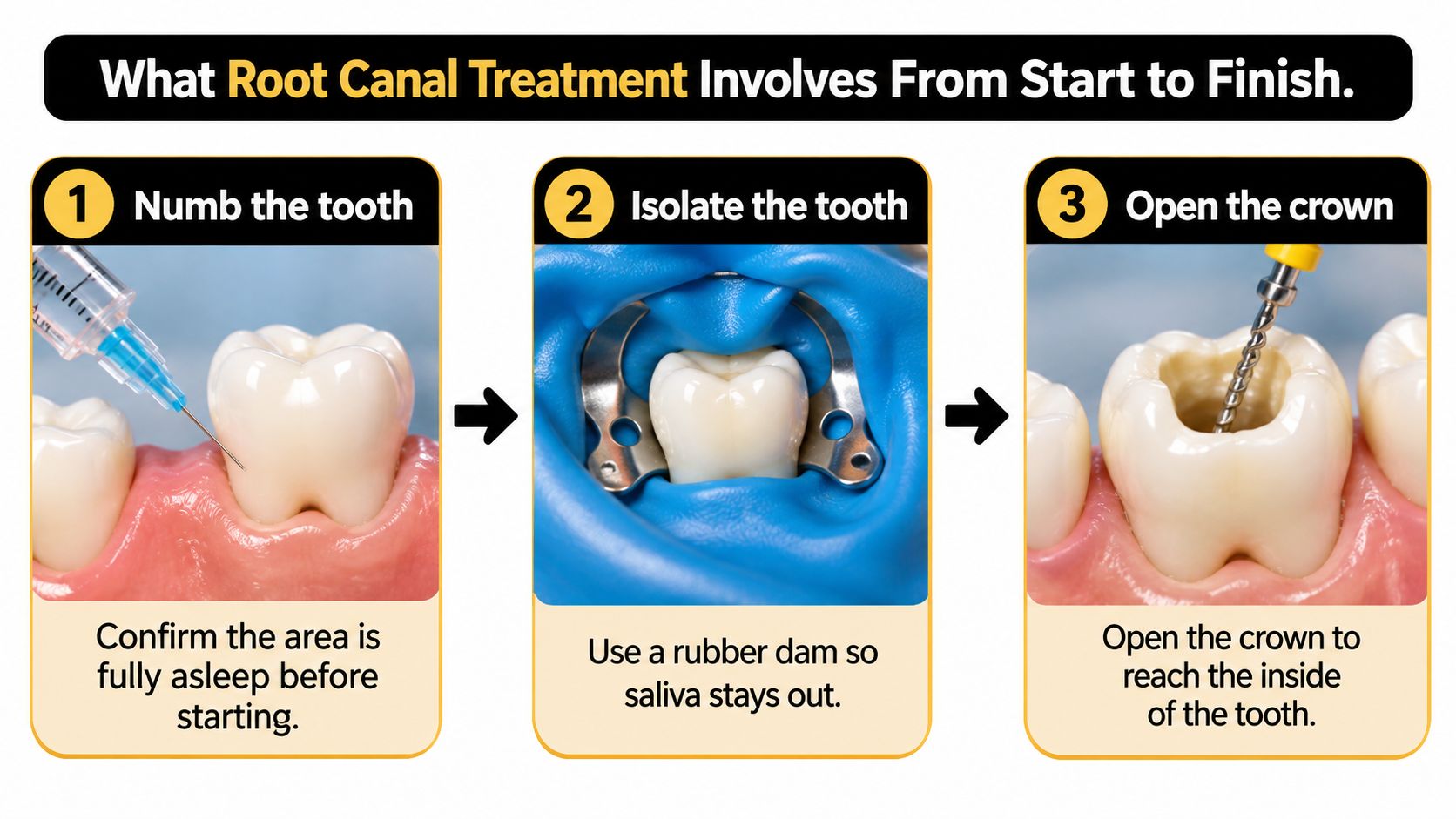
Numb the tooth. Local anesthetic is given, and the dentist checks that the area is adequately numb before beginning. Tell the dentist if you feel sharp pain so they can stop and adjust anesthesia.
Isolate it with a rubber dam. This protective sheet keeps saliva away from the working area. It also helps prevent instruments and irrigating solutions from entering your mouth.
Open the crown of the tooth. The dentist creates an access opening through the chewing surface or another appropriate surface. This provides access to the pulp chamber and canal entrances.
Clean and shape the canals. Fine endodontic files remove tissue and prepare the canal spaces. An electronic apex locator, supported by appropriate X-rays, helps establish the working length.
Irrigate thoroughly. Disinfecting solution reaches areas that files can't contact directly. Cleaning involves both instruments and irrigation, not pulling out a nerve.
Dry and seal the canals. The prepared spaces are filled with gutta-percha and sealer. If treatment needs another appointment, the dentist places an interim seal and explains the next step.
Rebuild the tooth's core. A buildup replaces missing structure and provides a foundation for the final restoration. A post is used only when needed for retention, not automatically.
Place the protective restoration. A crown, onlay, or another suitable restoration completes the plan. The choice depends on tooth position, remaining structure, and chewing forces.
Comfort, scheduling, and the final seal
Appointment length and the need for additional visits depend on canal anatomy, infection, and treatment complexity. Get an individualized estimate rather than assuming every tooth fits the same schedule.
Some tenderness afterward can occur, particularly when the tissues around the root were already inflamed. Your dentist should explain suitable pain relief based on your medical history and give clear instructions about worsening pain or swelling.
Paul described his experience on our reviews page: “The root canal was completely painless The team used modern technology and explained everything clearly.” Individual experiences differ, but pain during treatment is something to report, not endure.
This video offers another way to visualize the procedure.
What success figures actually mean
A systematic review of primary root canal treatment studies reported weighted pooled success of approximately 82.0% under strict clinical and radiographic criteria and 92.6% under less strict criteria.
| Outcome definition | Pooled success |
|---|---|
| Strict clinical and radiographic criteria | Approximately 82.0% |
| Less strict criteria | Approximately 92.6% |
These aren't personal guarantees. Pre-existing inflammation around the root tip lowers the likelihood of healing, and the quality of the canal filling and final restoration also matters.
A crown isn't necessary for every treated tooth, but a reliable definitive seal is essential. Leakage or fracture can compromise treatment, which is why planning root canal treatment and the restoration afterward belongs in the same conversation.
The Antibiotic Trap and Other Myths That Delay Treatment
A prescription can feel easier to fit into a workday than a dental appointment. But reducing symptoms or limiting bacterial spread isn't the same as treating the source inside a tooth.
The American Dental Association's antibiotic guidance says antibiotics are usually unnecessary for immunocompetent adults with irreversible pulpitis, symptomatic apical periodontitis, or a localized acute apical abscess when definitive dental treatment is available. Systemic involvement, such as fever or malaise, changes that assessment.
Beliefs worth correcting
- Antibiotics will cure it. They don't remove irreversibly inflamed or necrotic pulp, so selected patients may need them alongside dental treatment, not instead of it.
- The procedure must hurt more than the toothache. Treatment is performed with local anesthesia, and inadequate numbness calls for adjustment rather than pushing through pain.
- Pulling it is automatically simpler and cheaper. Compare the complete extraction-and-replacement plan, including suitability for an implant or bridge, rather than the extraction fee alone.
- It stopped hurting, so it healed. A change in symptoms doesn't establish recovery and may reflect a change in pulp status.
- Watching it means I can leave it indefinitely. Reassessment is appropriate only when the diagnosis supports it and there's a clear follow-up plan.
When the next step is urgent care
Facial or jaw swelling, fever, or feeling generally unwell warrants same-day assessment. Tell the office about these symptoms when you call rather than mentioning them only after arrival.
Difficulty breathing, difficulty swallowing, rapidly spreading swelling, or swelling that closes the eye requires immediate emergency medical assessment. Don't wait for a routine dental opening or rely on a prescription request.
Safety rule: Trouble breathing or swallowing is an emergency, not a symptom to monitor at home.
If access, cost, or anxiety is making you postpone care, say so directly. A dentist can distinguish urgent stabilization from the longer-term restoration plan, but can't make that judgment from pain intensity alone.
Book an Assessment Before the Pain Decides for You
When you call, describe the trigger, the duration, and any swelling. Explain whether the sensation stops when you stop drinking, continues afterward, or starts without a trigger. Mention a recent injury, broken filling, or previous recommendation.
Our office is at 57 W 57th St, near Central Park South and Columbus Circle. We offer short-notice visits and make every effort to schedule dental emergencies as quickly as possible.
Getting here and preparing
Patients come from Midtown, Chelsea, the Upper West Side, the Upper East Side, Lenox Hill, Turtle Bay, Hell's Kitchen, the Theatre District, Gramercy Park, the West Village, Greenwich Village, NoHo, the East Village, SoHo, Tribeca, Hudson Yards, Chinatown, and Wall Street, with subway routes connecting these areas to Midtown.
These are service-area descriptions, not separate medical jurisdictions. The Department of City Planning's Manhattan map provides planning context; neighborhood labels don't determine diagnosis, insurance eligibility, or treatment standards.
Bring:
- Your insurance card and any coverage information you already have.
- Your medication list, including allergies and relevant medical conditions.
- Your symptom timeline, including triggers and what happens afterward.
- Previous dental records, if available, especially recent images and recommendations.
The office can help review dental insurance plan options and explain coverage questions. The assessment should establish the diagnosis, whether the tooth can be saved, and the reasonable alternatives; request a written treatment plan with costs before authorizing treatment.
Paul L. Gregory, DDS offers root canal evaluation, treatment, and emergency assessment for painful or infected teeth, with restorative care when a tooth needs rebuilding. Visit Paul L. Gregory, DDS to arrange an assessment and get a clear explanation of whether your tooth needs a root canal or a different approach.