

You're awake at 2 a.m. with a throb that gets worse every time you lie flat, your cheek feels tight, and you're trying to decide if this is an emergency room problem, a same-day dentist problem, or something you can manage until morning. That decision matters more than the painkiller you choose. Emergency tooth pain usually comes from a tooth that needs a procedure, not just medication, but a small set of symptoms means medical care first. Sort yourself into the right row below, take only the self-care steps that actually help, and don't let a prescription convince you the tooth is fixed.
Triage Table for Where to Go Right Now
If you've got trouble breathing or swallowing, swelling spreading toward the neck, eyes or floor of the mouth, bleeding that won't stop with firm pressure, or a fever above 38°C (101.4°F) with facial swelling, go to the emergency room or call 911 now. Don't message a dental office and wait for a reply. Those signs point to airway risk, uncontrolled bleeding, or infection that's no longer contained in one tooth.
Why the destination matters
An emergency department can assess danger, control bleeding, and give medication for pain or spreading infection. It usually can't place a filling, crown, root canal or extraction, so patients often leave more comfortable while the cracked, decayed or infected tooth stays exactly as it was. I would send you to the ER for medical danger and to a dentist for dental urgency. Severe pain alone doesn't make the ER the faster fix, and mouth swelling that stays localized usually needs dental source control, not a hospital bed.
That split applies whether you're in Midtown, Chelsea, the Upper West Side, Upper East Side, Lenox Hill, Turtle Bay, Hell's Kitchen, the Theatre District, Gramercy Park, West Village, Greenwich Village, NoHo, East Village, SoHo, Tribeca, Hudson Yards, Chinatown or Wall Street. Find your symptom first, then think about travel.
| Symptom | Where to go | How fast |
|---|---|---|
| Trouble breathing or swallowing | Emergency room or 911 | Immediately |
| Swelling spreading to neck, eyes or floor of mouth | Emergency room | Immediately |
| Bleeding that will not stop with firm pressure | Emergency room | Immediately |
| Fever above 38°C (101.4°F) with facial swelling | Emergency room or urgent medical care | Same day |
| Knocked-out or displaced permanent tooth | Emergency dentist | Within the hour |
| Cracked tooth, broken filling or crown, severe pain | Same-day dentist | Same day |
| Localized abscess with pain and gum swelling | Same-day dentist | Same day |
| Mild toothache, no swelling, no fever | Dentist appointment | Within 24 to 48 hours |
Escalation signs that change the answer
The clinical guidance on dental abscesses lists fever above 38°C (101.4°F), severe facial swelling or hard lumps, tender neck lymph nodes, and an abscess larger than 1 centimeter as reasons to seek urgent medical care. Hospital-level evaluation is advised when pain cannot be controlled with painkillers, swelling causes shortness of breath or difficulty swallowing, dehydration develops because liquids cannot be taken, mouth opening becomes severely restricted, or swelling extends into the neck, around the eyes, or across the face.
If a gum bump, bad taste or localized swelling matches your picture, read the guide to dental abscess symptoms and treatment while you're on hold, not instead of calling. A bump that drains and feels better hasn't resolved, because the source inside the tooth or bone is still there.
Quick self-test: If you can eat, sleep and swallow, and swelling stays inside the mouth, a same-day dental appointment is usually the right call.
Self-Care Steps to Take in the Next Hour
A sudden toothache can make it hard to focus, but the next hour is for reducing irritation and arranging care. Home steps may ease pain temporarily. They will not repair decay, a crack, or an infected pulp.
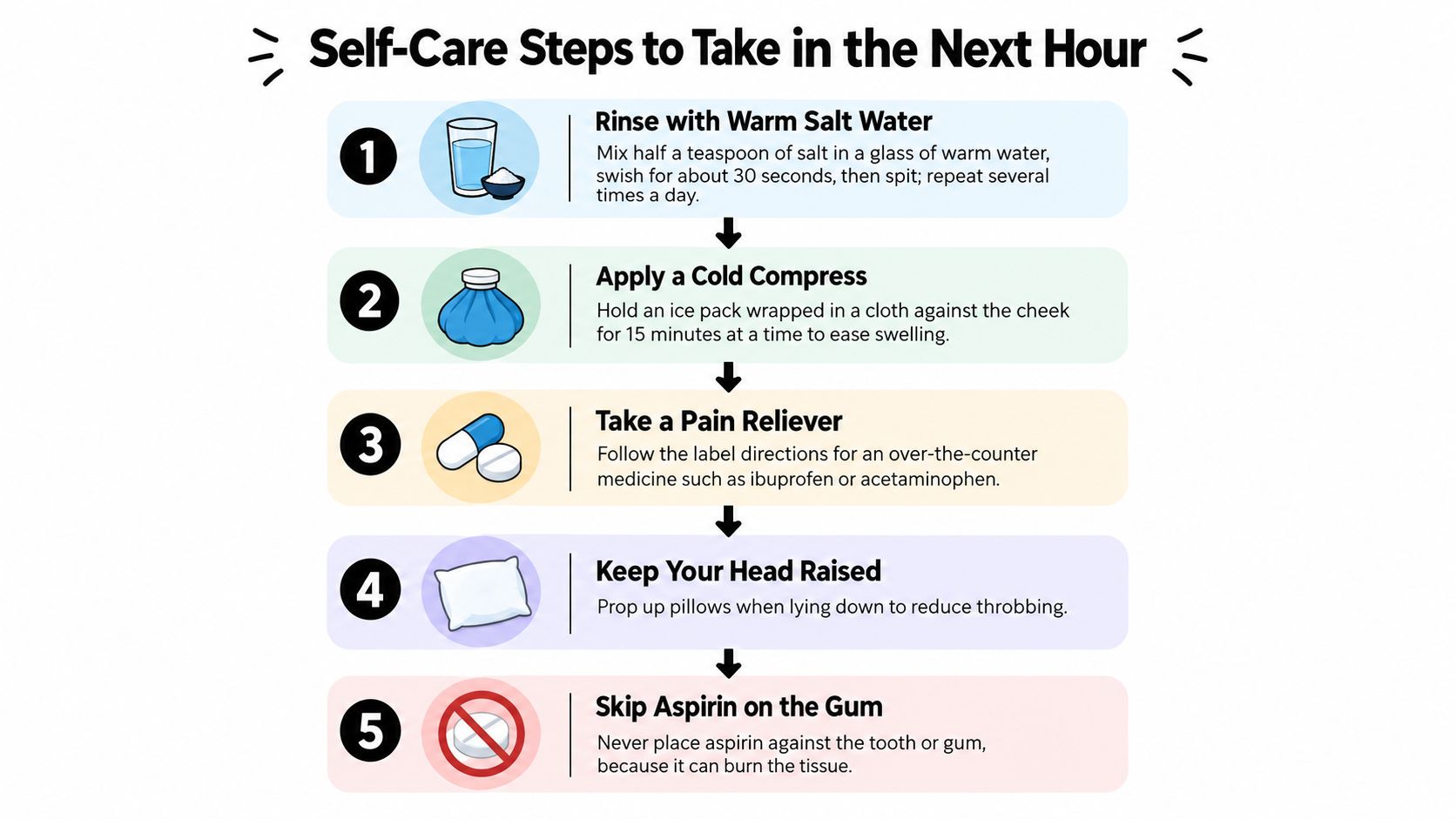
- Rinse with warm salt water. Stir half a teaspoon of salt into a glass of warm water, swish for about 30 seconds, then spit it out. Repeat several times a day to clear debris and soothe irritated gum.
- Floss gently around the sore tooth. Food caught between teeth can add to the pain, and careful removal may help within minutes. Do not force floss into swollen gum or snap it down hard.
- Cool the outside of your cheek. Wrap a cold pack in cloth and hold it against your cheek for 15 to 20 minutes, then rest for 20 minutes. Cold may ease swelling and numb the area. Avoid heat on the face, which can worsen swelling.
- Use an appropriate pain reliever. The ADA guidance on oral analgesics for acute dental pain identifies NSAIDs as a first-line option for dental pain, which is commonly inflammatory. It lists ibuprofen 400-600 mg every 6 hours for the first 24 hours for moderate-to-severe pain, or ibuprofen 400 mg plus acetaminophen 500 mg every 6 hours as another option.
- Keep your head raised. Use extra pillows when lying down. Throbbing can ease a little when you are upright.
- Protect the tooth until your appointment. Avoid very hot, very cold, or sugary foods, and chew on the other side. If a filling has come out, leave the hole alone rather than probing it with your tongue or packing it with household materials.
Never put aspirin directly on the gum. It can burn the tissue and create a painful ulcer. Set an alarm for each dose to avoid taking extra medication when pain and fatigue make it harder to keep track.
| Medication | Adult dose for dental pain | Daily maximum | Watch for |
|---|---|---|---|
| Ibuprofen | 400-600 mg every 6 hours for the first 24 hours | 2,400 mg | Stomach upset; avoid with ulcers, bleeding risk, or blood thinners |
| Naproxen sodium | 220 mg every 8 to 12 hours (OTC) or 550 mg every 12 hours if prescribed | 1,100 mg | Stomach and kidney cautions similar to ibuprofen |
| Acetaminophen | 500 mg every 6 hours, as the paired option with ibuprofen | 4,000 mg | Duplicate doses in cold, flu, or combination products; lower limit with liver disease or heavy alcohol use |
Lower limits may apply with liver or kidney disease, ulcers or bleeding risk, pregnancy, anticoagulants, or interacting medicines. Check cold and flu labels for acetaminophen too, since combination products can lead to accidental duplicate doses. For a travel or weekend bag, the Adventure Medical Kits dental emergency kit can help with temporary needs until care is available, but it cannot treat the cause.
If a tooth has broken, follow this broken tooth first-aid guide to protect fragments and sharp edges. If pain remains uncontrolled after 24 hours despite taking medication as directed, do not try stronger drugs at home. Arrange a dental visit.
Likely Causes Behind Sudden Tooth Pain
Untreated decay sits behind most cases. The American Dental Association summary of CDC data for 2015-2018 shows 25.9% of U.S. adults ages 20-44 had untreated dental caries, as did 25.3% of adults ages 45-64 and 20.2% of adults 65 and older, while 13.2% of children ages 5-19 had untreated caries. That's roughly one in four working-age adults walking around with decay that can advance without obvious warning signs.
Decay moves from enamel into deeper tooth structures, causing sensitivity, persistent or spontaneous pain, pulp inflammation, abscess formation and facial swelling. Once inflammation builds inside the pulp, pressure has nowhere to go because the tooth is a hard shell. That's why pain can shift from an occasional twinge with sweets to a constant throb in a short time.
| Pain pattern | Likely cause | Usual dental treatment |
|---|---|---|
| Lingering pain to cold or sweets | Deep decay near the pulp | Filling, or root canal if the pulp is inflamed |
| Throbbing ache that wakes you at night | Irreversible pulpitis | Root canal therapy, or extraction if the tooth cannot be saved |
| Sharp pain on biting that stops on release | Cracked tooth | Bonding, crown or root canal, depending on crack depth |
| Tender tooth with a gum bump or pimple | Dental abscess | Drainage, then root canal or extraction |
| Sensitivity after a lost filling or crown | Exposed dentin or leaking restoration | Replacement filling or crown, sometimes a temporary cover |
| Pain and jaw swelling behind the last molar | Partially erupted or infected wisdom tooth | Extraction and infection control |
Your triggers and timing narrow the cause, they don't confirm it. Lingering cold pain, night pain and pain on release point in different directions, but a crack below the gumline or decay under an old crown won't show in a bathroom mirror. If night pain is your pattern, this explanation of when a tooth needs a root canal outlines the signs dentists weigh. Only a clinical exam and a targeted X-ray confirm whether the tooth is restorable.
Why Antibiotics and Painkillers Don't Fix the Tooth
When tooth pain sends you to an emergency department, treatment may ease the pain or address immediate infection risks, but it often cannot repair the tooth. Decay, an inflamed or dead pulp, a leaking restoration, or a pocket of pus requires dental treatment. Medication can reduce pain or help control a spreading infection; it cannot rebuild tooth structure.
A 2025 analysis of Temple University Health System patients identified 2,918 dental-related ED visits among 89,349 patients. Of those visits, 70% involved an antibiotic prescription and 11% involved an opioid prescription. Emergency departments often cannot complete the dental procedure that removes or seals the source, so follow-up with a dentist is usually needed. A prescription may help bridge the gap, but it is not definitive treatment.
When antibiotics are and aren't indicated
The ADA guideline on antibiotics for dental pain and swelling recommends against antibiotics for most pulpal and periapical dental-pain conditions in otherwise healthy adults. Instead, it prioritizes definitive care, such as pulpotomy, pulpectomy, nonsurgical root-canal treatment, or incision and drainage. Acetaminophen or ibuprofen may also be appropriate. Antibiotics may be indicated when infection causes systemic signs, such as fever or malaise, or when a patient is severely immunocompromised.
For an ordinary toothache or localized dental abscess without signs of systemic or spreading infection, dental treatment is generally the priority. Unnecessary antibiotics can cause adverse effects and contribute to resistance. They may also create false confidence while the untreated source remains.
An antibiotic does not repair decay, seal a leaking restoration, remove an inflamed pulp, or drain every localized infection.
Painkillers have limits, even when they work well. If ibuprofen and acetaminophen help you sleep, use that relief to arrange dental care rather than canceling because the pain eases by morning. Pain can fade when the nerve dies, even as infection continues around the root tip.
Diffuse swelling, cellulitis, fever, or any airway concern needs prompt assessment, not home medication alone. Antibiotics may be part of medical stabilization, while a dentist or surgeon addresses the source.
Before you leave care, ask what procedure will remove or seal the source and when it will happen. Without a clear treatment plan, the tooth problem remains unresolved.
What Happens at an Emergency Dental Visit
A good emergency visit follows a sequence, and each step answers a specific question. You're not just getting a quick look and a prescription.
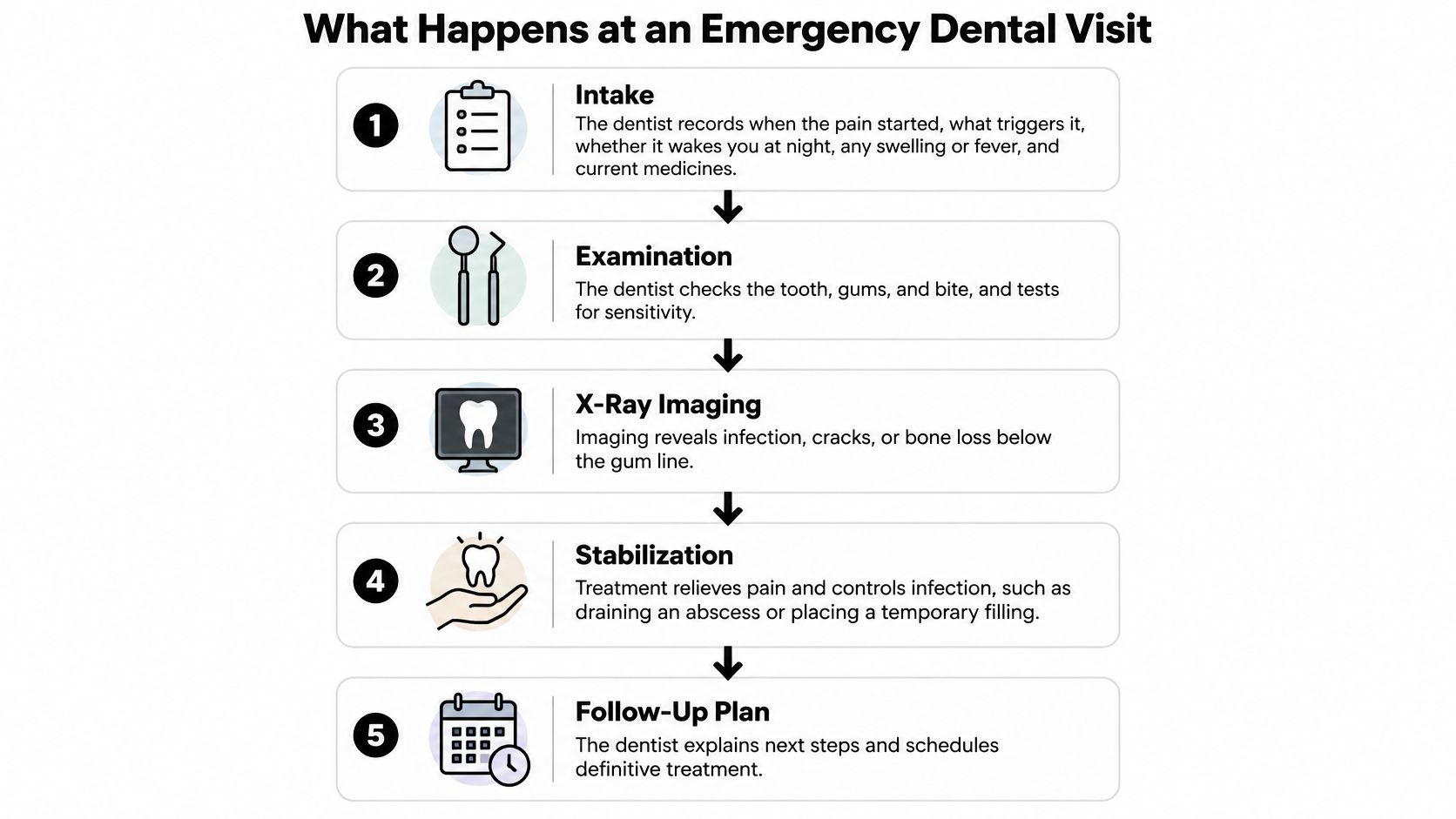
1. Intake. The dentist records when pain started, what triggers it, whether it's spontaneous or wakes you at night, any swelling or fever, medical risks and current medications. Bring dose times for painkillers, because that affects what's safe next.
2. Exam and testing. The tooth and surrounding tissues are examined, with pulp, percussion and palpation tests plus a periodontal assessment. Tapping pain, lingering cold response and gum probing help separate a nerve problem from a gum or bite problem.
3. Imaging. Targeted radiographs are obtained when indicated to look for deep decay, bone changes at the root tip, or a crack pattern. This overview of digital X-rays for teeth explains what those low-radiation images show, and an intraoral camera lets you see a broken margin or fractured cusp on screen.
This short video walks through how an urgent dental assessment is approached before definitive treatment is chosen.
4. Stabilization. The dentist removes irritants and may place a temporary restoration, drain an abscess when clinically indicated, start pulp therapy, extract a hopeless tooth, or refer you. The Cochrane review on antibiotics for severe toothache from irreversible pulpitis found only one small randomized study involving 40 people split between penicillin and placebo, with no significant reduction in toothache or analgesic use. That's why antibiotics aren't started for severe pain alone without systemic involvement.
5. Definitive plan. You'll hear whether the tooth needs a root canal, crown, extraction or specialist referral, with fees and insurance coverage discussed before treatment. You should leave with a named diagnosis, home instructions you can follow, and a booked follow-up date for the permanent repair.
Book a Short-Notice Visit from Your Manhattan Neighborhood
Paul L. Gregory, DDS at 57 W 57th St, near Central Park South and Columbus Circle, handles emergency assessment and stabilization with short-notice availability. For Midtown, Hell's Kitchen, the Theatre District, Hudson Yards, Turtle Bay and Lenox Hill, that's a short trip. Chelsea and nearby west-side neighborhoods are also close, while downtown travel needs a little more transit planning when you're in pain.
The NYC Insider Guide Manhattan neighborhood map places Chelsea between West 14th and West 34th Streets from Avenue of the Americas to the Hudson River, the Upper East Side between East 59th and East 96th Streets from Fifth Avenue to the East River, and the Upper West Side between West 57th and West 116th Streets from Central Park West to the Hudson River. Patients also come from Gramercy Park, West Village, Greenwich Village, NoHo, East Village, SoHo, Tribeca, Chinatown and Wall Street, so call before you travel rather than walking in and hoping.
- Call and say emergency tooth pain. List your symptoms from the triage table, including swelling, fever, trauma or a broken crown.
- Ask for the earliest short-notice slot. Ask whether the team can triage you by phone first, especially if you're unsure it's an ER case. If phone lines are busy, practices increasingly use tools like an automated voice assistant for appointment booking to capture urgent requests, but keep calling if symptoms are escalating.
- Bring your medication list and insurance card. Include painkiller dose times, allergies and any antibiotics you've already taken.
- Don't travel first if red flags are present. Ask the front desk for triage advice, and go to the ER instead if breathing, swallowing or spreading swelling is involved.
If you're comparing location and services, this guide to finding the best dentist in Midtown Manhattan for your needs covers what to check. Don't wait for the pain to decide for you.
If emergency tooth pain is keeping you from eating, sleeping or working, Paul L. Gregory, DDS offers short-notice assessment and stabilization for fractures, infection, broken restorations and severe toothache at 57 W 57th St in Midtown Manhattan. Call to describe your symptoms, ask for phone triage if you're unsure where to go, and get a definitive plan for the tooth, not just medication. Visit Paul L. Gregory, DDS to request care and take the next step today.