

No, a root canal isn't bad for your overall health. Modern evidence found weighted pooled success rates of 92.6% under broader criteria and 82.0% under stricter healing criteria, while leaving an infected tooth untreated allows the local infection to persist and potentially spread.
The most popular advice about root canals is often the least useful: “Avoid the procedure because it puts toxins into your body.” That warning comes from an old theory, not from modern endodontic evidence. The more practical question is whether your tooth can be predictably treated and restored, or whether an established infection should be left in place.
That distinction matters in Manhattan, where a packed schedule can make postponing care feel easier than confronting it. A painful molar in Midtown, Chelsea, or the Upper East Side may be competing with meetings, travel, childcare, or a demanding professional calendar. But delay doesn't turn an infected pulp into a harmless problem. It can make the tooth harder to restore and limit your choices.
Is a Root Canal Actually Bad for You
The blunt answer is no, a properly performed root canal isn't generally harmful to your overall health. The procedure removes infected or irreversibly inflamed pulp, disinfects the canal system, and seals the tooth. Modern evidence doesn't support the claim that a treated tooth routinely causes systemic disease. The American Association of Endodontists' safety guidance explains that contemporary research hasn't established a valid causal link between endodontically treated teeth and systemic illness.
The fear usually comes from the historical “focal infection” theory, which suggested that bacteria trapped inside treated teeth could drive disease elsewhere in the body. That idea has persisted online because it sounds plausible and because many patients heard it from relatives or alternative-health sources. Plausibility, however, isn't the same as evidence.
The comparison that matters
A root canal isn't a risk-free event. You can experience tenderness, a flare-up, reinfection, fracture, or treatment failure. No dental treatment guarantees permanent success. The relevant comparison is usually:
- Treated tooth: The dentist removes diseased pulp, cleans the canal, seals it, and restores the remaining tooth.
- Untreated infection: The infected pulp remains, and disease can extend through the root into surrounding tissue and bone.
- Extraction: The tooth is removed, but replacement may require additional planning and procedures.
That framework is especially important for professionals moving between Midtown, Turtle Bay, Hell's Kitchen, the Theatre District, and Hudson Yards. Fear can make every option sound equally dangerous, but they aren't biologically or functionally equivalent.
A patient with immunosuppression, significant cardiac disease, or poorly controlled diabetes should tell the dentist before treatment. Those conditions may affect infection risk, healing, and coordination with a physician. They don't show that root canals themselves are toxic.
What a Root Canal Procedure Actually Does
Think of a tooth as a small house with a central plumbing space. The enamel and dentin form the structure, while the pulp sits inside the canals and contains nerves and blood vessels. When deep decay, a crack, or trauma allows bacteria into that space, the pulp can become irreversibly inflamed or infected.
A root canal treats the inside of the tooth while preserving the outer structure. The dentist first confirms the diagnosis with an examination and imaging, then numbs the area and isolates the tooth. A small opening provides access to the canals.
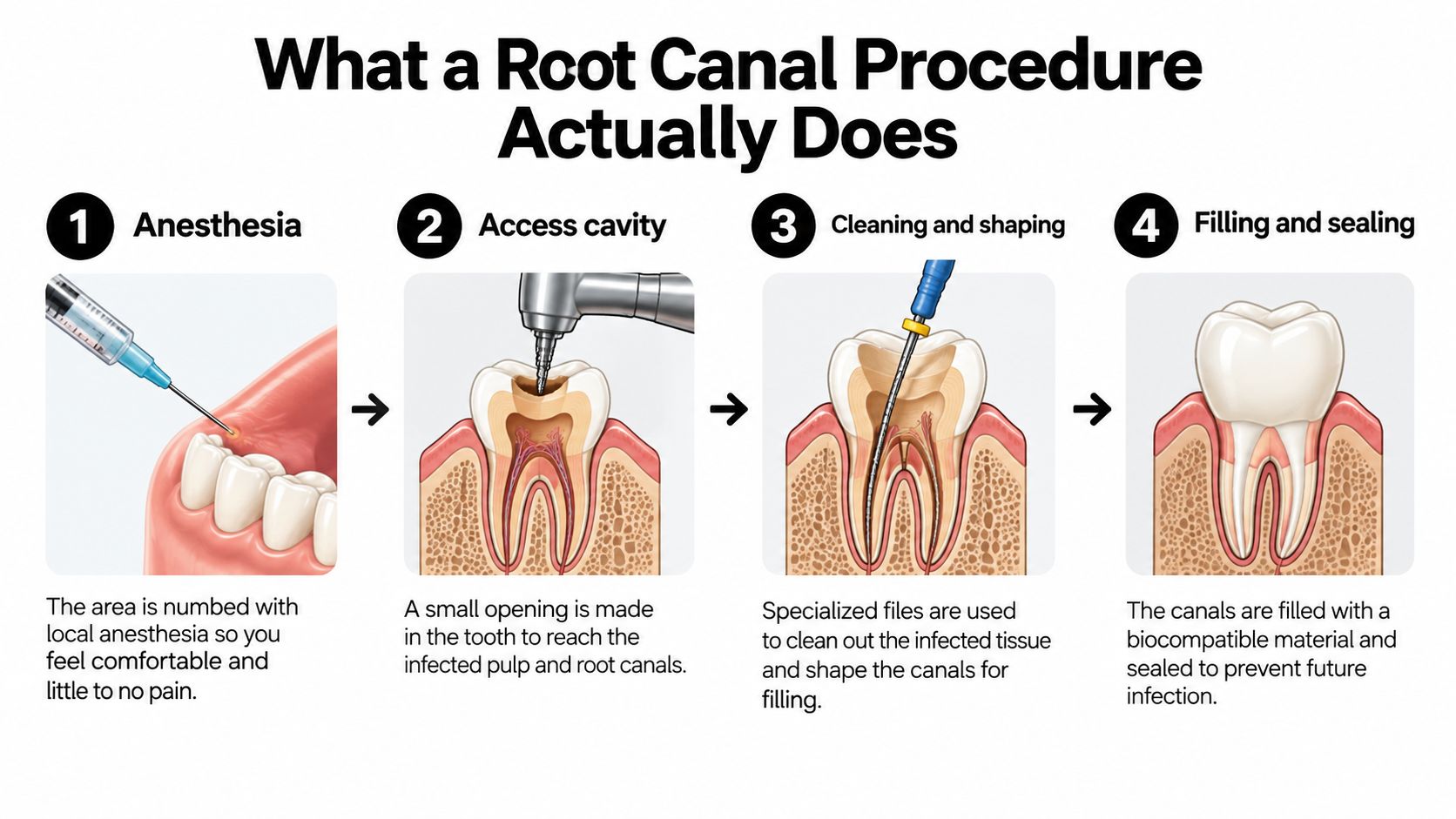
Four clinical steps
- Anesthesia and isolation: Local anesthetic controls pain, and isolation helps keep saliva and new bacteria away from the treatment area.
- Access: The dentist creates a small opening through the tooth to reach the pulp chamber and canals.
- Cleaning and shaping: Fine instruments and disinfecting solutions remove diseased tissue and prepare the canals for a stable seal.
- Filling and sealing: The cleaned space is filled, and the tooth receives a temporary or definitive restoration.
The purpose isn't to leave a “dead” tooth full of contamination. It's to remove the tissue that can no longer recover and to prevent bacteria from continuing to occupy the canal system. The surrounding ligament and supporting tissues remain active, so the tooth can continue to function in your bite.
Extraction takes a different path. Instead of cleaning the tooth, it removes the entire tooth from its socket. If you're trying to understand appointment length, the practice's explanation of how long a root canal takes can help you prepare questions about the visit, restoration, and scheduling.
Success Rates and Clinical Evidence
The strongest answer to “root canal bad for you” comes from looking at outcomes rather than anecdotes. A 2022 updated systematic review examined primary root canal studies published from 2003 through 2020. It included 21 studies in a broader analysis and 39 studies under stricter criteria requiring more complete radiographic evidence of healing. The review reported weighted pooled success rates of 92.6% under broader clinical and radiographic criteria and 82.0% under stricter criteria. (Systematic review in PMC)
Those figures aren't contradictory. They answer slightly different questions. Under broader criteria, a tooth may count as successful when it's comfortable, functional, and clinically healthy, even if an image still shows residual or incomplete healing. Stricter criteria demand more complete radiographic resolution, so fewer teeth meet the definition.
Why results vary
The same review reported substantial variation between individual studies. Results ranged from 73.3% to 100% under broader criteria and from 29.8% to 97.3% under strict criteria. (The review's outcome analysis) The variation reflects differences in case selection, follow-up duration, anatomy, infection before treatment, restoration quality, and the definition of success.
A molar with complex canals and a large pre-treatment infection presents a different challenge from a straightforward tooth with accessible anatomy. A well-cleaned canal can also be undermined later by a leaking restoration or a crack. That's why a percentage should guide expectations, not replace an individual diagnosis.
Clinical perspective: A tooth can be clinically comfortable and useful even when an X-ray shows that healing is incomplete. Your dentist should explain both the symptoms and the images.
Guidelines are useful for the same reason. They organize evidence and clinical judgment rather than promising identical outcomes for every patient. Readers who want a broader explanation of how ACC/AHA and NCCN guidelines work can use that resource to understand why recommendations depend on patient context and evidence quality.
The decision also depends on restorability. A root canal may preserve a tooth that can support a crown, but it can't make a tooth with an unmanageable fracture or inadequate remaining structure restorable. For a direct comparison of the alternatives, review root canal versus extraction.
Debunking the Focal Infection Myth
The “toxic tooth” story comes from the historical focal infection theory. It proposed that bacteria associated with teeth could trigger illness in distant organs. That idea influenced dental decisions in an earlier era, but it does not match current endodontic evidence.
Current endodontic research has discredited the historical focal infection theory. A properly treated tooth is not routinely a source of systemic disease. Root canal treatment removes infected or necrotic pulp, disinfects the canal system, and seals the space. The goal is to remove an established local source of bacterial inflammation, not trap infection inside the tooth.
For busy Manhattan professionals, the practical question is not whether a treated tooth sounds frightening. It is whether the tooth is treated and restored, or whether an infection remains active and unmanaged. Delaying care because of an outdated theory can allow pain, swelling, or tissue damage to progress while work and travel continue.
Why antibiotics aren't the main treatment
Patients sometimes expect antibiotics to resolve a dental infection. The American Dental Association's antibiotic-stewardship guidance explains that endodontic infections are generally managed with dental procedures, including pulpotomy, pulpectomy, nonsurgical root canal treatment, or incision and drainage, rather than systemic antibiotics alone.
Antibiotics have limited access to necrotic tissue. Unnecessary use can contribute to antibiotic resistance and Clostridioides difficile infection. For adults with a normal immune response, routine antibiotics are discouraged for several localized conditions, including symptomatic irreversible pulpitis, symptomatic apical periodontitis, and a localized acute apical abscess.
Antibiotics may be appropriate when fever, malaise, or another sign of systemic involvement is present, or when a medical condition changes the risk calculation. Facial swelling, worsening pain, fever, cellulitis, or difficulty swallowing warrants urgent assessment. While arranging professional care, patients can review dental abscess symptoms and treatment.
Root Canal Versus Tooth Extraction
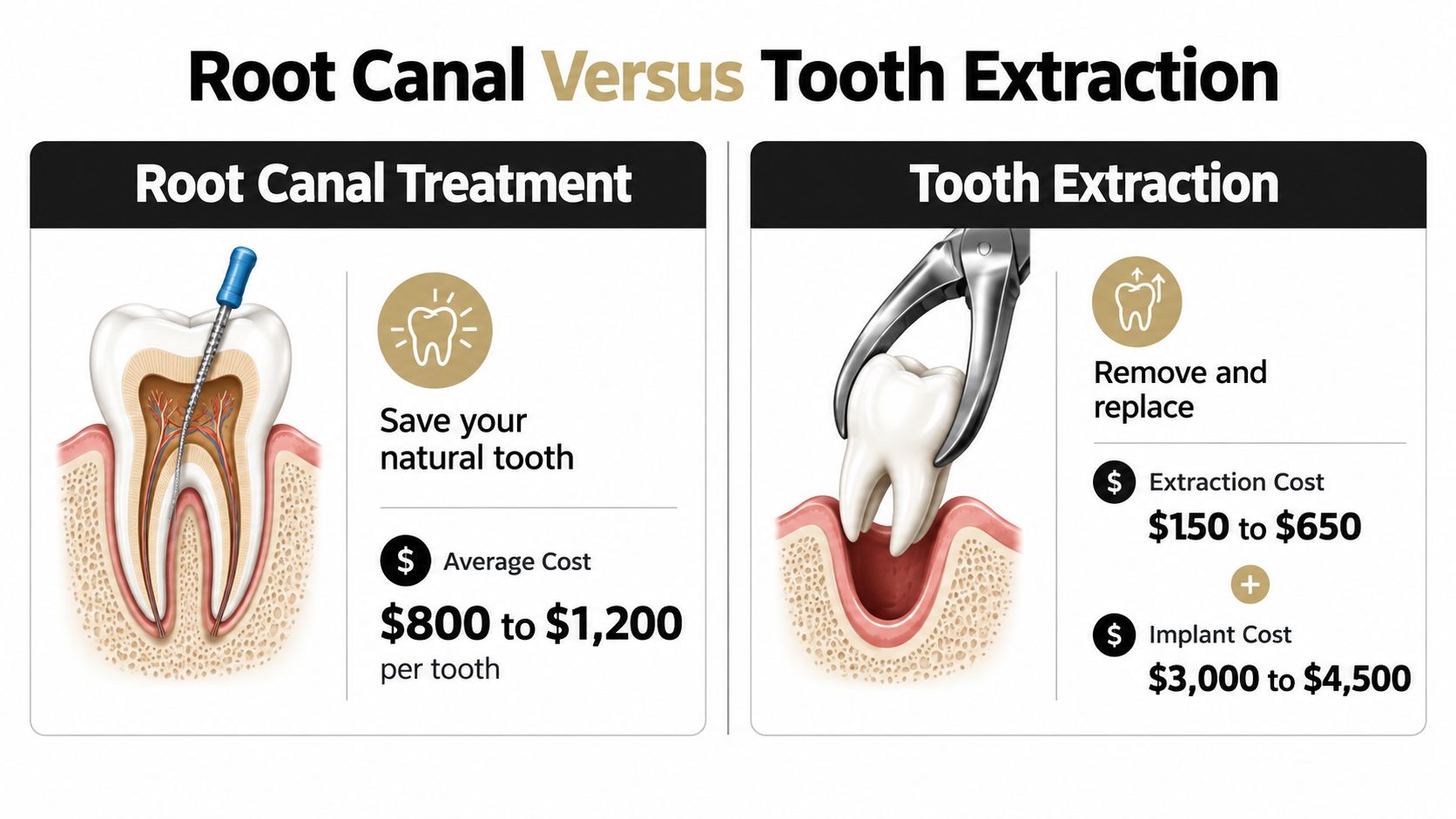
When a tooth is badly compromised, the choice isn't between a dangerous root canal and a harmless extraction. It's between two different treatment pathways, each with biological, functional, scheduling, and financial consequences.
A root canal preserves the natural tooth when the tooth is restorable. After the infected pulp is removed and the canals are sealed, the dentist rebuilds the tooth. A posterior tooth that has lost substantial structure may need a crown to withstand chewing forces.
Extraction removes the immediate source of infection, but it leaves an empty space. Replacing that tooth may involve an implant, bridge, or another prosthetic option. Those treatments can require additional visits, healing, imaging, and restorative planning. The decision also depends on bone, gum health, bite, adjacent teeth, and the quality of the remaining tooth structure.
What the evidence says about tooth loss
A 2023 analysis found that only 12% of tooth loss was attributed to root-canal-treatment failure, while more than half of extractions were associated with non-restorable fractures. The analysis also identified prosthetic or periodontal considerations among other extraction-related factors. (BMJ Open analysis)
Those findings don't mean every tooth should receive a root canal. They do show why a failed root canal shouldn't automatically be treated as proof that the original procedure was the main cause of tooth loss. Many failures undergo nonsurgical or surgical retreatment, and extraction remains one possible outcome rather than the inevitable result.
| Option | Main advantage | Main consideration |
|---|---|---|
| Root canal and restoration | Preserves the natural tooth and its position | Requires adequate structure and a reliable final seal |
| Extraction | Removes a tooth that can't be predictably restored | Leaves a space that may need replacement |
| Extraction and implant or bridge | Replaces missing tooth structure | Adds restorative planning and additional treatment |
For someone working near Wall Street or commuting from Tribeca, an extraction may initially appear faster. But speed at the first appointment doesn't define the full treatment commitment. Ask whether the tooth is restorable, what restoration it needs, and what replacement would involve if it's removed.
A side-by-side visual can help frame the decision:
Post-Op Expectations and Care
Mild tenderness after a root canal is common. The tissues around the root may be irritated by cleaning instruments, irrigation, filling materials, and temporary inflammation. This soreness does not show that disease has spread or that treatment failed. Follow the dentist's instructions, and note whether symptoms gradually improve or begin to worsen.
A flare-up is different. It means acute pain or swelling develops after treatment and may require prompt advice from the dental office. A BMJ Open systematic review and meta-analysis examined 10 trials involving 1,257 teeth. It found no statistically significant difference in overall complications between single-visit and multiple-visit treatment, with a risk ratio of 1.00 and a 95% confidence interval of 0.75 to 1.35. (BMJ Open systematic review)
The review also examined postoperative pain in 20 studies involving 3,008 teeth. Pain did not differ significantly between the two treatment schedules, with a risk ratio of 0.99 and a 95% confidence interval of 0.76 to 1.30. Flare-ups appeared more frequent after single-visit treatment in an analysis of eight studies involving 1,110 teeth, with a risk ratio of 2.13, although the evidence was described as very weak.
Protecting the treated tooth
A root canal addresses infection inside the tooth. It does not restore lost strength or protect the surrounding teeth and gums. Until the permanent restoration is placed, chew carefully and avoid unnecessary force on the treated tooth.
- Complete the restoration: A definitive filling or crown helps prevent leakage and fracture. Posterior teeth often need a crown when substantial structure has been lost.
- Keep cleaning: Brush and clean between the teeth as directed. Decay and gum disease can still affect the rest of the mouth.
- Watch the restoration: Contact the office if it becomes loose, cracked, or leaky.
- Report worsening symptoms: Persistent or spreading swelling, fever, severe worsening pain, facial swelling, or difficulty swallowing requires urgent dental or medical attention.
The root canal recovery guide explains what the first days may feel like and when to contact the office. Busy Manhattan professionals should not postpone care because of a meeting or commute if swelling is spreading or they feel systemically unwell.
Finding Care Across Manhattan
For a busy Manhattan professional, dental anxiety often collides with a crowded calendar. Throbbing during a Midtown meeting, pain on the commute from Lenox Hill, or swelling before a hospital shift can make postponing care feel easier than arranging it. The more useful question is not whether a root canal sounds safe or unsafe. It is whether the tooth will be treated before an infection or irreversible inflammation continues.
A convenient office can support continuity for patients from Midtown, Chelsea, Gramercy Park, the West Village, Greenwich Village, NoHo, the East Village, SoHo, Tribeca, Hudson Yards, Chinatown, and Wall Street. Location matters, but clinical explanation matters more. Ask whether the dentist can examine the tooth, review imaging with you, explain whether it can be restored, and coordinate the final restoration.
Questions worth asking
- Diagnosis: Is the pulp irreversibly inflamed, infected, or still treatable another way?
- Restorability: Is a crack or missing structure likely to change the prognosis?
- Alternatives: What would extraction and tooth replacement involve?
- Follow-up: Which symptoms are expected, and which require urgent contact?
- Scheduling: Can treatment and restoration fit around work and family responsibilities?
Paul L. Gregory, DDS, at 57 W 57th St, provides family, cosmetic, restorative, endodontic, periodontic, implant, and emergency dental care. The office also uses digital diagnostics and offers short-notice assessment for painful or infected teeth. Information about dental marketing strategies addresses how practices communicate services, not whether a particular treatment is appropriate.
A root canal dentist in Manhattan can assess symptoms, imaging, and the tooth's remaining structure before discussing root canal treatment, retreatment, restoration, or extraction. A clear consultation cannot remove every uncertainty, but it can replace internet fear with a decision grounded in the condition of your tooth.
If you are concerned that a root canal may be harmful, Paul L. Gregory, DDS can evaluate the tooth and explain the available options. Visit Paul L. Gregory, DDS to request an appointment in Midtown Manhattan.