

You're in the chair for a visit that started as a routine cleaning, then turned into a bigger conversation. The hygienist measured pockets, the dentist looked at the spaces under your gums, and now you're being told you need periodontal scaling and root planing instead of a standard polish. That can sound ominous the first time you hear it, but it's a common, evidence-based treatment for gum disease, not a sign that you've failed at brushing or flossing.
When a Regular Cleaning Is Not Enough
A patient hears the words “deep cleaning” and usually thinks something went wrong. In reality, what changed is the depth of the pocket around the tooth, because that's where routine maintenance stops being enough and periodontal treatment starts making sense. The difference is less about effort and more about where the bacteria and hardened deposits are hiding.
I've had patients feel embarrassed when they hear they need scaling and root planing, even when they've been diligent at home. That reaction makes sense, but it misses the point. Gum disease can progress below the gumline, and the office exam is where that hidden activity shows up. The ADA cites chronic periodontitis prevalence of 47.2% among U.S. adults over 30, so this isn't a rare or unusual recommendation, it's part of everyday dentistry for a very large share of adults. The same topic is also covered in the context of routine exams and cleanings at professional dental cleanings and exams.
What the dentist is looking for
A regular cleaning focuses on the visible surfaces and shallow sulcus areas. SRP is recommended when the exam shows a deeper pocket, because deposits below the gumline can't be fully reached with routine instruments alone. The clinical logic is straightforward, once a pocket gets deep enough, you're no longer dealing with simple plaque control, you're dealing with a protected bacterial environment.
Practical rule: a cleaning removes what's reachable, but SRP targets what's hiding beneath the gum edge.
That's why a recommendation for SRP doesn't mean your mouth is “bad.” It means the disease process has moved into a place where a standard cleaning won't do enough. If you want to understand the bigger periodontal treatment picture, periodontal therapy is the broader category SRP belongs to.
What Scaling and Root Planing Actually Does
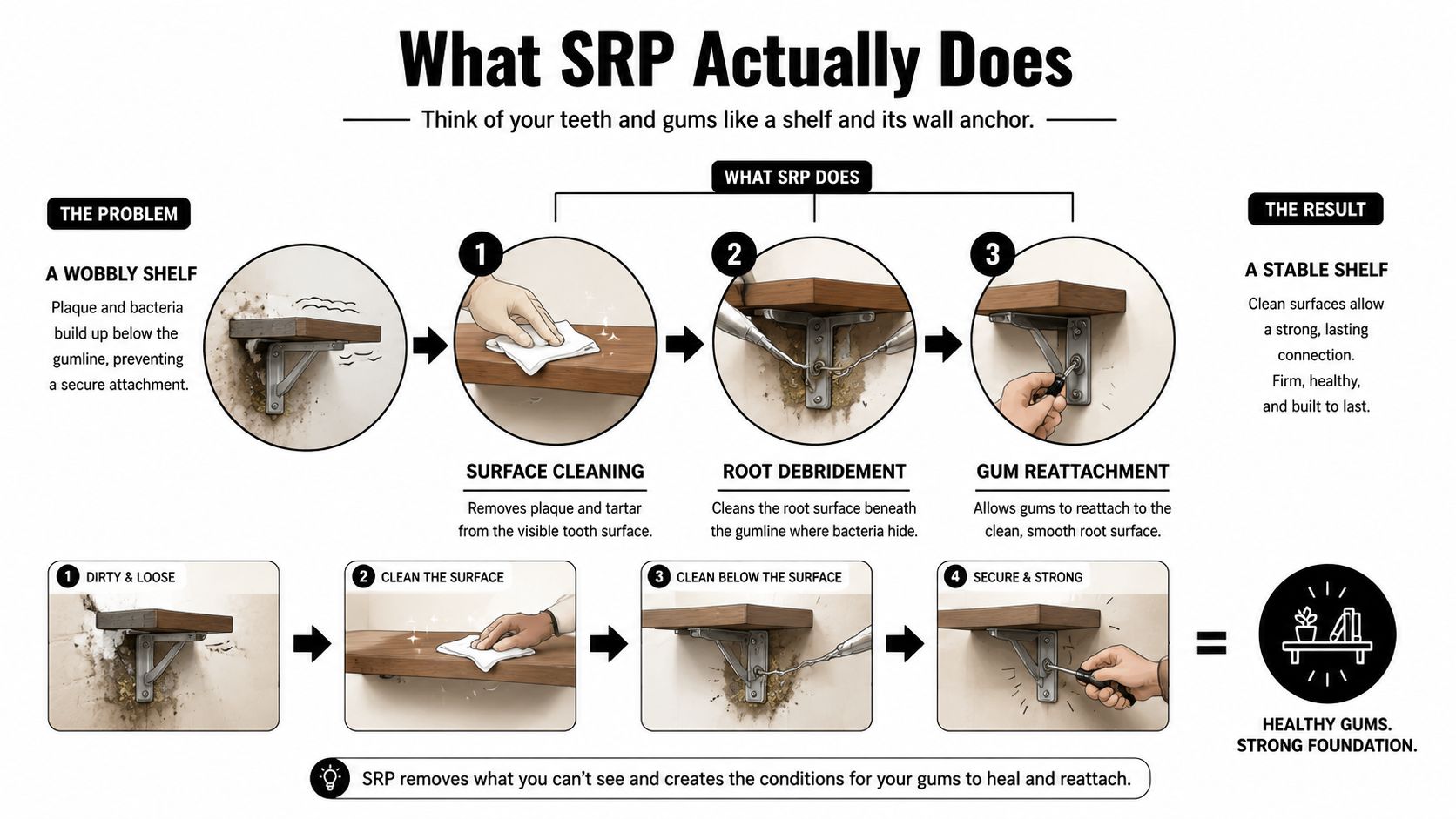
Think about a loose shelf on a wall. Wiping the visible dust off the shelf helps, but the wobble doesn't stop until someone tightens the hidden bracket and smooths out the rough contact points. Scaling and root planing works the same way, it's not just surface cleaning, it's cleanup at the hidden support level.
Scaling removes the hard buildup
Scaling means removing plaque, tartar, and contaminated material from below the gumline. The goal is to clear the biologic clutter that keeps inflammation going. Periodontal guidance describes SRP as the gold-standard initial nonsurgical therapy because it mechanically disrupts the subgingival biofilm and removes calculus, contaminated cementum, and toxin-bearing root surfaces, and it's typically used when pockets are at least 4 mm deep NCBI Bookshelf.
Root planing smooths the surface
Once the deposits are removed, the root surface is smoothed so the gum tissue can settle against a cleaner, less irritating surface. That matters because a rough root behaves like rough wood. Dirt clings more easily, and the gum margin has a harder time healing into a stable seal. The tools vary, but most dentists use a mix of hand instruments and ultrasonic scalers because each one helps in a different way.
The point isn't to make the tooth “shiny.” The point is to reduce pocket depth and give the gum tissue a surface it can tolerate. A useful way to think about it is this, SRP is mechanical therapy with a measurable goal, not a longer version of a regular cleaning.
How Dentists Decide You Need SRP
The decision usually starts with a periodontal chart, not a guess. A probe measures the space between gum and tooth, and those numbers tell the dentist whether the tissue is still in a gingivitis pattern or whether the support structures are already involved. Once there's bone loss or deeper pocketing, the treatment shifts from routine prevention to active periodontal care.
The pocket depth threshold matters
A reading around 4 mm is a practical dividing line because it often means plaque and calculus are sitting below the level that normal home care and routine cleanings can reliably reach. Deeper pockets are harder to debride fully, and that's where SRP starts to make sense. The depth itself isn't the only clue, but it's usually the first one that changes the treatment plan.
Bleeding and X-rays add context
Bleeding on probing tells the dentist that the tissue is inflamed and active. X-rays show whether bone support has changed, which matters because bone loss is what separates a simple inflammation problem from true periodontitis. If you're trying to follow your own chart, the exam becomes easier to understand. A pocket with bleeding and radiographic changes is much more concerning than a shallow site that just looks irritated on the day of the visit. More information about how X-rays fit into that judgment is available in dental X-rays.
Clinical shorthand: depth, bleeding, and bone levels tell the story together. None of them should be read alone.
Why your mouth may need one area treated and another left alone
SRP is often recommended only where the numbers justify it. Healthy or shallow areas don't need the same level of intervention, and treating every site the same would be overkill. That selectivity is part of good periodontal care, not a shortcut.
What Happens During the Appointment
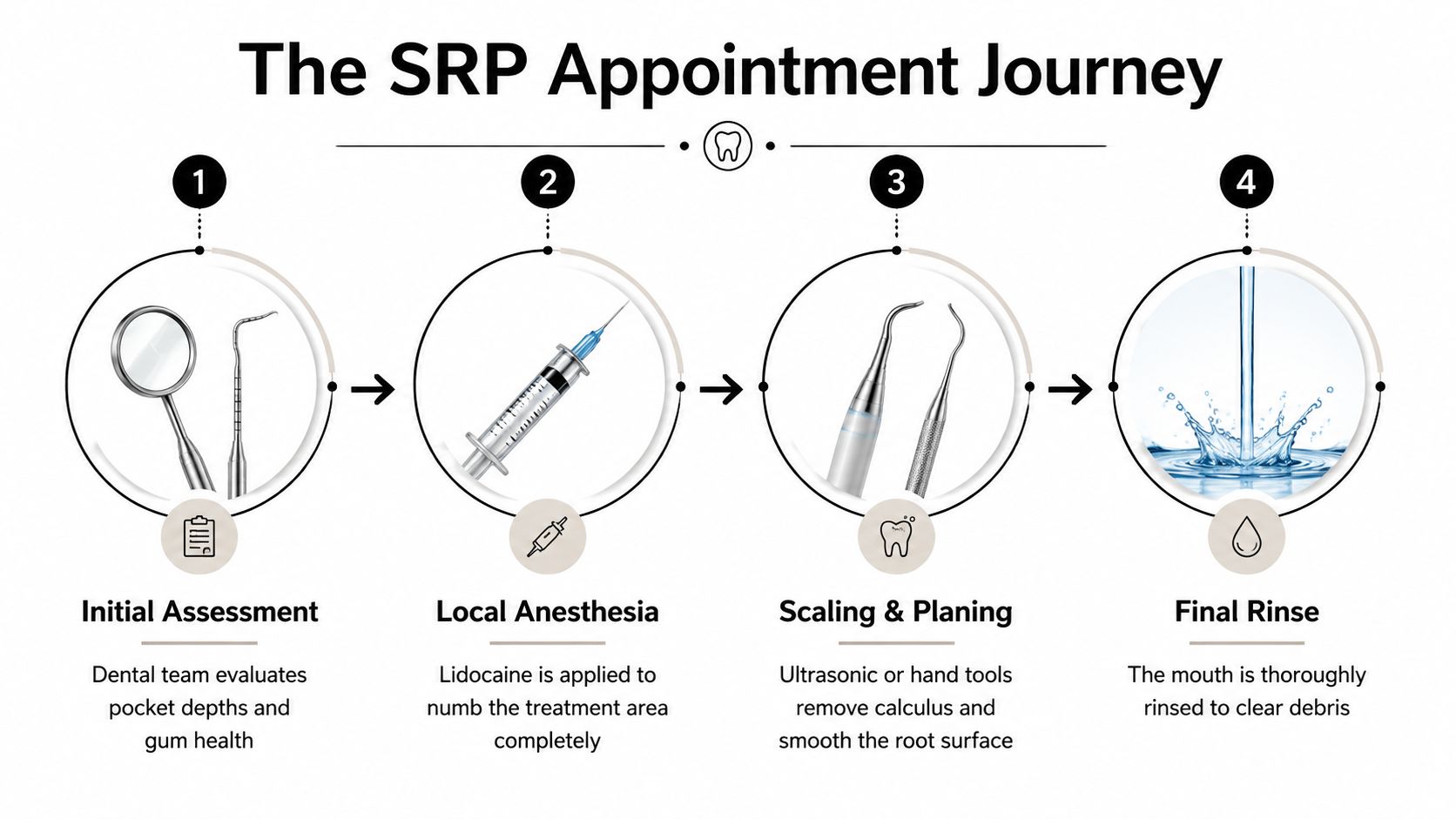
Most appointments start with numbing, because working below the gumline can be sensitive without local anesthesia. Once the area is comfortable, the dentist or hygienist removes deposits with a combination of ultrasonic and hand instruments, depending on what each site needs. The experience is usually a mix of pressure, vibration, water spray, and an occasional scraping sensation, not sharp pain.
Why it's often split into more than one visit
A full mouth is commonly treated in sections so each area gets enough time and the numbing stays comfortable. That also lets the clinician work more carefully in deeper pockets. Many patients prefer that approach because it feels manageable, especially when one side of the mouth is being treated while the other side gets a break.
What you'll feel in the chair
The vibration from the ultrasonic scaler is usually the most noticeable sensation. Hand instruments feel different, more like controlled pressure along the root surface. Some people notice water spray and a salty taste from the rinsing, and others mostly notice that their gums feel “worked on” afterward. The whole point is to make the treatment thorough without making it miserable.
If your office also manages routine hygiene visits, the contrast with a standard cleaning becomes obvious fast. A normal cleaning is quicker, lighter, and mostly above the gumline. If you're looking for a simple comparison point, teeth cleaning is the everyday maintenance side of the story.
The appointment is more about precision than force. The clinician is trying to reach every irregular surface that trapped bacteria can hide on.
The First 72 Hours After Scaling and Root Planing
The first day usually feels odd more than dramatic. Once the numbness wears off, the area can feel tender, and some people notice mild sensitivity to temperature or pressure. Soft foods make the day easier, and anything sharp or crunchy can irritate tissue that's already been worked on.
Day one
Cool, soft meals are usually easiest. Many patients do best with yogurt, eggs, soup that isn't too hot, or anything that doesn't scrape the gums. The mouth may also feel a little “thicker,” partly because the tissue is irritated and partly because you're paying attention to every sensation.
Day two
A small amount of bleeding when brushing can be surprising, but it's often just healing tissue reacting to contact. That doesn't mean you should stop brushing, it means you should be gentler and more deliberate. Use a soft brush, keep the pressure light, and clean the area so plaque doesn't settle back in while the gums are settling down.
Day three
If swelling is going to show up, this is often when it peaks and then starts easing. Warm salt-water rinses can be soothing, and smoking makes healing less predictable, so it's a good time to avoid it. Call the office if you have severe pain, pus, fever, or bleeding that doesn't calm down, because those aren't the usual recovery signs.
Adjuncts That Can Improve the Results
SRP does most of the work, but dentists sometimes add other tools when the pocket depth, inflammation pattern, or risk profile suggests extra help is justified. The most common local adjunct in periodontal care is ARESTIN, a locally applied antibiotic placed into treated pockets. It is not a replacement for debridement. It is an add-on for sites that need more help settling down.
What the evidence says about add-ons
A 2014 meta-analysis covering the past 40 years found that adjunctive local or systemic measures improved classic SRP, with pocket-reduction gains of 0.77 mm for locally delivered agents and 0.90 mm for systemic agents versus SRP alone Zaugg et al., 2014. That is helpful, but the message is not that every patient needs medication. It means adjuncts can add measurable benefit in the right situations, especially when a pocket is still acting like a narrow gutter that keeps collecting debris after cleaning.
How clinicians think about the options
- Locally applied antibiotics: Useful when one or a few pockets need extra support after mechanical cleaning.
- Antimicrobial rinses: Can help with short-term bacterial control, especially when home care is still being rebuilt.
- Systemic antibiotics: Used more selectively, because SRP itself is already the main intervention.
- Lasers: Sometimes included in periodontal protocols, but they are not a substitute for thorough root debridement.
Adjuncts are best thought of as targeted help, not magic upgrades. They can tip the balance in deeper or more stubborn sites, but they work on top of a procedure that already does the heavy lifting. In a Midtown practice like Paul L. Gregory, DDS, SRP, ARESTIN, and supportive periodontal maintenance can be coordinated in one treatment plan when appropriate.
What Patients Get Wrong About Deep Cleanings
The first myth is that SRP is cosmetic. It isn't. The reason the procedure exists is to treat disease below the gumline, where inflammation and bacterial deposits are damaging the supporting tissues.
Myth 1, it weakens teeth
A lot of patients worry that removing buildup will make teeth loose. What usually happens is the opposite, the buildup was propping up an unhealthy situation, and once it's removed, the true condition of the gums and bone becomes visible. Teeth can feel different afterward because the thick deposit layer is gone, not because the procedure harmed the tooth.
Myth 2, one treatment cures gum disease forever
SRP is a phase of treatment, not the end of the story. Evidence-based reviews note that non-surgical debridement has limited effectiveness in probing depths greater than about 5–7 mm, and deeper or still-active sites may need flap surgery or another periodontal procedure instead Canadian Dental Association review. That's why re-evaluation matters so much. The dentist needs to see which sites responded and which ones stayed active.
Myth 3, it's punishment for bad hygiene
Gum disease isn't a moral test. Biology, genetics, smoking, diabetes, and daily biofilm control all influence how quickly pockets develop and how well they heal. A patient who needs SRP isn't being scolded, they're being treated.
Useful mindset: SRP answers the question, “What still needs to be cleaned below the gumline?” It doesn't answer the question, “Did you try hard enough?”
Keeping the Results for the Long Term
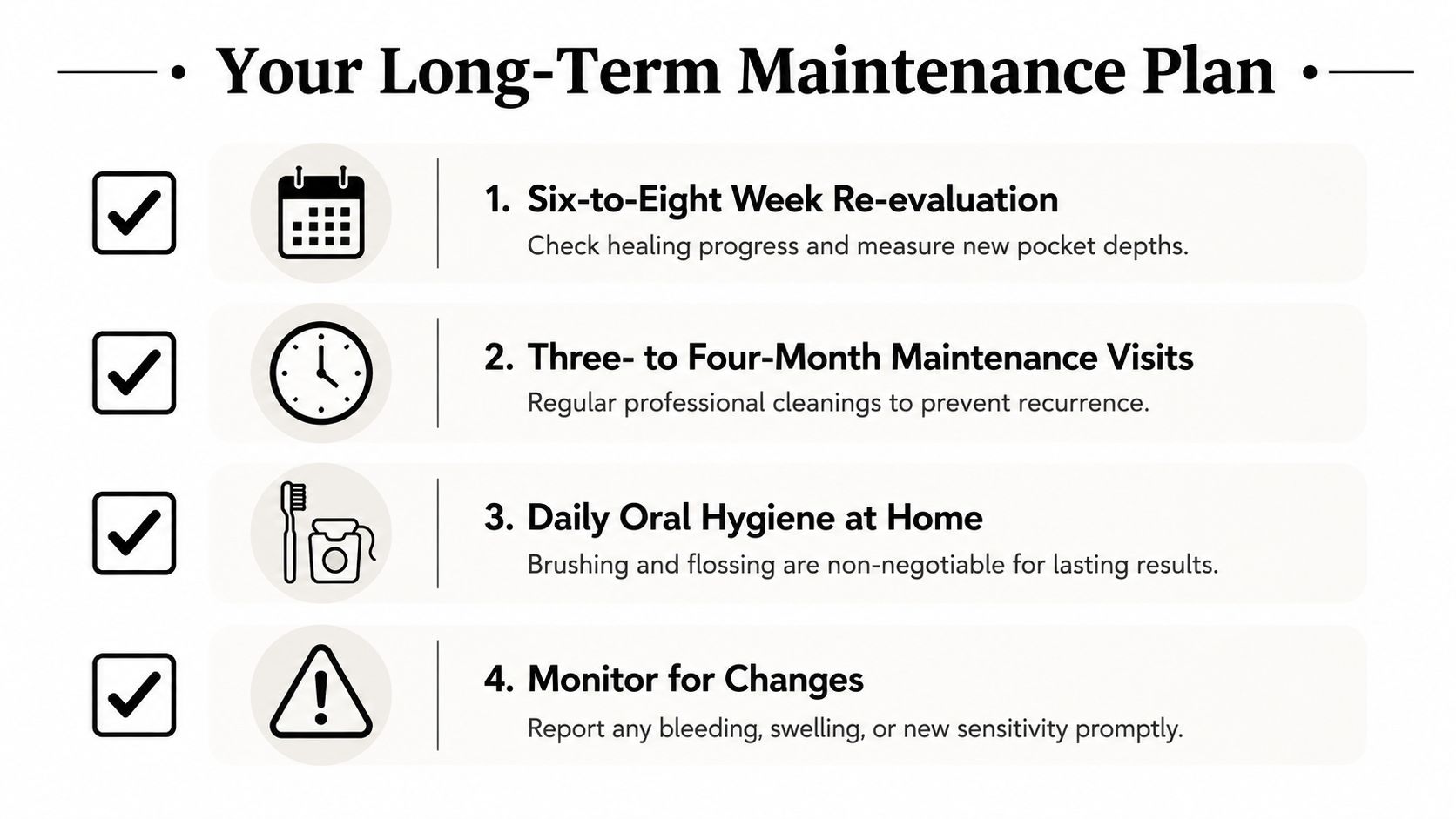
The follow-up appointment is where the value of SRP becomes clear. Dentists recheck healing, look for pockets that stayed deep, and decide whether the mouth is moving toward stability or whether certain areas need more work. After that, many patients shift from six-month hygiene visits to periodontal maintenance, which is more frequent because gum disease needs closer monitoring than a healthy mouth does. More detail on that follow-up pattern is available in dental periodontal maintenance.
What helps most at home
A 24-week randomized clinical trial of Stage I/II periodontitis found that SRP plus powered toothbrush home care reduced bleeding on probing by 0.24 at week 24 versus 0.02 in the manual-toothbrush group, with p < 0.0001 ADA. That doesn't mean everyone needs the same toothbrush, but it does show that daily home care changes the healing picture.
A simple checklist patients can keep
- Re-evaluate healing: Ask what pockets improved and which sites still need attention.
- Keep maintenance visits: Follow the interval your periodontist recommends.
- Brush and clean between teeth daily: Powered brushes, floss, or interdental brushes can all matter.
- Report changes early: New bleeding, swelling, or sensitivity shouldn't sit unchecked.
SRP can also matter beyond the mouth. Earlier evidence found modest glycemic benefit in patients with type 2 diabetes, which is one more reason maintenance isn't optional. Stable gums are a long game, and the patients who do best are the ones who treat it that way.
If you're trying to decide whether your gums need a deeper evaluation, Paul L. Gregory, DDS offers periodontal assessment, scaling and root planing, adjunctive periodontal treatment, and ongoing maintenance in one Manhattan office. If you want a calm, straightforward conversation about what your chart means and what comes next, visit Paul L. Gregory, DDS to schedule a visit.